Hidden in the counts
The full Birch and Swinnerton-Dyer formula from low Selmer corank
Covers result 002 in OpenAI’s catalog: all 3 papers. See its connections to other results and the work it cites.
8:10. English captions available. The video loads from YouTube when you press play.
Chapters
The claim, in plain words
An elliptic curve is the set of solutions of an equation like y² + y = x³ − x. Its rational points, the solutions in fractions, form a group, and the rank counts how many independent points generate all of them.
In the 1960s Bryan Birch and Peter Swinnerton-Dyer predicted that counting solutions modulo primes, packaged into the curve’s L-function, reveals the rank. They also predicted the exact size of the first nonzero term of L(E, s) at s = 1: the real period, times the regulator, times the order of the Tate–Shafarevich group Sha, times the Tamagawa numbers, divided by the number of torsion points squared.
Result 002 claims that whenever, for some single prime q, the q-power Selmer group has corank zero or one, everything holds: the rank equals the order of vanishing equals that corank, Sha is finite, and the leading-term formula is exactly right, every prime factor included, with no extra conditions on the curve.
What it doesn’t claim
It says nothing about curves of rank two or more, where the formula remains open. It doesn’t prove that Sha is finite in general; that follows only under the low-corank hypothesis. And it doesn’t settle the Millennium Prize problem, which asks for the rank prediction for every elliptic curve.
The broader consequences in the video come from companion papers: covering almost every quadratic twist of every curve needs result 006 (Goldfeld’s conjecture), and the statement about sums of two rational cubes is proved in the companion paper on the Selmer converse.
What it relies on
Three other papers in the same release, all unreviewed preprints:
- The Selmer converse for elliptic curves at every prime (October 7, 2026): the rank and finiteness statements.
- The two-primary Birch–Swinnerton-Dyer formula in Selmer corank at most one (October 6, 2026): the factors of 2.
- Goldfeld’s analytic density conjecture and the 2-converse (October 7, 2026): choosing the auxiliary fields.
It also builds on published work, including modularity (Wiles; Taylor–Wiles; Breuil, Conrad, Diamond and Taylor), Gross–Zagier, Kolyvagin, Kato’s Euler system, and Burungale–Flach for curves with complex multiplication.
Where it stands
- Posted as a preprint
- OpenAI, October 7, 2026 edition
- Peer reviewed
- Not yet; OSVerify found one minor citation issue
- Checked in Lean
- Not yet
Last checked October 19, 2026. The claim has not been withdrawn. This edition replaces an October 3, 2026 version; the change removed an obsolete citation and updated citations to revised companion papers. The result is not in the collection’s catalog of Lean-formalized results. OSVerify, a Stanford review project, refereed this edition (noted October 15, 2026) and reported no major issues and one minor one: eight citations to the companion Selmer-converse paper point to the wrong equation or lemma numbers. The intended passages are nearby, and OSVerify says the issue “does not establish a mathematical obstruction.”
How the proof goes
For each odd prime p, let Xp(E) be the number of factors of p on the L-function side of the formula, minus the number of factors of p in the order of Sha. The formula holds exactly when every Xp is zero.
- Never negative. Using Kato’s Euler system, rebuilt inside large families of Galois cohomology with extra “tame” variables, show Xp(E) ≥ 0 for curves without complex multiplication and analytic rank at most one.
- A pair that cancels. Pair E with a quadratic twist ED so that one has order of vanishing zero and the other one, and show Xp(E) + Xp(ED) = 0, using theta series and CM measures over the imaginary quadratic field ℚ(√D).
- Squeeze. Two numbers that are never negative and add up to zero are both zero. The factor 2 comes from a companion paper, and curves with complex multiplication use the rank-zero theorem of Burungale and Flach.
The numbers in the video
Every value shown was recomputed with PARI/GP 2.15. Each curve is named by its label in Cremona’s tables.
- 11a1, y² + y = x³ − x² − 10x − 20, rank 0: L(E, 1) = 0.25384…, real period 1.26921…, c11 = 5, five torsion points, so Sha has order 1.
- 37a1, y² + y = x³ − x, rank 1: L′(E, 1) = 0.30600…, real period 5.98692…, regulator 0.05111…, everything else 1, so Sha has order 1.
- 389a1, y² + y = x³ + x² − 2x, rank 2: outside the theorem.
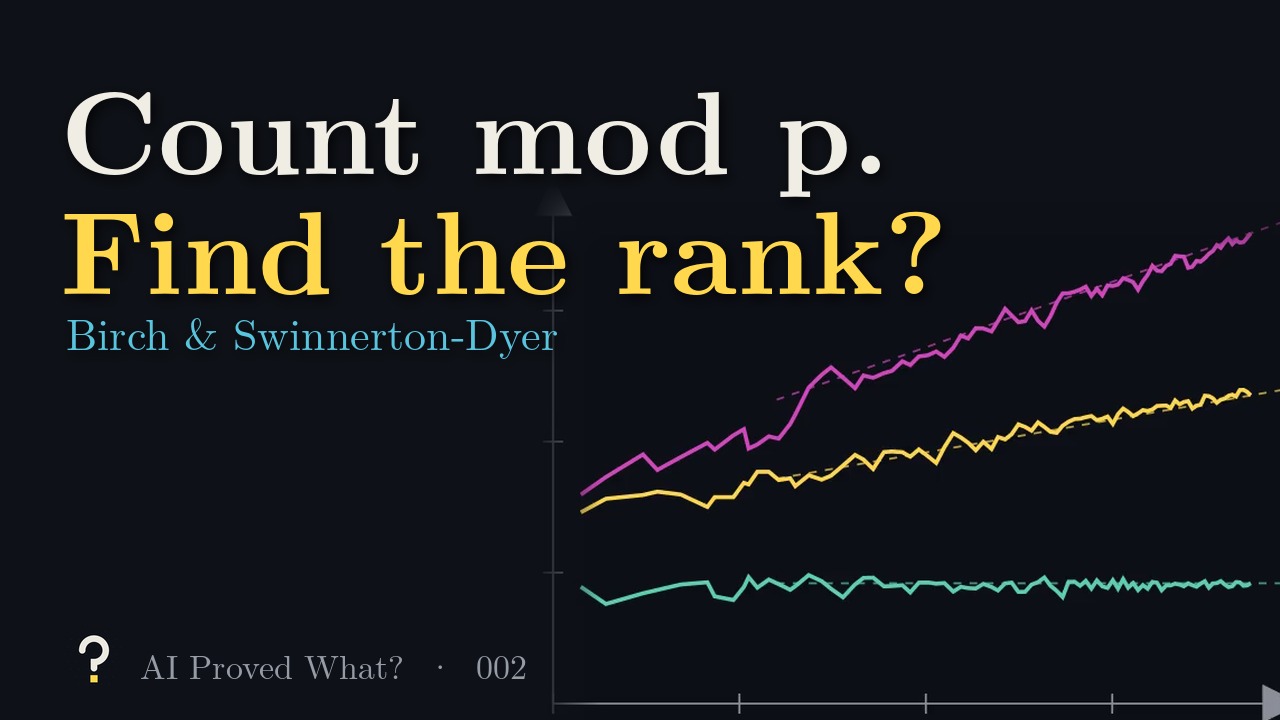
- In the slope chart, the fitted slopes over primes up to 2,000,000 are 0.01, 1.02 and 2.07.
Read the source
- The paper (PDF), “Exact Birch–Swinnerton-Dyer Formula from Low Selmer Corank,” OpenAI Math Release preprint, October 7, 2026.
- The collection’s catalog, where this is result 002.
- The collection’s history of withdrawals and fixes.
- B. J. Birch and H. P. F. Swinnerton-Dyer, “Notes on elliptic curves. II”, J. Reine Angew. Math. 218 (1965), where the conjecture was set out.
The 3 papers in this result
OpenAI groups related papers, such as alternative proofs, supporting results and consequences, into one result; we label the first paper it lists the main paper and the others companions.
Transcript
Read the full script
0:00The question: sums of two cubes
Result 002 in OpenAI’s math repository claims something mathematicians have chased for sixty years: the full Birch and Swinnerton-Dyer formula, proved exactly, for a huge family of elliptic curves. Here’s a taste of why that matters. Which whole numbers are a sum of two cubes of fractions? Seven is: two cubed, plus negative one cubed. Thirteen is: seven thirds cubed, plus two thirds cubed. Seventeen takes more searching. But five never works, no matter how long you look. Questions like this are questions about elliptic curves. And the deepest tool we have for them is a single formula, predicted by Birch and Swinnerton-Dyer in the 1960s.
0:44Rational points and rank
An elliptic curve is the set of solutions to an equation like this one: y squared, plus y, equals x cubed, minus x. Over the real numbers, it’s a smooth curve, here in two pieces. We care about rational points: solutions where both coordinates are fractions. Here’s one: zero, zero. Draw the tangent line there. It meets the curve at exactly one more point, and reflecting that point gives a new rational solution: one, zero. A line through two rational points meets the curve at a third. Keep going, and one starting point produces infinitely many, with numerators and denominators that grow very fast. This curve needs just one starting point, so we say it has rank one. Some curves have rank zero, and only finitely many rational points. Others need two starting points, or more. Mordell proved in 1922 that the rank is always finite. But to this day, there’s no method guaranteed to compute it.
1:44Counting solutions mod p
So in the early 1960s, Bryan Birch and Peter Swinnerton-Dyer tried something different, on one of Cambridge’s early computers. Instead of hunting for rational points, they counted solutions modulo primes. For each prime p, count the solutions mod p, and call that Nₚ. A curve with many rational points tends to have slightly more solutions mod p, on average across primes. So multiply the ratios, Nₚ over p, for all the primes up to some bound X. Here is that experiment, redone with every prime up to two million. Plotted the right way, a rank zero curve levels off. A rank one curve grows with slope one. And a rank two curve grows with slope two. The rank was hiding in the counts.
2:32The L-function
To make this precise, the counts are packaged into one function, the L-function of the curve. At the point s equals one, it’s roughly the reciprocal of that same product. The prediction: the L-function vanishes at s equals one to an order exactly equal to the rank. For the rank zero curve, the graph passes through a nonzero value. For rank one, it crosses zero. For rank two, it just touches zero, and turns back. Proving this in general is one of the Clay Millennium Prize problems.
3:05The full formula: five ingredients
But Birch and Swinnerton-Dyer predicted more than the rank. They predicted the exact size of the first term that isn’t zero: the value, or the slope, or the curvature at s equals one. It should equal a product of five ingredients. First, the real period: the total length of the real curve, measured with a ruler built into the equation. Second, the regulator. Every rational point has a height, measuring how big its numerators and denominators get. The regulator is the volume of the lattice the points form, measured with that height. Third, the Tamagawa numbers: small local corrections at the primes where the curve misbehaves. Fourth, the torsion points, the finitely many that cycle back to where they started. They appear squared, in the denominator. And fifth, the strangest: the Tate–Shafarevich group, called Sha. It counts hidden curves that have solutions modulo every prime power, and over the real numbers, but no rational solution at all. Its size is one when there are none. Nobody knows how to compute it directly. It isn’t even known to be finite in general. Check it on our rank one curve. The slope at s equals one is 0.3060. The real period times the regulator is 0.3060 as well, and everything else is one. For a rank zero curve: 1.269 times 5, divided by 5 squared, gives 0.2538, exactly the value. The numbers match when Sha has size one. Proving matches like that, for every prime factor at once, is the hard part.
4:44Sha and the Selmer group
To get a grip on Sha, mathematicians use the Selmer group, named after Ernst Selmer, who found one of the first famous hidden curves. For each prime q, there’s a q-power Selmer group, assembled from pieces that can actually be computed. It contains the rational points, and the q-part of Sha, mixed together. Its size is measured by a number called the corank. It’s always at least the rank, and the two are equal exactly when that part of Sha is finite.
5:13The theorem
Here’s what result 002 claims. Take any elliptic curve over the rational numbers. Suppose that for some single prime q, the Selmer corank is zero or one. Then the rank, the order of vanishing, and the Selmer corank all agree. Sha is finite. And the full formula holds exactly, prime factor by prime factor, with no extra conditions on the curve. Parts of this were known. Since the 1980s, work of Gross and Zagier, and of Kolyvagin, gives the rank and the finiteness of Sha when the order of vanishing is zero or one. The new link, from a small Selmer group to a small order of vanishing, comes from a companion paper in the same release. Earlier exact formulas each needed extra hypotheses about the curve or the prime. Combined with result 006 from the same collection, the claim covers almost every quadratic twist of every elliptic curve. And a companion paper uses the same ideas to show that every prime leaving remainder four, seven, or eight when divided by nine, like seven, thirteen and seventeen, is a sum of two rational cubes.
6:22How the proof goes
How does the proof go? The core idea fits on one line. For each odd prime p, measure the discrepancy: how many factors of p the L-value has, after dividing out the other ingredients, minus how many Sha has. Call it X. Step one: for curves without complex multiplication, show X is never negative. This uses Kato’s Euler system, a tool linking L-values to Galois cohomology, rebuilt inside large families with extra variables. Step two: pair the curve with a carefully chosen twist, so that one has order of vanishing zero and the other has order one. Then show their two discrepancies add up to zero, using theta series and measures from an imaginary quadratic field. Two numbers that are never negative, and add up to zero, must both be zero. So every odd prime factor matches. The factor of two comes from a companion paper, and curves with extra symmetry, called complex multiplication, start from a published rank-zero theorem of Burungale and Flach, then use the same pairing.
7:29Why it matters, and the caveats
Why care? This formula is one of the central predictions in number theory. It ties counting, geometry, and hidden arithmetic into one equation. Until now, it was proved exactly only in restricted cases. The caveats. This is a machine-generated preprint. It hasn’t been peer reviewed, and it hasn’t been checked in Lean. It also relies on three companion papers from the same release, which are unreviewed too. And curves of rank two or more, like our third example, are untouched. Count solutions modulo primes, and recover the hidden arithmetic of the curve. Exactly. If the proof holds.
Spot a mistake?
This episode simplifies on purpose, but it shouldn’t be wrong. If something is, open an issue on GitHub or leave a comment on YouTube. Corrections are noted here with a date.