AI Proved What?

What’s new

  • New episode for 379: the sunflower conjecture, proved? OpenAI’s Euclidean-price proof and its fixed-base Lean. Episode out
  • New episode for 379: OpenAI’s claim that the matrix multiplication exponent is exactly 9/4 over every field, the lower bound matching 107: what it would mean, why it does not contradict the older 2.371 upper bounds, its conflict with one unrefereed ω = 2 claim, the tripod at the heart of the proof, and what its Lean proof covers (the exponent, not the finite bound). Not built or run by us. Watch the episode. Episode out
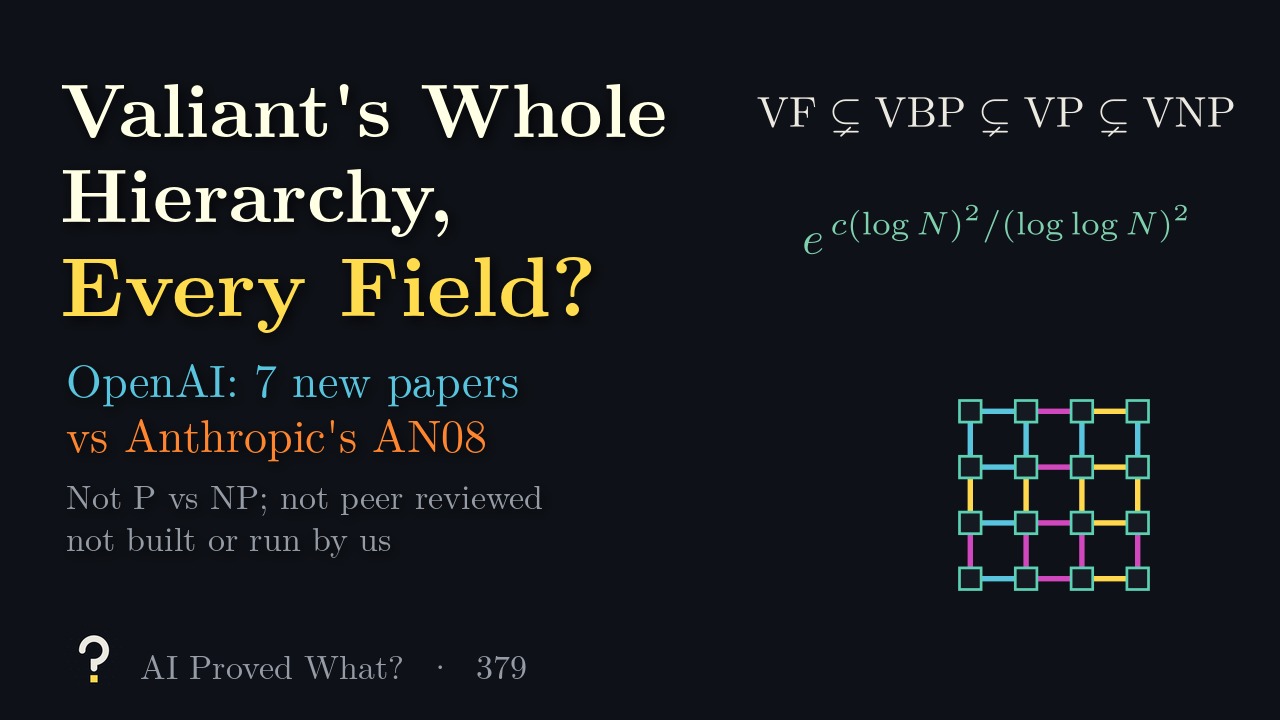
  • New episode for 379: Valiant’s whole hierarchy, every field? OpenAI’s seven-paper claim, its partial Lean, and how it compares with AN08. Anthropic makes Claude, which helps make this series. Episode out
  • New episode for 380: strongly polynomial LP and the polynomial Hirsch conjecture: OpenAI’s two claims, their Lean scope, and how they fit. Episode out
  • Result 379 extended: seven OpenAI papers claim Valiant’s whole hierarchy, ω = 9/4 exactly (107), logarithmic exponent 1/2 for Fourier transforms and integer multiplication (130, 109) and the sunflower conjecture; partly in Lean. Episode out

All updates · RSS

An AI system claims a strongly polynomial algorithm for linear programming, answering Smale’s ninth problem, and polytopes whose diameter beats every polynomial in their facet count, disproving the polynomial Hirsch conjecture.

What does that even mean, and has anyone checked? Each episode takes one claim like this, builds the intuition with animation, and keeps a running record of how far the proof has been verified.
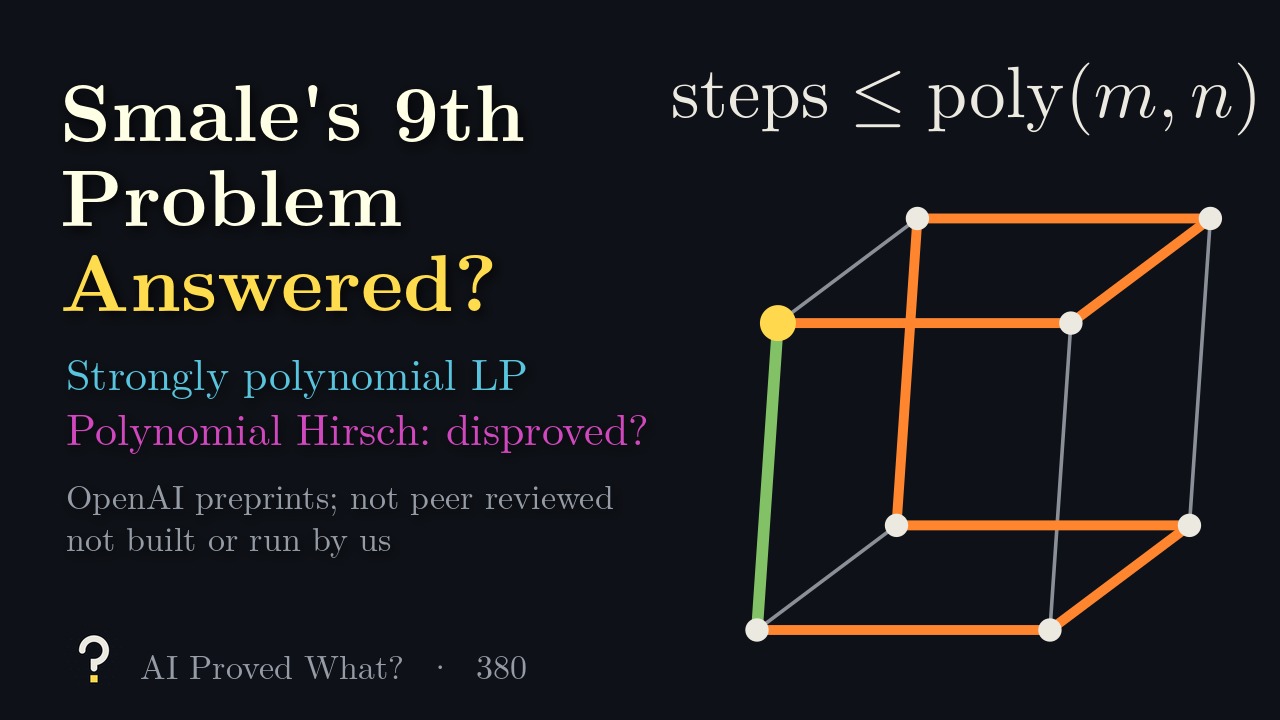
Episode 380: Strongly polynomial linear programming?, about 8 minutes.

Where this claim stands

Posted as a preprint
OpenAI, November 24, 2026
Under expert review
Not yet
Peer reviewed
Not yet
Checked in Lean
OpenAI published a Lean proof of part of the claim (scope notes)

Last checked November 24, 2026. The claims have not been withdrawn. Two preprints (58 and 57 pages). OpenAI published Lean proofs of rational linear programming in strongly polynomial time and of the polytope theorems (not the real-number case, quadratic programming or the games); we have not run the check, and no build log is published. Not yet peer reviewed.

Recent episodes

Browse by subject

Progress

Explained
375 of 375 results (730 papers in all)
Under expert review
10 results: 9 reviewed by OSVerify (002, 041, 069, 074, 086, 167, 237, 306, 340); 1 announced as under review by a named group (378)
Lean proof published by OpenAI
251 of 375 results: 182 of the main theorem, 69 of part of the claim; +1 by another lab (Axiom: 265)
Peer reviewed
0 as of November 24, 2026

OpenAI’s 730 papers are grouped into 375 results. A result is one main claim plus any companion papers, such as alternative proofs, supporting results or consequences, and each episode explains one whole result, all of its papers included.

All 375 results

Beyond OpenAI’s catalogue

One-off announcements by OpenAI, and results from other labs. Same record, kept apart from the counts above.

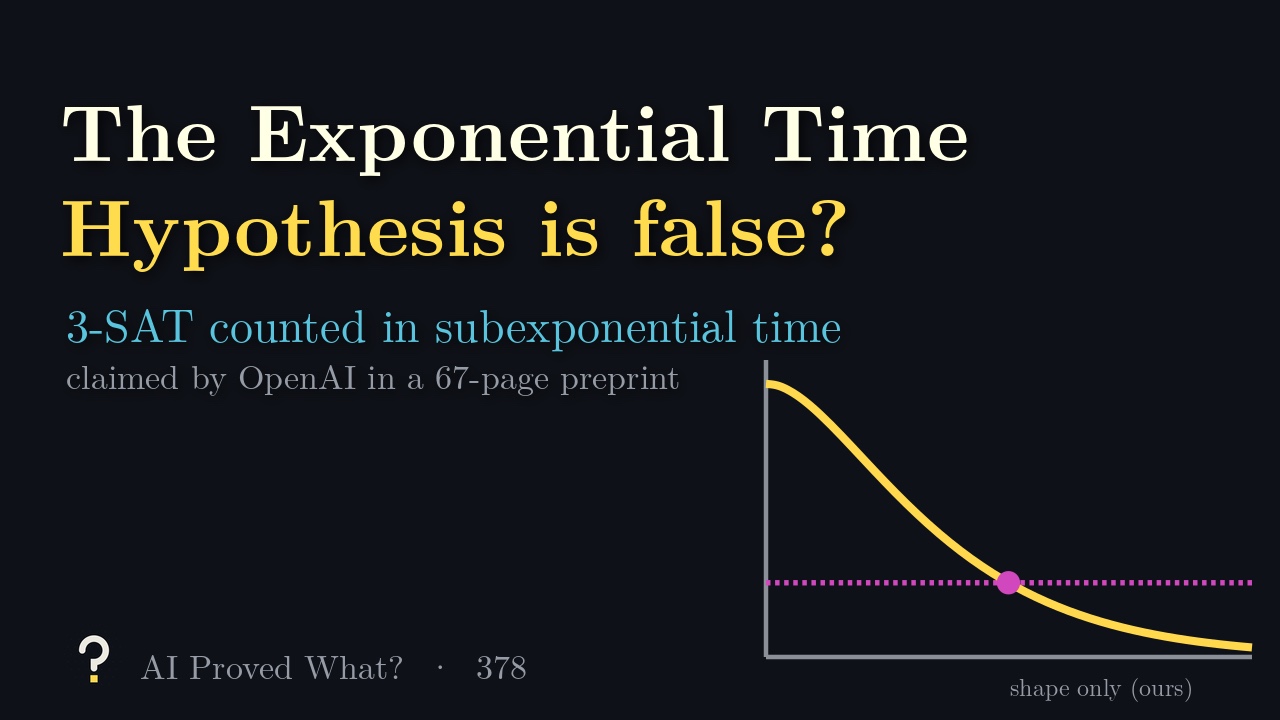
Special S01 · OpenAI, outside its catalogue · Announced September 8, 2026 Navier–Stokes and Euler: blowup in finite time Two papers and Lean proofs claim Navier–Stokes breakdown alternatives (C) and (D), with a smooth force, and blowup for the unforced Euler equations. AX01 · Axiom Math · Announced October 26, 2026 The classification of finite simple groups, in Lean Axiom Math’s Lean formalization of the classification of finite simple groups, about 43.1 million lines in 24 days, with a new written proof of the Unbalanced Group Theorem. AX02 · Axiom Math · Announced October 12, 2026 No zeros past 31/32, for every number field Dean Cureton and Jesse Thorner, with AxiomProver, claim a zero-free half-plane Re s > 31/32 for every Dedekind zeta function, building on OpenAI’s results 003 and 029. AX03 · Axiom Math · Announced September 17, 2026 Rogers–Ramanujan for every a, b Yifeng Huang, Kenny Lau and Ken Ono prove the Huang–Jiang–Oblomkov conjecture for every coprime pair 1 < a < b, with a Lean proof by Axiom. AX04 · Axiom Math · Announced October 14, 2026 Collatz: an explicit positive density (not a proof of Collatz) Kenny Lau, with AxiomProver, makes Lech Mazur’s positive-proportion theorem explicit, with the constant 2^2^2^163. Not a proof of the Collatz conjecture. AX05 · Axiom Math · Announced August 27, 2026 Faster random clocks, farther away? Only for p that is not even Colin Defant and Ken Ono (Axiom Math), with AxiomProver, prove that on every dihedral group raising symmetric clock rates never increases the ℓ^p distance to uniform when p is an even integer, and that every other p > 1 fails on some dihedral group. AX06 · Axiom Math · Announced November 4, 2026 The Stacks Project, all in Lean? Mostly AI-written, not yet human-reviewed Axiom Math’s Lean formalization of the Stacks Project, about 15.75 million lines: 16,219 of 16,249 formalizable tags counted as complete by its own data, about 97% of the formalized tags written by AI agents and not yet human-reviewed. Known mathematics; counterexamples to some printed statements are Axiom’s claims. AX07 · Axiom Math · Announced November 6, 2026 The Weil conjectures, all in Lean? AI-written, not yet human-reviewed Axiom Math’s Lean formalization of the four Weil conjectures, following Freitag–Kiehl (1988): about 980 modules that its README says were written by AI agents and not yet reviewed by humans. The decisive weight estimate comes from the unreviewed StacksFrontier tier of AX06. Its README says it proves verbatim an outside LeanEval statement (without the Betti numbers); our text check agrees the statement matches. Known mathematics, not a new theorem. AX08 · Axiom Math · Announced November 10, 2026 Cluster algebras, all in Lean? AI-written, with its assumptions stated Axiom Math’s Lean library for the first seven chapters of Fomin, Williams and Zelevinsky’s Introduction to Cluster Algebras: the Laurent phenomenon, Somos-4 and the finite type classification (with the E8 counts checked by Lean’s kernel) are in; positivity is not. Cited results and some exercises enter as stated hypotheses. Axiom’s project site says AI agents (Anthropic’s Claude) wrote it; the blog post does not mention AI. A comparator file for 11 headline statements and one CI build; no independent check yet. Known mathematics, not a new theorem. AX09 · Axiom Math · Announced November 12, 2026 Faltings’ theorem, all in Lean? AI-written, not yet reviewed by people Axiom Math’s Lean proof of Faltings’ theorem (curves of genus at least two over a number field have finitely many rational points), following Bombieri’s 1990 simplification of Vojta’s proof. The statement matches the LeanEval benchmark problem written by Junyan Xu (our text comparison). The README says about 430 modules were written by AI agents and not yet reviewed by humans; the code rests on Axiom’s AI-written StacksFrontier library (AX06). No CI or comparator run; partial outside builds. A known theorem, not new mathematics. AX10 · Axiom Math · Announced November 17, 2026 The minimal model program in Lean? OpenAI’s fourfold proof, AI-formalized, not yet reviewed Axiom Math’s Lean library for the minimal model program in dimension at most four. By Axiom’s account, its Lean theorems formalize the main theorem of OpenAI’s projective fourfold paper (result 056): every program for a projective log canonical fourfold with rational boundary, over an algebraically closed field of characteristic zero, has finitely many birational steps, and a maximal one ends at a nef adjoint or a Mori fibre space. By our reading the Lean statement matches the paper’s Theorem 1.2. The README says about 2,270 modules were written by AI agents and not yet reviewed by humans; the code rests on Axiom’s AI-written StacksFrontier library (AX06). No CI or comparator run. No new mathematics beyond result 056; the four Kähler papers are not covered. PSI01 · PSI · Announced October 23, 2026 Three copies of the Werner state: the sharp curve in dimensions three and four and a bound in every dimension Open Quantum Problems 2: Undistillability implies PPT? By Ian MacCormack, Ning Bao. PSI02 · PSI · Announced October 23, 2026 The vacuum Bell correlation of the massive free scalar field attains the classical bound for bounded regions beyond a finite separation Open Quantum Problems 12: Bell inequalities for long range vacuum correlations By David Turturean. PSI03 · PSI · Announced October 23, 2026 The optimal CGLMP measurements on maximally entangled states Open Quantum Problems 27: The power of CGLMP inequalities By David Turturean, Ning Bao. PSI04 · PSI · Announced October 23, 2026 Entanglement Breaking after 2(d−1) PPT Maps Open Quantum Problems 38: The PPT squared conjecture By David Turturean, Ning Bao. PSI05 · PSI · Announced October 23, 2026 An extensibly causal quantum process with no purification Open Quantum Problems 43: Are all extensibly causal processes purifiable? By David Turturean, Ning Bao. PSI06 · PSI · Announced November 6, 2026 The Aaronson–Ambainis conjecture, proved? PSI’s AI proof in Lean, not yet checked outside PSI says a non-public Anthropic model found a proof of the Aaronson–Ambainis conjecture (open since 2008): every bounded polynomial on the cube of degree d with variance at least ε has a bit of influence at least (ε/d)7. A 60-page paper by David Turturean and a Lean proof of the influence bound; the recorded checks were PSI’s own (rented machines, private repositories). Not on arXiv, not peer reviewed; the quantum consequences are not in Lean. AN01 · Anthropic · Announced September 4, 2026 Fermat’s Last Theorem, formalized in Lean Anthropic’s Lean proof of Fermat’s Last Theorem, written by Claude agents in 11 days: about 13 million lines, following Darmon, Diamond and Taylor. Anthropic makes Claude, which helps make this series. AN02 · Anthropic · Announced August 10, 2026 Two thirds of the zeta zeros, simple and on the line A result first found by Claude and written up by Levent Alpöge and Ralph Furman of Anthropic, proved again by Youness Lamzouri, with Lean by Anthropic and by Axiom. Anthropic makes Claude, which helps make this series. AN03 · Anthropic · Announced October 26, 2026 ETH false, a second time? A paper credited to Claude (Anthropic) claims a deterministic 2^o(n) algorithm for 3-SAT, refuting the Exponential Time Hypothesis, released the same day as OpenAI’s paper with the same claim (result 378). Purely asymptotic; Lean by Anthropic. Anthropic makes Claude, which helps make this series. AN04 · Anthropic · Announced, paper not public Fermat in Lean in 30 hours? Anthropic’s Fable 5.2 claim, no code yet Anthropic says about 1,000 Fable 5.2 agents redid its September Lean formalization of Fermat’s Last Theorem (AN01) in about 30 hours, with one-third the tokens and a proof seven times shorter. Its blog and system card say the agents started from 60 statements, definitions and 47 proved lemmas from the September run. No Lean code is public and no outside check is named. Known mathematics, not a new theorem. Anthropic makes Claude, which helps make this series. AN05 · Anthropic · Announced November 7, 2026 An exact limit for a quantum gravity bound? A Hexagon preprint contributed by Anthropic (author line “Claude (Anthropic)”, no named human author) claims the exact best slope Λ_V = 12π²/(π² + 4 arcsinh²1) ≈ 9.1266 of the spinless modular bootstrap bound Δ₁ ≤ c/Λ at large central charge, previously known only to lie between 8.503 and 12. Optimality proved by hand, attainment computer-assisted, finer details conjectured. Mathematical physics, at the edge of the series’ scope. Anthropic makes Claude, which helps make this series. AN06 · Anthropic · Announced; checked in Lean, no paper The Riemann hypothesis in Lean? An Anthropic mathematician’s proof with Claude, checked in Lean; no paper yet Levent Alpöge, a mathematician at Anthropic, says that working with Claude he found a proof of the Riemann hypothesis and of the Generalized Riemann Hypothesis for Dirichlet L-functions, formalized in Lean “without assumptions” (note, November 20, 2026). There is no paper, only a Lean archive of 175,187 files (about 17.4 million lines; our count). By our reading the main theorem is Mathlib’s own RiemannHypothesis and the companion statements are GRH for Dirichlet L-functions; not the Extended RH. On November 21 Andrew Sutherland (MIT) published a full build with only Lean’s three standard axioms, independent kernels accepted the proof, and the Lean and Mathlib communities said they have “full confidence” it is correct. No human-readable proof or peer review yet; not built or run by us. Anthropic makes Claude, which helps make this series. AN07 · Anthropic · Announced; checked in Lean, no paper The Riemann hypothesis in Lean, checked: what the kernels confirm, and what they don’t The follow-up to AN06. Levent Alpöge’s Lean proof of the Riemann hypothesis and of GRH for Dirichlet L-functions, made working with Claude, has been checked by people outside Anthropic. Andrew Sutherland (MIT; checks run with Claude Code) reports all 175,187 modules compiling with zero errors, only Lean’s three standard axioms, the exported proof accepted by the independent kernels nanoda and con-leche, and the statements matched exactly to Mathlib’s; the Lean and Mathlib communities say they have “full confidence” it is correct. That means the formal statements follow from the standard axioms according to those kernels, relying on Mathlib’s definitions. No paper, human-readable proof or peer review yet; not built or run by us. Anthropic makes Claude, which helps make this series. AN08 · Anthropic · Announced November 23, 2026 VP ≠ VNP over every field? A paper credited to Claude (Anthropic) claims that, over every field, arithmetic circuits for the Hamiltonian cycle polynomial, and for the permanent outside characteristic 2, need more than m^(c·(log m)^(1/3)) gates for all large m, so VP ≠ VNP: Valiant’s conjecture of 1979. Lean by Anthropic, passing its own CI; no human mathematician has checked the proof (README). Not P vs NP. Anthropic makes Claude, which helps make this series.

All of them

How to read the record

Every claim gets the same four steps. A filled gold box means a step has happened; an empty box means it hasn’t yet.

Posted as a preprint
The proof is public
Under expert review
A named independent group has reviewed it, or is said to be checking it
Peer reviewed
Refereed by mathematicians
Checked in Lean
Verified step by step by computer

Posted as a preprint means the lab has released a written proof anyone can read. That’s where a claim starts, not where it ends. A claim announced before its paper is public reads Announced, paper not public instead. Under expert review is filled when a named independent group has published a review of the proof (so far OSVerify (a Stanford verification project) for OpenAI’s catalogue, and Kevin Buzzard’s outside check of AN01’s Lean code; a review is not a certification), shown as a blue box when a lab names a group that will review it (we quote who said so), and left empty otherwise. Peer reviewed means independent mathematicians have refereed it, usually for a journal. Checked in Lean means the main result has been verified by Lean, a computer program that accepts a proof only when every step is justified.

When a published Lean proof (OpenAI’s or another lab’s) covers only part of a claim, a half-filled box marks it, on episode pages and in lists, and the record says what is covered.

If a claim is withdrawn, its box turns red and the episode stays up, clearly marked. Mistakes are part of the story.