Only flat walls in eight dimensions?
An AI preprint claims De Giorgi’s conjecture in dimension eight and the classification of stable solutions in seven
Covers result 375 in OpenAI’s catalog: its one paper. See its connections to other results and the work it cites.
4:12. English captions available. The video loads from YouTube when you press play.
Chapters
The claim, in plain words
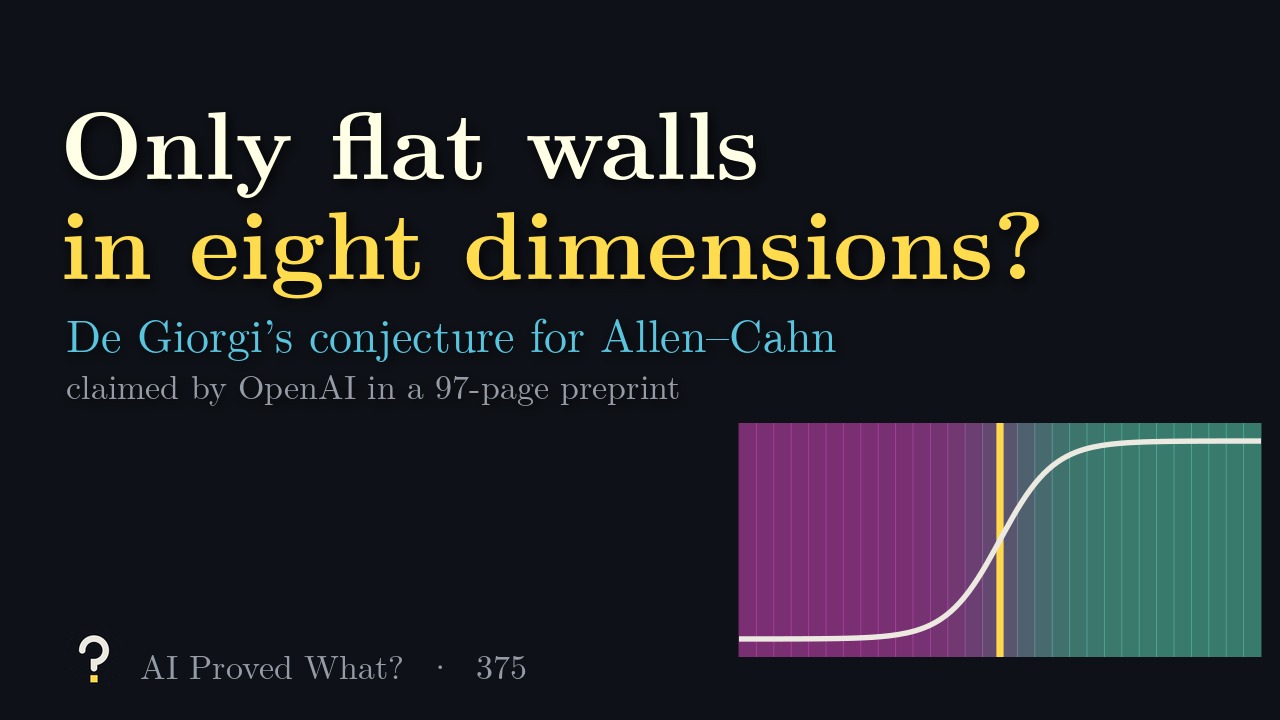
The Allen-Cahn equation, Laplacian of u equals u cubed minus u, models a mixture separating into two phases, with u near plus one in one phase and minus one in the other. A single flat wall between them has a fixed profile: our computer checks that the hyperbolic tangent of x over root two solves it, with wall energy 2√2/3 per unit area. In 1978 De Giorgi asked: if a solution with values between minus one and one increases in one direction, must it be a single flat wall? He conjectured yes, at least up to dimension eight.
It was proved in dimension two by Ghoussoub and Gui, in three by Ambrosio and Cabré, and up to eight by Savin under an extra limit condition; in nine and up it is false, by del Pino, Kowalczyk and Wei. Eight is where minimal surfaces change: our computer runs the classic test, and cones over products of spheres first pass the stability test in eight dimensions, with 25/4 at least six, while in seven, four is less than five; graphs built over such cones give the counterexamples in nine. Before September 2026, dimensions four to eight were open without Savin’s condition; that month two teams independently posted proofs of the stable case in three dimensions, and with it of De Giorgi’s conjecture in four.
Result 375 is one OpenAI paper, 97 pages, dated September 26 and made public October 6, 2026. It claims that every solution in eight dimensions with values between minus one and one that increases in one direction is a single flat wall: De Giorgi’s conjecture at its dimension-eight endpoint, with no limit condition. A stronger theorem says every stable solution in seven dimensions is constant or a flat wall, with no assumption on energy growth, and a third covers stable solutions with finite energy density in dimensions four to seven.
What it doesn’t claim
Lower dimensions follow by adding unused variables, a step the paper does not state. The claim is for this standard cubic equation only, and one step builds on an unrefereed 2025 preprint by Florit-Simon and Serra. The third theorem has a concurrent proof: on the day of the release, one of the September teams posted the same rigidity for all dimensions up to seven and more general equations, disclosing OpenAI models as assistive tools.
Where it stands
- Posted as a preprint
- OpenAI, 97 pages, dated September 26, 2026
- Peer reviewed
- Not yet; no specialist verdict
- Formalized in Lean
- None in OpenAI’s catalog; an uncatalogued folder in the repository (AllenCahn) states the three theorems and proves supporting lemmas only
Last checked October 19, 2026. The paper is unrefereed and unchanged since release. There is no catalogued Lean proof; an uncatalogued Lean folder, about 14,000 lines, states the three theorems and proves supporting lemmas, but not the theorems themselves, and we did not run it. We found no specialist verdict. OSVerify has not reviewed it.
How the proof goes
- From eight dimensions down to seven. Part one follows a classical route. A solution that increases in one direction is stable, and its two limits at the ends are stable solutions in seven dimensions. The new seven-dimensional theorem makes each of those limits a constant or a flat wall, so the solution minimizes energy. Zooming out then gives a minimizing cone in eight dimensions, tilted one way, which must be a flat plane, and a known density theorem from 2017 finishes the job.
- The new part: stable solutions in seven dimensions. The new mathematics is the seven-dimensional stable theorem. With bounded energy density, stacked sheets would give two clashing estimates of the gap between them. Without that bound, the paper builds a penalized reach, a fourth-moment growth bound and a radial test function whose numerical budget leaves a strict margin. Our computer checks every printed inequality in that budget: all hold, some by less than a millionth. An appendix explains where the argument stops working in dimension nine.
The numbers in the video
- Ours: the wall profile tanh(x/√2) solves the equation, with wall energy 2√2/3 per unit area (the paper's constant, recomputed).
- Ours: cones over products of spheres first pass the stability test in eight dimensions (25/4 ≥ 6), not in seven (4 < 5).
- Ours: every printed inequality in the paper's numerical budget holds; C(1.001) = 0.0832726206 against the printed bound .083272621.
- Lean: the uncatalogued AllenCahn folder has 53 files and 14,131 lines (counted by us; not run by us); it proves supporting lemmas, not the theorems.
Read the source
- A positive resolution of De Giorgi’s conjecture in dimension eight (PDF), 97 pages.
- The collection’s catalog, where this is result 375.
The paper
OpenAI groups related papers into one result; this one has a single paper.
Transcript
Read the full script
0:00The question
The Allen-Cahn equation, Laplacian of u equals u cubed minus u, models a mixture separating into two phases, with u near plus one in one phase and minus one in the other. A single flat wall between them has a fixed profile: our computer checks that the hyperbolic tangent of x over root two solves it, with wall energy 2√2/3 per unit area. In 1978 De Giorgi asked: if a solution with values between minus one and one increases in one direction, must it be a single flat wall? He conjectured yes, at least up to dimension eight. It was proved in dimension two by Ghoussoub and Gui, in three by Ambrosio and Cabré, and up to eight by Savin under an extra limit condition; in nine and up it is false, by del Pino, Kowalczyk and Wei. Eight is where minimal surfaces change: our computer runs the classic test, and cones over products of spheres first pass the stability test in eight dimensions, with 25/4 at least six, while in seven, four is less than five; graphs built over such cones give the counterexamples in nine. Before September 2026, dimensions four to eight were open without Savin’s condition; that month two teams independently posted proofs of the stable case in three dimensions, and with it of De Giorgi’s conjecture in four.
1:26The claim
Result 375 is one OpenAI paper, 97 pages, dated September 26 and made public October 6, 2026. It claims that every solution in eight dimensions with values between minus one and one that increases in one direction is a single flat wall: De Giorgi’s conjecture at its dimension-eight endpoint, with no limit condition. A stronger theorem says every stable solution in seven dimensions is constant or a flat wall, with no assumption on energy growth, and a third covers stable solutions with finite energy density in dimensions four to seven. Lower dimensions follow by adding unused variables, a step the paper does not state. The claim is for this standard cubic equation only, and one step builds on an unrefereed 2025 preprint by Florit-Simon and Serra. The third theorem has a concurrent proof: on the day of the release, one of the September teams posted the same rigidity for all dimensions up to seven and more general equations, disclosing OpenAI models as assistive tools.
2:35How the proof goes
Part one follows a classical route. A solution that increases in one direction is stable, and its two limits at the ends are stable solutions in seven dimensions. The new seven-dimensional theorem makes each of those limits a constant or a flat wall, so the solution minimizes energy. Zooming out then gives a minimizing cone in eight dimensions, tilted one way, which must be a flat plane, and a known density theorem from 2017 finishes the job. The new mathematics is the seven-dimensional stable theorem. With bounded energy density, stacked sheets would give two clashing estimates of the gap between them. Without that bound, the paper builds a penalized reach, a fourth-moment growth bound and a radial test function whose numerical budget leaves a strict margin. Our computer checks every printed inequality in that budget: all hold, some by less than a millionth. An appendix explains where the argument stops working in dimension nine.
3:35Where it stands
The paper is unrefereed and unchanged since release. There is no catalogued Lean proof; an uncatalogued Lean folder, about 14,000 lines, states the three theorems and proves supporting lemmas, but not the theorems themselves, and we did not run it. We found no specialist verdict. If it holds, a solution of the Allen-Cahn equation in eight dimensions that increases in one direction is a single flat wall, and so, by adding variables, in every dimension up to eight, as De Giorgi conjectured.
Spot a mistake?
This episode simplifies on purpose, but it shouldn’t be wrong. If something is, open an issue on GitHub or leave a comment on YouTube. Corrections are noted here with a date.