One third, not one half?
An AI preprint claims sharp one-third stability of Brenier maps, disproving Letrouit's square-root conjecture
Covers result 374 in OpenAI’s catalog: its one paper. See its connections to other results and the work it cites.
3:40. English captions available. The video loads from YouTube when you press play.
Chapters
The claim, in plain words
Optimal transport moves one distribution of mass onto another as cheaply as possible, paying the squared distance moved. Brenier showed that from a source with a density, like a uniform one, the best plan is a map, the gradient of a convex function. A natural question is stability: if the target moves a little, measured by the Wasserstein distance, how much can the map move? Our computer tries two atoms of fixed mass rotating by a small angle: the map moves like the square root of the distance.
A square root is the best one can hope for in general, a point traced back to Gigli in 2011. Proven bounds were weaker: exponents of 2/15, then 1/6, then, in a preprint this May, one quarter. Also this May, Letrouit put in print a conjecture that, for uniform sources on convex bodies, the square root is the truth. So by our reading, the true exponent lay somewhere between a quarter and a half.
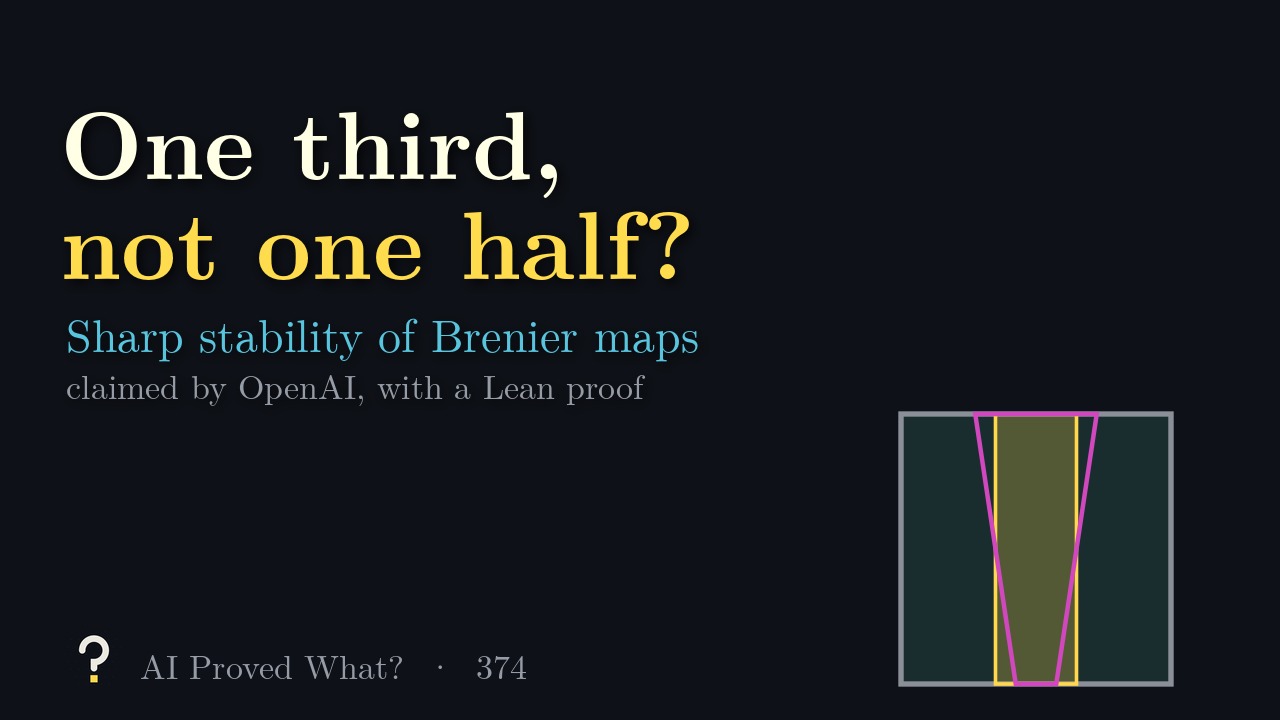
Result 374 is one OpenAI paper, 18 pages, dated September 25 and made public October 6, 2026. It claims that for a uniform source on any compact convex body in dimension two and up, and all targets in a fixed compact set, the maps differ by at most a constant times the Wasserstein distance to the power one third. And one third is sharp, even on a cube with three-atom targets, which disproves Letrouit’s square-root conjecture.
What it doesn’t claim
Our computer checks the sharpness example exactly: a central atom of mass a moves by a over two. Divided by the distance to the one third, the map change tends to 0.63, while divided by the square root it grows without bound, to about 126 when a is 10⁻⁹. Not claimed: an optimal constant, non-uniform sources, or nonconvex bodies. One day after the release, Han and Zhu posted examples ruling out exponents above one third on manifolds, citing this paper as concurrent, but without a matching one-third bound.
Where it stands
- Posted as a preprint
- OpenAI, 18 pages, dated September 25, 2026
- Peer reviewed
- Not yet; no specialist verdict
- Formalized in Lean
- The bound and the sharpness; the shipped definitions match the comparator’s (scope notes)
Last checked October 19, 2026. The paper is unrefereed and unchanged since release. Both the bound and the sharpness have a Lean proof, about 31,000 lines, not run by us. A public post notes the comparator would accept a solution that redefines its twelve definitions, so we checked that the shipped ones match. We found no specialist verdict. OSVerify has not reviewed it.
How the proof goes
- Cells, potentials, and a linear bound. First, approximate the target by finitely many atoms; then the map is the gradient of a maximum of affine functions, which cuts the body into cells. Move the atoms along an optimal coupling while holding the cell masses fixed. A new moment estimate, with the constant 162, controls how the cells shift, and gives potentials within a constant times the distance itself, a linear bound. In the cube example, the paper notes, and our computer confirms, that the potentials differ by exactly root five over four times the distance.
- Where the one third comes from. Then a slice-by-slice interpolation passes from potentials to their gradients, using a step size of the distance to the two thirds, and that step costs a cube root. That is where the one third comes from. Approximation then extends the bound to every target. Our computer also shows this in a toy: with fixed masses the change behaves like a square root, and the one third appears when the moving atom’s mass shrinks along with the move.
The numbers in the video
- Ours: in the paper's cube example the map change divided by W₂^(1/3) tends to 0.63, while divided by the square root it reaches 126 at a = 10⁻⁹.
- Ours: two atoms of fixed mass rotating slightly move the map like the square root of W₂; the one third appears when a moving atom's mass shrinks.
- Ours: the potentials in the cube example differ by exactly √5/4 times W₂ (the paper's Remark 5.2).
- Lean: 82 files and 31,286 lines in the closure of the two proofs (89 files, 33,020 lines in the module; counted by us; not run by us).
Read the source
- Sharp One-Third Stability of Brenier Maps (PDF), 18 pages.
- The Lean formalization notes.
- The collection’s catalog, where this is result 374.
The paper
OpenAI groups related papers into one result; this one has a single paper.
Transcript
Read the full script
0:00The question
Optimal transport moves one distribution of mass onto another as cheaply as possible, paying the squared distance moved. Brenier showed that from a source with a density, like a uniform one, the best plan is a map, the gradient of a convex function. A natural question is stability: if the target moves a little, measured by the Wasserstein distance, how much can the map move? Our computer tries two atoms of fixed mass rotating by a small angle: the map moves like the square root of the distance. A square root is the best one can hope for in general, a point traced back to Gigli in 2011. Proven bounds were weaker: exponents of 2/15, then 1/6, then, in a preprint this May, one quarter. Also this May, Letrouit put in print a conjecture that, for uniform sources on convex bodies, the square root is the truth. So by our reading, the true exponent lay somewhere between a quarter and a half.
0:57The claim
Result 374 is one OpenAI paper, 18 pages, dated September 25 and made public October 6, 2026. It claims that for a uniform source on any compact convex body in dimension two and up, and all targets in a fixed compact set, the maps differ by at most a constant times the Wasserstein distance to the power one third. And one third is sharp, even on a cube with three-atom targets, which disproves Letrouit’s square-root conjecture. Our computer checks the sharpness example exactly: a central atom of mass a moves by a over two. Divided by the distance to the one third, the map change tends to 0.63, while divided by the square root it grows without bound, to about 126 when a is 10⁻⁹. Not claimed: an optimal constant, non-uniform sources, or nonconvex bodies. One day after the release, Han and Zhu posted examples ruling out exponents above one third on manifolds, citing this paper as concurrent, but without a matching one-third bound.
2:06How the proof goes
First, approximate the target by finitely many atoms; then the map is the gradient of a maximum of affine functions, which cuts the body into cells. Move the atoms along an optimal coupling while holding the cell masses fixed. A new moment estimate, with the constant 162, controls how the cells shift, and gives potentials within a constant times the distance itself, a linear bound. In the cube example, the paper notes, and our computer confirms, that the potentials differ by exactly root five over four times the distance. Then a slice-by-slice interpolation passes from potentials to their gradients, using a step size of the distance to the two thirds, and that step costs a cube root. That is where the one third comes from. Approximation then extends the bound to every target. Our computer also shows this in a toy: with fixed masses the change behaves like a square root, and the one third appears when the moving atom’s mass shrinks along with the move.
3:07Where it stands
The paper is unrefereed and unchanged since release. Both the bound and the sharpness have a Lean proof, about 31,000 lines, not run by us. A public post notes the comparator would accept a solution that redefines its twelve definitions, so we checked that the shipped ones match. We found no specialist verdict. If it holds, for uniform sources on convex bodies, Brenier maps are stable with exponent one third, and no better.
Spot a mistake?
This episode simplifies on purpose, but it shouldn’t be wrong. If something is, open an issue on GitHub or leave a comment on YouTube. Corrections are noted here with a date.