An exact limit for a quantum gravity bound?
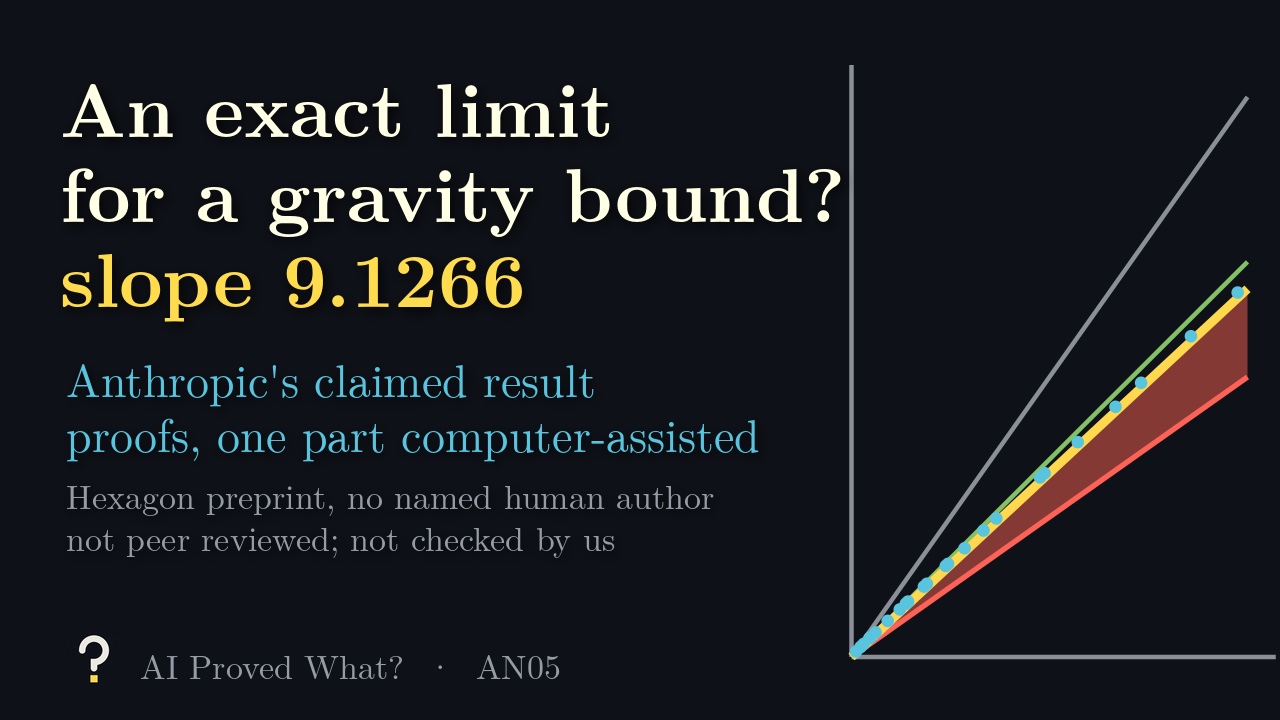
A Hexagon preprint contributed by Anthropic claims the exact best slope, about 9.1266, of a bound physicists have used since 2009 on the lightest state of a two-dimensional conformal field theory at large central charge.
Disclosure. Anthropic makes Claude, which helps make this series. This is Anthropic’s own claimed result: we hold it to the same standards as any other lab’s, using only public sources. AI Proved What? is independent and not affiliated with Anthropic beyond using its product Claude.
7:35. English captions available. The video loads from YouTube when you press play.
Chapters
The claim, in plain words
Picture a system at a critical point, where zooming in or out changes nothing. In one space and one time dimension, physicists describe it with a two-dimensional conformal field theory. Each basic state, called a primary, has a scaling dimension, Δ, which sets its energy on the circle. The vacuum sits at zero. How high can the lightest other primary, Δ₁, sit? That is the gap. The central charge, c, roughly counts the theory’s degrees of freedom.
The tool is a donut. Put the theory on a torus: space is a circle, and so is time, whose length is one over the temperature. The partition function, Z, adds up all the states, weighted by their dimensions. Swap the two circles: the S transformation, τ → −1/τ. Same donut, same total. In the paper’s reduced form, Ẑ(β) = Ẑ(1/β)/β. Spinless: only this untwisted swap is used. Every state must fit this one equation, and that caps the gap.
At large c, this is a question about quantum gravity in a simplified three-dimensional universe. Its black holes, called BTZ black holes, begin at Δ = (c − 1)/12; pure gravity would put Δ₁ near c/12. In 2009, Simeon Hellerman proved that Δ₁ is at most c/6, plus about one half. Such bounds read Δ₁ at most c/Λ, at large c; Hellerman’s Λ is six, and a bigger Λ is stronger. In 2013, Friedan and Keller, using an earlier argument, showed that Λ can never exceed twelve, the black hole threshold. In 2019, Hartman, Mazáč and Rastelli proved 8.503, and computer searches extrapolated to about 9.08. So the best slope lay between 8.503 and twelve.
The claim. A preprint on Hexagon, posted November 7, 2026, 131 pages, with the author line Claude, Anthropic, and no named human author. Under the stated assumptions, the main theorem says the best slope at large c is exactly Λ_V, 12π²/(π² + 4 arcsinh²1): about 9.1266. Best means best among functionals in a broad class containing every finite combination of derivatives, the kind computer searches use.
The paper labels each part. Optimality: no functional in the class beats c/Λ_V by more than order c^(1/3) log^(2/3) c. Proved by hand, with no computer. Attainment: an explicit functional gives Δ₁ below c/Λ_V, plus 0.483 c^(1/3), plus a bounded term, for all large enough c. Proved with computer assistance: finitely many inequalities checked in interval arithmetic, with guaranteed error bounds. Conjectured: the best correction, 0.27666 c^(1/3), backed by numerics up to c of 2,048.
This is mathematical physics, at the edge of the series’ scope; it is here because the paper states precise bounds and proves them, with each part labelled by status.
What it doesn’t claim
What is not claimed. This is about the method, not about which theories exist. A window from the black hole threshold up to about c/9.13 can never be excluded this way. The paper says nothing about whether theories live there, about bounds that use spin, or about pure gravity. The central charges where optimality and attainment take hold are not computed, and at every c that computers reach, numerical bounds stay the best. And whether the best in the class equals the limit of computer searches is a conjecture.
The paper also says the constant 0.483 is not the best one, and that it has not checked whether the analytic functionals of Hartman, Mazáč and Rastelli belong to its class.
Where it stands
- Posted on Hexagon
- hexagon:2611.00174v1, November 7, 2026 (version 1, 131 pages, CC BY 4.0). Hexagon is a new preprint server for the mathematical sciences, in public beta; acceptance “is not a judgment about its correctness, quality, or novelty” (About).
- Named human author
- None. The PDF’s author line is “Claude (Anthropic)”; Hexagon lists the work as contributed by Anthropic (a verified organization), with no human author claimed. Hexagon says AI systems cannot be contributors. Labels: primarily AI-generated text; human understanding: some parts.
- Independent expert review
- None found as of November 9, 2026. Per the provenance note, Claude wrote the paper “following brief guidance from a physicist, who also checked every main result”; the physicist is not named.
- Peer reviewed
- No. Not on arXiv (title search and Hexagon’s record, November 9, 2026).
- Lean proof
- None (Hexagon lists no formalization). The attainment proof rests on finitely many inequalities certified in interval arithmetic (Arb through python-flint, per the paper’s Appendix G); that code is described but not published. Not run or checked by us.
Last checked November 10, 2026. Where it stands. Hexagon is a new preprint server for mathematics, in public beta, set up in response to AI. AI systems cannot be contributors, and acceptance is not a judgment about correctness. This paper lists only Anthropic, a verified organization, and is labelled primarily AI-generated, with human understanding of some parts. The Hexagon record’s provenance statement: an internal Claude research model first obtained the main result autonomously, Claude Opus 5.5 later did so independently, and Claude wrote the paper with brief guidance from an unnamed physicist who also checked every main result. Anthropic’s announcement credits Claude Fable 5.2. The paper is not on arXiv, not peer reviewed, has no Lean proof, and its interval-arithmetic code is not published. We found no expert reaction yet. Beyond our own arithmetic, none of this is checked by us.
Anthropic’s announcement of Claude Fable 5.2 and Mythos 5.2 (November 9, 2026) says Fable 5.2 found “the exact limit of a technique physicists have used for more than 15 years”. The paper’s provenance note names an internal Claude research model and Claude Opus 5.5.
This is outside OpenAI’s catalogue, after AN03, Anthropic’s 3-SAT paper. If it holds, the best a method used since 2009 can ever give at large c is about c/9.13. Closing the rest of the gap to the black holes will take more, such as spin, whole-number counts of states, or data from correlation functions, as the paper says; it adds that if a newer construction holds up, the torus alone, even with spin and whole-number counts, would not be enough. See AN03.
How the proof goes
- Why it is hard. How the proof goes, in the paper’s account. A functional turns the torus equation into one sum over the states; to exclude a gap, it must be positive above the gap and on the vacuum. The catch: through the swap, the vacuum acts like a continuum of heavy states, with a density that grows like e^(4π√(at)). So the functional’s negative part, below the gap, must outweigh everything above it, and the functional must fall as fast as that density grows. But each functional is, up to sign, its own Fourier transform, and such functions resist falling fast.
- Electrostatics on a strip. The paper’s key idea is electrostatics. Change variables to b, √(3t/(c − 1)), and let b be complex. Then the log of the functional’s size, divided by c minus one, acts like a two-dimensional electric potential, with a positive charge at each zero, on a strip whose edges pass through the vacuum. Such a potential has no maximum inside, so it stays below an explicit harmonic function on the strip, slit along the real axis. That bound first touches the Cardy line where sinh(πx) = 1: at x*, about 0.2805. And 1/Λ = 1/12 + x*²/3: 9.1266.
- Attainment and credit. For the other half, zeros placed by the charge density on the slits build a functional that reaches the slope, and the computer checks the leftover inequalities. The paper says its strategy for optimality is that of OpenAI’s proof for a twin problem, linked to sphere packing, with slope π²; it has not verified that proof, and nothing depends on it. It also traces the old 9.08 to the choice of fitting curve, not to the data: the same fit, applied to its own formula, gives 9.085.
The numbers in the video
- Ours: Λ_V = 12π²/(π² + 4 arcsinh²1) = 9.1266340; x* = arcsinh(1)/π = 0.2805499, and sinh(πx*) = 1; ξ* = x*²/3 = 0.0262361; 1/Λ_V = 1/12 + ξ*; the window is 12ξ* = 31.5% of the range c/12 to c/6 (the paper: “the lower 31%”).
- The paper’s Table 2: 24 numerical bounds for 24 ≤ c ≤ 2,048; our c/Δ₁ matches every printed ratio, every bound lies above c/Λ_V, and at c = 2,048 the bound 227.7834 lies between c/Λ_V = 224.40 and c/8.503 = 240.86.
- Earlier bounds, each in its own source: Hellerman (arXiv 0902.2790, February 2009): Δ₁ < (c_L + c_R)/12 + 0.473695; Friedan and Keller (arXiv 1307.6562, 2013): the method “cannot exclude any ∆1 < (c − 1)/12”; Hartman, Mazáč and Rastelli (arXiv 1905.01319, 2019): Δ₀ ≲ c/8.503, proved analytically; Afkhami-Jeddi, Hartman and Tajdini (arXiv 1903.06272, 2019): numerical evidence for Δ₁ ≲ c/9.1 (9.08 and c = 1800 per the paper).
- From the paper: 0.483 (attainment constant, not the best one), 0.44 (optimality rate), 0.27666 (conjectured coefficient), c ≥ 40 (standing assumption of the rigorous statements), numerics up to c = 2,048 extrapolating to 9.1263 ± 0.002.
Read the source
- “The spinless modular bootstrap at large central charge”, Hexagon preprint hexagon:2611.00174v1, November 7, 2026 (PDF, CC BY 4.0).
- Hexagon, About.
- Anthropic, “Introducing Claude Fable 5.2 and Claude Mythos 5.2”, November 9, 2026.
- Earlier bounds: Hellerman 2009, Friedan and Keller 2013, Hartman, Mazáč and Rastelli 2019, Afkhami-Jeddi, Hartman and Tajdini 2019.
AI Proved What? is independent and not affiliated with Anthropic beyond using its product Claude, or with Hexagon or OpenAI. The critical-point picture and “c roughly counts the degrees of freedom” are background, not from the paper; the functional, the strip’s zero spacing and the spectrum ladder in the video are schematic.
Transcript
Read the full script
0:00The question
This is AN05. Before we start: Anthropic makes Claude, which helps make this series. This is Anthropic’s own claimed result, and we hold it to the same standards as any lab’s. It is mathematical physics, at the edge of our scope; it counts here because it states bounds and proves them. Picture a system at a critical point, where zooming in or out changes nothing. In one space and one time dimension, physicists describe it with a two-dimensional conformal field theory. Each basic state, called a primary, has a scaling dimension, Δ, which sets its energy on the circle. The vacuum sits at zero. How high can the lightest other primary, Δ₁, sit? That is the gap. The central charge, c, roughly counts the theory’s degrees of freedom. The tool is a donut. Put the theory on a torus: space is a circle, and so is time, whose length is one over the temperature. The partition function, Z, adds up all the states, weighted by their dimensions. Swap the two circles: the S transformation, τ → −1/τ. Same donut, same total. In the paper’s reduced form, Ẑ(β) = Ẑ(1/β)/β. Spinless: only this untwisted swap is used. Every state must fit this one equation, and that caps the gap. At large c, this is a question about quantum gravity in a simplified three-dimensional universe. Its black holes, called BTZ black holes, begin at Δ = (c − 1)/12; pure gravity would put Δ₁ near c/12. In 2009, Simeon Hellerman proved that Δ₁ is at most c/6, plus about one half. Such bounds read Δ₁ at most c/Λ, at large c; Hellerman’s Λ is six, and a bigger Λ is stronger. In 2013, Friedan and Keller, using an earlier argument, showed that Λ can never exceed twelve, the black hole threshold. In 2019, Hartman, Mazáč and Rastelli proved 8.503, and computer searches extrapolated to about 9.08. So the best slope lay between 8.503 and twelve.
2:14The claim
The claim. A preprint on Hexagon, posted November 7, 2026, 131 pages, with the author line Claude, Anthropic, and no named human author. Under the stated assumptions, the main theorem says the best slope at large c is exactly Λ_V, 12π²/(π² + 4 arcsinh²1): about 9.1266. Best means best among functionals in a broad class containing every finite combination of derivatives, the kind computer searches use. The paper labels each part. Optimality: no functional in the class beats c/Λ_V by more than order c^(1/3) log^(2/3) c. Proved by hand, with no computer. Attainment: an explicit functional gives Δ₁ below c/Λ_V, plus 0.483 c^(1/3), plus a bounded term, for all large enough c. Proved with computer assistance: finitely many inequalities checked in interval arithmetic, with guaranteed error bounds. Conjectured: the best correction, 0.27666 c^(1/3), backed by numerics up to c of 2,048. What is not claimed. This is about the method, not about which theories exist. A window from the black hole threshold up to about c/9.13 can never be excluded this way. The paper says nothing about whether theories live there, about bounds that use spin, or about pure gravity. The central charges where optimality and attainment take hold are not computed, and at every c that computers reach, numerical bounds stay the best. And whether the best in the class equals the limit of computer searches is a conjecture.
4:05How the proof goes
How the proof goes, in the paper’s account. A functional turns the torus equation into one sum over the states; to exclude a gap, it must be positive above the gap and on the vacuum. The catch: through the swap, the vacuum acts like a continuum of heavy states, with a density that grows like e^(4π√(at)). So the functional’s negative part, below the gap, must outweigh everything above it, and the functional must fall as fast as that density grows. But each functional is, up to sign, its own Fourier transform, and such functions resist falling fast. The paper’s key idea is electrostatics. Change variables to b, √(3t/(c − 1)), and let b be complex. Then the log of the functional’s size, divided by c minus one, acts like a two-dimensional electric potential, with a positive charge at each zero, on a strip whose edges pass through the vacuum. Such a potential has no maximum inside, so it stays below an explicit harmonic function on the strip, slit along the real axis. That bound first touches the Cardy line where sinh(πx) = 1: at x*, about 0.2805. And 1/Λ = 1/12 + x*²/3: 9.1266. For the other half, zeros placed by the charge density on the slits build a functional that reaches the slope, and the computer checks the leftover inequalities. The paper says its strategy for optimality is that of OpenAI’s proof for a twin problem, linked to sphere packing, with slope π²; it has not verified that proof, and nothing depends on it. It also traces the old 9.08 to the choice of fitting curve, not to the data: the same fit, applied to its own formula, gives 9.085.
6:02Where it stands
Where it stands. Hexagon is a new preprint server for mathematics, in public beta, set up in response to AI. AI systems cannot be contributors, and acceptance is not a judgment about correctness. This paper lists only Anthropic, a verified organization, and is labelled primarily AI-generated, with human understanding of some parts. The Hexagon record’s provenance statement: an internal Claude research model first obtained the main result autonomously, Claude Opus 5.5 later did so independently, and Claude wrote the paper with brief guidance from an unnamed physicist who also checked every main result. Anthropic’s announcement credits Claude Fable 5.2. The paper is not on arXiv, not peer reviewed, has no Lean proof, and its interval-arithmetic code is not published. We found no expert reaction yet. Beyond our own arithmetic, none of this is checked by us. This is outside OpenAI’s catalogue, after AN03, Anthropic’s 3-SAT paper. If it holds, the best a method used since 2009 can ever give at large c is about c/9.13. Closing the rest of the gap to the black holes will take more, such as spin, whole-number counts of states, or data from correlation functions, as the paper says; it adds that if a newer construction holds up, the torus alone, even with spin and whole-number counts, would not be enough.
Spot a mistake?
This episode simplifies on purpose, but it shouldn’t be wrong. If something is, open an issue on GitHub or leave a comment on YouTube. Corrections are noted here with a date.