Exactly two and a quarter?
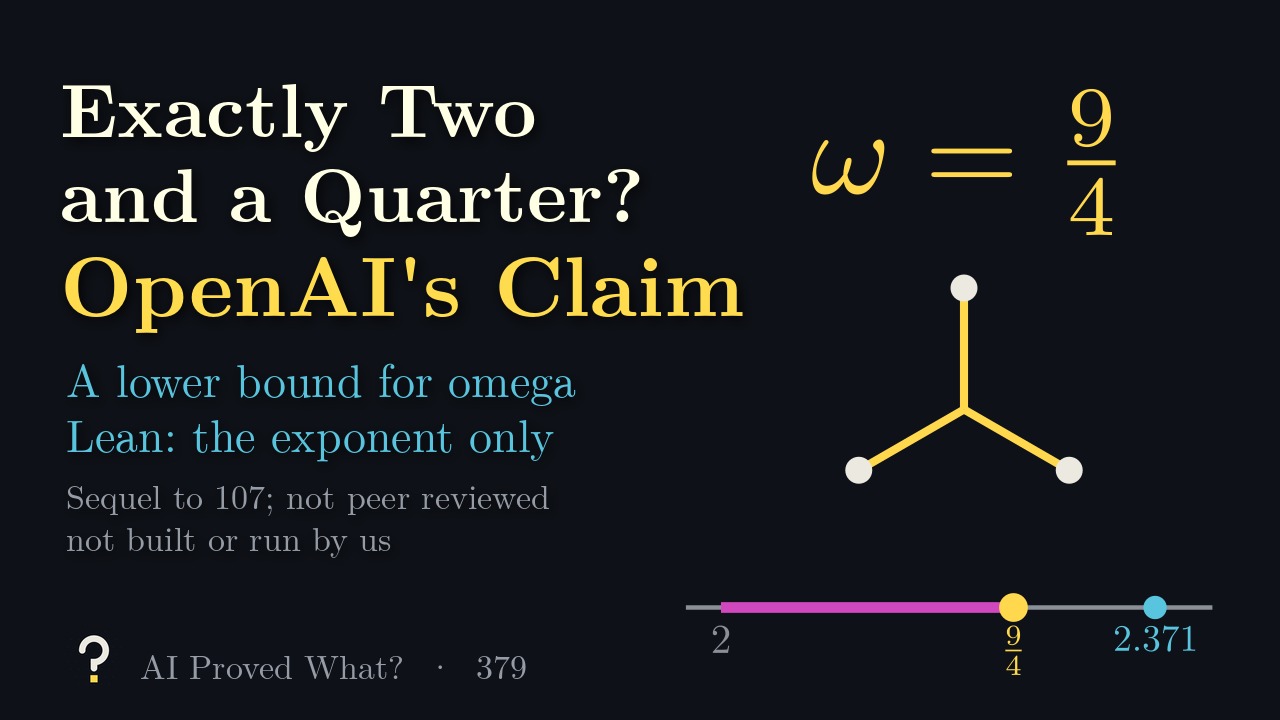
An OpenAI preprint claims the matching lower bound to its October upper bound: the exponent of matrix multiplication is exactly 9/4 over every field, for formal arithmetic circuits. Its Lean proof covers the exponent, not the finite bound.
A companion episode of result 379 in OpenAI’s catalog, on one of its 7 papers: The matrix multiplication exponent is nine fourths. Main episode: VP ≠ VNP and Valiant’s whole hierarchy?. Other companion episode: The sunflower conjecture, proved?. See the result’s connections.
8:31. English captions available. The video loads from YouTube when you press play.
Chapters
The question
Multiplying two n by n matrices the schoolbook way takes n³ multiplications. Strassen found that two by two matrices can be multiplied with seven products, not eight, and used recursively, that saves a power of n. The exponent omega is the smallest power of n such savings can reach in the limit, counting arithmetic operations. It is at least two, since there are n² entries to fill in. For decades, upper bounds crept down, to about 2.371. Then, in October, OpenAI’s result 107, our earlier episode, claimed that omega is at most 9/4: two and a quarter. Outside researchers have since posted their own expositions and proofs of that upper bound, several of them extending it to every field.
Lower bounds are the hard direction. To show that omega is more than two, you must rule out every possible algorithm, not just the known ones. The best lower bounds the paper cites count products exactly: at least (5/2)n² − 3n, by Bläser, and about 3n² over the complex numbers, by Landsberg. A constant factor times n² disappears in the exponent, so the proven lower bound on omega itself stayed at two. Whether omega equals two was open.
The claim, in plain words
On November 24, 2026, OpenAI added seven papers as result family 379. One of them, 111 pages, is titled “The matrix multiplication exponent is nine fourths”. Its main theorem: over every field, omega equals 9/4. The model is formal arithmetic circuits. Inputs are independent variables; gates add, subtract, multiply or divide; and each output must equal the right entry as a formal identity, even over finite fields. The upper bound is the October result, extended to every field by Amanov, van den Berg and Zuiddam, following Lü. What is new is the matching lower bound, at every size: for n at least two, such a circuit needs at least n^(9/4)/2 multiplication or division gates, even if additions and scalings are free. A bilinear algorithm needs at least n^(9/4) products.
In the paper’s words (Theorem 1.1): “Over every field F, the exponent of square matrix multiplication is ω_F = 9/4.” Its circuits are formal: “Each output must agree with the corresponding entry of the product as an identity of rational functions. This convention applies also over finite fields.” Corollary 1.2: for every n ≥ 2 and every field F, the geometric border rank of the n × n multiplication tensor is at least n^(9/4), its asymptotic rank over F equals n^(9/4), and every formal arithmetic circuit has at least ⌈n^(9/4)/2⌉ nonscalar multiplication or division gates.
What it would mean
What would that mean? In our table, at n equals two, the bound asks for at least 5 products; Strassen’s method uses 7. At a thousand, about 5.6 million, against a billion the schoolbook way. By our arithmetic, it beats Bläser’s count for every n from 34 on, and the leading term of Landsberg’s beyond 81. The paper draws consequences: omega equals two is false, and so is Strassen’s conjecture on tight tensors, which predicts n² here. For rectangular products, the largest power of n that the middle dimension can have, while the cost stays near n², lies between one half and two thirds.
Does it square with the older literature?
Does this square with the older literature? As far as we can check, yes. The famous 2.371 is an upper bound, reached by analyses of the Coppersmith–Winograd tensor; a lower bound of two and a quarter contradicts none of it. It would mean that no method of any kind can go below two and a quarter in this model. Amanov, van den Berg and Zuiddam had shown that 9/4 is the best a specified set of polynomial-based steps can give; this paper claims it for every circuit. It does conflict with one unrefereed claim: Zhi-Wei Sun’s September preprint, which says omega is two. The paper notes that at 256 by 256, Sun’s bound is 2^17 and its own lower bound 2^18. Both cannot be right. Not claimed: a practical algorithm, or a circuit of size exactly n^(9/4). And, we note, nothing about algorithms outside the algebraic model, such as bit-level tricks.
The bounds near 2.371 (Coppersmith and Winograd, Stothers, Vassilevska Williams, Le Gall, Alman, Duan, Xu, Zhou and others; over every field 2.371055 by OpenAI’s staggered extraction) are upper bounds: they show what some algorithms achieve, and say nothing about whether faster ones exist. The proven lower bound on ω before this paper was 2. So a claim that ω = 9/4 is consistent with all of them; it would mean that the October 9/4 upper bound is optimal. Ambainis, Filmus and Le Gall’s limits, and Amanov, van den Berg and Zuiddam’s barrier, concern specific methods, not all algorithms.
How the proof goes
How the proof goes, by the paper’s account. It argues by contradiction. Suppose omega were below 9/4. Then one bilinear algorithm with a strict saving exists, and its equations survive reduction to some finite field. There the paper uses prices: numbers attached to tensors that add up under tensor products and can only fall under local linear maps. A wire shared by two sites gets a price per bit, which acts as a distance. Matrix multiplication is a triangle of three wires, while a rank decomposition is one shared label at a hub. So the triangle’s perimeter, divided by the label’s rate, bounds omega from below. Flat Euclidean prices give only two. The critical shape is a tripod with unit arms: tips at distance two, perimeter six, and a label rate of 8/3, which gives 9/4. Under the strict saving, the paper shows that such a tripod cannot occur, and ruling it out lets it price whole families of what it calls sphere tensors at once.
Here tensor networks come in: graphs of small tables on bits, at most three bits per table, summed over internal wires. From the sphere-tensor prices the paper builds sorting, table lookup, and a compression theorem: many copies of a network can be written together, cutting each copy’s size by a power of the logarithm, at a small charge per input bit. Now take a test. Given a list of 2^w words of 2w bits each, are all the words distinct? Sort them, then compare neighbours. In our example, 8 words of 6 bits take 19 compare-and-swap steps. Compress that network a fixed number of times, and its cost per input bit falls to a tiny power of w. But the paper proves that any network testing many independent lists at once needs more than w to a fixed power, σ, per input bit. Choose the tiny power below sigma, and that is a contradiction: omega is at least 9/4. That list bound leans on two same-day companion papers, on tensor geometry and on circuit lower bounds for the Hamiltonian cycle polynomial and the permanent, and the price framework rests on the first of them.
The paper also cites, as related to its use of fermionic contractions, OpenAI’s ETH paper and Anthropic’s 3-SAT paper (our AN03). Anthropic makes Claude, which helps make this series. Companion papers the proof relies on: Euclidean geometry in the asymptotic spectrum of tensors and Circuit lower bounds for Hamiltonian cycle and the permanent.
The Lean proof
Finally, the gate count. A rank below n^(9/4) at any size would, used recursively, push omega below 9/4. Each multiplication or division adds at most two products of linear forms, so a circuit needs n^(9/4)/2 such gates. OpenAI’s Lean proof, not run by us, covers the exponent. Its comparator states that over every field, for division-free formal programs counting every addition, subtraction and multiplication, the exponent is 9/4; the scope note says Lean also proves that allowing division leaves the exponent unchanged. The finite bound, n^(9/4)/2, is not formalized. The comparator also states that the largest middle power is exactly one half, with an exact formula for all rectangular shapes: more than this paper proves, one half to two thirds. We found no manuscript in the repository that states those. Our text scan of the proof’s files, about 590 of them, found no sorry or axiom. The pull request says the Lean build was not run for it.
Our reading of the comparator file (not a machine check): it imports only Mathlib; a program is a list of gates (constant, input, add, sub, mul; no division), each add, sub or mul costing 1; FormalCorrect asks that each output register equal Σⱼ X(i,j)·X(j,k) as a polynomial; formalOmega F 1 1 1 is the infimum of exponents τ with programs of cost at most C·N^(τ+ε) for every ε; square_exponent states it equals 9/4 for every field. dual_exponent states that the supremum of t in [0, 1] with ω(1, 1, t) = 2 is 1/2, and rectangular_exponent gives an exact formula for every shape. The configuration does not enable the nanoda kernel. The proof (solution module) follows the paper’s parts (sphere tensors, routing, lookup, rounds, shaving, list bounds) by its folder names; we did not read the proof. The same statements appear in the rewritten scope note for result 107.
Where it stands
- Posted as a preprint
- OpenAI, 111 pages, in github.com/openai/math: one of seven papers added as result family 379 (commit 92b516e, merged November 24, 2026, 16:18 PT as pull request #6).
- Peer reviewed
- No.
- Upper bound (ω ≤ 9/4) examined by others
- Yes, the October upper bound (episode 107): outside expositions and proofs by Amir Shpilka (ECCC TR26-281, October 27, with explicit algorithms), Amanov, van den Berg and Zuiddam (arXiv 2610.30054, October 21, over every field after Lü’s extension to every characteristic, with a barrier for these methods), Doğan, Lysikov, Sakabe and Walter (arXiv 2611.09716, November 6), Pass, Lü and Li. These concern the upper bound only.
- Lower bound (ω ≥ 9/4) reviewed by experts
- None found as of November 24, 2026, evening PT. Scott Aaronson’s November 24 post is about VP vs VNP; we found nothing on the Computational Complexity blog or on Gil Kalai’s or Terence Tao’s blogs; one Hacker News thread had a few comments, none assessing the proof. OSVerify has not reviewed it. Later that evening (6:47 pm PT), Emanuele Viola welcomed the result on his blog, without reviewing the proof, and the Hacker News thread grew to about 40 comments, still with no assessment of the proof.
- Formalized in Lean (partly)
- The exponent: over every field, ω = 9/4 for division-free formal programs counting additions, subtractions and multiplications, and Lean also proves that division changes nothing (scope note, comparator). Not the finite bound ⌈n^(9/4)/2⌉, which the scope note lists as unformalized. The comparator also states α = 1/2 and an exact rectangular formula, more than this paper proves (1/2 ≤ α ≤ 2/3). Not run by us; the pull request says “Lean and LaTeX builds were not run for this PR.”
Last checked November 24, 2026, evening PT. The repository’s README says its manuscripts were “produced by an unnamed internal OpenAI model”. Not built or run by us.
Episode 107 covered the upper bound, and our family episode on result 379 covers its geometry. If it holds, omega is exactly two and a quarter over every field: no algebraic algorithm can multiply matrices in n^(2+ε), and the long search for faster ones in this model has reached its floor.
The numbers in the video
- Ours, from the claimed bound: at n = 2, n^(9/4) ≈ 4.757, so at least 5 bilinear products and 3 multiplication or division gates (Strassen’s method uses 7 products; the schoolbook way 8). At n = 1,000: at least 5,623,414 products (about 5.6 million), against 10^9 for the schoolbook method. \n
- Ours: n^(9/4) exceeds Bläser’s (5/2)n² − 3n at n = 2 and for every n ≥ 34; it exceeds the leading term 3n² of Landsberg’s 3n² − o(n²) for n > 81 (n^(1/4) > 3). \n
- The paper’s comparison with Zhi-Wei Sun’s arXiv 2610.13971v1: at 256 × 256, Sun’s proposed border-rank bound is 2^17 = 131,072 and this paper’s lower bound 256^(9/4) = 2^18 = 262,144. Ours: Sun’s abstract claims 2^(2k+1) at side 2^k for every k ≥ 5, below 2^(9k/4) for every such k. \n
- The paper’s critical example: a tripod with unit arms has tips 2 apart (perimeter 6); with a shared-label rate of 8/3 the ratio is 6/(8/3) = 9/4. For flat Euclidean prices, a bit shared by three sites costs half the triangle’s perimeter, giving ratio 2. \n
- Ours: the list test with w = 3: 8 words of 6 bits (48 input bits); Batcher’s odd–even merge sort on 8 inputs has 19 compare-and-swap steps, then 7 neighbour comparisons; checked on 2,000 random lists. \n
- Ours, text only: the Lean import closure of the comparator’s solution module has 592 files and 257,771 lines (OpenAI files, Mathlib excluded); no sorry, admit, axiom declaration or native_decide in them (the comparator challenge file has its sorry by design).
Read the source
- OpenAI, The matrix multiplication exponent is nine fourths (PDF), 111 pages, November 24, 2026 edition (folder with LaTeX sources).
- The upper bound: OpenAI, An Upper Bound of 9/4 for the Matrix Multiplication Exponent (October 2, 2026; our episode 107).
- The Lean scope note, comparator challenge and solution module.
- The collection’s catalog (family 379); OpenAI’s history file (November 24, 2026).
- Outside work on the upper bound: Amanov, van den Berg and Zuiddam; Shpilka; Doğan, Lysikov, Sakabe and Walter. The conflicting claim: Zhi-Wei Sun, arXiv 2610.13971v1.
- Background the paper cites: V. Strassen, Gaussian elimination is not optimal (1969); M. Bläser, Lower bounds for the bilinear complexity of associative algebras (Computational Complexity); J. M. Landsberg’s rank and Landsberg and Michałek’s border-rank bounds; V. Strassen, Algebra and complexity (1994), Conjecture 5.3 on tight tensors.
AI Proved What? is independent and not affiliated with OpenAI, or with Anthropic beyond using its product Claude.
Transcript
Read the full script
0:00The question
Multiplying two n by n matrices the schoolbook way takes n³ multiplications. Strassen found that two by two matrices can be multiplied with seven products, not eight, and used recursively, that saves a power of n. The exponent omega is the smallest power of n such savings can reach in the limit, counting arithmetic operations. It is at least two, since there are n² entries to fill in. For decades, upper bounds crept down, to about 2.371. Then, in October, OpenAI’s result 107, our earlier episode, claimed that omega is at most 9/4: two and a quarter. Outside researchers have since posted their own expositions and proofs of that upper bound, several of them extending it to every field. Lower bounds are the hard direction. To show that omega is more than two, you must rule out every possible algorithm, not just the known ones. The best lower bounds the paper cites count products exactly: at least (5/2)n² − 3n, by Bläser, and about 3n² over the complex numbers, by Landsberg. A constant factor times n² disappears in the exponent, so the proven lower bound on omega itself stayed at two. Whether omega equals two was open.
1:19The claim
On November 24, 2026, OpenAI added seven papers as result family 379. One of them, 111 pages, is titled “The matrix multiplication exponent is nine fourths”. Its main theorem: over every field, omega equals 9/4. The model is formal arithmetic circuits. Inputs are independent variables; gates add, subtract, multiply or divide; and each output must equal the right entry as a formal identity, even over finite fields. The upper bound is the October result, extended to every field by Amanov, van den Berg and Zuiddam, following Lü. What is new is the matching lower bound, at every size: for n at least two, such a circuit needs at least n^(9/4)/2 multiplication or division gates, even if additions and scalings are free. A bilinear algorithm needs at least n^(9/4) products. What would that mean? In our table, at n equals two, the bound asks for at least 5 products; Strassen’s method uses 7. At a thousand, about 5.6 million, against a billion the schoolbook way. By our arithmetic, it beats Bläser’s count for every n from 34 on, and the leading term of Landsberg’s beyond 81. The paper draws consequences: omega equals two is false, and so is Strassen’s conjecture on tight tensors, which predicts n² here. For rectangular products, the largest power of n that the middle dimension can have, while the cost stays near n², lies between one half and two thirds. Does this square with the older literature? As far as we can check, yes. The famous 2.371 is an upper bound, reached by analyses of the Coppersmith–Winograd tensor; a lower bound of two and a quarter contradicts none of it. It would mean that no method of any kind can go below two and a quarter in this model. Amanov, van den Berg and Zuiddam had shown that 9/4 is the best a specified set of polynomial-based steps can give; this paper claims it for every circuit. It does conflict with one unrefereed claim: Zhi-Wei Sun’s September preprint, which says omega is two. The paper notes that at 256 by 256, Sun’s bound is 2^17 and its own lower bound 2^18. Both cannot be right. Not claimed: a practical algorithm, or a circuit of size exactly n^(9/4). And, we note, nothing about algorithms outside the algebraic model, such as bit-level tricks.
4:00How the proof goes
How the proof goes, by the paper’s account. It argues by contradiction. Suppose omega were below 9/4. Then one bilinear algorithm with a strict saving exists, and its equations survive reduction to some finite field. There the paper uses prices: numbers attached to tensors that add up under tensor products and can only fall under local linear maps. A wire shared by two sites gets a price per bit, which acts as a distance. Matrix multiplication is a triangle of three wires, while a rank decomposition is one shared label at a hub. So the triangle’s perimeter, divided by the label’s rate, bounds omega from below. Flat Euclidean prices give only two. The critical shape is a tripod with unit arms: tips at distance two, perimeter six, and a label rate of 8/3, which gives 9/4. Under the strict saving, the paper shows that such a tripod cannot occur, and ruling it out lets it price whole families of what it calls sphere tensors at once. Here tensor networks come in: graphs of small tables on bits, at most three bits per table, summed over internal wires. From the sphere-tensor prices the paper builds sorting, table lookup, and a compression theorem: many copies of a network can be written together, cutting each copy’s size by a power of the logarithm, at a small charge per input bit. Now take a test. Given a list of 2^w words of 2w bits each, are all the words distinct? Sort them, then compare neighbours. In our example, 8 words of 6 bits take 19 compare-and-swap steps. Compress that network a fixed number of times, and its cost per input bit falls to a tiny power of w. But the paper proves that any network testing many independent lists at once needs more than w to a fixed power, σ, per input bit. Choose the tiny power below sigma, and that is a contradiction: omega is at least 9/4. That list bound leans on two same-day companion papers, on tensor geometry and on circuit lower bounds for the Hamiltonian cycle polynomial and the permanent, and the price framework rests on the first of them. Finally, the gate count. A rank below n^(9/4) at any size would, used recursively, push omega below 9/4. Each multiplication or division adds at most two products of linear forms, so a circuit needs n^(9/4)/2 such gates. OpenAI’s Lean proof, not run by us, covers the exponent. Its comparator states that over every field, for division-free formal programs counting every addition, subtraction and multiplication, the exponent is 9/4; the scope note says Lean also proves that allowing division leaves the exponent unchanged. The finite bound, n^(9/4)/2, is not formalized. The comparator also states that the largest middle power is exactly one half, with an exact formula for all rectangular shapes: more than this paper proves, one half to two thirds. We found no manuscript in the repository that states those. Our text scan of the proof’s files, about 590 of them, found no sorry or axiom. The pull request says the Lean build was not run for it.
7:19Where it stands
Where it stands, on the evening of November 24. The paper is a preprint, not peer reviewed; OpenAI’s repository says its manuscripts come from an unnamed internal model. The upper bound it relies on has outside expositions and proofs, by Shpilka, by Amanov, van den Berg and Zuiddam, by Doğan, Lysikov, Sakabe and Walter, and by others. The lower bound is new today, and we found no expert review of it. Scott Aaronson’s post today is about VP and VNP; we found nothing on the Computational Complexity blog or on the blogs of Gil Kalai and Terence Tao, and one Hacker News thread with a few comments, none assessing the proof. No OSVerify review. Not built or run by us. Episode 107 covered the upper bound, and our family episode on result 379 covers its geometry. If it holds, omega is exactly two and a quarter over every field: no algebraic algorithm can multiply matrices in n^(2+ε), and the long search for faster ones in this model has reached its floor.
Spot a mistake?
This episode simplifies on purpose, but it shouldn’t be wrong. If something is, open an issue on GitHub or leave a comment on YouTube. Corrections are noted here with a date.