No algorithm for fractions
Hilbert’s tenth problem over the rational numbers
Covers result 004 in OpenAI’s catalog: all 2 papers. See its connections to other results and the work it cites.
6:50. English captions available. The video loads from YouTube when you press play.
Chapters
The claim, in plain words
In 1900 David Hilbert asked for a procedure that decides whether a polynomial equation with integer coefficients has a solution in whole numbers. In 1970, building on work of Martin Davis, Hilary Putnam and Julia Robinson, Yuri Matiyasevich showed that no such procedure exists: equations can imitate computer programs, and no algorithm decides which programs halt.
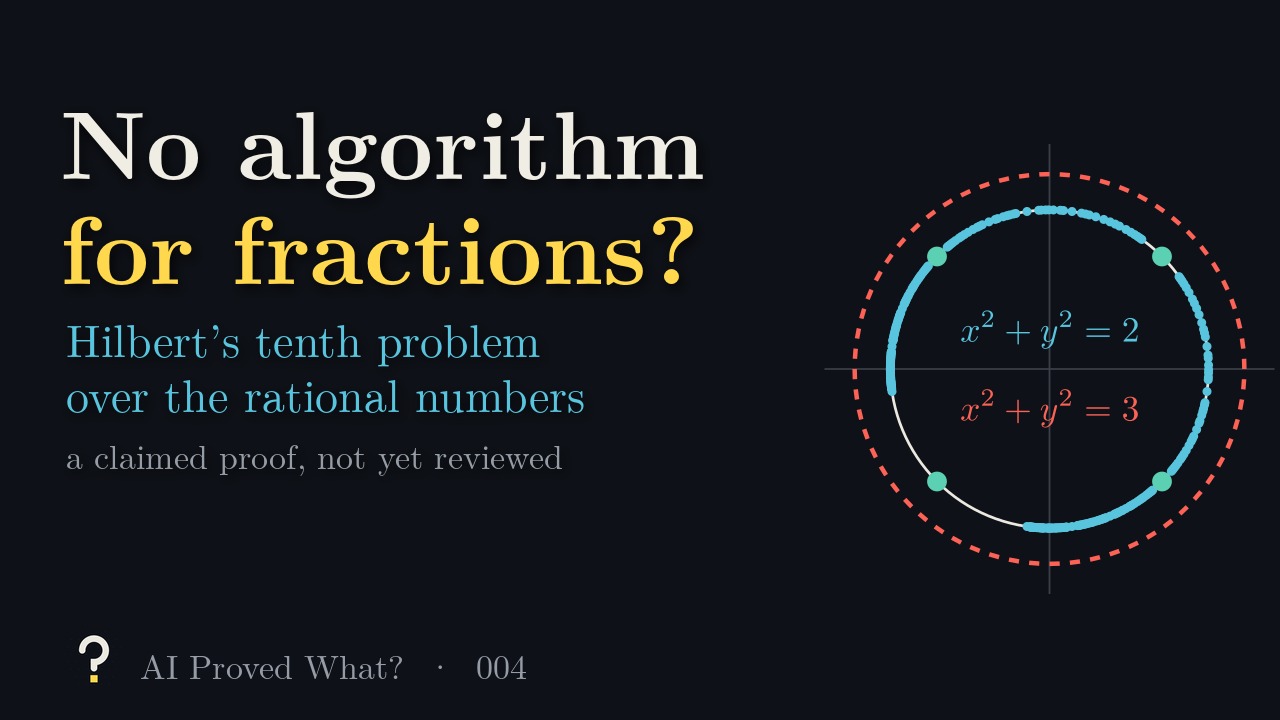
Allowing fractions changes the question. Some equations gain solutions (x² + y² = 2 has (1/5, 7/5)), some still have none (x² + y² = 3), and x³ + y³ = 6 has a fraction solution, (17/21, 37/21), but no whole-number one. Whether an algorithm can decide fraction solutions had remained open.
Result 004 claims the answer is no: there is no algorithm which, given a polynomial with integer coefficients in any number of variables, decides whether it has a rational zero. It also claims the problem is exactly as hard as the halting problem, even for equations of degree at most four.
What it doesn’t claim
The obvious route to this answer would be a single equation that has a fraction solution exactly when its first unknown is a whole number. A conjecture of Barry Mazur predicts that no such equation exists. The paper does not build one and says so: it gives “no single existential definition of Z in Q” (p. 57), so Mazur’s conjecture is neither proved nor contradicted. The paper gives no bound on the number of variables, and it says nothing about whether equations in a few variables, such as curves, are decidable.
What it relies on
Two other papers from the same release, both unreviewed preprints:
- A pointwise 2-converse for elliptic curves with rational two-torsion (October 7, 2026; 91 pages), the companion in the same result family. It turns a 2-descent “promise” (a Selmer class) into an actual rational point. The paper says the 2-converse in result 006 can be used instead (Remark 3.5).
- Fontaine–Mazur modularity at the prime 2, filed under result 010, used for the height bound built from a Shimura curve (§4.7).
It also uses published work, including the Davis–Putnam–Robinson–Matiyasevich theorem, Green–Tao–Ziegler, Faltings’ theorem and isogeny estimates.
Where it stands
- Posted as a preprint
- OpenAI, October 6, 2026 edition
- Peer reviewed
- Not yet
- Checked in Lean
- Not yet
Last checked October 19, 2026. The claim has not been withdrawn. No Lean formalization is listed for this result or for the two papers it relies on. An earlier edition dated September 24, 2026 differs only in its date and updated citations.
How the proof goes
- A detour instead of a definition. The paper builds an effectively listed, endless sequence of tests. Each test is one finite system of conditions that must be solvable in fractions all at once. A whole-number equation has a whole-number solution exactly when every test passes. If an algorithm decided fraction equations, running a search for whole-number solutions alongside a search for a failing test would decide whole-number equations, which is impossible. This is a Turing reduction, not a translation of each equation into one fraction equation.
- Whole numbers as points on a curve. The tests track each whole number n as the point nP on the elliptic curve y² = x³ − d²x with d = 75 − 53√2, whose coordinates are numbers a + b√2 written as pairs of fractions. Adding numbers matches adding points; multiplication has no matching move, which is the central difficulty.
- The squeeze. If every test passed with no whole-number solution, compactness from logic gives a nonstandard “world” where everything holds. There the tests, checked prime by prime and combined with a height bound, cap every quantity at about the solution’s size B, while heights on the curve grow like B². So B is bounded and the solution was an ordinary whole-number solution after all.
- Where the outside papers come in. One condition in every test asks for rational points on curves y² = x(x − l)(x + 3l). A 2-descent shows a point should exist, and the companion’s 2-converse proves that it does. The height bound uses a Shimura curve and the modularity theorem at the prime 2.
The examples in the video
- (1/5)² + (7/5)² = 2 and (17/13)² + (7/13)² = 2; x² + y² = 3 has no rational solution, because squares mod 3 are 0 or 1.
- 17³ + 37³ = 6 · 21³, so x³ + y³ = 6 has a fraction solution. Sums of two cubes mod 9 are 0, 1, 2, 7 or 8, so it has no whole-number solution.
- For y² = x³ − 2 with P = (3, 5), the denominator of the x-coordinate of nP has 1, 3, 5, 8, 15, 21, 28 and 37 digits for n = 1 to 8. This simpler curve stands in for the paper’s.
- On y² = x(x − 11)(x + 33), the point (75, 720) checks out: 75 · 64 · 108 = 720². Its 2-Selmer group has 2³ elements. This small example is found by computer search; the paper’s values of l are far too large for that.
- All of these were recomputed with PARI/GP 2.15.
Read the source
- The paper (PDF), “Hilbert’s tenth problem over the rational numbers,” OpenAI Math Release preprint, October 6, 2026 (62 pages).
- The companion (PDF), “A pointwise 2-converse for elliptic curves with rational two-torsion,” October 7, 2026.
- The collection’s catalog, where this is result 004, and its history of withdrawals and fixes.
The 2 papers in this result
OpenAI groups related papers, such as alternative proofs, supporting results and consequences, into one result; we label the first paper it lists the main paper and the others companions.
Transcript
Read the full script
0:00The question: fractions and algorithms
Result 004 in OpenAI’s math repository claims to settle a question that has been open for more than fifty years. Take any polynomial equation with whole-number coefficients. Is there an algorithm that can always tell you whether it has a solution in fractions? The claim is no. No computer program, however clever, can decide that for every equation. Most experts expected that answer. What nobody had was a way to prove it. To see why it’s hard, start with the version Hilbert actually asked.
0:32Hilbert’s tenth problem
In 1900, David Hilbert listed 23 problems for the new century. The tenth asks for a process that decides, in finitely many steps, whether a Diophantine equation has a solution in whole numbers. The answer took seventy years, and it was no. Martin Davis, Hilary Putnam and Julia Robinson, and finally Yuri Matiyasevich in 1970, showed that equations can imitate computer programs. Here’s a tiny example. A number n is composite exactly when (x + 2)(y + 2) = n for some whole numbers x and y that are zero or more. Their theorem says every listable set, even the set of programs that eventually halt, can be described by an equation like this. No algorithm decides which programs halt, so none decides which equations have whole-number solutions.
1:26Whole numbers versus fractions
Now allow fractions. Some equations gain solutions. x² + y² = 2 has the obvious point (1, 1), but also (1/5, 7/5), and infinitely many more. Others have none at all. x² + y² = 3 has no fraction solution: clear the denominators, and a short argument modulo three rules it out. And x³ + y³ = 6 has no whole-number solution, but it does have a fraction solution: x = 17/21 and y = 37/21. Searching through fractions finds a solution if there is one, but it can never certify that there is none. For fractions, whether some cleverer algorithm exists stayed open, and it became one of the best known open problems in the field.
2:15The obvious route, and the wall
The natural plan is to reuse the whole-number answer. Find one equation that has a fraction solution exactly when its first unknown is a whole number. Then every question about whole numbers becomes a question about fractions. Logicians came close. In 1949, Julia Robinson pinned down the integers inside the rationals with a formula that uses ’for all’ as well as ’there exists’. Later, Poonen and Koenigsmann found new formulas that switch less often between ’for all’ and ’there exists’. But an equation can only say ’there exists’. And a conjecture of Barry Mazur, about the shape of rational points, predicts that no equation can single out the integers. If he’s right, the natural plan is a dead end.
3:02The theorem
Here’s what result 004 claims. There is no algorithm which, given a polynomial with integer coefficients in any number of variables, decides whether it has a rational zero. It claims more: even for equations of degree at most four, deciding whether a fraction solution exists is exactly as hard as the halting problem. And it gets there without the forbidden equation. The paper says plainly that it gives no equation for the integers. Mazur’s conjecture is untouched.
3:34The detour: endless checklists
So how does it work? Instead of one equation, the paper builds an endless list of checklists. Each checklist is one finite list of conditions, and it passes if fractions can meet all of them at once. The key fact it proves: a whole-number equation has a whole-number solution exactly when every checklist passes. Now imagine a machine that decides fraction equations. Run two searches side by side. One tries whole-number inputs. The other uses the machine to hunt for a checklist that fails. Exactly one of the two must stop. So the machine would decide whole number equations, which the 1970 theorem showed is impossible. No such machine can exist.
4:16Counting on an elliptic curve
What do the checklists test? Whole numbers become steps along an elliptic curve. The number n becomes the point nP, and adding numbers means adding points. But multiplying numbers has no matching move on the curve, and that’s the hard part. The paper’s curve uses numbers of the form a + b√2, written as pairs of fractions. Points like these grow fast. On the simpler curve shown here, the denominator of the x-coordinate of nP grows roughly like n²: 1 digit, 3, 5, 8, 15, 21. The hard direction is the converse: with no whole-number solution, some checklist must fail. So the paper imagines a world where every checklist passes anyway. There, the tests, checked prime by prime and fed into a size bound, cap every quantity at about the solution’s size, B, while the curve forces the points to grow like B². Both can hold only if B stays small, so the solution was a genuine whole-number solution all along.
5:18Where the curves come in
One ingredient of every test controls denominators. It asks for rational points on curves like y² = x(x − l)(x + 3l). A classic method called 2-descent gives a promise, a Selmer class, that a point might exist. But a promise isn’t a point. To turn the promise into a point, the paper relies on its companion, a 91-page paper on elliptic curves, or alternatively on result 006. For l equal to eleven, a computer finds the point (75, 720). For the paper’s enormous values of l, only the theorem can. Another step, a size bound built from Shimura curves, relies on a third new paper from the same release: Fontaine–Mazur modularity at the prime two, part of result 010.
6:10Why it matters, and the caveats
If it all holds, this settles the most famous open version of Hilbert’s tenth problem, with the answer most people expected, by a route that goes around the obstacle everyone knew about. The caveats. This is a preprint, not peer reviewed, and there is no computer-checked Lean proof. It leans on two other new, unreviewed papers from the same release. A serious gap in any of them could sink the claim, unless another paper can fill it. And questions remain: can an equation single out the integers? Are equations with a few variables decidable? No algorithm for fractions, if the proof holds.
Spot a mistake?
This episode simplifies on purpose, but it shouldn’t be wrong. If something is, open an issue on GitHub or leave a comment on YouTube. Corrections are noted here with a date.