Only two points
The Zilber–Pink conjecture for abelian varieties and for curves in the Siegel threefold
Covers result 016 in OpenAI’s catalog: all 4 papers. See its connections to other results and the work it cites.
5:08. English captions available. The video loads from YouTube when you press play.
Chapters
The claim, in plain words
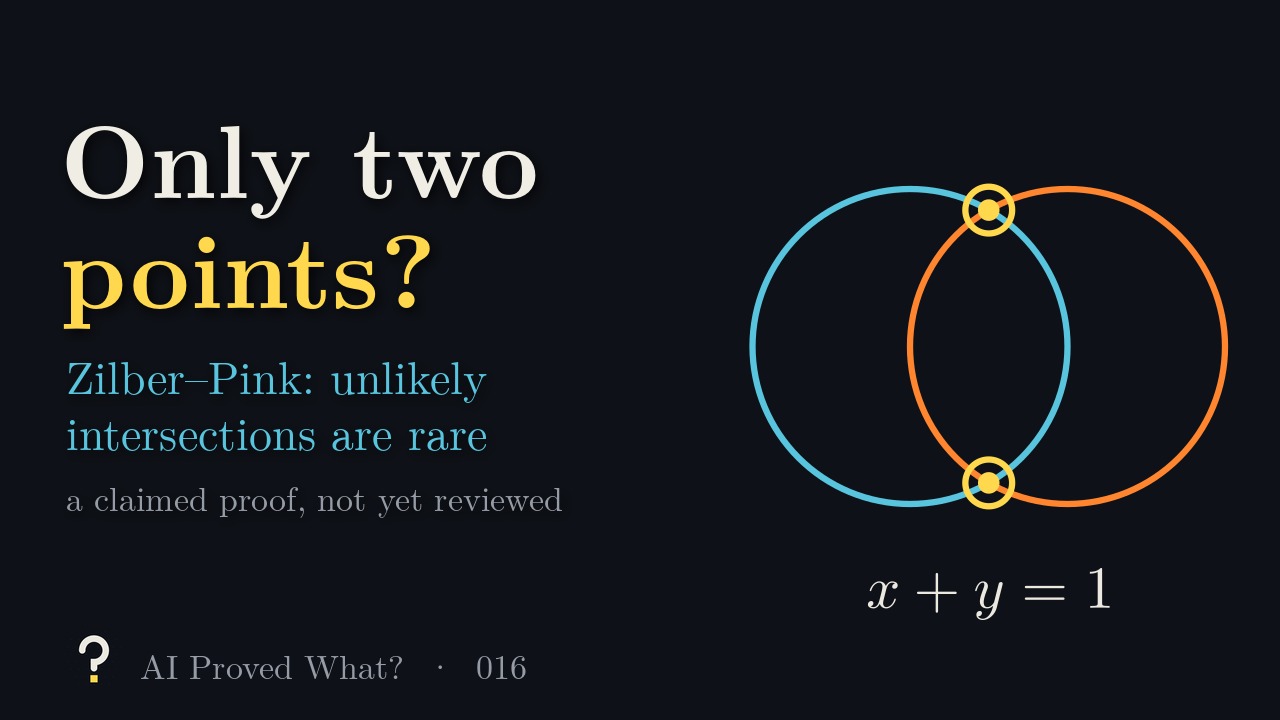
The curve x + y = 1 has exactly two points at which x and y are both roots of unity: x = e±iπ/3, y = e∓iπ/3. A dimension count explains why that is a coincidence: in the two-dimensional space of pairs, a curve and a point should not meet at all. When a subvariety meets a special subvariety (for groups, a subgroup shifted by a point of finite order) in larger dimension than the count predicts, the intersection is atypical. The Zilber–Pink conjecture says that any subvariety has only finitely many maximal atypical pieces.
Result 016 claims two major cases:
- Abelian varieties (44 pages). For every abelian variety over a number field and every irreducible subvariety X over Q̄, there are only finitely many maximal atypical subvarieties of X, measured inside the smallest torsion coset containing X. No hypothesis is placed on the abelian variety.
- Curves in the Siegel threefold A2, the moduli space of principally polarized abelian surfaces. A Hodge-generic curve over Q̄ (one in no proper special subvariety) meets the union of all special curves and special points in only finitely many points, with no boundary or reduction assumption. One paper for each kind of special curve: E × CM (15 pages), squares of elliptic curves without CM (65 pages, which also assembles the full theorem), and quaternion division multiplication (46 pages).
What it doesn’t claim
None of the papers gives an explicit bound on the number of atypical pieces. The A2 results are over the algebraic numbers (for abelian varieties, earlier work of Barroero and Dill extends the statement to ℂ). Zilber–Pink in general remains open: for higher-dimensional subvarieties of tori and semiabelian varieties, and for other Shimura varieties.
Where it stands
- Posted as preprints
- OpenAI, September 24, 2026; four papers
- Peer reviewed
- Not yet
- Checked in Lean
- No: OpenAI published no Lean proof for this result
Last checked October 19, 2026. The claims have not been withdrawn, and we found no public critique.
What was known
- Manin–Mumford, the case of points of finite order: Lang (1965, crediting Ihara, Serre and Tate) for curves in (ℂ×)2; Raynaud (1983) for abelian varieties.
- The unlikely-intersection framework: Bombieri, Masser and Zannier (1999), Zilber (2002), Pink (2005).
- Curves in abelian varieties: Habegger and Pila (2016); higher-dimensional subvarieties only under extra conditions.
- A2: André–Oort for special points, by Pila and Tsimerman (2013); Daw and Orr proved the curve case for curves with a particular kind of degeneration at the boundary.
How the proofs go
- Abelian varieties. The paper proves that points of X on special subvarieties of codimension greater than dim X are not Zariski dense, uniformly over all X, then applies the optimal-subvariety reduction of Barroero and Dill. The engine is height theory in the tradition of Vojta, Faltings and Rémond (in Dill’s form), kept uniform across several height scales, with a Bogomolov-type comparison of measures.
- Curves in A2. The Pila–Zannier strategy: infinitely many meeting points would bring large Galois orbits, giving too many rational points on a definable set, against the Pila–Wilkie counting theorem. The missing ingredient was a height bound. The elliptic-square and quaternionic papers get it from period equations at many primes at once, centered at a point inside the curve, which is why no boundary assumption is needed; the E × CM paper uses a period estimate of Gaudron and Rémond.
The example in the video
- If x and y = 1 − x both have absolute value 1, then x lies on the unit circles around 0 and around 1, so Re x = 1/2 and x = e±iπ/3. A short Python script confirms that among all roots of unity of order up to 300, exactly these two pairs satisfy x + y = 1.
Read the source
- The abelian Zilber–Pink conjecture (PDF), September 24, 2026 (44 pages).
- Elliptic squares and Zilber–Pink for curves in A2 (PDF), September 24, 2026 (65 pages).
- The E×CM component of Zilber–Pink for curves in A2 (PDF), September 24, 2026 (15 pages).
- Quaternionic division points on curves in the Siegel threefold (PDF), September 24, 2026 (46 pages).
- The collection’s catalog, where this is result 016.
The 4 papers in this result
OpenAI groups related papers, such as alternative proofs, supporting results and consequences, into one result; we label the first paper it lists the main paper and the others companions.
Transcript
Read the full script
0:00Two points
Here is a curve: x + y = 1, where x and y are complex numbers. Look for points on it where x and y are both roots of unity, numbers whose powers eventually return to 1. There are infinitely many roots of unity, so you might expect many such points. There are exactly two. Here’s why. A root of unity has size one. So x lies on the unit circle around 0, and since y is 1 − x, x also lies on the unit circle around 1. Those circles cross at just two points, e^(±iπ/3), and both are sixth roots of unity. A coincidence like this is called an unlikely intersection. Result 016 in OpenAI’s math repository claims two major cases of the central conjecture about them: the Zilber–Pink conjecture.
0:53Counting dimensions
Count dimensions. Inside a space of dimension n, a piece of dimension a and a piece of dimension b should meet in dimension a + b − n. Our curve and a single point made of roots of unity, in the two-dimensional space of pairs x, y, should meet in dimension −1: not at all. When they meet anyway, the intersection is atypical. The pieces we test against are special: subgroups, shifted by points of finite order. The Zilber–Pink conjecture, from Boris Zilber and Richard Pink, building on Bombieri, Masser and Zannier, says that any subvariety has only finitely many maximal atypical pieces. Its simplest case, for points of finite order, is the Manin–Mumford conjecture. For pairs of nonzero complex numbers, Serge Lang proved it in 1965, crediting Ihara, Serre and Tate, and Michel Raynaud proved it for abelian varieties in 1983.
1:52Abelian varieties
Our opening example lives among pairs of nonzero numbers. Abelian varieties are the higher-dimensional cousins of elliptic curves: complex tori with a group law, defined by polynomial equations. For curves inside them, Philipp Habegger and Jonathan Pila proved Zilber–Pink in 2016. For higher-dimensional subvarieties, it was known only under extra conditions. The first paper claims the full abelian case over the algebraic numbers: for every abelian variety and every subvariety, only finitely many maximal atypical subvarieties, measured inside the smallest special subvariety that contains it.
2:33The Siegel threefold
The other three papers work in a moduli space. Each point of the Siegel threefold, A₂, is a principally polarized abelian surface. Special points are surfaces with complex multiplication. Special curves are families with extra symmetry of three kinds: a product with a CM elliptic curve, the square of an elliptic curve, or multiplication by a quaternion division algebra. A curve and a special curve in a three-dimensional space should not meet. Zilber–Pink predicts that a Hodge-generic curve, one not trapped in a smaller special surface, meets all special curves together, every one of infinitely many, in only finitely many points. Pila and Tsimerman handled special points in 2013. Christopher Daw and Martin Orr proved the curve case for curves that degenerate at the boundary in a particular way. The three papers claim the full curve case over the algebraic numbers, with no boundary assumption: one paper for each kind of special curve.
3:33How the proofs go
For abelian varieties, the paper first proves that the atypical points are not dense, then uses a reduction of Barroero and Dill to get finiteness. The engine is height theory, in the tradition of Vojta and Faltings, kept uniform across several scales at once. For the Siegel threefold, the strategy is Pila and Zannier’s. If a curve met special curves infinitely often, the meeting points would bring many Galois conjugates with them, and those would give too many rational points on a definable set, contradicting the Pila–Wilkie counting theorem. The missing piece was a height bound, to make the Galois orbits large. Two of the papers get it from period equations at many primes at once, centered at a point inside the curve rather than at the boundary. The E×CM paper uses a different period estimate. Either way, no boundary assumption is needed.
4:29The caveats
The caveats. These are four preprints, 170 pages, not peer reviewed, and with no Lean proof. The Siegel results are over the algebraic numbers, and none of the papers gives an explicit bound on how many atypical pieces there are. Zilber–Pink in general, for tori in higher dimensions and for other Shimura varieties, remains open. x + y = 1 has just two points made of roots of unity. Coincidences like that are rare, in every abelian variety, and on every Hodge-generic curve in A₂. If the proofs hold.
Spot a mistake?
This episode simplifies on purpose, but it shouldn’t be wrong. If something is, open an issue on GitHub or leave a comment on YouTube. Corrections are noted here with a date.