Only so lucky
The irrationality exponent of π is 2, and the Flint–Hills series converges
Covers result 017 in OpenAI’s catalog: its one paper. See its connections to other results and the work it cites.
4:37. English captions available. The video loads from YouTube when you press play.
Chapters
The claim, in plain words
For any irrational number, infinitely many fractions p/q come within 1/q2 of it. The irrationality exponent μ(x) is the supremum of the powers ν for which infinitely many fractions come within 1/qν of x. Every irrational number has μ ≥ 2, and almost every real number has μ = 2 exactly.
Result 017 (23 pages) claims that μ(π) = 2: for every ν above 2 there is a threshold Q such that |π − p/q| ≥ q−ν for every integer p and every q ≥ Q. As a consequence, the Flint–Hills series Σ 1/(n3 sin2 n) converges. Alekseyev (2011) showed that convergence would force μ(π) ≤ 5/2, and Meiburg (2022) showed that μ(π) < 5/2 is enough; the paper also gives a direct proof.
What it doesn’t claim
The threshold Q is not computed, and the method can’t compute it, so there is no explicit bound. Exponent 2 still allows large terms in π’s continued fraction, as long as they grow more slowly than any power of the denominators. Whether those terms are bounded (equivalently, whether |π − p/q| ≥ c/q2 for some fixed c) is not claimed and remains open.
Where it stands
- Posted as a preprint
- OpenAI, dated September 24, 2026, released October 6; 23 pages
- Peer reviewed
- Not yet
- Checked in Lean
- Main theorem, by OpenAI (scope note); we have not run the check
Last checked October 19, 2026. The claim has not been withdrawn, and we found no public critique. OpenAI’s Lean proof (challenge statement) asserts both the threshold form and that the supremum equals 2; with its supporting library it runs to 869 files and about 95,000 lines, not counting Mathlib. It is not yet in OpenAI’s formalization catalog. The Flint–Hills convergence is proved in the same Lean files, but it is outside the official statement.
What was known
- Dirichlet: μ ≥ 2 for every irrational number. Khintchine: μ = 2 for almost every real number.
- Roth (1955): μ = 2 for every irrational algebraic number, such as the cube root of 2. π is not algebraic, so this says nothing about π.
- Upper bounds for μ(π): Mahler 42 (1953), Mignotte 20 (1974), Hata 8.016 (1993), Salikhov 7.606 (2008), Zeilberger and Zudilin 7.103 (2020).
How the proof goes
- Suppose not. If some ν above 2 allowed infinitely many fractions within 1/qν of π, pick several of them, one after another, with denominators far apart, an idea from Roth.
- Interpolation. Each fraction p/q gives an approximation 2ijp/q to the periods 2πij of the logarithm. The paper proves that polynomials in the exponential and logarithm can match any prescribed Taylor coefficients at several centers at once. So a square matrix of those coefficients has a nonzero determinant.
- Two bounds collide. Being a nonzero number with controlled denominators, the determinant can’t be too small. But because the fractions are so close to the true periods, an analytic estimate forces it to be smaller still. The contradiction leaves only finitely many such fractions.
The numbers in the video
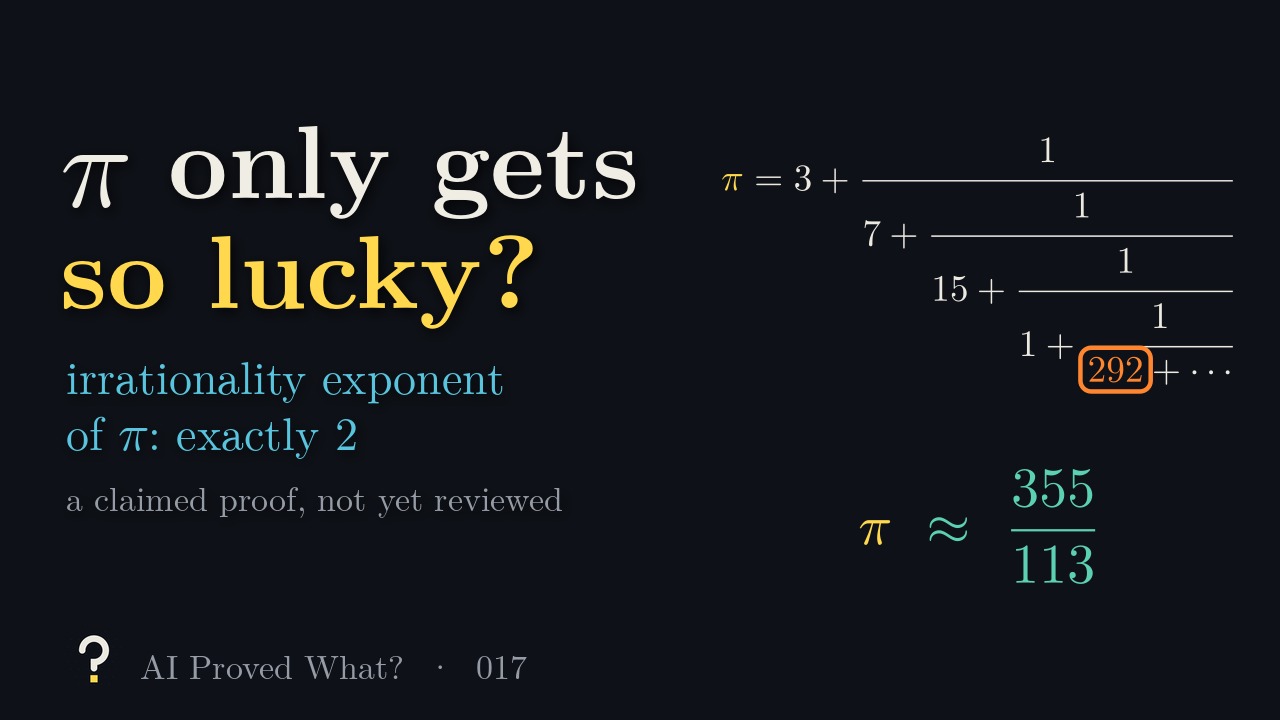
- π = [3; 7, 15, 1, 292, 1, 1, 1, 2, …]. The convergent 355/113 misses π by 2.667 × 10⁻⁷, which is 0.0034/q2, about 1/(294 q2), because the next term is 292. Its exponent, −log|π − p/q| / log q, is about 3.2.
- The Flint–Hills partial sum up to n = 106 is about 30.31. The single term at n = 355 is about 24.6.
- A short Python script reproduces these numbers.
Read the source
- The irrationality exponent of π is 2 (PDF), dated September 24, 2026 (23 pages).
- The Lean challenge statement and OpenAI’s scope note.
- The collection’s catalog, where this is result 017.
The paper
OpenAI groups related papers into one result; this one has a single paper.
Transcript
Read the full script
0:00How close can fractions get?
22/7 is a famous fraction for pi. 355/113 is far better: it misses by less than 3 ten-millionths. How close can fractions get to pi? There’s a natural yardstick. For any irrational number, infinitely many fractions p/q come within 1/q² of it. So the real question is whether pi allows much better than that, infinitely often. The irrationality exponent of pi measures exactly this, and mathematicians expected it to be 2. Result 017 in OpenAI’s math repository claims to prove it, and, as a consequence, that a notorious series converges.
0:43The exponent
Here is the definition. Pi’s irrationality exponent is the largest power ν, strictly the supremum, such that infinitely many fractions come within 1/q^ν. Every irrational number has exponent at least 2, and almost every real number has exactly 2. Exponent 2 allows occasional lucky fractions, but they can’t get too lucky. The continued fraction of pi shows where luck comes from: 3; 7, 15, 1, 292. That 292 is why 355/113 is so good. It beats the 1/q² yardstick about three hundred times over. The claim, exponent 2, says that for any power bigger than 2, past some point, no fraction comes that close. It still allows large terms in the continued fraction, as long as they grow more slowly than any power of the denominators.
1:37What was known
For irrational algebraic numbers, like the cube root of two, Klaus Roth proved exponent 2 in 1955, work recognized with a Fields Medal. But pi is not algebraic, so Roth’s theorem says nothing about it. For pi, the best results were upper bounds. Kurt Mahler proved 42 in 1953. Then 20, 8, 7.6, and in 2020 Doron Zeilberger and Wadim Zudilin reached 7.103. The claim jumps straight to 2, the lowest possible value.
2:12The Flint–Hills series
Now the series. Add up 1/(n³ sin² n), for n = 1, 2, 3, and so on. Whenever n is close to a multiple of pi, sin n is tiny, and the term spikes. At n = 355, a single term is about 24.6. Up to a million, the sum is about 30.3. But does it converge? A future spike could be huge, if pi had fractions that were too good. Max Alekseyev showed in 2011 that convergence would force pi’s exponent to be at most 5/2, and later work showed that below 5/2 is enough. The claim gives 2, so the series converges.
2:53How the proof goes
The proof is an interpolation determinant argument, with one idea from Roth. Suppose pi had infinitely many fractions better than 1/q^ν, for some ν above 2. Pick several of them, with denominators spread far apart, as Roth did. Each fraction gives an approximation to 2πi, the period of the logarithm. The paper proves that polynomials in the exponential and logarithm can match any prescribed values for many Taylor coefficients at once. So a square matrix of those coefficients has a nonzero determinant. Being nonzero, with controlled denominators, it can’t be too small. But because the fractions are so close to the true periods, an analytic estimate forces the same determinant to be smaller still. The two estimates collide, so only finitely many such fractions exist.
3:46Lean, and the caveats
OpenAI also published a Lean proof of the main theorem: for every ν above 2, some threshold Q exists past which every fraction misses pi by at least 1/q^ν, and the exponent equals 2. It runs to about 95,000 lines. It isn’t in OpenAI’s formalization catalog yet, and we haven’t run the check. The Flint–Hills consequence is proved in the same Lean files, but it isn’t part of the official statement. This is a preprint, not peer reviewed. The threshold Q is not computed, and the method can’t compute it, so the result gives no explicit bound. And it doesn’t say whether pi’s continued fraction has bounded terms. That remains open. 355/113 is lucky. Pi only gets so lucky. If the proof holds.
Spot a mistake?
This episode simplifies on purpose, but it shouldn’t be wrong. If something is, open an issue on GitHub or leave a comment on YouTube. Corrections are noted here with a date.