A hidden clock
The Margulis–Platonov conjecture over every global field
Covers result 018 in OpenAI’s catalog: all 2 papers. See its connections to other results and the work it cites.
6:57. English captions available. The video loads from YouTube when you press play.
Chapters
The claim, in plain words
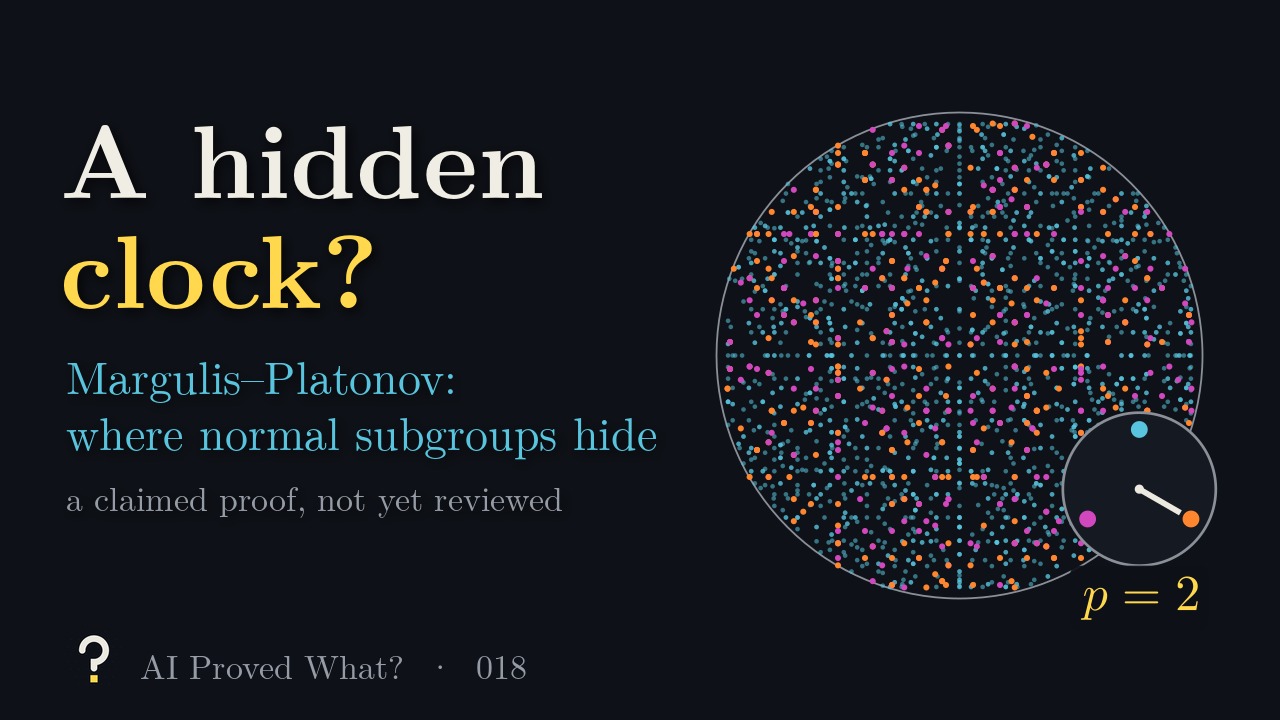
The quaternions q = a + bi + cj + dk with rational coordinates and a2 + b2 + c2 + d2 = 1 form a group under multiplication. It has a hidden three-hour clock. Write q = (A + Bi + Cj + Dk)/m in lowest terms. If m is odd, q has color 0. If m is even, it has color 1 when ABCD ≡ 3 (mod 4) and color 2 when ABCD ≡ 1 (mod 4). Colors add mod 3, so the color-0 quaternions form a normal subgroup of index 3. The clock comes from the prime 2: Hamilton’s quaternions become 2 × 2 matrices over the p-adic numbers for every odd p, but stay a division algebra over the 2-adic numbers, where the length-one quaternions form a compact group. Reducing that group at the prime 2 lands in the field 𝔽4, and its three nonzero elements are the clock.
The Margulis–Platonov conjecture says this is the only source of normal subgroups. Let G be an absolutely almost simple, simply connected algebraic group over a global field k, and let A be the finite set of nonarchimedean places v where G is anisotropic (where G(kv) is compact). Then every noncentral normal subgroup N of G(k), taken as an abstract group with no topology, is the preimage of an open normal subgroup of ∏v∈A G(kv). If A is empty, G(k) is simple modulo its center.
Result 018 claims the conjecture over every global field, in two preprints: number fields (78 pages) and function fields (81 pages, every characteristic, including 2).
What it doesn’t claim
The new work covers the cases that were still open; the earlier cases (isotropic groups, most anisotropic types, all division algebras) were already settled, and the papers use those results. Over number fields, the conjecture makes a recent conditional theorem of Andrei Rapinchuk unconditional, but only for the congruence subgroup property with a set of primes S of positive density. It does not address Serre’s congruence subgroup conjecture for finite S.
Where it stands
- Posted as preprints
- OpenAI, September 23 and October 5, 2026; two papers, 159 pages
- Peer reviewed
- Not yet
- Checked in Lean
- No: OpenAI published no Lean proof for this result
Last checked October 19, 2026. The claims have not been withdrawn, and we found no public critique. The proofs rely on many deep theorems, including the classification of finite simple groups, and the function-field paper builds explicitly on the number-field one.
What was known
- The question goes back to Kneser’s question about normal subgroups of quaternion norm-one groups and Platonov’s local-to-global simplicity proposal. Margulis formulated the precise statement in 1979 and proved that noncentral normal subgroups have finite index.
- Isotropic groups: simple modulo the center over global fields, by the Kneser–Tits problem (complete by 2009, Gille’s survey) and Tits’s simplicity theorem.
- Anisotropic groups of types B, C, D (not triality), E7, E8, F4 and G2: the 1980s.
- Inner type A, the norm-one groups of division algebras: quaternions by Margulis (1980); a reduction by Rapinchuk and Potapchik (1996); completed by Segev (1999) and Segev–Seitz (2002), using the classification of finite simple groups; Rapinchuk–Segev–Seitz (2002) proved that every finite quotient of the multiplicative group of a division algebra is solvable.
- Still open: anisotropic outer type A (unitary groups), triality forms of D4 and forms of E6 over number fields; outer type A over function fields, where by Harder’s theorem only type A can be anisotropic.
How the proofs go
- A finite gap. A noncentral normal subgroup has finite index, so it contains the subgroup R generated by all e-th powers for some e. The compact local groups predict a subgroup V0 ⊇ R (the preimage of the closure of R), and V0/R is finite. The goal is V0 = R.
- Abelian or simple. For unitary groups of odd-degree division algebras, a nontrivial gap would give either a finite abelian character or a map onto a nonabelian finite simple group. The abelian case is excluded by an algebraic difference identity and the known inner-type-A theorem.
- Colors and recurrence. In the nonabelian case, each rational element is colored by its image in the finite simple group. The paper builds a translation-invariant random pattern of colors with uniform marginals (from Langlands’s Eisenstein-series theory and Howe–Moore mixing), and Furstenberg–Katznelson recurrence forces a rigid repetition that a lemma about finite simple groups, checked family by family with the classification, rules out. Over function fields, finite Fourier analysis replaces Furstenberg–Katznelson.
- The rest. Unitary groups of every degree follow by induction. Over number fields, triality D4 is handled through products of two involutions inside A2 subgroups, and E6 is reduced to D4 and type A pieces by a torsor argument.
The example in the video
- (1 + i + j + k)/2 has color 2, (1 + i + j − k)/2 has color 1, and their product is j, with color 0.
- A short Python script checks that colors add mod 3 on 200,000 random pairs of rational unit quaternions, that the 24 Hurwitz units split 8, 8, 8 by color, and that each color comes arbitrarily close to every point of the sphere.
Read the source
- The Margulis–Platonov conjecture over number fields (PDF), September 23, 2026 (78 pages).
- The Margulis–Platonov conjecture over global function fields (PDF), October 5, 2026 (81 pages).
- Prasad and Rapinchuk, Developments on the congruence subgroup problem, §3.4–3.5, for the earlier status.
- The collection’s catalog, where this is result 018.
The 2 papers in this result
OpenAI groups related papers, such as alternative proofs, supporting results and consequences, into one result; we label the first paper it lists the main paper and the others companions.
Transcript
Read the full script
0:00A hidden clock
Take quaternions, numbers like a + bi + cj + dk, with rational coordinates and length one: a² + b² + c² + d² = 1. Multiply two of them, and you get another. They form a group. Here is a strange rule. Write the quaternion over a common denominator, in lowest terms. If the denominator is odd, give it color 0. If it’s even, multiply the four numerators. A remainder of 3, mod 4, gives color 1, and a remainder of 1 gives color 2. Now multiply. (1 + i + j + k)/2 has color 2. (1 + i + j − k)/2 has color 1. Their product is j, with color 0. 2 + 1 = 0, mod 3. That’s no accident: colors always add, mod 3. So the color-0 quaternions form a normal subgroup. The group hides a clock with three hours. Where does the clock come from? From the prime 2. The Margulis–Platonov conjecture says that clocks like this can only come from a few special primes. Result 018 in OpenAI’s math repository claims to prove it, over every global field.
1:13Where clocks come from
First, what is a normal subgroup? It’s a subgroup that conjugation can’t move, exactly what a homomorphism sends to the identity, like the color-0 quaternions. A group with no normal subgroups, except the obvious ones, is called simple. Many groups of rational matrices are simple, up to their centers. Take 2-by-2 rational matrices with determinant 1, modulo ±1. That group contains unipotent elements, like (1 1; 0 1), and they generate everything. Groups with elements like these are called isotropic, and for them, simplicity over global fields was fully proved by 2009. Our quaternion group has no unipotent elements. It’s anisotropic. So look at it one prime at a time, over the p-adic numbers. At every odd prime, Hamilton’s quaternions become 2-by-2 matrices, and the group is isotropic there. But at the prime 2, they stay a division algebra, and the length-one quaternions form a compact group. Compact p-adic groups have many finite quotients. Reducing them at the prime 2 lands in a field with four elements. Its three nonzero elements are the clock. In the real picture, the group is a three-dimensional sphere. It’s compact too, but connected, and the three colors are mixed together everywhere on it. So geometry can’t see the clock. Only the prime 2 can. The conjecture says this is the only source. Take an absolutely almost simple, simply connected group over a global field, such as the rationals. It is compact at only finitely many primes. Every normal subgroup that isn’t central is pulled back from an open normal subgroup at those primes. The subgroup can be completely arbitrary, with no topology assumed, and it is still detected there. If there are no such primes, the group is simple, up to its center.
3:07What was known
The question goes back to Martin Kneser, who asked about normal subgroups of these quaternion groups. Vladimir Platonov proposed a general local-to-global version, and Gregory Margulis formulated the precise statement in 1979. He also showed that such normal subgroups have finite index. Then the cases fell, one family at a time. The isotropic groups, finished by 2009. Most anisotropic types, in the 1980s. Quaternions, by Margulis in 1980. Then division algebras in general, completed in 2002 by Yoav Segev and Gary Seitz, building on a reduction by Rapinchuk and Potapchik. That step needed the classification of finite simple groups. Three families remained over number fields: unitary groups of division algebras, called outer type A; triality forms of D₄; and forms of E₆. Over function fields, only the unitary family of the three can be anisotropic, and it was open in every characteristic, including 2.
4:13The claim
Two preprints claim to finish the job. The first, 78 pages, dated September 23, covers number fields. The second, 81 pages, dated October 5, covers function fields, including characteristic 2. Together, they claim the Margulis–Platonov conjecture over every global field. There’s a consequence over number fields. A recent theorem of Andrei Rapinchuk, which assumed the conjecture, would now hold unconditionally. When the primes allowed in the denominators avoid the special primes and have positive density, in a precise sense, every finite-index normal subgroup of these arithmetic groups contains a congruence subgroup.
4:56How the proofs go
The proof starts from what’s already known. A noncentral normal subgroup has finite index, so it contains every product of e-th powers, for some exponent e. The compact groups at the special primes predict what that power subgroup should be. Any gap between the two is a finite group, and the job is to show it’s trivial. For unitary groups of odd-degree division algebras, a nontrivial gap would produce one of two things: an abelian character, like a clock, or a map onto a nonabelian finite simple group. The abelian case is ruled out with an algebraic identity and the known inner type A case. For the nonabelian case, color each rational element by its image in the finite simple group. The paper builds a random, translation-invariant pattern of colors, in which every color is equally likely, using Eisenstein series and mixing in p-adic groups. A recurrence theorem of Furstenberg and Katznelson then forces colors to repeat in a rigid way. A lemma about finite simple groups, checked family by family with the classification, says that can’t happen. Over function fields, that recurrence argument breaks down, so the second paper uses finite Fourier analysis instead. Unitary groups of every degree then follow by induction. Back over number fields, triality D₄ is handled through products of two involutions, and E₆ is reduced to D₄ and type A pieces.
6:23Where it stands
There is no Lean proof for this result. These are preprints, not peer reviewed, 159 pages in all. They rely on many deep theorems, including the classification of finite simple groups, and the second paper builds on the first. We found no public critique, and nothing has been withdrawn. The rational quaternions hide a clock with three hours, set by the prime 2. If the proofs hold, every clock of this kind, in every such group, is set by a prime like that.
Spot a mistake?
This episode simplifies on purpose, but it shouldn’t be wrong. If something is, open an issue on GitHub or leave a comment on YouTube. Corrections are noted here with a date.