Points from symmetries
The local p-adic section conjecture, and the section conjecture for modular curves
Covers result 019 in OpenAI’s catalog: all 2 papers. See its connections to other results and the work it cites.
5:51. English captions available. The video loads from YouTube when you press play.
Chapters
The claim, in plain words
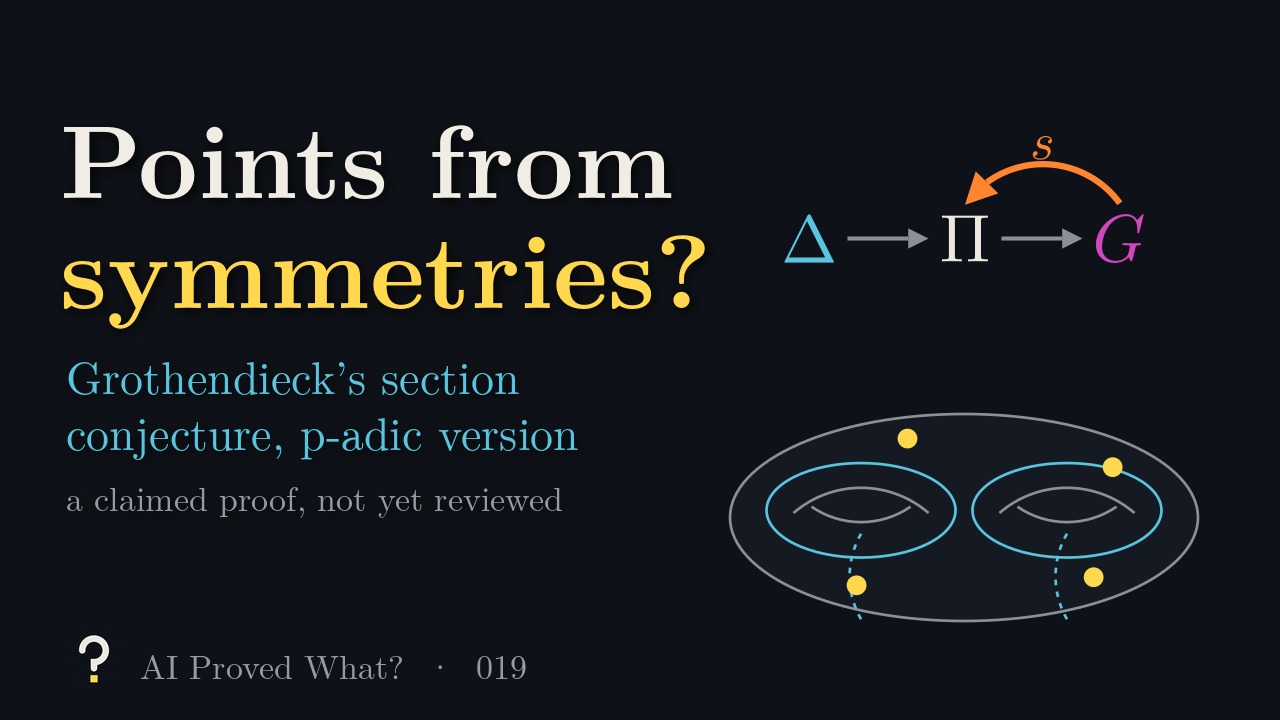
A smooth proper curve X over a field k has two fundamental groups. The geometric one, Δ, is made of loops on the curve over an algebraic closure of k. The arithmetic one, Π, also sees the Galois group G of k, the symmetries of its algebraic numbers. Together they form an exact sequence 1 → Δ → Π → G → 1. A section is a homomorphism s: G → Π that projects back to the identity on G. Every rational point of X gives one, because maps induce maps on fundamental groups. Grothendieck’s section conjecture, from his letter to Faltings of June 27, 1983, says that for curves of genus at least 2 these are all the sections, and different points give different sections, counted up to conjugation by Δ.
Result 019 (24 pages) claims the local version: for every prime p, every finite extension k of ℚp, and every smooth proper geometrically connected curve of genus at least 2 over k, the map from k-points to sections up to conjugation is a bijection. Combined with descent results of Stoll, Harari and Stix, this gives the global section conjecture over a number field whenever the curve’s finite descent condition holds. That includes the modular curves X0(N) and X1(N) of genus at least 2 over ℚ: infinitely many curves, starting with X0(22) and X1(13).
What it doesn’t claim
The global section conjecture remains open in general. The local theorem settles it over a number field only when the finite descent condition holds, and that condition is itself a conjecture (of Stoll) for most curves. A 7-page companion paper constructs étale covers with a prescribed sheet over the exterior of finitely many small disks; the main proof does not use it.
Where it stands
- Posted as preprints
- OpenAI, October 6, 2026 (24 pages), and a companion, September 24, 2026 (7 pages)
- Peer reviewed
- Not yet
- Checked in Lean
- No: OpenAI published no Lean proof for this result
Last checked October 19, 2026. The claims have not been withdrawn, and we found no public critique. The proof relies on many recent results, including the resolution of nonsingularities of Mochizuki and Tsujimura, which the paper cites as a 2024 preprint.
What was known
- Faltings (1983): a curve of genus at least 2 over a number field has finitely many rational points. The proof doesn’t locate them.
- That different points give different sections was already known; the hard part is that every section comes from a point.
- Koenigsmann (2005): the birational version over p-adic fields, using the Galois group of the curve’s function field. Pop (2010) gave a sharper birational criterion.
- Pop and Stix (2017): every section singles out a valuation extending the p-adic one.
- Over the real numbers, the analogue was proved by Stix.
How the proof goes
- Approximation. Let K̃ be the field generated by the function fields of all étale covers of the curve. The main technical theorem says that its completion, for any p-adic absolute value, already contains every finite separable extension of the function field, branched or not.
- From there to points. A section localized at such an absolute value then lifts to the Galois group of the whole function field, where Koenigsmann’s theorem places it at a rational point. A valuation that isn’t a point would leave one field with two incompatible henselian valuations, which a classical principle of F. K. Schmidt rules out. Rank-two valuations are handled with Pop and Stix’s analysis.
- Patching. Near a branch point a cover looks like t = ze. If another cover supplies an e-th root of t on the whole inverse image of a ring around the branch point, the cover splits there; cutting out the disk and gluing in trivial sheets gives an étale cover lying over the original outside the disk.
- Two stages of roots. First, roots of a fixed odd prime order ℓ ≠ p, from stable reduction, the lifting theorem of Amini–Baker–Brugallé–Rabinoff and the resolution of nonsingularities of Mochizuki–Tsujimura. Then roots of every order, from cyclic covers of the projective line whose skeleton has two vertices joined by ℓ edges, the p-adic uniformization of their Jacobians, and the p-adic logarithm and exponential.
The numbers in the video
- X0(N) has genus at least 2 for every N except 1–21, 24, 25, 27, 32, 36 and 49; X1(N) for N = 13 and every N ≥ 16. A short Python script checks these with the standard genus formulas.
- 1 + 52 = 26 is a fifth power in the 5-adic integers (computed as exp(log(26)/5)), while 6 is not: units near enough to 1 have m-th roots even when p divides m.
Read the source
- The p-adic section conjecture (PDF), October 6, 2026 (24 pages).
- Étale covers with a prescribed exterior sheet (PDF), September 24, 2026 (7 pages).
- The collection’s catalog, where this is result 019.
The 2 papers in this result
OpenAI groups related papers, such as alternative proofs, supporting results and consequences, into one result; we label the first paper it lists the main paper and the others companions.
- Étale covers with a prescribed exterior sheet main paper
- The p-adic section conjecture companion
Transcript
Read the full script
0:00Points from symmetries
Take a curve of genus 2. Over the complex numbers, it’s a surface with two holes. In 1983, Gerd Faltings proved that such a curve has only finitely many rational points. But his proof doesn’t tell you where they are. That same year, Alexander Grothendieck wrote to Faltings with a radical idea. The points might be recorded entirely in group theory: in the curve’s fundamental group, its loops, together with the symmetries of the algebraic numbers. This is the section conjecture. Result 019 in OpenAI’s math repository claims to prove its p-adic version, and, with known descent results, the full conjecture for infinitely many modular curves over the rationals.
0:46Sections
Two groups meet here. Delta is the geometric fundamental group: loops on the curve, seen over the algebraic numbers. G is the Galois group: the symmetries of the algebraic numbers. Together they form a bigger group, Pi, the arithmetic fundamental group, which maps onto G, with Delta as its kernel. A section is a way to lift G back into Pi: a homomorphism s from G to Pi, so that following s by the projection gives back every element of G. Each rational point gives one. A rational point is a map from a single point into the curve, and maps induce maps on fundamental groups. Grothendieck conjectured the converse, for curves of genus at least 2. Every section comes from a rational point, and different points give different sections, counted up to conjugation by Delta. Rational points would become pure group theory. A picture helps. The Galois symmetries act on the curve, and the rational points are exactly the points they fix. A section is a weaker thing, a point that’s fixed only up to deformation. The conjecture says that on these curves, nothing is fixed up to deformation without being truly fixed.
1:59The p-adic version
There’s a local version. Replace the rationals by the p-adic numbers, or a finite extension of them. Now a curve can have infinitely many points, or none at all, but the question still makes sense: is the map from points to sections a bijection? Different points giving different sections is the easier half. The hard half is showing that every section comes from a point. In 2005, Jochen Koenigsmann proved a birational version, using the Galois group of the curve’s function field. In 2017, Florian Pop and Jakob Stix showed that every section singles out a p-adic valuation on the curve. In the p-adic world, a curve looks like a branching, tree-like space. Rational points sit at tips of its branches, and other valuations fill in the rest. Pop and Stix placed every section somewhere in this space. The missing step was to show it always sits at a rational point.
2:55The claim
The main preprint, 24 pages, dated October 6, claims exactly that. For every curve of genus at least 2, over every finite extension of the p-adic numbers, points and sections match one to one. A 7-page companion, dated September 24, not used in the main proof, constructs étale covers with a prescribed sheet outside a few small disks. Then the global consequence. Combined with earlier descent results of Michael Stoll, David Harari and Jakob Stix, the section conjecture follows over a number field whenever a finite descent condition holds. That includes the modular curves X₀(N) and X₁(N) of genus at least 2 over the rationals. There are infinitely many, starting with X₀(22), and X₁(13).
3:44How the proof goes
The heart of the proof is a statement about approximation. Build the field of all étale covers of the curve, the covers with no branch points. Complete it at any p-adic absolute value. The claim is that this completion already contains every finite extension of the curve’s function field, branched or not. That’s enough. A section at such a valuation then lifts to the Galois group of the whole function field, where Koenigsmann’s theorem pins it to a rational point. A valuation that isn’t a point would leave one field with two incompatible valuations, and a classical principle of Friedrich Karl Schmidt rules that out. Why can étale covers approximate branched ones? Near a branch point, a branched cover looks like t = zᵉ. If some other cover supplies an e-th root of t on the whole ring around the branch point, the cover splits there into separate sheets. Cut out the small disk, glue in flat sheets, and you get an étale cover that, outside the disk, lies over the original. The roots come in two stages. First, roots of a fixed odd prime order ℓ, other than p, from the curve’s stable reduction, using a lifting theorem from tropical geometry and the resolution of nonsingularities of Mochizuki and Tsujimura. Then roots of every order, from covers of the projective line whose skeleton has two vertices joined by ℓ edges, the p-adic uniformization of their Jacobians, and the p-adic logarithm.
5:14Where it stands
There’s no Lean proof for this result. These are preprints, not peer reviewed: 24 pages and 7. The proof leans on many recent results, including the resolution of nonsingularities of Mochizuki and Tsujimura, which the paper cites as a 2024 preprint. And the global conjecture stays open in general: the descent condition is itself only conjectured for most curves. Grothendieck guessed that symmetries alone could find the points. If the proof holds, over the p-adic numbers, they always do.
Spot a mistake?
This episode simplifies on purpose, but it shouldn’t be wrong. If something is, open an issue on GitHub or leave a comment on YouTube. Corrections are noted here with a date.