Squarefree, 3 in 4
Squarefree values of quartics, and power-free values of polynomials in every degree from 4
Covers result 020 in OpenAI’s catalog: its one paper. See its connections to other results and the work it cites.
4:54. English captions available. The video loads from YouTube when you press play.
Chapters
The claim, in plain words
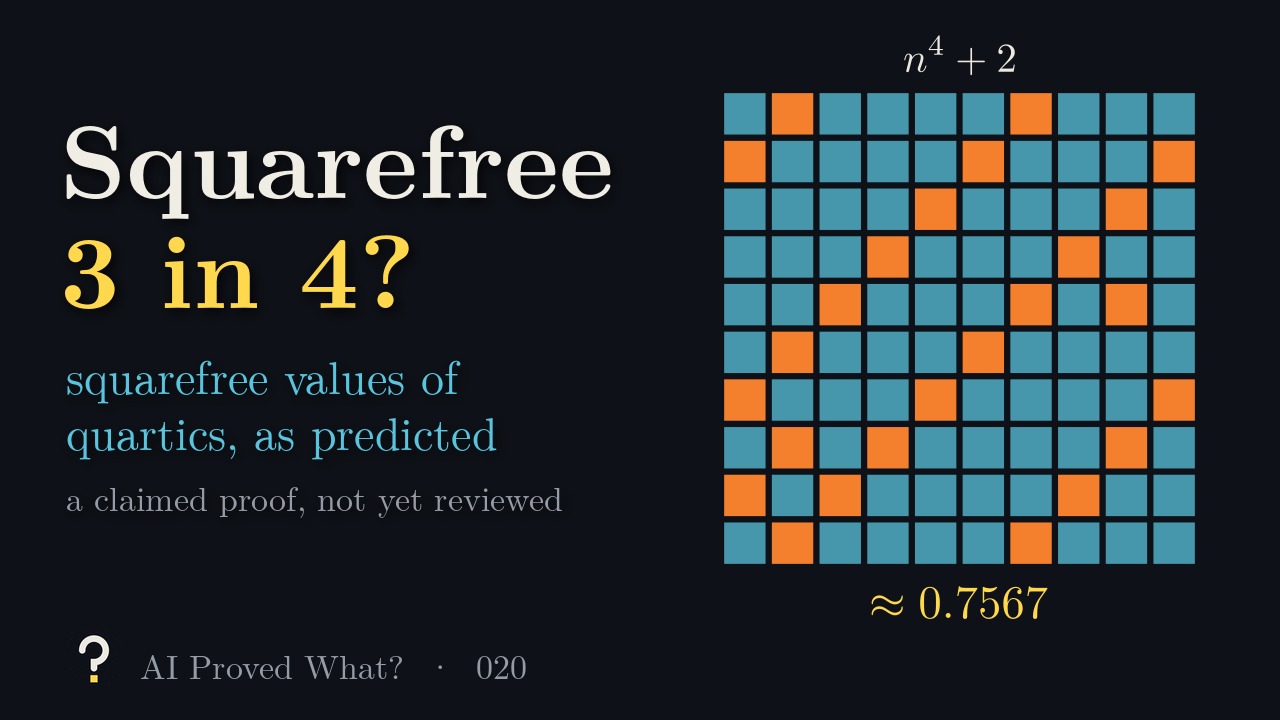
An integer is squarefree if no prime divides it twice. The values of n4 + 2 are 3, 18, 83, 258, 627, …; 18 = 2·32 is not squarefree, the others are. One prime at a time, p2 divides f(n) for ρ(p2) of the p2 residue classes of n (for n4 + 2 and p = 3, the classes 2 and 7 mod 9). If the primes acted independently, the fraction of squarefree values would be cf = ∏p (1 − ρ(p2)/p2), which is 0.7567 for n4 + 2. The squarefree-values conjecture says this is right for every irreducible integer polynomial with no fixed prime-square divisor.
Result 020 (55 pages) claims it for quartics, and more generally: for every irreducible integer polynomial f of degree d with 4 ≤ d ≤ 8, with no prime p such that pk divides all its values, where k = d − 2, the number of n ≤ X with f(n) free of k-th powers is cf·X + o(X), with cf = ∏p (1 − ρf(pk)/pk) > 0. Combined with Browning’s theorem for degree 9 and up, this covers every degree from 4 up.
What it doesn’t claim
The theorem gives the density with no stated rate of convergence, and no uniformity is claimed as the polynomial varies. It concerns one fixed polynomial at a time, at positive integers. Two other recent preprints claim n4 + 1 (one of them also n4 + 2); this paper uses neither.
Where it stands
- Posted as a preprint
- OpenAI, September 24, 2026; 55 pages
- Peer reviewed
- Not yet
- Checked in Lean
- Every degree from 4 up, by OpenAI (scope note); we have not run the check
Last checked October 19, 2026. The claim has not been withdrawn, and we found no public critique. OpenAI’s Lean proof (challenge statement) covers every degree from 4 up, including a separate large-prime bound for degree 9 and up; it is 63 files and about 23,000 lines, not counting Mathlib, and it is listed in OpenAI’s formalization catalog, whose review status is “unchecked”.
What was known
- Ricci (1933): the asymptotic for exponents at least d. Hooley (1967): exponent d − 1, which includes squarefree values of cubics.
- Erdős (1953) wrote that he could not even prove that n4 + 2 is squarefree infinitely often.
- Exponent d − 2: Nair (1976) for degree 24 and up, Heath-Brown (2006) for degree 10 and up, Browning (2011) for degree 9 and up. Heath-Brown (2013) handled binomials xd + c at this exponent for d ≥ 6.
- Granville (1998): the abc conjecture would give the predicted squarefree density for every separable polynomial.
How the proof goes
- The large-prime estimate. Small primes act independently by the Chinese remainder theorem, and primes up to X are rare enough. Everything reduces to showing that, among X < n ≤ 2X, at most X1−δ inputs have pk | f(n) for some prime p > X.
- The surface. Writing f(n) = ypk puts each bad input on the surface f(x) = yzk. For very large p, the determinant method (Bombieri–Pila, Heath-Brown, Salberger) traps the integer points in a box on relatively few auxiliary curves.
- Number-field factorization. For the harder range, with θ a root of f, ideal factorization gives αkβ = μ(n − θ) with α, β of balanced size. Their coordinates fill two boxes, cut into small paired boxes; in each pair a determinant gives a polynomial equation, and lattice reduction plus a uniform counting theorem with adaptive auxiliary primes finish the count.
- Quartics. Surfaces and curves need sharper geometry. In the limiting curve case, a polynomial of degree 5 with four prescribed critical values, only finitely many polynomials occur up to a change of variable, so their values form one set of size O(X1/5), removed once.
The numbers in the video
- For n ≤ 30,000, n4 + 2 is squarefree 22,699 times (75.66%), against the Euler product 0.75668; n4 + 1 is squarefree 29,427 times (98.09%), against 0.98082.
- 974 + 2 = 88,529,283 = 32·1792·307: a prime larger than n whose square divides the value.
- A short Python script reproduces these counts exactly (sieving by primes up to a million and checking the remaining cofactor).
Read the source
- Squarefree values of quartics and power-free values of polynomials (PDF), September 24, 2026 (55 pages).
- The Lean challenge statement and OpenAI’s scope note.
- The collection’s catalog, where this is result 020.
The paper
OpenAI groups related papers into one result; this one has a single paper.
Transcript
Read the full script
0:00Squarefree values
Plug n = 1, 2, 3, and so on into n⁴ + 2. You get 3, 18, 83, 258, 627. 18 is 2 × 3²: a square divides it. The others are squarefree: no prime appears twice. Up to 30,000, about 75.7 percent of these values are squarefree. That matches, almost exactly, a number you can predict from the primes alone. In 1953, Paul Erdős wrote that he couldn’t even prove n⁴ + 2 is squarefree infinitely often. Result 020 in OpenAI’s math repository claims that every quartic like it has squarefree values with exactly the predicted density, and more.
0:46The prediction
Where does the prediction come from? Take one prime at a time. 3² divides n⁴ + 2 exactly when n leaves a remainder of 2 or 7 when divided by 9. That’s 2 classes out of 9, so a fraction 7/9 survives. Do the same for every prime, and multiply the surviving fractions. For n⁴ + 2, the product is about 0.7567. The conjecture says this is right for any irreducible polynomial, as long as no fixed prime square divides all its values. Small primes are easy: finitely many of them act independently, by the Chinese remainder theorem. The trouble is primes larger than n itself. For a quartic, a prime as large as n² could have its square divide the value, and the sieve has nothing to say about it. For example, 97⁴ + 2 is divisible by 179².
1:43What was known
In degree d, the next exponent to reach is d − 2: for a quartic, that’s squares. Exponents of d or more were handled by Giovanni Ricci in 1933. Christopher Hooley reached d − 1 in 1967, which settles squarefree values of cubics. The exponent d − 2 was the frontier. Mohan Nair reached it in degree 24 and up, Roger Heath-Brown in degree 10 and up, and Tim Browning, in 2011, in degree 9 and up. Degrees 4 through 8 stayed open in general. Assuming the abc conjecture, Andrew Granville proved everything in 1998.
2:23The claim
The preprint, 55 pages, dated September 24, claims degrees 4 through 8. For every irreducible integer polynomial of degree d in that range, with no fixed prime power of exponent d − 2 dividing all its values, the values free of such powers have exactly the predicted density. For quartics, that’s squarefree values. With Browning’s theorem, every degree from 4 up is covered. OpenAI also published a Lean proof of the statement for every degree from 4 up: 63 files, about 23,000 lines, not counting Mathlib. It’s listed in OpenAI’s formalization catalog, and we haven’t run the check.
3:05How the proof goes
Everything reduces to one estimate. Write k for d − 2. Among the inputs n between X and 2X, at most X^(1−δ) have a value divisible by pᵏ, for some prime p larger than X. That’s a vanishing fraction. Write f(n) = y·pᵏ. That puts each bad input on a surface. When p is very large, the determinant method handles the surface directly: it traps all the integer points in a box on relatively few auxiliary curves. For the harder middle range, the paper factors in the number field of a root θ: αᵏβ is a fixed multiple of n − θ. The coordinates of α and β fill two boxes. Cut into small paired boxes, a determinant forces the points in each pair onto a polynomial equation, and a uniform counting theorem finishes the count. Quartics need extra geometry, on surfaces and curves where the counts are tight. The worst case is a polynomial of degree 5 with four prescribed critical values. Up to a change of variable, only finitely many such polynomials exist, so their values form one small set, at most about X^(1/5), which is removed once.
4:23Where it stands
This is a preprint, not peer reviewed. The result gives the density, with no stated rate of convergence, and no uniformity is claimed as the polynomial varies. Two other recent preprints claim n⁴ + 1, one of them also n⁴ + 2; this paper uses neither. 3, 18, 83. About three in four are squarefree, just as the primes predict. If the proof holds, that’s now a theorem.
Spot a mistake?
This episode simplifies on purpose, but it shouldn’t be wrong. If something is, open an issue on GitHub or leave a comment on YouTube. Corrections are noted here with a date.