Any shift will do?
The weak inhomogeneous Duffin–Schaeffer conjecture
Covers result 022 in OpenAI’s catalog: its one paper. See its connections to other results and the work it cites.
4:33. English captions available. The video loads from YouTube when you press play.
Chapters
The claim, in plain words
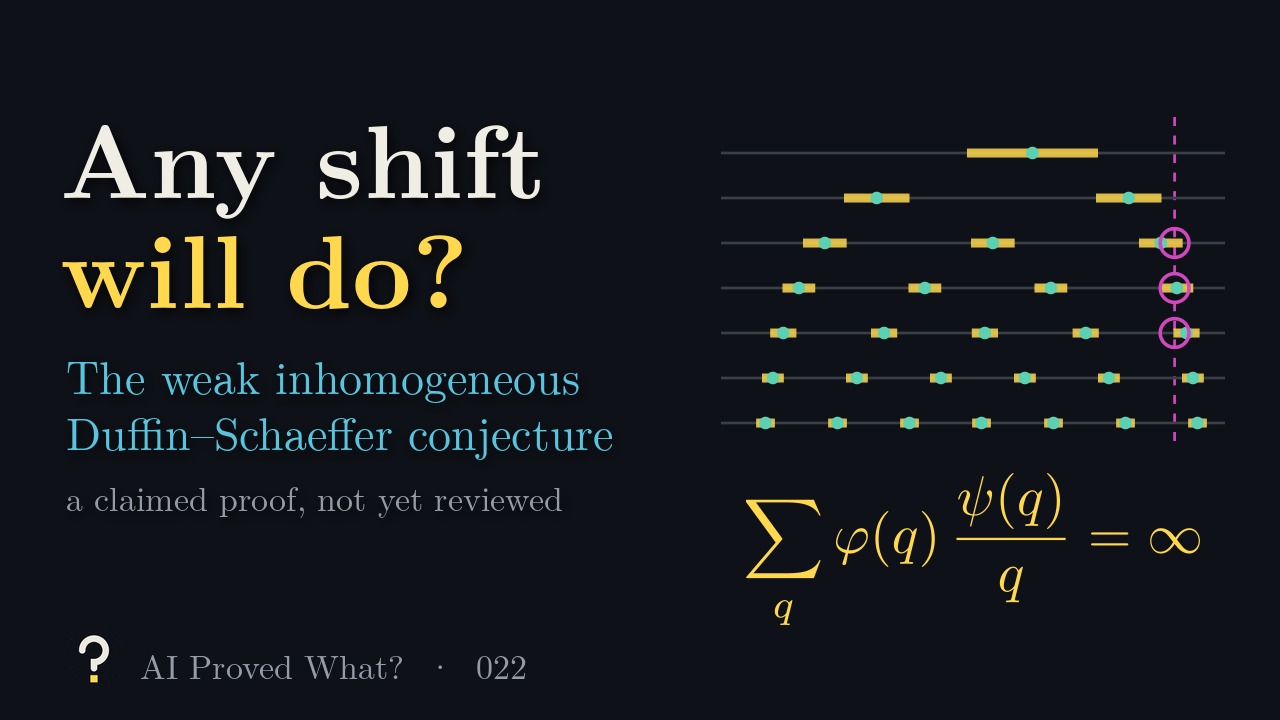
Fix a real number γ, the shift, and a sequence of tolerances ψ(1), ψ(2), … ≥ 0. For each denominator q, put a small interval of half-width ψ(q)/q around every point (a + γ)/q, for every integer a. Which numbers x land in infinitely many of these intervals? Equivalently, when is ‖qx − γ‖ < ψ(q) for infinitely many q, where ‖·‖ is the distance to the nearest integer?
If the total Σ ψ(q) is finite, almost no x does: that is the easy half. Result 022 (87 pages) claims the hard half in a weighted form, for every shift: if Σ φ(q)ψ(q)/q diverges, where φ is Euler’s totient, then almost every x satisfies ‖qx − γ‖ < ψ(q) for infinitely many q. No monotonicity of ψ is assumed, no condition is put on γ, and the numerator a is unrestricted (that is the “weak” in the name). A corollary gives the same kind of criterion for Hausdorff measures, through the mass transference principle of Beresnevich and Velani.
What it doesn’t claim
It is a divergence statement only: no rate, no asymptotic count, and the exceptional set of measure zero may depend on γ and ψ. It says nothing for reduced fractions only (gcd(a, q) = 1); that stronger version fails for some shifts, according to two recent preprints.
Where it stands
- Posted as a preprint
- OpenAI, dated September 25, 2026, released October 6; 87 pages
- Peer reviewed
- Not yet
- Checked in Lean
- No: OpenAI published no Lean proof for this result
Last checked October 19, 2026. The claim has not been withdrawn (unlike three other results in the same release), and we found no public response to it. The repository contains one Lean file with definitions and the preliminary reductions of Section 2.1, not a proof of the theorem.
What was known
- Khintchine (1924): with no shift and ψ non-increasing, divergence of Σ ψ(q) gives almost every x. Szüsz (1958) extended this to any fixed shift.
- Duffin and Schaeffer (1941) showed that without monotonicity overlap breaks Khintchine’s criterion, and proposed counting reduced fractions with the weighted sum Σ φ(q)ψ(q)/q. Koukoulopoulos and Maynard proved their conjecture (Annals of Mathematics, 2020).
- With a shift, Ramírez (2017) built nonmonotone counterexamples to the unweighted criterion for any countable set of shifts. Beresnevich, Hauke and Velani proved the weak conjecture for every rational shift; for irrational shifts there were partial results (Yu; Chow and Technau).
- The strong (reduced-fraction) version is false for every nonzero rational shift: Hauke-Treuer, Maynard and Pollington and He and Liao, both preprints from September 2026.
How the proof goes
- Blocks and moments. A row is the grid (z + γ)/q for one denominator. The proof works with late, finite blocks of rows, and builds a nonnegative weighted sum of interval indicators inside the original intervals. It is spread evenly on every fixed interval and has a controlled second moment, so no set of positive measure can avoid every late block.
- Close pairs. When two shifted points nearly coincide, an integer combination of their numerators lies in a short interval. An inverse estimate, adapting the method of Koukoulopoulos and Maynard, forces the denominators to concentrate around a common integer, prime by prime in their exponents. Then either a rotation estimate bounds the overlap, or the grid offsets have precise rational approximations, which are treated separately.
- Large shared primes. These create correlations again and again as groups of rows merge. The paper exposes the prime factors step by step, suppresses the most correlated weights at each prime, and pays for the rest with a squared-mass accounting.
The numbers in the video
- A short Python script checks the overlap example: M = 2·3·5·7·11·13 = 30030 has 64 divisors; with intervals of radius 1/(4M) for every divisor q, the intervals cover exactly half of [0, 1), their total length is σ(M)/(2M) ≈ 1.611, and the φ-weighted length is exactly 1/2. With more primes the total length keeps growing (above 2 with 15 primes) while the covered part stays 1/2.
- The pictures of rows use the shift γ = 0.618…; the chart of clustering denominators in the proof chapter is a cartoon, not data.
Read the source
- The weak inhomogeneous Duffin–Schaeffer conjecture (PDF), dated September 25, 2026 (87 pages).
- Koukoulopoulos and Maynard, On the Duffin–Schaeffer conjecture (Annals of Mathematics, 2020).
- The collection’s catalog, where this is result 022.
The paper
OpenAI groups related papers into one result; this one has a single paper.
Transcript
Read the full script
0:00Shifted fractions
Pick a number x, and a fixed shift γ. For each denominator q, mark the points (a + γ)/q, for every integer a, and draw a small interval around each one, of half-width ψ(q)/q. Does x land in infinitely many of these intervals? For each q, the intervals cover a fraction 2ψ(q) of the line. If those fractions add up to something finite, almost no x lands in infinitely many: that’s the easy half. The hard half asks when a divergent sum is enough to catch almost every x. Result 022 in OpenAI’s math repository claims an answer for every shift γ: the weak inhomogeneous Duffin–Schaeffer conjecture.
0:44Overlap
With no shift, and ψ(q) never increasing as q grows, Aleksandr Khintchine proved in 1924 that divergence is enough. Almost every x is caught. Without that steadiness, it fails, because intervals overlap. Take M, the product of the primes up to 13, and give every divisor q of M intervals of radius 1/(4M). Every centre, a/q, is a multiple of 1/M, so all the intervals pile onto the same M spots, and they cover exactly half the line. Yet their lengths add up to more than 1.6, and using more primes pushes that sum as high as you like. In 1941, Richard Duffin and Albert Schaeffer proposed the fix: count only the reduced fractions, φ(q) of them for each q. In the example, the weighted length is exactly 1/2, matching the truth. Their conjecture was proved by Dimitris Koukoulopoulos and James Maynard, published in 2020.
1:43Adding a shift
Now add the shift. For ψ(q) that never increases, Peter Szüsz showed in 1958 that Khintchine’s theorem still holds. But without monotonicity, the plain sum fails again: Felipe Ramírez built counterexamples for any countable set of shifts. The weak version allows any numerator a, and asks whether divergence of the φ-weighted sum is enough. Victor Beresnevich, Manuel Hauke and Sanju Velani proved it for every rational shift. For irrational shifts, only partial results were known. The strong version, with reduced fractions, is false: two recent preprints give counterexamples for every nonzero rational shift.
2:25The claim
The preprint, 87 pages, dated September 25, claims the weak conjecture for every real shift γ. If the sum of φ(q) times ψ(q)/q diverges, then for almost every x, qx − γ is within ψ(q) of an integer for infinitely many q. No monotonicity is assumed, and no condition on γ. By the mass transference principle of Beresnevich and Velani, a matching divergence criterion follows for Hausdorff measures, which measure the size of sets of measure zero. There is no Lean proof for this result.
3:02How the proof goes
The proof works with late, finite blocks of rows, where a row is the shifted grid of points for one denominator q. It builds a weighted sum of interval indicators, inside the original intervals. If the sum is spread evenly and has a controlled second moment, it can’t miss a set of positive measure. The second moment is where overlaps bite. When two shifted points nearly coincide, an integer combination of their numerators is trapped in a short interval. An inverse estimate, in the spirit of Koukoulopoulos and Maynard, then forces the denominators to crowd around a common integer, prime by prime. Either a rotation estimate bounds the overlap, or the grid offsets have precise rational approximations, which are handled separately. The second obstruction is large shared primes, which create correlations again and again as groups of rows merge. The paper reveals the prime factors step by step, suppresses the most correlated weights at each prime, and pays for what remains with a squared-mass accounting.
4:05Where it stands
This is a preprint, not peer reviewed, and there’s no Lean proof. It’s a divergence statement only: no rate, and the exceptional null set may depend on γ and ψ. The version with reduced fractions fails for some shifts. Overlapping intervals can hide how little they cover. Weighted by φ(q), the claim says, divergence is enough for every shift. If the proof holds.
Spot a mistake?
This episode simplifies on purpose, but it shouldn’t be wrong. If something is, open an issue on GitHub or leave a comment on YouTube. Corrections are noted here with a date.