Still biased?
Patterson’s first moment for cubic Gauss sums
Covers result 023 in OpenAI’s catalog: its one paper. See its connections to other results and the work it cites.
5:14. English captions available. The video loads from YouTube when you press play.
Chapters
The claim, in plain words
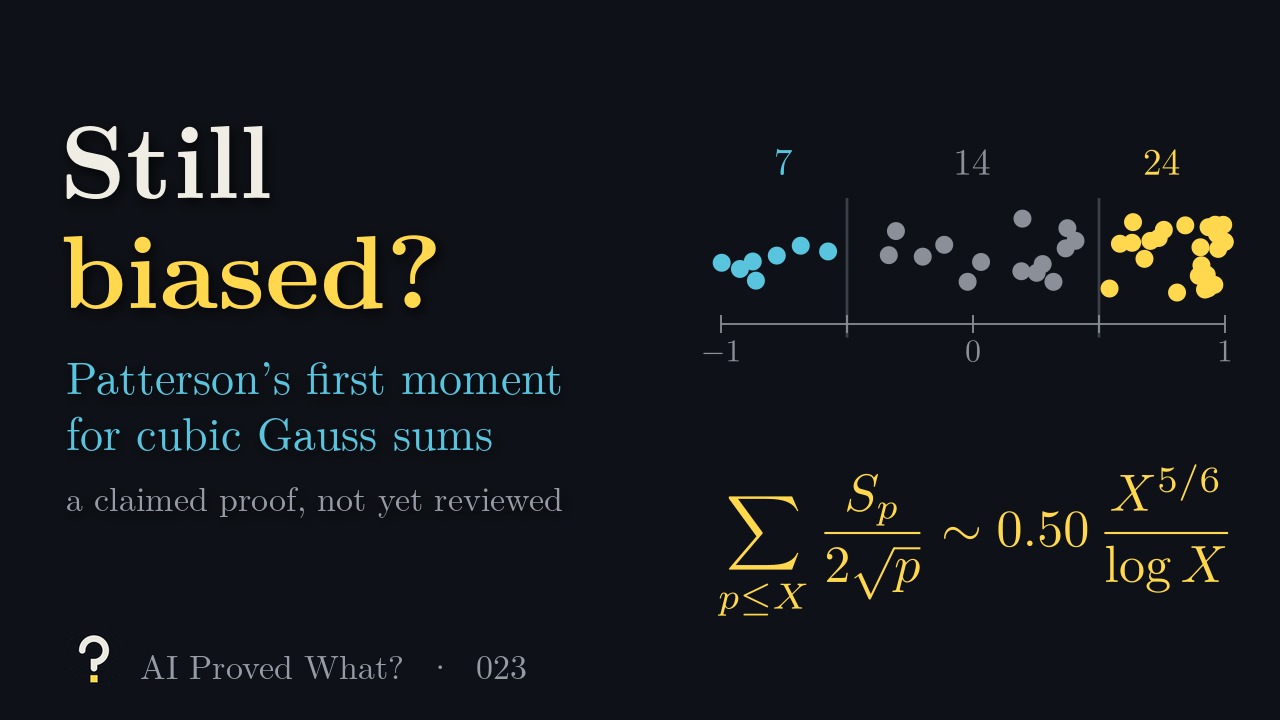
For a prime p ≡ 1 mod 3, Kummer’s sum Sp adds up the unit steps e(x3/p) = e2πix3/p for x = 0, …, p − 1. It is a real number with |Sp| < 2√p, so Sp/(2√p) lies between −1 and 1. Kummer noticed in 1846 that these values lean positive. They do not lean in the limit, but the lean fades slowly, and Patterson predicted in 1978 that their total up to X grows like X5/6/log X.
Result 023 (52 pages) claims this unconditionally and with a sharp cutoff, in the language of the Eisenstein integers ℤ[ω]. For each primary prime π (π ≡ 1 mod 3), let G(π) be the cubic Gauss sum, scaled to length 1. Then the sum of G(π) over all primary primes of norm up to X is (6/5)c*X5/6/log X plus a smaller error, where c* = (2π)2/3/(3Γ(2/3)) ≈ 0.838. Since G(π) + G(π̄) = Sp/√p, this says the total of Sp/(2√p) up to X is about (3/5)c*X5/6/log X ≈ 0.50 X5/6/log X. The paper also proves cancellation after twisting by any fixed nonzero power of π/|π|.
What it doesn’t claim
The error is only shown to be smaller than the main term, with no rate. Patterson’s companion prediction, cancellation for the sums of G(π)k, is covered only when 3 does not divide k. And the paper flags that one earlier paper printed the same constant for two sums that differ by a factor of two; it proves the form stated above and does not decide which printed version was intended.
Where it stands
- Posted as a preprint
- OpenAI, dated September 25, 2026, released October 6; 52 pages
- Peer reviewed
- Not yet
- Checked in Lean
- By OpenAI (scope note); we have not run the check
Last checked October 19, 2026. The claim has not been withdrawn, and we found no public response to it. OpenAI’s Lean statement covers the first moment and both angular statements. Following its imports gives about 3,600 files and 306,000 lines, not counting Mathlib and other libraries, with no unfinished proofs (sorry) in OpenAI’s files. The result is not listed in OpenAI’s formalization catalog.
What was known
- Kummer (1846) computed the 45 primes below 500 and conjectured the proportions 1/2, 1/3, 1/6 for the top, middle and bottom thirds.
- Von Neumann and Goldstine (1953) computed the 611 primes below 10,000 (272, 201 and 138), with the calculation programmed by Hedvig Selberg, and saw “a trend toward randomness”.
- Heath-Brown and Patterson (1979) proved that the normalized sums are equidistributed, so each third gets 1/3 in the limit. Patterson (1978) predicted the X5/6/log X bias.
- Heath-Brown (2000), with his cubic large sieve, bounded the total by X5/6+ε. Dunn and Radziwiłł (2021; Annals of Mathematics, 2024) proved Patterson’s prediction assuming the generalized Riemann hypothesis, with a smooth weight.
How the proof goes
- A model. Each G(π) is compared with c*N(π)−1/6 on dyadic ranges; summed over primes, the model gives the main term. The sharp cutoff forces smoothing at a fine scale, which brings in oscillation at heights up to about X1/6.
- Type I and bilinear sums. Sums with one long smooth variable use the unconditional Voronoi formula of Dunn and Radziwiłł, with a mean-square bound of Heath-Brown. In bilinear sums, Poisson summation leaves frequencies that are perfect cubes, which produce exactly the model term; a corrected dispersion method subtracts it, and large sieves control the rest except in two configurations, handled by moments at several lengths and a Gram-matrix estimate.
- Prime decomposition and large heights. An exact stopping rule decomposes the primes while keeping the coefficients independent; the only delicate transition, three primes of nearly equal norm, is handled by prime sparsity. At large heights, localizing both norm variables finishes the argument. No result conditional on the Riemann hypothesis is used.
The numbers in the video
- A short Python script computes Sp directly for all 8,988 primes p ≡ 1 mod 3 below 200,000. It reproduces Kummer’s 24, 14, 7 and von Neumann and Goldstine’s 272, 201, 138 exactly; below 200,000 the thirds hold 3,628, 2,990 and 2,370.
- The running total of Sp/(2√p) at 200,000 is 1,160, against 1,208 for the model sum c*Σp−1/6 and 1,078 for the leading term (3/5)c*X5/6/log X.
- The arrows are the 414 Gauss sums G(π) at primary primes of prime norm below 3,000; the script checks |G(π)| = 1 and G(π) + G(π̄) = Sp/√p for each.
Read the source
- An unconditional first moment for cubic Gauss sums (PDF), dated September 25, 2026 (52 pages).
- The Lean statement: PattersonFirstMoment.lean, and OpenAI’s scope note.
- Dunn and Radziwiłł, Bias in cubic Gauss sums: Patterson’s conjecture (Annals of Mathematics, 2024).
- The collection’s catalog, where this is result 023.
The paper
OpenAI groups related papers into one result; this one has a single paper.
Transcript
Read the full script
0:00Kummer’s walk
Take a prime p that leaves remainder one when divided by three, say thirteen. For each x from zero to twelve, cube it, and take one step of length one, at the angle 2π·x³/p. Where does the walk end? It always ends on the real line, within 2√p of the start. Divide by 2√p, and you get a number between minus one and one. In 1846, Ernst Kummer computed this for the 45 such primes below 500, and saw a pattern: about half the values above 1/2, a third in the middle, and a sixth below −1/2. Result 023 in OpenAI’s math repository is about the bias Kummer saw, and how much of it survives, to leading order.
0:46A fading bias
Kummer’s pattern did not hold up. In the early 1950s, John von Neumann and Herman Goldstine ran the sums on one of the first electronic computers, for every such prime below 10,000, with Hedvig Selberg programming the calculation. Of 611 primes, nearly 45 percent landed in the top third, which they called a trend toward randomness. In 1979, Roger Heath-Brown and Samuel Patterson proved that in the long run, each third gets exactly one third. But the bias fades slowly. Below 200,000, the top third still holds 40%. In 1978, Patterson had predicted the size of what remains. Add up the values for all primes up to X, and the total should grow like X^(5/6)/log X, times an explicit constant. That’s far less than the number of primes, but far more than chance alone would give. Up to 200,000, the total is about 1,160, from almost 9,000 primes. Heath-Brown’s cubic large sieve, in 2000, bounded the total by X^(5/6+ε). In 2021, Alexander Dunn and Maksym Radziwiłł proved Patterson’s prediction, assuming the generalized Riemann hypothesis, and with a smooth weight in place of a sharp cutoff.
2:09Eisenstein primes
The natural setting is the Eisenstein integers, a + bω, where omega is a complex cube root of one. Each of these primes p splits into two Eisenstein primes, π and its conjugate, each chosen to leave remainder one mod three. For each such prime, the cubic residue symbol and an additive phase build a cubic Gauss sum, G(π), scaled to have length one. The two conjugate sums average to Kummer’s value: G(π) plus G(π̄) is S_p/√p. Picture an arrow for each prime. Heath-Brown and Patterson showed the arrows point every way equally often; Patterson’s bias is a slight lean to the right.
2:50The claim
The preprint, 52 pages, dated September 25, claims Patterson’s prediction without any unproved hypothesis, and with a sharp cutoff. The sum of G(π), over all these primes of norm up to X, is (6/5)c* times X^(5/6)/log X, plus a smaller error. The constant c* is about 0.84. It also claims cancellation after twisting by any fixed nonzero power of the prime’s direction. OpenAI published a Lean proof of these statements, about 3,600 files and 300,000 lines, not counting Mathlib and other libraries. We haven’t run the check.
3:31How the proof goes
The proof compares each G(π) with a simple model, c* times the norm of π to the power −1/6. Summed over primes, the model gives the main term. The hard part is the sharp cutoff: smoothing the edge finely brings in oscillation at heights up to about X^(1/6). For sums with one long smooth variable, an unconditional Voronoi formula of Dunn and Radziwiłł, with a mean-square bound of Heath-Brown, does the work. For bilinear sums, Poisson summation leaves frequencies that are perfect cubes, and these produce exactly the model term. A corrected dispersion method subtracts it. Large sieves control the rest, except in two configurations, which need moments at several lengths and a Gram-matrix estimate. To feed these estimates, the primes are decomposed exactly, by a stopping rule that keeps the coefficients independent. The one delicate transition, a product of three primes of nearly equal norm, is handled because primes are sparse. At the largest heights, localizing both norm variables finishes the job.
4:37Where it stands
This is a preprint, not peer reviewed, and we haven’t run the Lean check. The error is only shown to be smaller than the main term, with no rate. Patterson’s companion prediction for higher powers is covered only for powers not divisible by three. And earlier work printed the same constant for two sums that differ by a factor of two; the paper says which form it proves. Kummer saw a bias in 45 primes. It fades like one over the sixth root of p, and the claim pins down the leading size of what is left. If the proof holds.
Spot a mistake?
This episode simplifies on purpose, but it shouldn’t be wrong. If something is, open an issue on GitHub or leave a comment on YouTube. Corrections are noted here with a date.