Long gaps, how often?
Positive lower density of large prime gaps
Covers result 026 in OpenAI’s catalog: its one paper. See its connections to other results and the work it cites.
3:47. English captions available. The video loads from YouTube when you press play.
Chapters
The claim, in plain words
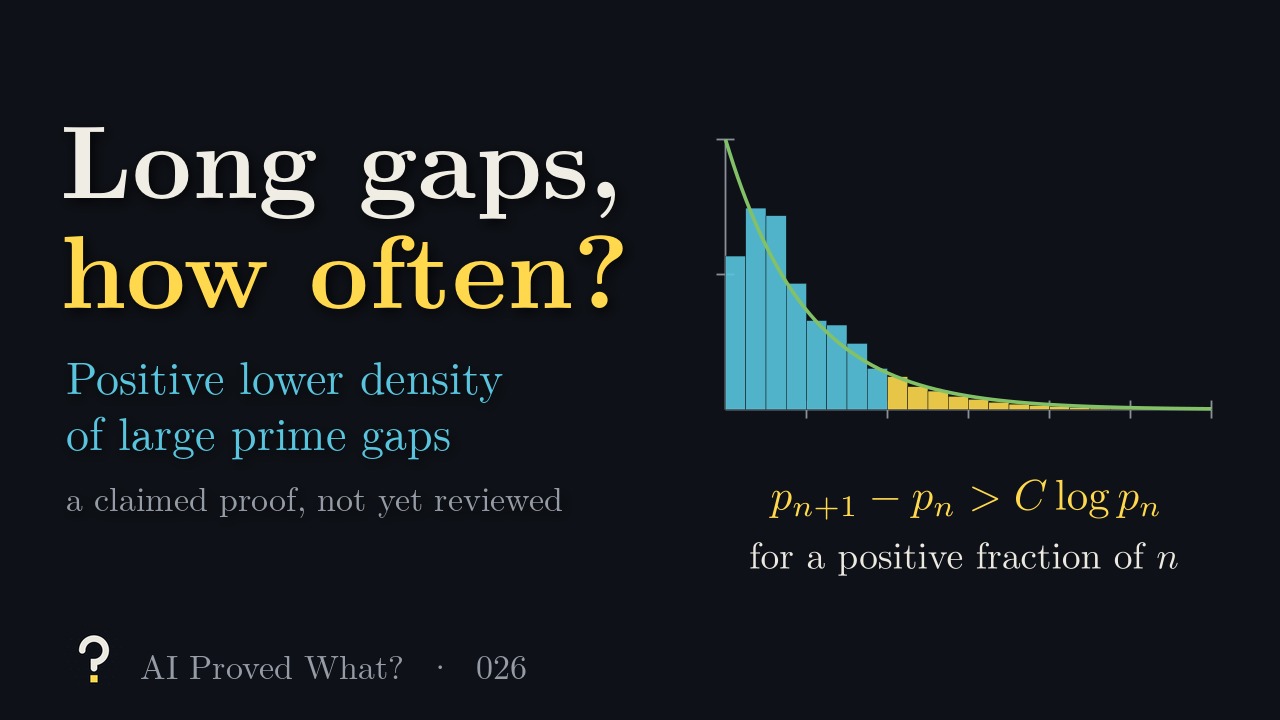
Near a number p, primes are about log p apart on average (natural log). Some gaps are far longer, but how often is a gap long? Result 026 (19 pages), claims unconditionally that for every fixed C > 0 there is a c(C) > 0 such that, for every large N, at least c(C)·N of the first N gaps pn+1 − pn exceed C log pn.
Since pn/n < pn+1/(n + 1) exactly when the gap exceeds pn/n ≈ log pn, the case C = 2 shows that pn/n increases on a set of indices of positive lower density. That answers a question of Erdős and Prachar (Erdős problem #968).
What it doesn’t claim
The proportions c(C) are not computed, and the claim says nothing about the exact fraction that a random model predicts (about e−C). It concerns how often gaps are long, not how long the longest gaps are.
Where it stands
- Posted as a preprint
- OpenAI, dated September 25, 2026, released October 6; 19 pages
- Peer reviewed
- Not yet
- Checked in Lean
- By OpenAI (scope note); we have not run the check
Last checked October 19, 2026. The claim has not been withdrawn, and we found no public response to it. OpenAI’s Lean statement covers both the theorem for every C > 0 and the corollary. Following its imports gives 56 files and about 23,000 lines, not counting Mathlib, with no unfinished proofs (sorry); the Bombieri–Vinogradov theorem is proved there, not assumed. The result is not listed in OpenAI’s formalization catalog.
What was known
- Westzynthius (1931) showed that some gaps exceed any fixed multiple of log p. Later work, up to Ford, Green, Konyagin, Maynard and Tao, found much longer gaps. These results concern the size of rare record gaps, not how often gaps are long.
- Bazzanella, Languasco and Zaccagnini (2010) proved, unconditionally, that a positive fraction of gaps exceed C log p for C below about 0.58.
- Gallagher (1976), assuming a strong form of the prime tuples conjecture, derived Poisson statistics for primes in short intervals: the random-model picture.
How the proof goes
- Two windows. Near a large X, take h ≈ λ log X with λ > max(C, 1). For a start m, if (m, m + h] contains a prime and (m + h, m + 2h] contains none, the last prime in the first window starts a gap longer than h.
- Bounded counting. That prime arises from at most h starts m, however long its gap. So δX good starts give at least δX/h distinct long gaps.
- The weights. The paper builds nonnegative weights on the starts, squares of signed sums of smooth divisor sums built from divisors of integers in the second window. They detect a prime in the first window but give the second window arbitrarily small prime mass, because where the second window has a prime, terms of neighboring sizes nearly cancel. Two second-moment estimates turn this into a positive fraction of ordinary starts.
- Inputs. Smooth divisor-sum correlations (as in Goldston–Yıldırım and Maynard), the Bombieri–Vinogradov theorem, and Gallagher’s singular-series average.
The numbers in the video
- A short Python script sieves all 11,078,937 primes below 200 million. It finds 37.5% of gaps above log p, 11.5% above 2 log p and 0.99% above 4 log p; the model values e−C are 36.8%, 13.5% and 1.8%.
- The share above 2 log p among the first N gaps is steady near 11% for N = 104 to 107. The ratio pn/n rises at 42.0% of steps.
- The largest gap relative to log p in this range is 248, after 191,912,783 (about 13 log p).
Read the source
- Positive lower density of large prime gaps (PDF), dated September 25, 2026 (19 pages).
- The Lean statement: PrimeGaps.lean, and OpenAI’s scope note.
- Erdős problem #968.
- The collection’s catalog, where this is result 026.
The paper
OpenAI groups related papers into one result; this one has a single paper.
Transcript
Read the full script
0:00Gaps between primes
Near a number p, primes are about log p apart on average, with log the natural logarithm. That’s the prime number theorem. Some gaps are much longer: in 1931, Erik Westzynthius showed that some gaps exceed any fixed multiple of log p, and later work, up to Ford, Green, Konyagin, Maynard and Tao, found gaps far longer still. But those results are about rare record gaps. How often is a gap long? Is a positive fraction of all gaps longer than twice log p? Ten times log p? Result 026 in OpenAI’s math repository claims yes, for every fixed multiple.
0:39Counting long gaps
Among the primes below 200 million, about 37.5% of gaps exceed log p, 12% exceed twice log p, and 1% exceed four times log p. A simple random model predicts a fraction near e^(−C) for C times log p. The counts look steady as you take more primes. Proving it is another matter. Earlier unconditional work, by Bazzanella, Languasco and Zaccagnini, showed a positive fraction of gaps exceed C log p only for C below about 0.58. Assuming a strong form of the prime tuples conjecture, Gallagher’s work gives the random-model picture. Erdős and Prachar asked a related question: how often does p_n/n go up? It rises exactly when the next gap exceeds p_n/n, which is about log p. Below 200 million, it rises at 42% of the steps.
1:36The claim
The preprint, 19 pages, dated September 25, claims, with no unproved hypothesis: for every fixed C, there is a positive constant c(C) such that, for every large N, at least c times N of the first N gaps exceed C log p. The fraction may depend on C, and it isn’t computed. With C equal to two, it answers Erdős and Prachar: the indices where p_n/n increases have positive lower density. OpenAI published a Lean proof of both statements, about 56 files and 23,000 lines, not counting Mathlib. We haven’t run the check.
2:15How the proof goes
Near a large number X, pick a length h, about λ log X, with λ bigger than C and one. From a starting point m, look at two windows: m to m + h, and m + h to m + 2h. If the first window has a prime and the second has none, the last prime in the first window starts a gap longer than h. That prime is counted by at most h starting points, however long its gap. So if a positive fraction of starting points are good, a positive fraction of gaps are long. To find good starting points, the paper builds weights: squares of signed sums of smooth divisor sums, built from divisors of integers in the second window. They detect a prime in the first window, yet leave the second window almost no prime mass, because terms of neighboring sizes nearly cancel. Two second-moment estimates turn the weights into a positive fraction of ordinary starting points. The inputs are divisor-sum correlations, as in Goldston, Yıldırım and Maynard, the Bombieri–Vinogradov theorem, and Gallagher’s singular-series average.
3:22Where it stands
This is a preprint, not peer reviewed, and we haven’t run the Lean check. The proportions aren’t computed, and the claim says nothing about the exact fraction the random model predicts. If the proof holds, long gaps are not just rare records: every fixed multiple of log p is exceeded by a positive fraction of prime gaps.
Spot a mistake?
This episode simplifies on purpose, but it shouldn’t be wrong. If something is, open an issue on GitHub or leave a comment on YouTube. Corrections are noted here with a date.