Which of 2, 3, 5?
Primitive roots for every admissible integer base: Artin’s conjecture
Covers result 029 in OpenAI’s catalog: all 2 papers. See its connections to other results and the work it cites.
5:11. English captions available. The video loads from YouTube when you press play.
Chapters
The claim, in plain words
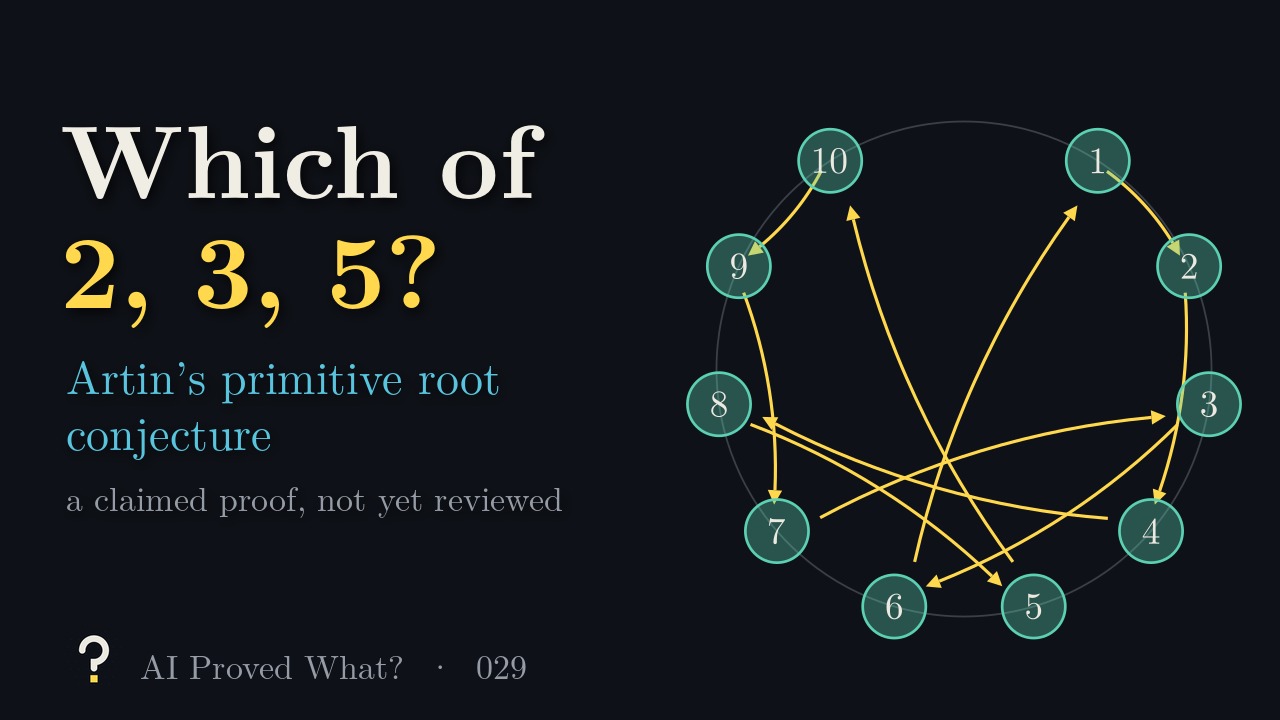
An integer a is a primitive root modulo a prime p if its powers run through every nonzero remainder: doubling modulo 11 gives 2, 4, 8, 5, 10, 9, 7, 3, 6, 1. In 1927 Emil Artin conjectured that every integer other than −1 and the perfect squares is a primitive root modulo infinitely many primes, and predicted the share: about 37.4% of primes for a = 2.
Result 029 (main preprint, 92 pages) claims the infinitude part for every such a: there is ca > 0 such that, for every large x, at least ca·x/(log x)² primes between x and 2x have a as a primitive root. A 21-page companion extends this to any fixed finite set of prime bases at once, assuming four inputs from the main paper.
What it doesn’t claim
The count is a lower bound, smaller than Artin’s prediction of a fixed share of all primes (about x/log x of them); the predicted share is still unproved. The constants are not explicit.
Where it stands
- Posted as a preprint
- OpenAI, dated October 4, 2026, released October 6; 92 pages
- Peer reviewed
- Not yet
- Checked in Lean
- No: OpenAI published no Lean proof for this result
Last checked October 19, 2026. The claim has not been withdrawn, and we found no public response to it. It builds on companion papers in the same release that are also unreviewed: the quasi-Riemann hypothesis (result 003, our episode 3), whose method it adapts, and the papers on the prime factors of p − 1 (result 011, our episode 11), whose marked Type II estimate it uses. Result 003’s Lean proof covers its own headline, not the cyclotomic fields used here.
What was known
- Hooley (1967) proved Artin’s conjecture, with the predicted share, assuming the Riemann hypothesis for the Dedekind zeta functions of the fields ℚ(ζn, a1/n).
- Unconditionally, Gupta and Murty (1984) found a set of thirteen numbers, at least one of which works; Heath-Brown (1986) showed that at most two primes fail, so at least one of 2, 3, 5 is a primitive root modulo infinitely many primes. No specific base was known to work (see Moree’s survey).
- Averaged over the base, the predicted share holds for almost all a (Goldfeld, Stephens; Klurman, Shparlinski and Teräväinen in very short ranges), but that does not settle any prescribed base.
How the proof goes
- The obstruction. a fails modulo p exactly when a prime q divides p − 1 and a(p−1)/q ≡ 1 (mod p), that is, when p splits completely in ℚ(ζq, a1/q).
- A toy case. If p = 4Q + 1 with Q prime, then p ≡ 5 (mod 8), so 2 is a non-square modulo p, and Q would force 24 ≡ 1; so 2 is a primitive root modulo every such p > 5. Infinitely many such primes are not known.
- Controlled predecessors. The paper builds at least a constant times x/(log x)² primes in (x, 2x) with p − 1 = c·r·Q, c ∈ (2, 4), Q > x0.9 prime, and every prime factor of r between exp((log x)0.1) and exp((log x)0.3), in a residue class where a is a non-square. It uses Bombieri–Vinogradov, a block sieve and marked Type II estimates.
- Removing the blockers. Q would force aj ≡ 1 for some j < 2x0.1, which few primes satisfy. A prime q dividing r requires complete splitting in ℚ(ζq, a1/q), which happens for about 1 in q(q − 1) primes, uniformly in q thanks to the next step.
- A uniform zero-free strip. The paper claims that every finite-order Hecke L-function over every cyclotomic field containing the twelfth roots of unity has no zeros with Re s > 1 − 10−6, one width for the whole family. The proof uses cubic theta series in the style of Patterson and Kazhdan–Patterson (whose coefficients are cubic Gauss sums), reflection, Poisson summation, and Heath-Brown’s quadratic large sieve.
The numbers in the video
- A short Python script finds that among the primes below ten million, 2 is a primitive root for 37.39%, 3 for 37.41% and 5 for 39.39%. Artin’s constant is 0.37396; the corrected prediction for 5 is 20/19 of it, 0.39364.
- It checks the failure test for a = 2 and all primes below 100,000, and confirms that every prime p = 4Q + 1 with Q prime below ten million (16,196 of them, from 13, 29, 53 on) has primitive root 2.
Read the source
- Primitive roots for every admissible integer base (PDF), dated October 4, 2026 (92 pages).
- Simultaneous primitive roots: a conditional lower bound for prime bases (PDF), dated October 4, 2026 (21 pages).
- The collection’s catalog, where this is result 029.
The 2 papers in this result
OpenAI groups related papers, such as alternative proofs, supporting results and consequences, into one result; we label the first paper it lists the main paper and the others companions.
Transcript
Read the full script
0:00Primitive roots
Pick a prime, say eleven, and keep doubling, wrapping around at eleven: 2, 4, 8, 5, 10, 9, 7, 3, 6, 1. Every nonzero remainder appears before you return to one, so two is a primitive root modulo 11. Modulo 7, doubling gives 2, 4, 1, and it’s back after three steps: not a primitive root. In 1927, Emil Artin conjectured that every integer a, other than −1 and the perfect squares, is a primitive root modulo infinitely many primes. Beyond the prime three, those exceptions never work: powers of a square stay among the squares, and powers of −1 just bounce between one and −1. Artin even predicted how often. For a equal to two, the share of primes should be about 37.4%. Below ten million, two is a primitive root for 37.39% of primes, three for 37.41%, and five, whose prediction, as later corrected, is a little higher, for 39.4%.
1:05What was known
Two fails modulo p exactly when some prime q divides p − 1, and two to the power (p − 1)/q is already one. In 1967, Christopher Hooley showed that a generalized Riemann hypothesis would control these failures and prove Artin’s conjecture, with the predicted share. Without that hypothesis, Gupta and Murty found thirteen numbers, at least one of which works. In 1986, Heath-Brown showed that at most two primes fail, so at least one of two, three and five is a primitive root for infinitely many primes. But which one, nobody could say.
1:43The claim
Result 029 in OpenAI’s math repository claims all of them. Its main preprint, 92 pages, dated October 4, claims: for every integer a other than −1 and the squares, there’s a positive constant c such that, for every large x, at least c times x/(log x)² primes between x and 2x have a as a primitive root. That’s a smaller count than Artin’s prediction, a fixed share of all primes, about x/log x of them, but it still means infinitely many primes for every such base, two included. A short second preprint, assuming four inputs from the main one, extends this to several prime bases at once. There’s no Lean proof. The paper builds on companion papers we’ve covered: the quasi-Riemann hypothesis, in episode 3, and the papers on p − 1, in episode 11.
2:37How the proof goes
The idea is to build primes where p − 1 has a special shape. Take p equal to 4Q + 1, with Q prime. A prime that blocks two must divide 4Q, so it’s two or Q. Such p leave remainder five when divided by eight, which makes two a non-square modulo p and rules out two. And Q would force two to the fourth to be one, impossible beyond five. So two is a primitive root modulo 13, 29, 53, and every such prime. But nobody can prove there are infinitely many primes of that form. So the paper relaxes it: p − 1 is a small factor times r times Q, with Q a prime above x^0.9, and r made only of primes in a middle range. And p is chosen so that a is a non-square modulo p, which rules out two, as before. Sieve methods, with an input from the Poisson–Dirichlet paper, give at least a constant times x/(log x)² such primes between x and 2x. Now a blocking prime must divide r or Q. Q forces a to a small power to be one, which only a few primes can satisfy. A middle-range prime q requires p to split completely in the field made by the q-th roots of a and of one. That happens for roughly one prime in q², if the count is uniform in q. That uniformity is the analytic heart. The paper claims that every finite-order Hecke L-function over the cyclotomic fields containing the twelfth roots of unity has no zeros with real part above 1 − 10⁻⁶, one fixed width for the whole family. That’s itself a quasi-Riemann hypothesis, with a far thinner strip than episode 3’s, but for a whole family of number fields. The proof uses cubic theta series in the style of Patterson, whose coefficients are cubic Gauss sums, together with reflection, Poisson summation, and Heath-Brown’s quadratic large sieve.
4:38Where it stands
This is a 92-page preprint, not peer reviewed, with no Lean proof. It builds on companion papers that are also unreviewed, and the Lean proof for the quasi-Riemann paper covers its own headline, not the fields used here. And it proves only a lower bound: Artin’s predicted share is still unproved. If the proof holds, two, three and five are each a primitive root for infinitely many primes, and so is every integer that isn’t −1 or a square.
Spot a mistake?
This episode simplifies on purpose, but it shouldn’t be wrong. If something is, open an issue on GitHub or leave a comment on YouTube. Corrections are noted here with a date.