Every curve modular?
Modularity of elliptic curves over imaginary quadratic fields
Covers result 030 in OpenAI’s catalog: its one paper. See its connections to other results and the work it cites.
4:53. English captions available. The video loads from YouTube when you press play.
Chapters
The claim, in plain words
Count the points of an elliptic curve modulo each prime p and set ap = p + 1 − (count). The curve is modular if these numbers are the coefficients of a modular form: for y² + y = x³ − x² they are the coefficients of q∏(1 − qn)²(1 − q11n)². Over the rationals every elliptic curve is modular (Wiles, Taylor–Wiles; Breuil, Conrad, Diamond and Taylor).
Result 030 (30 pages) claims the same over every imaginary quadratic field K, such as ℚ(i): for every elliptic curve E over K there is an automorphic representation πE of GL2 over K (a Bianchi modular form when E has no complex multiplication) whose local parameters match those of E at every place, so L(E/K, s) = L(πE, s − 1/2).
What it doesn’t claim
It concerns imaginary quadratic fields only, not general CM fields or other number fields. It relies on Caraiani and Newton’s automorphy lifting theorem and modularity criterion as inputs.
Where it stands
- Posted as a preprint
- OpenAI, dated October 4, 2026, released October 6; 30 pages
- Peer reviewed
- Not yet
- Checked in Lean
- No: OpenAI published no Lean proof for this result
Last checked October 19, 2026. The claim has not been withdrawn, and we found no public response to it.
What was known
- Over ℚ: Wiles and Taylor–Wiles (1995) for semistable curves, which proved Fermat’s Last Theorem; Breuil, Conrad, Diamond and Taylor (2001) for every curve.
- Over imaginary quadratic fields the relevant cohomology occurs in more than one degree. Galois representations attached to Bianchi forms go back to Harris–Soudry–Taylor and Taylor in the 1990s; the torsion classes and general forms over CM fields needed for the method came with Scholze and with Harris, Lan, Taylor and Thorne. The ten-author paper (Allen, Calegari, Caraiani, Gee, Helm, Le Hung, Newton, Scholze, Taylor, Thorne) proved potential modularity of every elliptic curve over a CM field.
- Caraiani and Newton (2023) proved that every elliptic curve over K is modular whenever X0(15)(K) is finite, which covers infinitely many imaginary quadratic fields, including ℚ(i), ℚ(√−2), ℚ(√−3) and ℚ(√−5). Allen, Khare and Thorne had proved modularity for a positive proportion of curves.
How the proof goes
- Congruences carry modularity. If two curves have the same irreducible mod-ℓ Galois representation and one is modular, an automorphy lifting theorem (under conditions) makes the other modular. Wiles’s 3–5 switch used an auxiliary curve with the same mod-5 representation.
- A family of cyclic covers. For a non-CM E, pick a prime p > 100 with mod-p image containing SL2(𝔽p) and set n = 3p. Over a parameter t, build a genus-n cyclic cover of a quadratic twist Bt of E, branched at two points, with a dihedral involution. Its cohomology splits into rank-two pieces Vθ, one for each character of the rotations, each with the determinant and Hodge–Tate weights of an elliptic curve.
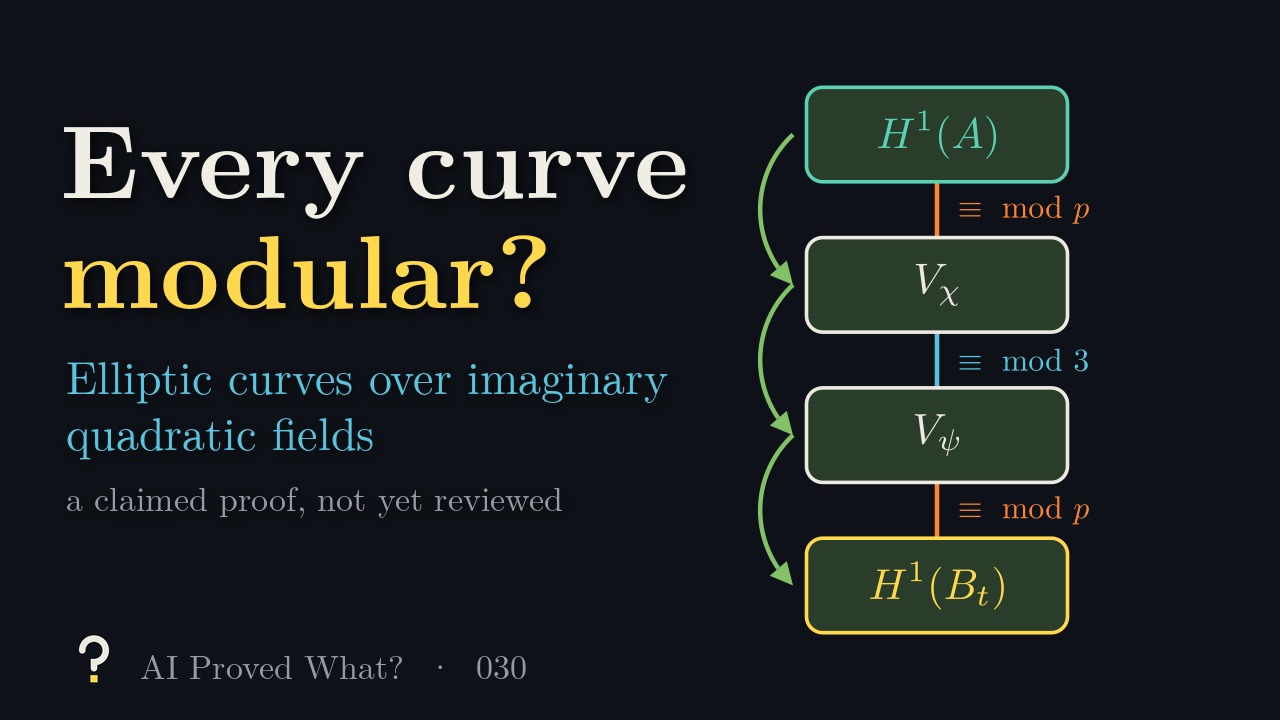
- A chain. The order-3 piece is H¹ of an elliptic curve A; it is congruent modulo p to the order-3p piece, which is congruent modulo 3 to the order-p piece, which is congruent modulo p to H¹(Bt). A is modular by Caraiani and Newton’s mod-5 criterion, and three applications of their lifting theorem carry modularity to Bt.
- Choosing t. At one degenerate fiber the Jacobian becomes En (compact type), and nearby fibers inherit its local reduction behavior; at another, explicit vanishing cycles keep every residual piece irreducible. Hilbert irreducibility then finds one parameter with every property. The proof descends from K(μn) to K and from the twist to E; curves with complex multiplication are handled by automorphic induction.
The numbers in the video
- A short Python script checks that the point counts of y² + y = x³ − x² equal the coefficients of q∏(1 − qn)²(1 − q11n)² for every prime below 400.
- For y² = x³ + ix + 1 over ℚ(i) it computes a𝔭 at every good prime of norm below 200 (for example −1 at 1 + 2i and −3 at the inert prime 3) and checks the Hasse bound.
- The curves y² = x³ − 6x − 4 and y² = x³ + 3x + 2 have ap congruent modulo 3 for every prime from 5 to 400, and neither has a rational 3-isogeny, so their shared mod-3 representation is irreducible.
Read the source
- Modularity of elliptic curves over imaginary quadratic fields (PDF), dated October 4, 2026 (30 pages).
- Caraiani and Newton, On the modularity of elliptic curves over imaginary quadratic fields (arXiv, 2023).
- The collection’s catalog, where this is result 030.
The paper
OpenAI groups related papers into one result; this one has a single paper.
Transcript
Read the full script
0:00Modularity
Take the elliptic curve y² + y = x³ − x², and count its solutions modulo each prime p. Write a_p for p + 1, minus that count. Modulo 7 there are 10 points, counting the point at infinity, so a₇ is −2. For p = 2, 3, 5, 7 and 13, the list goes −2, −1, 1, −2, 4. Now expand q·∏(1 − qⁿ)²(1 − q¹¹ⁿ)². The coefficient of q^p is a_p, for every prime p. That’s modularity: the curve’s point counts are the coefficients of a modular form. Wiles, with Taylor, proved it for semistable curves over the rationals in 1995, enough for Fermat’s Last Theorem, and Breuil, Conrad, Diamond and Taylor finished every curve over the rationals in 2001. The same question makes sense over other number fields. Over the Gaussian rationals, Q(i), take y² = x³ + ix + 1, and count points modulo each prime of the Gaussian integers. Modular there means matching an automorphic form for GL(2) over the field, a Bianchi modular form, which lives on hyperbolic three-space instead of the upper half-plane.
1:21What was known
Over imaginary quadratic fields like Q(i), Wiles’s method is much harder. The relevant cohomology appears in more than one degree. Galois representations for these forms came in the 1990s, but the method also needs them for torsion classes, and that took until the 2010s, with Scholze, and with Harris, Lan, Taylor and Thorne. A ten-author paper then proved potential modularity: every such curve becomes modular after enlarging the field. In 2023, Ana Caraiani and James Newton proved that every elliptic curve is modular over infinitely many imaginary quadratic fields, including Q(i), and the fields of √−2, √−3 and √−5: whenever a certain modular curve, X₀(15), has rank zero over the field. Other fields remained open.
2:14The claim
Result 030 in OpenAI’s math repository claims the rest. The preprint, 30 pages, dated October 4, claims: every elliptic curve over every imaginary quadratic field is modular, with the local factors matching at every place, so its L-function is the L-function of an automorphic form. There’s no Lean proof. The argument still relies on Caraiani and Newton’s lifting theorem and their modularity criterion, and it adds a new way to reach curves those results couldn’t reach directly.
2:49How the proof goes
Wiles’s key idea is that modularity travels along congruences. For these two curves, a_p agree modulo 3 at every prime from 5 on, though the numbers differ, and their shared mod 3 picture is irreducible. When that holds and one curve is modular, a lifting theorem makes the other modular too. Wiles’s 3–5 switch used an auxiliary curve with the same mod 5 picture as the curve he wanted. The paper builds a whole chain of congruences from one family. Pick a large prime p for which E’s mod p image is as big as possible, and set n = 3p. Over a parameter t, build a curve of genus n, a cyclic cover of a twist of E, branched at two points. Its cohomology splits into two-dimensional pieces, one for each character θ of the rotations, and each piece looks like an elliptic curve. Four pieces line up. The order-3 piece is an honest elliptic curve A. The order-3p piece agrees with it modulo p, then with the order-p piece modulo 3, which agrees with the twist of E modulo p. A is modular by Caraiani and Newton’s mod 5 criterion, and modularity moves along the chain by three lifts. Each lift needs conditions, and the paper chooses t to meet them all. At one degenerate fiber the Jacobian becomes n copies of E, and nearby fibers inherit its local behavior; near another, vanishing cycles keep every residual piece irreducible; Hilbert irreducibility then finds one good parameter. Finally it descends from the cyclotomic field back to K, and from the twist back to E. Curves with complex multiplication are handled separately.
4:31Where it stands
This is a preprint, not peer reviewed, with no Lean proof, and it builds on Caraiani and Newton’s lifting theorem. If the proof holds, every elliptic curve over every imaginary quadratic field is modular, the analogue for these fields of the theorem behind Fermat’s Last Theorem.
Spot a mistake?
This episode simplifies on purpose, but it shouldn’t be wrong. If something is, open an issue on GitHub or leave a comment on YouTube. Corrections are noted here with a date.