Groups remember fields?
Uchida’s conjecture for open homomorphisms of Galois groups
Covers result 031 in OpenAI’s catalog: its one paper. See its connections to other results and the work it cites.
4:17. English captions available. The video loads from YouTube when you press play.
Chapters
The claim, in plain words
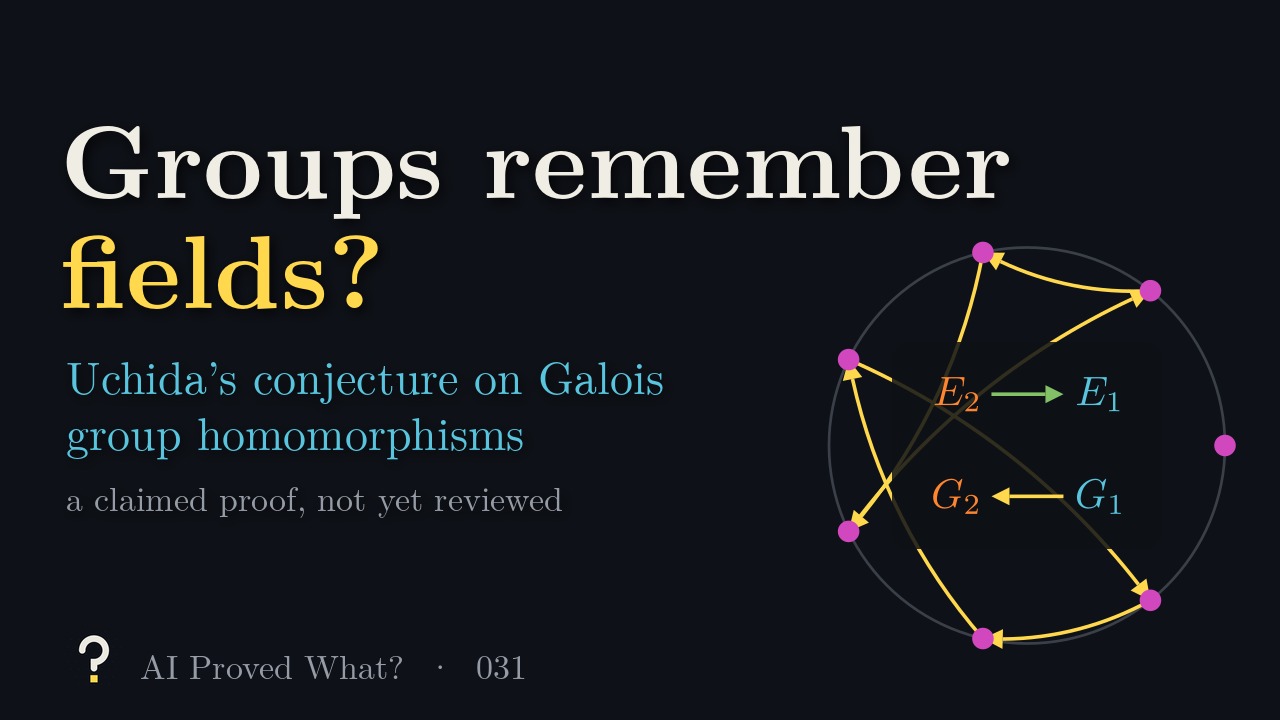
The absolute Galois group of a number field is the group of all symmetries of the algebraic numbers that fix the field. By the Neukirch–Uchida theorem, it determines the field: every isomorphism between two such groups comes from exactly one isomorphism of the fields. A field embedding j: E2 ↪ E1 also induces a map of Galois groups, in the opposite direction.
Result 031 (23 pages) claims Uchida’s 1981 conjecture: for number fields F1, F2 and solvably closed Galois extensions Ei/Fi (fields with no nontrivial abelian extensions, such as the algebraic numbers), every continuous homomorphism Gal(E1/F1) → Gal(E2/F2) with open image is induced by a unique field embedding E2 ↪ E1, with no condition on its kernel.
What it doesn’t claim
It concerns number fields and solvably closed extensions; the analogue for p-adic fields is false even for isomorphisms (Yamagata, 1976). Homomorphisms without open image are not covered.
Where it stands
- Posted as a preprint
- OpenAI, dated October 5, 2026, released October 6; 23 pages
- Peer reviewed
- Not yet
- Checked in Lean
- No: OpenAI published no Lean proof for this result
Last checked October 19, 2026. The claim has not been withdrawn, and we found no public response to it.
What was known
- Neukirch (1969) treated Galois number fields; Uchida, Iwasawa and Ikeda extended the isomorphism theorem to all number fields (Uchida, 1976), and Uchida (1979) to solvably closed Galois extensions.
- Uchida (1981) posed the homomorphism conjecture, proved it when the first group is over ℚ, proved uniqueness, and paired primes through their pro-ℓ inertia groups, missing finitely many target primes for each auxiliary prime ℓ.
- Hoshi (Tohoku Math. J., 2025) showed that an open homomorphism comes from an embedding exactly when it preserves the cyclotomic character, the action on roots of unity.
How the proof goes
- The goal. By Hoshi’s criterion, show the homomorphism preserves the cyclotomic character; in effect, it must match primes lying over the same rational prime p.
- Detecting characters. An additive ℓ-adic character of the absolute Galois group of a number field is determined by its values at any infinite set of primes of degree one. The key rank estimate is a special case of the ℓ-adic Waldschmidt–Masser theorem, proved with Laurent’s interpolation determinants.
- A uniform Kummer bound. Refining a Kummer argument of Uchida, the number of target primes missed by the inertia correspondence is bounded independently of ℓ.
- The route. Reduce to maps onto the Galois group of the maximal solvable extension of ℚ; show they are onto and preserve the cyclotomic character after logarithms for infinitely many ℓ; force corresponding primes to share their residue characteristic; compare Frobenius values to identify the map with ordinary restriction up to one conjugation. Full cyclotomic compatibility and Hoshi’s theorem give the embedding.
The numbers in the video
- A short Python script finds that among the 1,227 primes from 5 to 10,000, x³ − 2 has three roots modulo 200 of them (16%), one root modulo 616 (50%) and none modulo 411 (33%), close to the shares 1/6, 1/2, 1/3 of identity, transpositions and 3-cycles in S3. Modulo every prime ≡ 2 (mod 3) it has exactly one root.
- It checks that the 7th cyclotomic polynomial factors modulo p into irreducible pieces whose degree is the order of p modulo 7, for every prime below 200: Frobenius acts on the 7th roots of unity by ζ ↦ ζp.
Read the source
- Open Homomorphisms of Global Solvably Closed Galois Groups (PDF), dated October 5, 2026 (23 pages).
- The collection’s catalog, where this is result 031.
The paper
OpenAI groups related papers into one result; this one has a single paper.
Transcript
Read the full script
0:00Symmetries and primes
The polynomial x³ − 2 has three roots: the real cube root of two, and two complex ones. A symmetry of the algebraic numbers that fixes the rationals must permute these roots, and here all six permutations occur. Collect the symmetries of all algebraic numbers at once, and you get the absolute Galois group of the rationals: a single, enormous group. Primes see these symmetries. Modulo a prime p other than 2 and 3, x³ − 2 splits into three linear factors, or a linear times a quadratic, or doesn’t factor at all, depending on a symmetry attached to p, its Frobenius element. Among the primes from five to 10,000, the three cases occur 16%, 50% and 33% of the time, close to 1/6, 1/2 and 1/3, the shares of the three kinds of permutations. Roots of unity carry a special record. The Frobenius element at p raises every root of unity of order prime to p to the p-th power. This is the cyclotomic character, and it remembers p.
1:03Fields from groups
In the late 1960s and 1970s, Neukirch and Uchida proved a striking theorem: a number field is determined by its absolute Galois group. Isomorphic groups come from isomorphic fields, and every isomorphism of the groups comes from exactly one isomorphism of the fields. For p-adic fields, the analogous statement is false. In 1981, Uchida asked for more. A field embedding induces a map between Galois groups, in the opposite direction. Is every continuous homomorphism with open image, between Galois groups of solvably closed extensions of number fields, induced by an embedding? He proved this when the first group is a Galois group over the rationals, proved uniqueness, and matched primes to primes through their inertia groups. In a paper published in 2025, Hoshi showed that the answer is yes exactly when the homomorphism preserves the cyclotomic character.
2:03The claim
Result 031 in OpenAI’s math repository claims the full conjecture. The preprint, 23 pages, dated October 5, states: every continuous open homomorphism between Galois groups of solvably closed Galois extensions of number fields comes from a unique field embedding, with no condition on the kernel. Solvably closed means the field has no nontrivial abelian extensions, like the field of all algebraic numbers. There’s no Lean proof.
2:35How the proof goes
By Hoshi’s criterion, the task is to show the homomorphism preserves the cyclotomic character; in effect, it must match primes lying over the same p. Uchida’s correspondence pairs primes through inertia, using an auxiliary prime ℓ, and misses only finitely many target primes. But which ones it misses could depend on ℓ. The paper relies on two key tools. First, an additive ℓ-adic character, one with values in the ℓ-adic numbers under addition, is determined by its values at any infinite set of primes of degree one. The key rank estimate is a special case of the Waldschmidt–Masser theorem, proved here with Laurent’s interpolation determinants. Second, refining a Kummer argument of Uchida, it bounds the number of missed primes by a number that doesn’t depend on ℓ. The paper first reduces to maps onto the Galois group of the maximal solvable extension of the rationals. For such a map, it shows that it preserves the cyclotomic character after taking logarithms, for infinitely many ℓ; that corresponding primes can be forced to share their residue characteristic; and, comparing Frobenius values, that it is ordinary restriction up to a single conjugation. That gives the full cyclotomic compatibility, and Hoshi’s theorem supplies the field embedding.
3:56Where it stands
This is a preprint, not peer reviewed, with no Lean proof. It builds on the theorems of Uchida and Hoshi. If the proof holds, then for these Galois groups of number fields, every open homomorphism, and not just every isomorphism, comes from a field embedding.
Spot a mistake?
This episode simplifies on purpose, but it shouldn’t be wrong. If something is, open an issue on GitHub or leave a comment on YouTube. Corrections are noted here with a date.