Every Hodge class algebraic?
The rational Hodge conjecture for CM abelian varieties
Covers result 032 in OpenAI’s catalog: all 5 papers. See its connections to other results and the work it cites.
7:53. English captions available. The video loads from YouTube when you press play.
Chapters
The claim, in plain words
The Hodge conjecture, one of the Clay Millennium Prize problems, asks whether every rational Hodge class on a smooth complex projective variety is a rational combination of classes of algebraic cycles. An abelian variety is a complex torus that is also algebraic; it has complex multiplication (CM) when its commutative algebra of symmetries is as large as possible, of dimension twice the dimension of the variety.
Result 032 (53 pages) claims the conjecture for every complex CM abelian variety, in every dimension and every codimension: the cycle class map CHp(A)ℚ → H2p(A, ℚ) ∩ Hp,p(A) is surjective. Through two theorems of Milne (1999, 2002), this would give the Tate conjecture for every abelian variety over a finite field and Grothendieck’s Hodge standard conjecture for abelian varieties in every characteristic; following Hazama and Abdulali, it also gives the generalized Hodge conjecture for CM abelian varieties.
What it doesn’t claim
This is a special case. The Millennium problem asks about every smooth projective variety, and it would remain open, as would the Hodge conjecture for abelian varieties without complex multiplication.
Where it stands
- Posted as a preprint
- OpenAI, dated September 30, 2026 (revised October 6), released October 6; 53 pages
- Peer reviewed
- Not yet
- Checked in Lean
- No: OpenAI published no Lean proof of the theorem; two small uncatalogued Lean files check supporting lemmas (we have not run them)
Last checked October 19, 2026. OpenAI’s release notes say this result was produced outside their standard procedure, without further detail. On October 7, OpenAI withdrew three papers from this same entry after a sign error: Algebraicity of Weil classes on split abelian eightfolds, and the two behind the entry’s original headline claims, Algebraicity of Kuga–Satake Correspondences for K3 Surfaces and The rational Hodge conjecture for products of K3 surfaces. The CM paper cites none of them and has not been withdrawn. We found no public assessment by specialists. OpenAI published no Lean proof of the theorem. Its files do contain two small uncatalogued (not linked from the collection’s catalog) Lean files, 512 lines in all, excluding Mathlib, with no unproved steps by our search; we have not run them. One (225 lines) proves the paper’s scalar-descent lemma: a vector whose Galois conjugates all lie in a subspace comes from the rational part of that subspace. The other (287 lines) is about rational even Clifford algebras and likely belongs to the entry’s Kuga–Satake papers. Correction (October 15, 2026): the video says there is no Lean proof; that is still true of the theorem, but we missed these files.
What was known
- Degree two: the Lefschetz (1,1) theorem, going back to 1924; Hodge classes of degree two are classes of divisors.
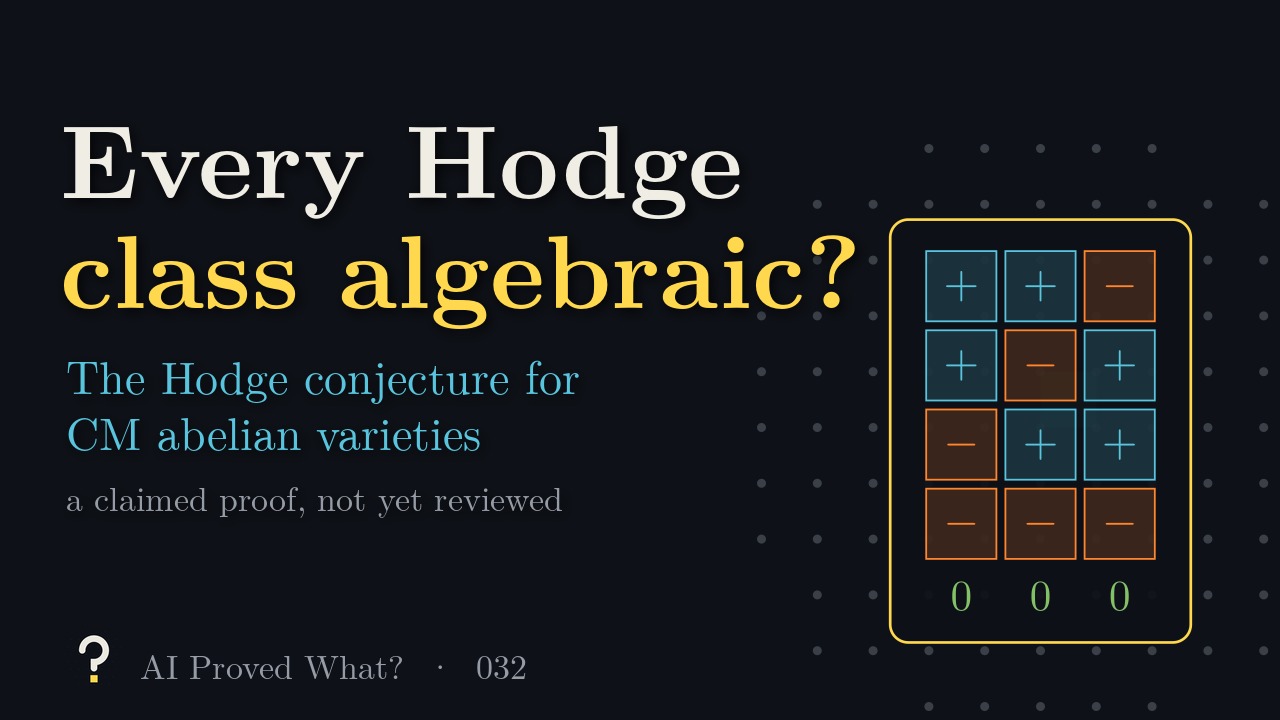
- Pohlmann (Annals, 1968): on a CM abelian variety, a product of embedding lines is a Hodge class exactly when its signs balance in every Galois conjugate. Weil classes need not be products of divisors, already on abelian fourfolds.
- Deligne (1982): every Hodge class on an abelian variety is absolute Hodge. André (1992): CM Hodge classes are sums of pullbacks of split Weil classes on auxiliary CM abelian varieties.
- Markman (2025): algebraicity of Weil classes on abelian sixfolds of Weil type with discriminant −1, giving the Hodge conjecture for all abelian fourfolds.
How the proof goes
- Reduction to four-factor switches. Split the sign matrix of a Hodge monomial into a top half and a sign-flipped bottom half with equal column sums, and turn one into the other by swapping entries between pairs of rows, column by column. Each swap is a relation a + b = a′ + b′, so it suffices that each four-factor switch class is algebraic; consecutive switches are composed with polarization pairings and transferred back to the original variety.
- A surface criterion. If a smooth projective surface carries degree-one classes from the four CM pieces whose cup product has nonzero integral, the surface’s image in the product of the four abelian varieties is an algebraic cycle that pairs nontrivially with the switch class, and four algebraic divisor classes turn this into the class itself.
- Theta forms on a ball quotient. On a compact quotient of the complex 2-ball by an arithmetic subgroup of a unitary group of signature (2,1) at one place and definite elsewhere, theta series give holomorphic one-forms whose wedges give two-forms. Weak approximation moves the data for a′, b′ close to those for a, b with the total fixed, so by continuity a mixed period stays nonzero.
- The arithmetic of the sources. Realizing the ball quotients in a projective moduli space of abelian varieties, counting ordinary isogeny neighbours gives a polynomial relation between Hecke operators and Frobenius; Frobenius slopes 0 or 1 and p-adic Hodge theory then pin down Hodge types, showing each theta form comes from the right CM piece.
The numbers in the video
- The curve y² = x³ − x (the torus ℂ/ℤ[i]) has exactly p + 1 points modulo every prime p ≡ 3 (mod 4); a short Python script checks all 619 such primes below 10,000. The curve y² = x³ + x + 1, without CM, has exactly p + 1 points for only ten primes below 10,000: 3, 17, 179, 227, 523, 1031, 3767, 6131, 6551 and 6679.
- For ℚ(ζ7) there are 8 sign patterns on 3 columns and 12 balanced four-row patterns; 10 pair off into opposite rows (products of divisors) and 2 do not.
- The row-swap reduction is checked on 20,000 random examples.
Read the source
- The rational Hodge conjecture for CM abelian varieties (PDF), revision dated October 6, 2026 (53 pages); first version, dated September 30, 2026.
- Companions in the same entry: Weil classes and Hodge classes on abelian powers, Abelian covers, Gale correspondences, and the Hodge conjecture for powers, Algebraic Kuga–Satake correspondences and Hodge conjectures on a K3 quadratic locus.
- The collection’s catalog, where this is result 032. Episode 001 covers Milne’s rationality conjecture; together with this result it would represent every specialized Hodge class of an abelian variety with good reduction by an algebraic cycle.
The 5 papers in this result
OpenAI groups related papers, such as alternative proofs, supporting results and consequences, into one result; we label the first paper it lists the main paper and the others companions.
- The rational Hodge conjecture for CM abelian varieties main paper
- Algebraic Kuga–Satake correspondences and Hodge conjectures on a K3 quadratic locus companion
- Weil classes and Hodge classes on abelian powers companion
- Abelian covers, Gale correspondences, and the Hodge conjecture for powers companion
- A Conditional Reduction for Algebraic Kuga–Satake Correspondences companion
Transcript
Read the full script
0:00Shapes and shadows
The Hodge conjecture is one of the seven Clay Millennium Prize problems. Here’s the cartoon. A smooth shape cut out by polynomial equations has a cohomology space. Its rational classes form a grid, and Hodge theory picks out a special slice through it. The grid points on that slice are called Hodge classes. Any smaller shape inside, cut out by more equations, is an algebraic cycle, and its class always lands on the slice. Hodge asked for the reverse at the 1950 International Congress. In today’s rational form: is every Hodge class a rational combination of classes of algebraic cycles? In degree two, the answer is yes. That’s the Lefschetz (1,1) theorem, going back to 1924, and the cycles are divisors, shapes of one dimension less. Multiplying divisor classes gives more cycles. Beyond that, the conjecture is open in general, even for the simplest higher-dimensional shapes: abelian varieties.
1:01Tori with extra symmetry
An abelian variety is a complex torus that is also algebraic. In dimension one, take a lattice in the complex plane and glue opposite sides: you get a donut, an elliptic curve. Use the square lattice of Gaussian integers, and something special happens. Multiplying by i turns the plane a quarter turn and carries the lattice to itself, so the torus gets an extra symmetry. This torus is the curve y² = x³ − x, and an extra symmetry like this is called complex multiplication, or CM. CM leaves a fingerprint on the primes. Modulo every prime of the form 4k + 3, this curve has exactly p + 1 points: all 619 such primes below 10,000, for instance. A typical curve, like y² = x³ + x + 1, has exactly p + 1 points for only ten primes in that range. In higher dimension, a CM abelian variety has the largest possible commutative algebra of symmetries. Its first cohomology then splits into lines, each either holomorphic, marked plus, or antiholomorphic, marked minus. A product of these lines is a class of higher degree. Pohlmann showed in 1968 how to recognize the Hodge classes among them: write the signs as a matrix, a row for each factor and a column for each Galois conjugate, up to complex conjugation. The product is a Hodge class exactly when every column balances, with as many pluses as minuses. A divisor class pairs a row with its exact opposite, so products of divisors are the matrices whose rows pair off. Take the field of seventh roots of unity: three columns, eight possible rows. Of the twelve balanced four-row patterns, ten pair off. Two don’t, like this one. It’s a Hodge class that no product of divisors can reach, and classes like it are where the difficulty lives. Deligne proved in 1982 that every Hodge class on an abelian variety behaves arithmetically like an algebraic one, without producing any cycles. André reduced the CM case to Weil classes on auxiliary CM varieties. And in 2025, Eyal Markman built cycles for Weil classes on certain sixfolds, which settles all abelian fourfolds. But for CM abelian varieties in general, the conjecture stayed open.
3:29The claim
Result 032 in OpenAI’s math release claims the whole CM case. A 53-page OpenAI preprint, dated September 30 and revised October 6, states: every rational Hodge class on every complex CM abelian variety, in every dimension and every degree, is a rational combination of classes of algebraic cycles. Through two theorems of James Milne, from 1999 and 2002, that would give much more: the Tate conjecture for every abelian variety over a finite field, and Grothendieck’s Hodge standard conjecture for abelian varieties in every characteristic. To be clear, this is a special case. The Millennium problem asks about every smooth projective variety, and it would remain open.
4:18How the proof goes
The proof has four steps. First, a reduction. Split the rows of a balanced matrix in half, and flip every sign in the bottom half, so the two halves have equal column sums. Then turn the top half into the bottom half, one column at a time, by swapping entries between pairs of rows. Each swap turns two rows, a and b, into a′ and b′, with the same sum. So everything reduces to one kind of class: four rows tied by a + b = a′ + b′. The paper calls it a four-factor switch. If every switch is algebraic, the paper chains consecutive switches together with polarization pairings, which are algebraic, and carries the result back to the original variety. Second, a criterion. Suppose an algebraic surface carries four one-forms, one coming from each of the four CM pieces, and the integral of their product over the surface isn’t zero. Each one-form comes from a map of the surface into an abelian variety. So the image of the surface in the product of the four is an algebraic cycle that detects the switch class, and four divisor classes turn detecting it into constructing it. Third, find the surface. The paper uses a compact quotient of the complex 2-ball by an arithmetic group of unitary symmetries. Theta series give holomorphic one-forms on it, and pairs of them give two-forms. One pair matches a and b, the other matches a′ and b′. Weak approximation moves the second pair’s data as close as needed to the first, while the total stays fixed. By continuity, the second two-form stays close to the first, so its integral against the conjugate of the first stays near a positive number, and can’t be zero. Fourth, the arithmetic. The criterion needs each theta one-form to come from the right CM piece. The paper realizes these ball quotients inside a moduli space of abelian varieties, and counts ordinary isogeny neighbors to get a polynomial relation between Hecke operators and Frobenius. Through p-adic Hodge theory, Frobenius slopes of zero or one pin down the Hodge types, and with them the CM source of each form. Then the criterion applies, every switch is algebraic, and so is every Hodge class.
6:39Where it stands
This is a preprint, not yet peer reviewed, and there is no Lean proof. OpenAI’s release notes say this result was produced outside their standard procedure, without saying how. On October 7, OpenAI withdrew three papers from this same entry, after a sign error: one on Weil classes on abelian eightfolds, and the two behind the entry’s original headline claims about K3 surfaces. The CM paper doesn’t cite any of them, and it hasn’t been withdrawn. The remaining companions claim the conjecture for powers of some other abelian varieties, for some complete intersections, and for a family of K3 surfaces. Two of them build on this theorem. We found no public assessment by specialists yet. If the proof holds, the most symmetric abelian varieties satisfy the Hodge conjecture completely, and the Tate conjecture for abelian varieties over finite fields comes with it. And together with the result in our very first episode, on Milne’s rationality conjecture, it would put an algebraic cycle behind every Hodge class of an abelian variety, after good reduction modulo a prime.
Spot a mistake?
This episode simplifies on purpose, but it shouldn’t be wrong. If something is, open an issue on GitHub or leave a comment on YouTube. Corrections are noted here with a date.