The mildest singularity?
The ordinary-double-point volume gap
Covers result 037 in OpenAI’s catalog: all 2 papers. See its connections to other results and the work it cites.
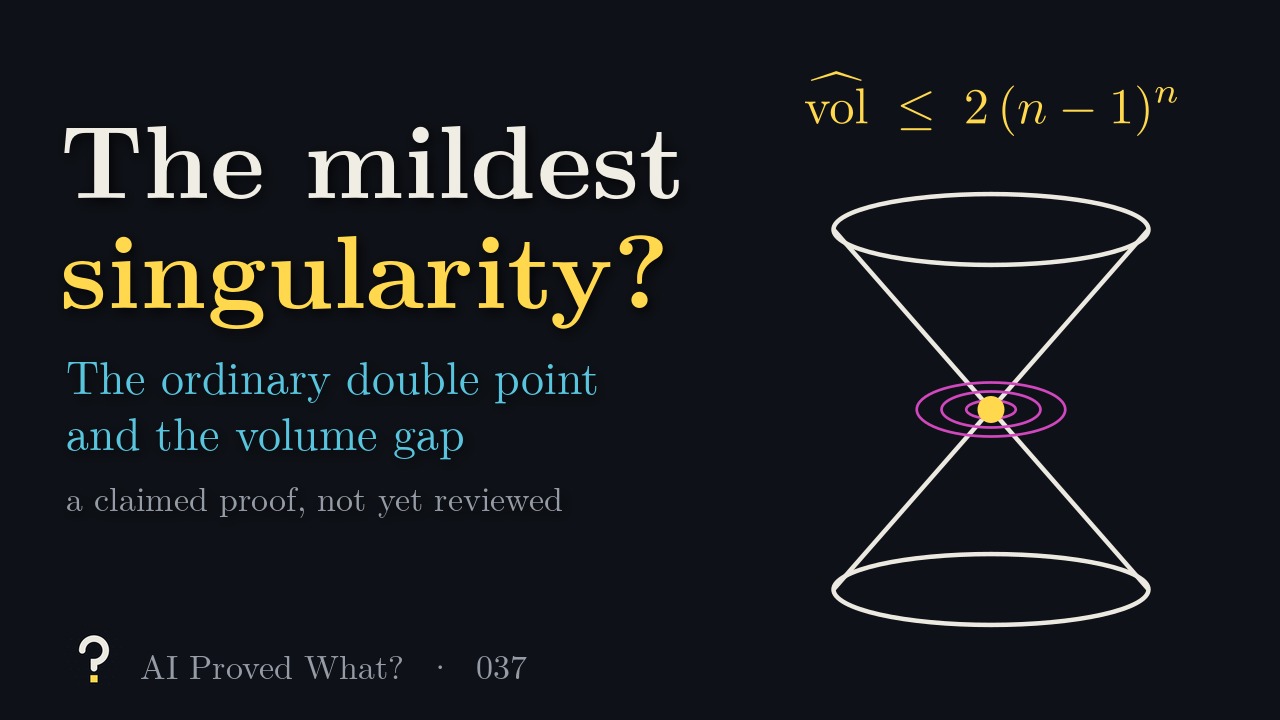
4:37. English captions available. The video loads from YouTube when you press play.
Chapters
The claim, in plain words
Chi Li’s normalized volume measures how singular a point is. Over all valuations v centred at the point (ways of measuring how fast functions vanish there), take the smallest value of A(v)n · vol(v), where A is the log discrepancy and vol(v) counts the conditions a function must meet to vanish to high order. A smooth point of an n-dimensional variety gives nn, the largest possible value, and only smooth points reach it (Liu–Xu). The ordinary double point, z0² + ⋯ + zn² = 0, gives 2(n − 1)n. Spotti and Sun conjectured that no singular klt point does better.
Result 037 has two preprints. A 20-page paper proves the bound 162 in dimension four. A 57-page paper, using that as its only companion input, proves the gap in every dimension: every singular point of a normal complex algebraic variety of dimension n ≥ 2 that is klt with zero boundary has normalized volume at most 2(n − 1)n, with equality exactly when the point is analytically an ordinary double point. The point need not be isolated, a hypersurface or a complete intersection. Through Liu’s local-to-global inequality, a singular K-semistable Fano variety then has anticanonical volume at most 2((n² − 1)/n)n, below 2nn.
What it doesn’t claim
The theorem is about klt points with zero boundary; points of pairs with a nonzero boundary are not covered. The smaller global bound for singular K-semistable Fano varieties comes with no claim that it is sharp and no classification of when equality holds.
Where it stands
- Posted as preprints
- OpenAI, two papers dated September 24, 2026, released October 6
- Peer reviewed
- Not yet
- Checked in Lean
- No: OpenAI published no Lean proof for this result
Last checked October 19, 2026. Neither paper has been withdrawn or revised. Both rest on the established theory of normalized volume (Li, Blum, Liu, Xu, Zhuang and others). We found no public assessment by specialists.
What was known
- Surfaces: Li–Liu, using that a surface klt point C²/G has normalized volume 4/|G|. Threefolds: Liu–Xu.
- Local complete intersections in every dimension: Liu. Toric points: Moraga–Süß. Cones over smooth K-semistable Fano manifolds: Li–Miao.
- Nonisolated points in dimension four satisfy the bound 4096/27 ≈ 151.7 (Liu), below 162.
How the proof goes
- A cone. Induction on dimension from 2, 3 and 4. A singular point with normalized volume at least 2(n − 1)n degenerates, by the theory of stable degeneration (Blum, Li, Wang, Xu, Zhuang), to a K-polystable cone with the same normalized volume; the lower-dimensional cases make that cone smooth away from its tip and Gorenstein.
- A grading. Approximating the cone’s minimizing scaling direction by integral gradings gives a smooth orbifold base B with −KB = rL. The argument splits on the largest orbifold stabilizer.
- Small stabilizers. A minimal orbifold rational curve and its deformations give a symmetric tensor; a weight bound from the Ricci-flat cone metric and the Kobayashi–Ochiai classification leave projective space or a quadric, so the cone is smooth or an ordinary double point.
- Large stabilizers. A volume estimate and an adjoint construction make the semigroup of leading Taylor terms saturated; two filtrations then give a singular slice of the same dimension, and with it the estimate that the cone’s normalized volume is at most the average of 2(n − 1)n and the largest value any singular point could have. Applied near that largest value, this forces it down to 2(n − 1)n.
The numbers in the video
- The cone over a Fermat hypersurface of degree d ≤ n has normalized volume d(n + 1 − d)n. For n = 4 this gives 256, 162, 48 and 4 for d = 1 to 4.
- The scalar quotients ℂn/μm have normalized volume nn/m; for n = 4 the dots at 128, 85.3 and 64 in the video are m = 2, 3 and 4.
- A short Python script recomputes these values, the ratio 2((n − 1)/n)n (which increases towards 2/e) and the global bound 2((n² − 1)/n)n for n up to 8.
Read the source
- The ordinary-double-point gap in every dimension (PDF), September 24, 2026 (57 pages); The normalized-volume gap in dimension four (PDF), September 24, 2026 (20 pages).
- Chi Li, Minimizing normalized volumes of valuations (Math. Z. 2018); Spotti and Sun, Explicit Gromov–Hausdorff compactifications of moduli spaces of Kähler–Einstein Fano manifolds (PAMQ 2017).
- The collection’s catalog, where this is result 037.
The 2 papers in this result
OpenAI groups related papers, such as alternative proofs, supporting results and consequences, into one result; we label the first paper it lists the main paper and the others companions.
Transcript
Read the full script
0:00Measuring a singularity
A singular point is where a shape stops being smooth, like the tip of a cone. How singular is it? Chi Li proposed a measurement: the normalized volume. Look at every way of measuring how fast functions vanish at the point, a valuation. Each one has a cost, its log discrepancy A, and a volume, which counts the conditions a function must meet to vanish to high order. The normalized volume is the smallest value of A^n times the volume. At a smooth point of an n-dimensional variety, the answer is n^n, the largest possible value, and Liu and Xu showed that only smooth points reach it. Roughly, the more singular the point, the smaller the number. Cones make good examples. Take the cone over a Fermat hypersurface of degree d, up to n. Its normalized volume is d(n + 1 − d)^n. Degree one is just a smooth point. Degree two, the cone over a quadric, is the ordinary double point, the simplest singularity, with value 2(n − 1)^n. In dimension four that’s 162, against 256 for a smooth point, and higher degrees give 48 and 4.
1:12The gap conjecture
Studying limits of Kähler–Einstein metrics, Spotti and Sun conjectured a gap. Every singular klt point, with no boundary, should have normalized volume at most 2(n − 1)^n, with equality only at the ordinary double point. So after smooth points there’s a jump, and the ordinary double point sits alone at the top of the singular ones. It was known for surfaces, by Li and Liu, for threefolds, by Liu and Xu, and for local complete intersections in every dimension, by Liu. A general singularity, though, comes with no tidy set of equations to work with. The difficulty is to get that structure out of nothing but a volume bound.
1:55The claim
Result 037 has two OpenAI preprints, both dated September 24. A 20-page paper proves the gap in dimension four, where the bound is 162. A 57-page paper uses that as its only companion input and proves the gap in every dimension: every singular klt point with zero boundary has normalized volume at most 2(n − 1)^n, with equality exactly at an ordinary double point. No structure is assumed: the point needn’t be isolated, or a hypersurface. And through Liu’s local-to-global inequality, a singular K-semistable Fano variety gets a smaller anticanonical volume than twice n^n.
2:42How the proof goes
The proof is an induction on dimension, starting from two, three and four. Suppose a singular point had normalized volume at least that of the ordinary double point. The theory of stable degeneration, by Blum, Xu, Zhuang and others, replaces it by a cone with the same normalized volume. That high volume, with the lower-dimensional cases, then forces the cone to be smooth away from its tip, and Gorenstein. Next, approximate the cone’s best scaling direction by whole-number gradings. Dividing by a grading leaves a smooth orbifold base. The argument splits on the size of the largest stabilizer. If the stabilizers are small, a minimal orbifold rational curve and its deformations build a symmetric tensor. A weight bound from the cone’s Ricci-flat metric, then the classification of Kobayashi and Ochiai, leave only projective space or a quadric, so the cone is smooth or an ordinary double point. If a stabilizer is large, a volume estimate and an adjoint construction make the semigroup of leading Taylor terms saturated, and two filtrations produce a singular slice of the same dimension. That slice yields an estimate: the cone’s normalized volume is at most the average of the double point’s value and the largest volume any singular point could have. Applied near that largest value, it forces the largest value down to the double point’s.
4:09Where it stands
These are preprints, not yet peer reviewed, with no Lean proof, and neither has been revised. Both rest on the established theory of normalized volume. We found no public assessment. If they hold, then in every dimension the ordinary double point is the mildest singularity there is, as measured by normalized volume, and every other singular point falls strictly below it.
Spot a mistake?
This episode simplifies on purpose, but it shouldn’t be wrong. If something is, open an issue on GitHub or leave a comment on YouTube. Corrections are noted here with a date.