All points alike?
Bloch’s conjecture for complex surfaces
Covers result 040 in OpenAI’s catalog: its one paper. See its connections to other results and the work it cites.
4:44. English captions available. The video loads from YouTube when you press play.
Chapters
The claim, in plain words
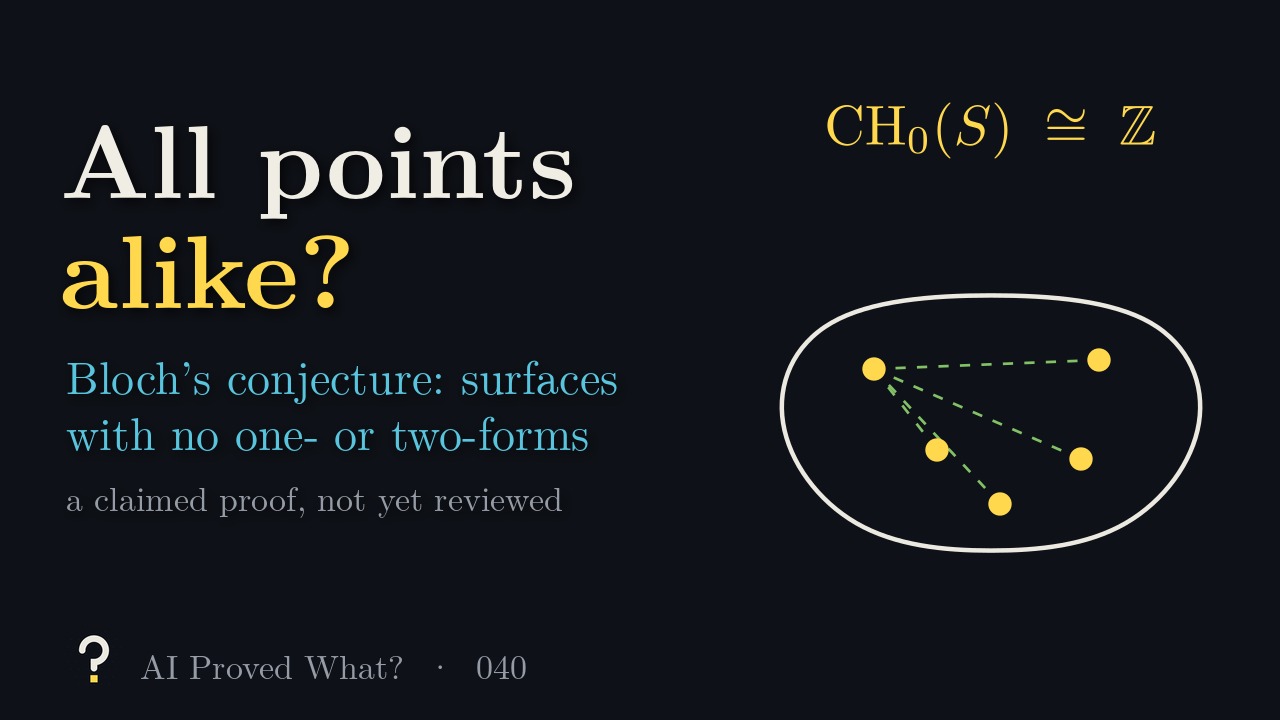
A zero-cycle on a surface is a formal sum of points with integer coefficients. Two are rationally equivalent if they differ by the zeros minus the poles of rational functions on curves; the classes form the Chow group CH0(S). Every class has a degree, and the degree-zero classes map onto the Albanese variety, a complex torus built from the one-forms. Mumford showed in 1969 that a nonzero holomorphic two-form makes CH0 infinite-dimensional. Spencer Bloch conjectured the converse in the 1970s: if the geometric genus pg is zero, the Albanese map on degree-zero zero-cycles is an isomorphism.
Result 040 is a single 45-page OpenAI preprint. Its main theorem treats pg = q = 0: for every smooth connected complex projective surface with no holomorphic one- or two-forms, the degree map CH0(S) → ℤ is an isomorphism with integer coefficients, so any two points are rationally equivalent. With the theorem of Bloch, Kas and Lieberman for surfaces not of general type, this gives Bloch’s conjecture for every surface with pg = 0. By known motivic criteria, the rational Chow motive of a surface with pg = q = 0 is then pure Tate.
What it doesn’t claim
The result is the pg = 0 case, over the complex numbers. It does not claim the general correspondence form of Bloch’s conjecture (a correspondence acting trivially on two-forms acts trivially on the Albanese kernel), which remains open.
Where it stands
- Posted as a preprint
- OpenAI, dated September 24, 2026, released October 6
- Peer reviewed
- Not yet
- Checked in Lean
- No: OpenAI published no Lean proof for this result
Last checked October 19, 2026. The paper has not been withdrawn or revised and uses no other paper from the release, but it relies on substantial modern machinery: derived moduli and determinant constructions, virtual classes, and cosection localization. Two other recent preprints propose proofs by different methods: Guletskiĭ (December 2025, the whole case) and Banerjee (minimal surfaces with K² = 9). We found no public assessment by specialists.
What was known
- Bloch–Kas–Lieberman (1976): every surface of Kodaira dimension below two. What remained were surfaces of general type with pg = q = 0, such as Godeaux, Campedelli and Barlow surfaces and fake projective planes.
- Special families by group actions and quotients (Inose–Mizukami, Barlow, Bauer, Pedrini–Weibel) and by families of surfaces (Voisin, for Catanese and Barlow surfaces).
How the proof goes
- The diagonal. On a minimal surface X of general type with pg = q = 0 (or a point blowup), find 0 = c[Δ] + Γ in CH²(X × X) with rational coefficients, c ≠ 0 and Γ a sum of products. The diagonal acts as the identity on zero-cycles and products kill degree-zero cycles, so the degree-zero group is torsion.
- A Quot scheme. Rank-zero quotients of L1 ⊕ L2 with fixed determinant, a torus acting with opposite weights, and virtual localization; keeping two surface factors through the Ellingsrud–Göttsche–Lehn recursion turns the numerical formula into the cycle relation.
- K² ≤ 8. A class α orthogonal to K with α² < 0, after at most three blowups, gives 0 = cα² + (a nonempty sum of squares), so c > 0.
- K² = 9. A comparison with the Cartwright–Steger surface (same Chern numbers, pg = q = 1), whose two-form detects the coefficient, and a length-two Hilbert scheme calculation give c = 12(s + τ) > 0. Roitman’s torsion theorem then gives the integral statement.
The numbers in the video
- A minimal surface of general type with pg = q = 0 has χ = 1, c2 = 12 − K² and b2 = 10 − K², so 1 ≤ K² ≤ 9. The Cartwright–Steger surface and the fake projective planes share K² = 9 and c2 = 3. A short Python script checks these.
Read the source
- Bloch’s conjecture for surfaces with pg = 0 (PDF), September 24, 2026 (45 pages).
- Mumford, Rational equivalence of 0-cycles on surfaces (1969); Bloch, Kas and Lieberman, Zero cycles on surfaces with pg = 0 (1976).
- The collection’s catalog, where this is result 040.
The paper
OpenAI groups related papers into one result; this one has a single paper.
Transcript
Read the full script
0:00Points up to equivalence
On a surface, a zero-cycle is a formal sum of points with integer coefficients, like p minus q. Two zero-cycles are rationally equivalent if they differ by the zeros minus the poles of rational functions on curves in the surface. The Chow group of zero-cycles collects the classes. On the projective plane, any two points are equivalent. The line through them is a projective line, and a function on it can have a zero at one point and a pole at the other. On any surface, every class has a degree, the sum of its coefficients, and the degree-zero part maps onto the Albanese variety, a complex torus built from the surface’s one-forms. So the question is when degree and the Albanese map tell you everything about zero-cycles.
0:47Mumford and Bloch
Mumford showed in 1969 that a nonzero holomorphic two-form makes the zero-cycles enormous: no finite-dimensional family parametrizes them. In the 1970s, Spencer Bloch conjectured the converse. When the geometric genus, p_g, is zero, meaning there are no such two-forms, the Albanese map on degree-zero cycles should be an isomorphism. Bloch, Kas and Lieberman proved it in 1976 for every surface that is not of general type. What remained are surfaces of general type with p_g and q both zero, such as Godeaux, Campedelli and Barlow surfaces, and fake projective planes. There, any two points should be rationally equivalent. Many families were settled one at a time, using group actions or Voisin’s method for families of surfaces, but no general proof was established.
1:42The claim
Result 040 is a single 45-page OpenAI preprint, dated September 24. It claims Bloch’s conjecture for every smooth complex projective surface with p_g equal to zero: the Albanese map on degree-zero zero-cycles, with integer coefficients, is an isomorphism. The main theorem is the case p_g equals q equals zero, where degree alone classifies zero-cycles, so any two points are rationally equivalent. Together with Bloch, Kas and Lieberman, that gives the whole conjecture. And by known motivic criteria, the rational Chow motive of such a surface is as simple as its cohomology.
2:25How the proof goes
The goal is one identity among cycles on X times X, with rational coefficients: a nonzero multiple of the diagonal, plus a sum of products of cycles, equals zero. The diagonal acts on zero-cycles as the identity, while the product terms kill every degree-zero cycle. So the identity forces the degree-zero group to be torsion. To find that identity, the paper uses a Quot scheme: quotients of a sum of two line bundles, with the determinant fixed. A torus acts with opposite weights on the two summands, and virtual localization writes a vanishing integral as a sum over torus-fixed quotients. Keeping two copies of the surface unintegrated through the Ellingsrud–Göttsche–Lehn recursion turns that numerical formula into the cycle identity on X times X. The second main step is showing that the diagonal’s coefficient isn’t zero. A minimal surface of this kind has K² between one and nine. When K² is at most eight, a class orthogonal to K with negative square, after at most three blowups, turns the identity into c times a negative number, plus a positive sum of squares, equals zero. So c is positive. When K² is nine, the paper compares with the Cartwright–Steger surface, which has the same Chern numbers but p_g and q equal to one, so its two-form can detect the coefficient. That comparison and a length-two Hilbert scheme calculation make the coefficient twelve times a positive number. Finally, Roitman’s torsion theorem removes the torsion, giving the statement with integers.
4:02Where it stands
This is a preprint, not yet peer reviewed, with no Lean proof, and it has not been revised. It uses no other paper from the release, but it leans on heavy modern machinery: derived moduli spaces, virtual classes and cosection localization. Two other recent preprints propose proofs, of the whole case or of K² equal to nine, by different methods. We found no public assessment. If it holds, the p_g = 0 case of Bloch’s conjecture is settled after about fifty years: on a surface with no holomorphic two-forms, a zero-cycle is determined by its degree and its Albanese image.
Spot a mistake?
This episode simplifies on purpose, but it shouldn’t be wrong. If something is, open an issue on GitHub or leave a comment on YouTube. Corrections are noted here with a date.