Fibered by tori?
Hyperkähler SYZ and projective-space bases
Covers result 041 in OpenAI’s catalog: all 2 papers. See its connections to other results and the work it cites.
4:36. English captions available. The video loads from YouTube when you press play.
Chapters
The claim, in plain words
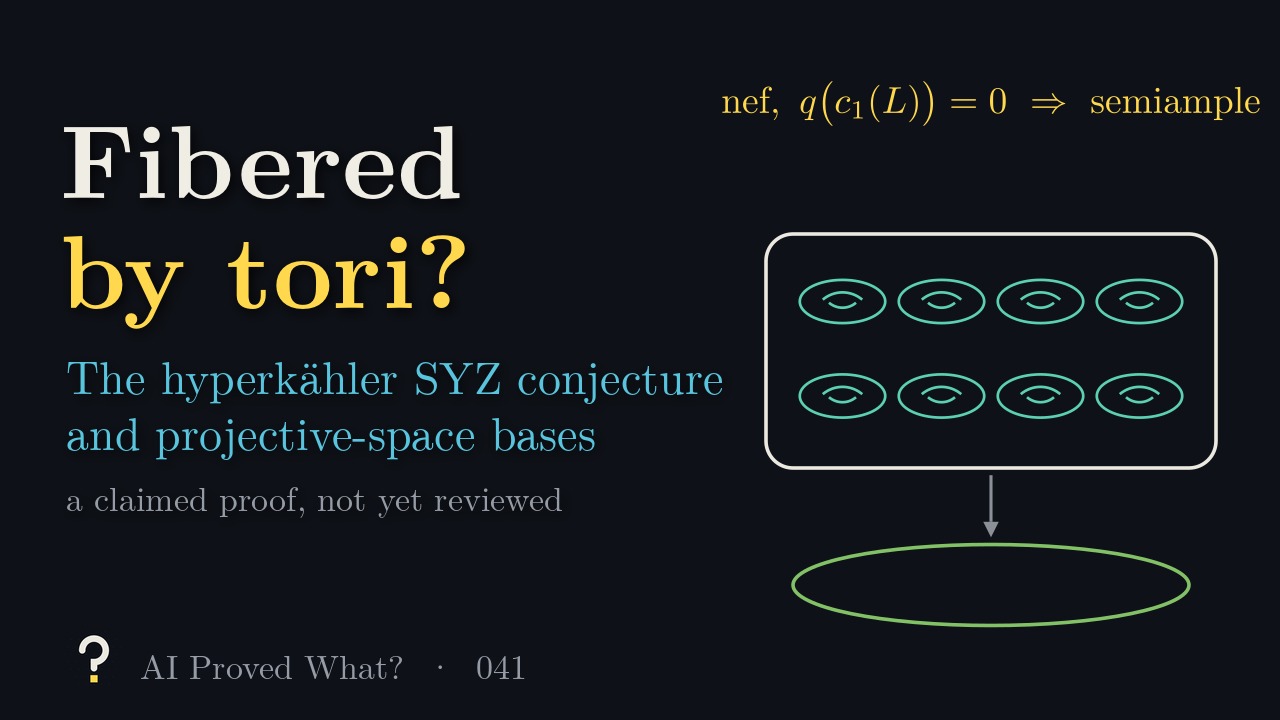
A hyperkähler (compact irreducible holomorphic symplectic) manifold is a simply connected compact Kähler manifold with a holomorphic two-form σ, nondegenerate everywhere and unique up to scale; its dimension is 2n, and for n = 1 these are the K3 surfaces. Its second cohomology carries the Beauville–Bogomolov–Fujiki form q. On a K3 surface, a nonzero nef line bundle with q = 0 is a multiple of an elliptic curve moving in a pencil, and gives an elliptic fibration over the projective line. The strong hyperkähler SYZ conjecture asks for the same in every dimension: a line bundle with nonzero nef isotropic class should be semiample, giving a fibration by Lagrangian tori over an n-dimensional base.
Result 041 has two preprints. A 32-page paper claims the strong hyperkähler SYZ conjecture for every compact irreducible holomorphic symplectic Kähler manifold, projective or not, with no restriction on dimension, deformation type or second Betti number. With the boundedness theorem of Engel–Filipazzi–Greer–Mauri–Svaldi, it deduces that in each dimension there are only finitely many deformation types with b2 ≥ 5. A 98-page companion claims that the normal projective base of every projective Lagrangian fibration of such a manifold is projective space.
What it doesn’t claim
The base theorem assumes the fibration is projective, which makes the manifold projective; for nonprojective manifolds the papers give the fibration but not the projective-space base. The finiteness corollary excludes second Betti number below five.
Where it stands
- Posted as preprints
- OpenAI, two papers dated September 23, 2026, released October 6
- Peer reviewed
- Not yet; OSVerify found one minor wording issue in the SYZ paper
- Checked in Lean
- No: OpenAI published no Lean proof for this result
Last checked October 19, 2026. Neither paper has been withdrawn or revised. The base paper uses the SYZ paper as an input, and both rest on many deep theorems, from limits of Ricci-flat metrics and special Lagrangian deformation theory to period maps and Hodge modules. OSVerify, a Stanford review project, refereed the SYZ paper (noted October 15, 2026) and reported no major issues and one minor one: the introduction describes a cited result of Engel, Filipazzi, Greer, Mauri and Svaldi as “boundedness”, while that result gives finitely many deformation classes in each dimension; the proof in Section 6 uses the correct finiteness statement. We found no other public assessment by specialists.
What was known
- For the four known deformation families (K3[n], generalized Kummer, O’Grady 6 and 10): work of Bayer–Macrì, Markman, Yoshioka, Mongardi–Rapagnetta and Mongardi–Onorati, with the deformation theorem of Soldatenkov–Verbitsky (a class semiample at one point of its family is semiample wherever it is nef).
- Bases: Matsushita (dimension n, Lagrangian fibers, for projective manifolds); Hwang (smooth base ⇒ ℙn); the known deformation types; dimension four (Ou, Huybrechts–Xu).
How the proof goes
- Degenerate. Keep the class as a labelled lattice vector, choose a polarization perpendicular to it, and build an algebraic family degenerating to a cusp labelled by the class, tracking monodromy.
- A torus. Rescaled Ricci-flat metrics near the degeneration converge to a flat cylinder; in logarithmic coordinates the nearby manifold contains an almost flat torus, perturbed to a special Lagrangian one.
- Rotate and return. Hyperkähler rotation and a cohomological criterion make the torus holomorphic Lagrangian on a nonprojective manifold, where Greb–Lehn–Rollenske give a fibration; Soldatenkov–Verbitsky carry semiampleness back to the original manifold.
- The base. An Euler characteristic obstruction, proved by reduction to positive characteristic, shows every singularity of the base is a finite quotient; a finite cover by an abelian variety rules those out too; Hwang’s theorem identifies the smooth base with ℙn.
The numbers in the video
- By Fujiki’s relation, a nonzero nef class a with q(a) = 0 has ∫akh2n−k = 0 for k > n and positive for k = n, so the expected base has dimension n. The second Betti numbers of the known types are 22 (K3), 23, 7, 8 and 24. A short Python script checks these.
Read the source
- The strong hyperkähler SYZ conjecture (PDF), September 23, 2026 (32 pages); Projective-space bases of Lagrangian fibrations (PDF), September 23, 2026 (98 pages).
- The collection’s catalog, where this is result 041.
The 2 papers in this result
OpenAI groups related papers, such as alternative proofs, supporting results and consequences, into one result; we label the first paper it lists the main paper and the others companions.
- Projective-space bases of Lagrangian fibrations main paper
- The strong hyperkähler SYZ conjecture companion
Transcript
Read the full script
0:00Hyperkähler manifolds
A hyperkähler manifold, also called irreducible holomorphic symplectic, is a simply connected compact Kähler manifold carrying a holomorphic two-form σ that is nondegenerate everywhere, and unique up to scale. Its complex dimension is even, two n. In dimension two, these are the K3 surfaces. Its second cohomology carries a quadratic form, the Beauville–Bogomolov–Fujiki form q. Call a class nef if it lies in the closure of the Kähler cone, and isotropic if q of it is zero. On a K3 surface, a nonzero nef isotropic line bundle is a multiple of an elliptic curve that moves in a pencil. Its sections map the surface onto the projective line, with elliptic curves as fibers.
0:47The SYZ picture
In higher dimensions the hope is the same. A nonzero nef isotropic line bundle should give a map onto an n-dimensional base whose general fibers are Lagrangian tori, half the dimension, with σ vanishing on them. This is a holomorphic cousin of the Strominger–Yau–Zaslow picture from mirror symmetry. The strong hyperkähler SYZ conjecture says that every such line bundle is semiample: some power is generated by its sections. For the four known families, it followed from work of Bayer and Macrì, Markman, Yoshioka, Mongardi and others, together with a deformation theorem of Soldatenkov and Verbitsky: if the class is semiample at one point of its family, it is semiample wherever it stays nef. A second question concerns the base. Matsushita showed, for projective manifolds, that it has dimension n, and the conjecture is that it is always projective space. Hwang proved that when the base is smooth.
1:46The claim
Result 041 has two OpenAI preprints, both dated September 23. A 32-page paper claims the strong hyperkähler SYZ conjecture: on every compact irreducible holomorphic symplectic Kähler manifold, projective or not, in every dimension and deformation type, a line bundle with nonzero nef isotropic class is semiample, and gives a Lagrangian fibration over an n-dimensional base. A 98-page companion claims that the base of a projective Lagrangian fibration is always projective space. And with a boundedness theorem of Engel, Filipazzi, Greer, Mauri and Svaldi, the first paper deduces that in each dimension, only finitely many deformation types have second Betti number at least five.
2:35How the proof goes
The SYZ proof builds one semiample deformation, then returns. First, keep the class as a labelled vector, choose a polarization perpendicular to it, and build an algebraic family that degenerates toward a cusp labelled by that class, tracking its monodromy. Second, near the degeneration, rescale the Ricci-flat metric. Its limit is a flat cylinder, so in logarithmic coordinates the nearby manifold contains an almost flat torus, and a small perturbation makes it special Lagrangian. Third, rotate the complex structure, which a hyperkähler metric allows. A cohomological criterion turns the special Lagrangian torus into a holomorphic Lagrangian torus, on a nonprojective manifold where a theorem of Greb, Lehn and Rollenske gives a fibration. Finally, the Soldatenkov–Verbitsky theorem carries semiampleness back to the original manifold. The base paper first shows that every singularity of the base is a finite quotient singularity, using an Euler characteristic obstruction proved by reduction to positive characteristic. Then a finite cover by an abelian variety rules out the quotient singularities too. A smooth base is projective space by Hwang’s theorem.
3:55Where it stands
These are preprints, not yet peer reviewed, with no Lean proof, and neither has been revised. The base paper uses the SYZ paper as an input, and both rest on many deep theorems, from limits of Ricci-flat metrics to period maps. We found no public assessment. If they hold, every nonzero nef isotropic line bundle on a hyperkähler manifold comes from a Lagrangian fibration, bases of projective Lagrangian fibrations are always projective space, and in each dimension the deformation types with second Betti number at least five are finite in number.
Spot a mistake?
This episode simplifies on purpose, but it shouldn’t be wrong. If something is, open an issue on GitHub or leave a comment on YouTube. Corrections are noted here with a date.