Every K3 flexible?
Oka classification for minimal compact complex surfaces: Kodaira dimension zero and class VII
Covers result 042 in OpenAI’s catalog: its one paper. See its connections to other results and the work it cites.
4:34. English captions available. The video loads from YouTube when you press play.
Chapters
The claim, in plain words
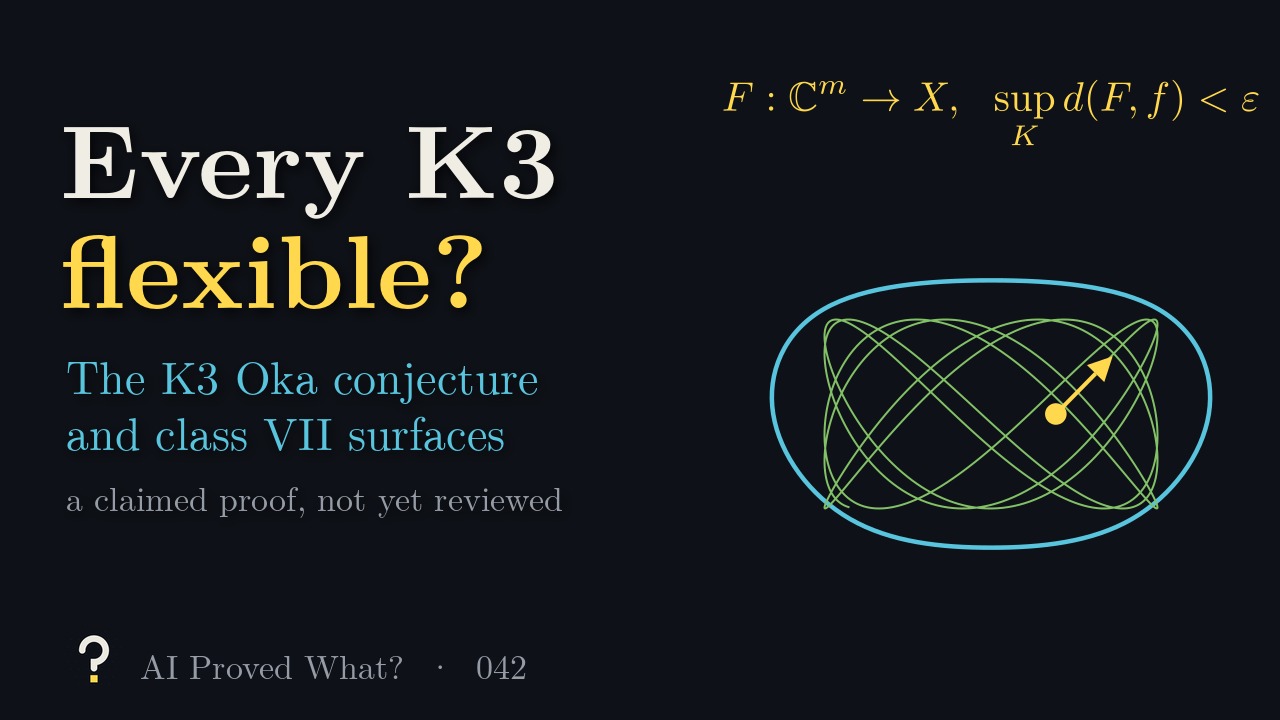
A complex manifold X is Oka if every holomorphic map into it defined near a compact convex set K ⊂ ℂm can be approximated uniformly on K by a holomorphic map from all of ℂm, for every m; Forstnerič showed this is equivalent to the full Oka principle. Oka manifolds are the opposite of hyperbolic ones: projective space, complex tori and Hopf surfaces are Oka, while a curve of genus two or more admits no nonconstant entire map at all. Whether every K3 surface is Oka was posed in Forstnerič and Lárusson’s survey (2011).
Result 042 is a single 56-page OpenAI preprint. It claims that every complex K3 surface is Oka, projective or not, with no condition on Picard rank or elliptic fibrations. Consequences: through every point, with any prescribed nonzero tangent vector, there is an immersed entire curve with dense image (Zariski dense if the surface is projective); every Enriques surface, and so every minimal compact complex surface of Kodaira dimension zero, is Oka; projective K3 and Enriques surfaces carry global dominating sprays. Separately, combining Forstnerič and Lárusson’s 2014 classification with the release’s global spherical shell theorem (result 060), a minimal class VII surface is Oka exactly when it is a Hopf or Enoki surface.
What it doesn’t claim
The classification statements are for minimal surfaces; nothing is claimed for arbitrary blowups or for properly elliptic surfaces. No global dominating spray is claimed on nonprojective K3 surfaces.
Where it stands
- Posted as a preprint
- OpenAI, dated September 23, 2026, released October 6
- Peer reviewed
- Not yet
- Checked in Lean
- No: OpenAI published no Lean proof for this result
Last checked October 19, 2026. The paper has not been withdrawn or revised. The K3 theorem uses no other paper from the release; the class VII statement does not use the K3 theorem and rests on result 060. We found no public assessment by specialists.
What was known
- Buzzard–Lu: elliptic and Kummer K3 surfaces are dominable by ℂ². Forstnerič–Lárusson: Kummer surfaces are strongly dominable.
- Kamenova–Lu–Verbitsky: the Kobayashi pseudodistance vanishes on every K3 (with Verbitsky’s 2017 correction).
- Alarcón–Forstnerič: the one-dimensional Oka-1 property for Kummer and elliptic K3 surfaces. Xie–Zhao (2026): Oka K3 surfaces with dense periods.
How the proof goes
- A local move. Enlarging a disc in the source across an attached disc, with arbitrary holomorphic parameters, follows near a point from two transverse holomorphic strips with complete directions.
- Convex sets. The local move at every point gives convex approximation in every dimension: a polynomial change of coordinates for polydiscs, then removal of the faces of a containing polytope.
- Finding strips. On projective K3 surfaces, two Chen–Gounelas families of genus-one curves; otherwise, long chains of annuli sewn exactly with bounds independent of their length, on two kinds of regions of period space.
- Periods. Ratner’s orbit theorem and Verbitsky’s analysis bring every non-projective period orbit into those regions; Torelli theory transfers the local move to every K3 surface.
The numbers in the video
- A K3 surface has Euler characteristic 24, b2 = 22 and h1,1 = 20; K3 surfaces form a 20-dimensional family, projective ones countably many 19-dimensional subfamilies, so the generic K3 is not projective. An Enriques surface has Euler characteristic 12 and a K3 double cover. A short Python script checks these.
Read the source
- Every complex K3 surface is Oka (PDF), September 23, 2026 (56 pages).
- Global Spherical Shells on Minimal Surfaces of Class VII (PDF), result 060 in the release.
- The collection’s catalog, where this is result 042.
The paper
OpenAI groups related papers into one result; this one has a single paper.
Transcript
Read the full script
0:00Flexible manifolds
Some complex manifolds are flexible: holomorphic maps into them can be bent almost at will. The model is complex Euclidean space. A manifold is called Oka if every holomorphic map into it, defined near a compact convex set in ℂ^m, can be approximated uniformly on that set by a holomorphic map defined on all of ℂ^m, for every m. Forstnerič showed that this convex approximation property is equivalent to the full Oka principle. Being Oka is the opposite of hyperbolicity. A compact Riemann surface of genus two or more admits no nonconstant holomorphic map from ℂ at all, so it is as far from Oka as possible. Projective space, complex tori and Hopf surfaces, on the other hand, are Oka.
0:49K3 surfaces
K3 surfaces sit in between. A complex K3 surface is a compact, simply connected complex surface with trivial canonical bundle, so it carries a nowhere-zero holomorphic two-form. Every K3 surface is Kähler, but most are not projective, and some contain no curves at all. Whether every K3 surface is Oka was posed in Forstnerič and Lárusson’s 2011 survey of Oka theory. Partial answers came from geometry. Buzzard and Lu showed that elliptic and Kummer K3 surfaces are dominated by ℂ². Kamenova, Lu and Verbitsky showed that the Kobayashi pseudodistance vanishes on every K3. Alarcón and Forstnerič proved a one-dimensional version, called Oka-1, for Kummer and elliptic K3 surfaces. And a 2026 preprint of Xie and Zhao found Oka K3 surfaces with dense periods, but a dense set of examples doesn’t reach every surface.
1:51The claim
Result 042 is a 56-page OpenAI preprint, dated September 23. It claims that every complex K3 surface is Oka, projective or not, with no condition on its Picard rank or on elliptic fibrations. As a consequence, through every point and in every tangent direction, there is an immersed entire curve whose image is dense. From this it derives that every Enriques surface, and so every minimal compact complex surface of Kodaira dimension zero, is Oka. Separately, the release’s global spherical shell paper, result 060, removes the one assumption in Forstnerič and Lárusson’s 2014 classification of class VII: among minimal ones, exactly the Hopf and Enoki surfaces are Oka.
2:41How the proof goes
The proof starts with a local operation: enlarge a disc in the source across an attached disc, while carrying along any number of holomorphic parameters. If two holomorphic strips through a point, each with one complete direction, cross transversally, a splitting argument gives this operation near that point. The paper then shows that this local operation at every point already gives approximation on all convex sets, in every dimension. A polynomial change of coordinates handles polydiscs, and then the faces of a containing polytope are removed one at a time. Next, the strips must be found. On projective K3 surfaces, two families of genus-one curves from Chen and Gounelas supply complete directions. For the others, the paper builds strips from long chains of annuli, sewn exactly with bounds that don’t grow with the chain’s length, on two kinds of regions of the period space. Finally, period dynamics. By Ratner’s orbit theorem and Verbitsky’s analysis, the orbit of every non-projective K3 period meets one of those regions, and projective surfaces were already handled. Torelli theory then transfers the local operation to every K3 surface.
3:57Where it stands
This is a preprint, not yet peer reviewed, with no Lean proof, and it has not been revised. The K3 theorem uses no other paper from the release, while the class VII classification skips the K3 theorem and rests on result 060. We found no public assessment. If it holds, every K3 surface, even one with no curves at all, is Oka: any holomorphic map into it from near a compact convex set in ℂ^m can be approximated there by a holomorphic map from all of ℂ^m.
Spot a mistake?
This episode simplifies on purpose, but it shouldn’t be wrong. If something is, open an issue on GitHub or leave a comment on YouTube. Corrections are noted here with a date.