P = W, every rank?
P = W for fixed-determinant SLn moduli spaces
Covers result 043 in OpenAI’s catalog: its one paper. See its connections to other results and the work it cites.
4:02. English captions available. The video loads from YouTube when you press play.
Chapters
The claim, in plain words
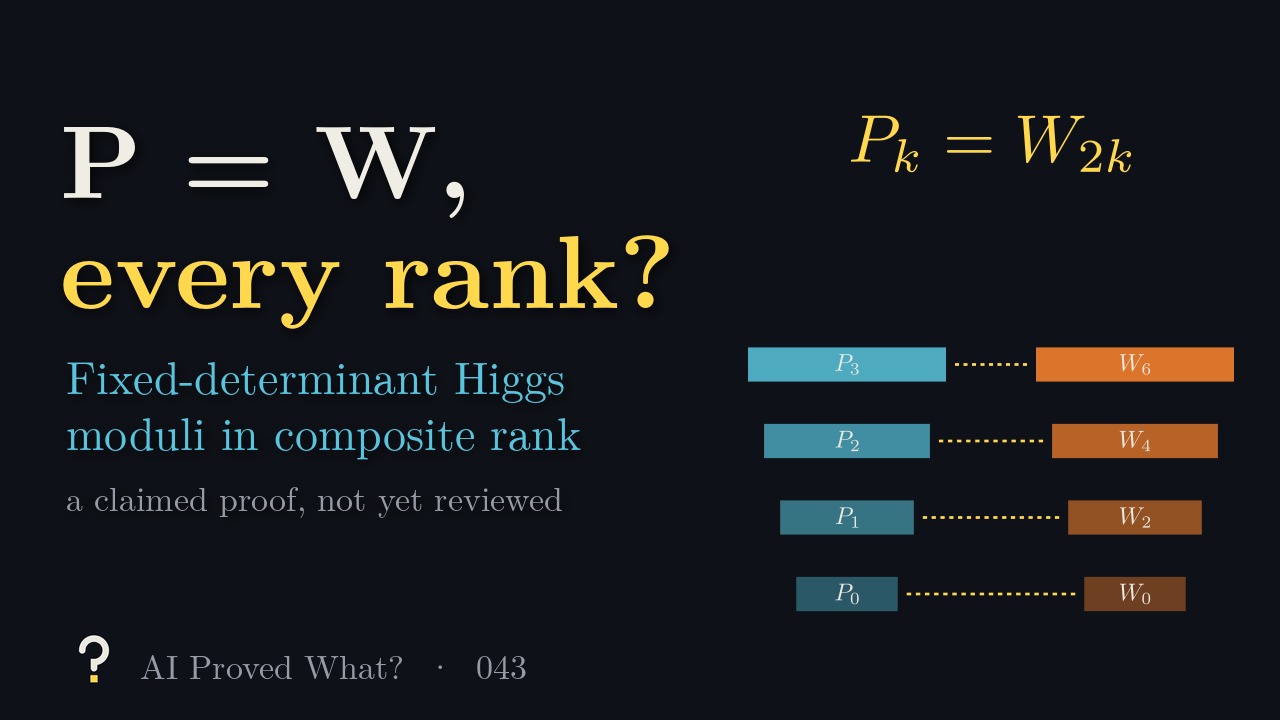
On a compact Riemann surface of genus at least two, nonabelian Hodge theory identifies the moduli space of Higgs bundles (a vector bundle with a matrix of one-forms) with a twisted character variety: the same smooth manifold with very different algebraic structures. The Hitchin map on the Higgs side gives the perverse filtration P on the cohomology; Deligne’s mixed Hodge theory on the character variety gives the weight filtration W. De Cataldo, Hausel and Migliorini proposed around 2010 that Pk = W2k, and proved it in rank two. For GLn it was proved in every rank by Maulik and Shen, with further proofs by Hausel–Mellit–Minets–Schiffmann and Maulik–Shen–Yin.
For fixed determinant and trace-free Higgs field (SLn), the group Γ of n-torsion line bundles acts, and the variant cohomology it moves is invisible to the GLn theory; de Cataldo, Maulik and Shen treated it in prime rank. Result 043 is a single 39-page OpenAI preprint claiming Pk = W2k = W2k+1 on the full rational cohomology, variant part included, for every composite rank n ≥ 4, every degree d coprime to n, and every curve of genus at least two. With the prime-rank cases this would complete the fixed-determinant conjecture in every rank with coprime degree.
What it doesn’t claim
The result concerns the smooth, coprime case (gcd(n, d) = 1). Its answer to Maulik and Shen’s question on endoscopic correspondences is stated for the canonical-twist operator.
Where it stands
- Posted as a preprint
- OpenAI, dated September 24, 2026, released October 6
- Peer reviewed
- Not yet
- Checked in Lean
- No: OpenAI published no Lean proof for this result
Last checked October 19, 2026. The paper has not been withdrawn or revised and uses no other paper from the release. It builds on the method of Hausel, Mellit, Minets and Schiffmann and on Mellit’s toric stratifications. We found no public assessment by specialists.
How the proof goes
- The class e. Cup product with a single degree-two class satisfies relative hard Lefschetz on the Higgs side and curious hard Lefschetz on the character variety; the latter is proved on the full cohomology by lifting Mellit’s toric stratifications through a determinant-root cover.
- A criterion. An operator f with fPk ⊂ Pk−2, fWj ⊂ Wj−4 and [[f, e], e] = −2e makes both filtrations sums of the same eigenspaces of [e, f].
- Building f. One logarithmic pole, moved over the curve, with a full flag; shifting two residue eigenlines in opposite directions gives a translation, which on the character side is eigenvalue monodromy whose logarithm lowers weights; a flag correspondence gives f, and nearby cycles give the perverse bound.
- The commutator. A lattice Riemann–Roch calculation gives [[f, e], e] = −2e; since f is built before averaging over Γ, the variant cohomology is covered.
The numbers in the video
- For rank n and genus g, the Hitchin base has dimension R = (n² − 1)(g − 1) and the moduli space 2R; Γ has n2g elements (for n = 4, g = 2: R = 15, |Γ| = 256). A short Python script checks these and the sl2 normalization [[f, e], e] = −2e.
Read the source
- P = W in composite rank for fixed determinant (PDF), September 24, 2026 (39 pages).
- The collection’s catalog, where this is result 043.
The paper
OpenAI groups related papers into one result; this one has a single paper.
Transcript
Read the full script
0:00Two filtrations
Fix a compact Riemann surface C of genus at least two. Nonabelian Hodge theory matches two moduli spaces. One parametrizes Higgs bundles: a vector bundle with a Higgs field, a matrix of one-forms. The other parametrizes twisted representations of the fundamental group, a character variety. They are the same as smooth manifolds, but their algebraic structures are completely different. Each side puts a filtration on the shared cohomology. On the Higgs side, the Hitchin map, which records the characteristic polynomial of the Higgs field, gives the perverse filtration P. On the character variety, Deligne’s mixed Hodge theory gives the weight filtration W. The P = W conjecture says they agree after doubling the index: P_k = W_2k. De Cataldo, Hausel and Migliorini proposed this around 2010, and proved it in rank two.
0:56The fixed-determinant problem
For the general linear group, Maulik and Shen proved P = W in every rank, and Hausel, Mellit, Minets and Schiffmann, and Maulik, Shen and Yin gave further proofs. The special linear version, with fixed determinant and trace-free Higgs field, is harder. A finite group Γ of n-torsion line bundles acts on the cohomology, and the part it does not fix, the variant cohomology, is invisible to the general linear theory. De Cataldo, Maulik and Shen handled the variant part in prime rank. For composite ranks, four, six, eight, nine and so on, the full equality remained open.
1:33The claim
Result 043 is a 39-page OpenAI preprint, dated September 24. It claims P = W on the full rational cohomology, variant part included, for every composite rank n, every degree d coprime to n, and every curve of genus at least two: P_k = W_2k, and also W_2k+1. Together with the prime-rank cases, that would settle the fixed-determinant P = W conjecture in every rank, for coprime degree. The paper also claims to answer a question of Maulik and Shen about their endoscopic correspondences.
2:12How the proof goes
Both filtrations come with a Lefschetz operator: cup product with one degree-two class e. It satisfies relative hard Lefschetz on the Higgs side, and curious hard Lefschetz on the character variety. The paper proves the second on the full cohomology, by lifting Mellit’s toric stratifications through a cover that takes roots of the determinant. Now suppose one more operator f lowers P by two and W by four, and its double commutator with e is minus two e. Then a linear algebra argument shows that both filtrations are sums of the same eigenspaces, so they coincide. To build f, allow one logarithmic pole on the curve, move it around, and choose a full flag there. Shifting two eigenlines at the pole in opposite directions gives a translation. On the character side it is eigenvalue monodromy, whose logarithm lowers weights. A flag correspondence then gives f, and on the Higgs side, nearby cycles give the perverse bound. A lattice Riemann–Roch calculation gives the double commutator. And because f is built before averaging over Γ, the argument covers the variant cohomology too.
3:24Where it stands
This is a preprint, not yet peer reviewed, with no Lean proof, and it has not been revised. It uses no other paper from the release, but it rests on a large body of recent work, including the method of Hausel, Mellit, Minets and Schiffmann, and Mellit’s stratifications. We found no public assessment. If it holds, the two filtrations agree on the whole cohomology of every smooth fixed-determinant moduli space with coprime rank and degree: the topology of Hitchin’s integrable system mirrors the Hodge theory of the character variety.
Spot a mistake?
This episode simplifies on purpose, but it shouldn’t be wrong. If something is, open an issue on GitHub or leave a comment on YouTube. Corrections are noted here with a date.