Shafarevich refuted?
Shafarevich counterexamples in dimension two and with large fundamental group
Covers result 046 in OpenAI’s catalog: all 2 papers. See its connections to other results and the work it cites.
5:25. English captions available. The video loads from YouTube when you press play.
Chapters
The claim, in plain words
Every compact Riemann surface is covered by the sphere, the plane or the disk. Shafarevich asked whether, in every dimension, the universal cover of a smooth projective variety is holomorphically convex: for every compact set K, the hull of points where every holomorphic function is bounded in absolute value by its maximum on K is compact again. A holomorphically convex cover maps properly onto a Stein space with compact fibers, so a cover with no compact curves or anything larger should itself be Stein. Strong evidence pointed that way: Katzarkov proved it for virtually nilpotent fundamental groups, and Eyssidieux, Katzarkov, Pantev and Ramachandran for fundamental groups with a faithful linear representation. Bogomolov and Katzarkov proposed potential counterexamples that depended on unproved group theory.
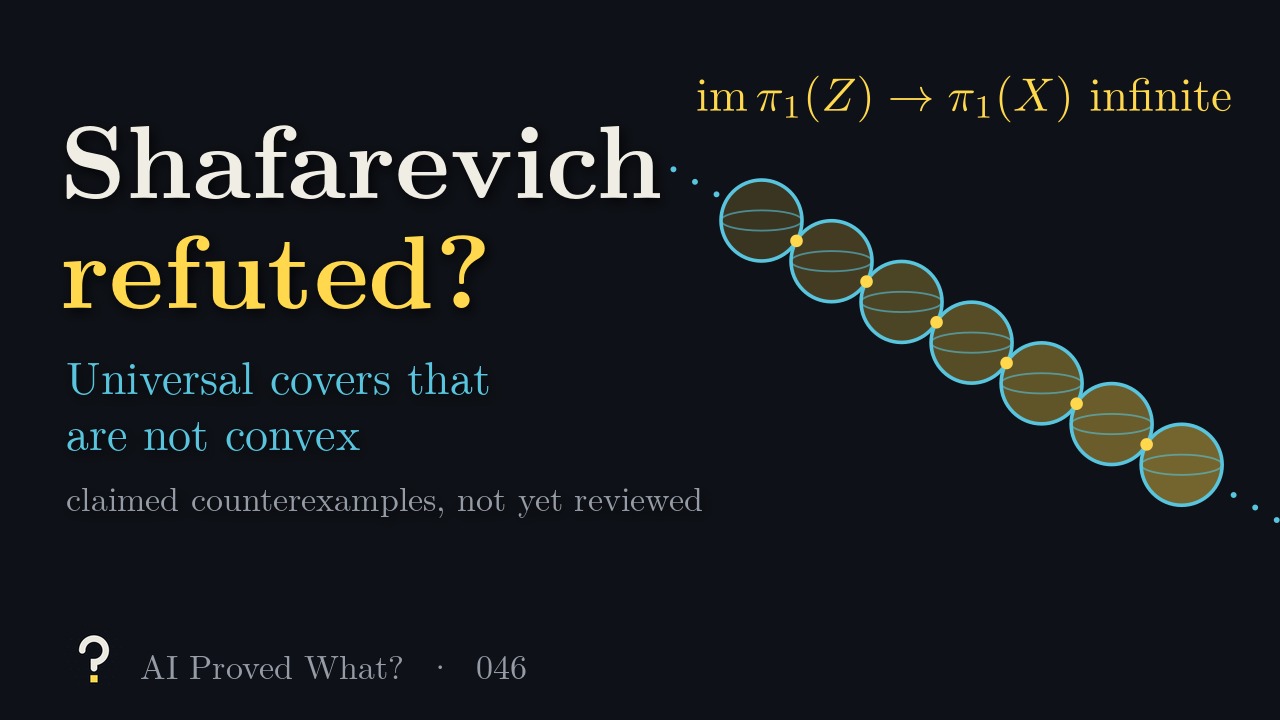
Result 046 is two OpenAI preprints. The first (September 23, 2026; 26 pages) claims a smooth projective surface containing a connected nodal cluster of rational curves whose fundamental-group image is infinite. In the universal cover the cluster unrolls into a noncompact necklace of compact spheres on which every holomorphic function is constant, so the cover is not holomorphically convex. The second (October 5, 2026; 41 pages) claims a smooth projective fourfold with large fundamental group, so its universal cover contains no positive-dimensional compact subvarieties, while a simple abelian surface inside it has infinite cyclic image. Its lift is a line times a three-torus, with nonzero homology in degree three, which a Stein surface cannot have; so the cover is not Stein, which would refute even the large-fundamental-group form of the conjecture.
What it doesn’t claim
The linear Shafarevich theorem is untouched: the surface’s fundamental group has no faithful finite-dimensional complex representation. The fourfold paper constructs a fourfold; it does not claim a counterexample with large fundamental group in dimension two or three.
Where it stands
- Posted as preprints
- OpenAI, dated September 23 (surface) and October 5, 2026 (fourfold), released October 6
- Peer reviewed
- Not yet
- Checked in Lean
- No: OpenAI published no Lean proof for this result
Last checked October 19, 2026. Neither paper has been withdrawn or revised. The fourfold paper cites no other paper from the release; the surface paper cites two release papers, only for side remarks about its surface. We found no public assessment by specialists.
How the constructions go
- The family. From the elliptic curve with an automorphism of order three, multiplication by four and the sign quotient give a family of spheres with 48 moving punctures. At one parameter value they collide in 24 pairs; a double base change and blowups give a main sphere with 24 spheres attached.
- An infinite group. A weighted Golod–Shafarevich count for pro-2 groups: 48 generators against 24 relations imposing the sign symmetry leave, at t = 49/200, a margin of about 0.028; one hundredth is spent on deep monodromy relations and one hundredth on high powers of the boundary loops, so the quotient stays infinite.
- The surface. A finite cover chosen to be faithful on every local boundary group gives a smooth projective surface whose special fiber is a cluster of spheres meeting in loops, and those loops carry the infinite image.
- The fourfold. A genus-two curve with simple Jacobian; hyperplane arrangements in complex hyperbolic ball quotients make its image cyclic; local covers modeled on the infinite dihedral group, read along hyperbolic graphs, show the image is infinite; two copies and an order-four symmetry lead to the Jacobian; a complete intersection in a product with a six-dimensional abelian variety gives the fourfold.
The numbers in the video
- A short Python script checks the puncture counts (96 upstairs, 48 on the sphere, 24 colliding pairs, free groups of ranks 47 and 97), the weighted Golod–Shafarevich count in exact fractions (generator polynomial 3t(1 + t + t² + t³)², relation polynomial 3t(1 + t)(1 + t²)², total below −1/125 at t = 49/200), the Betti numbers 1, 3, 3, 1 of the three-torus, and the fourfold paper’s incidence count.
Read the source
- A surface counterexample to Shafarevich holomorphic convexity (PDF), September 23, 2026 (26 pages).
- A projective fourfold with large fundamental group and non-Stein universal cover (PDF), October 5, 2026 (41 pages).
- The collection’s catalog, where this is result 046.
The 2 papers in this result
OpenAI groups related papers, such as alternative proofs, supporting results and consequences, into one result; we label the first paper it lists the main paper and the others companions.
Transcript
Read the full script
0:00Covers and convexity
Every compact Riemann surface is covered by one of three simple spaces: the sphere, the plane, or the disk. Shafarevich asked, in his textbook on algebraic geometry, whether something similar holds in every dimension: is the universal cover of every smooth projective variety holomorphically convex? Holomorphically convex means this. Take any compact set K. Collect the points where every holomorphic function is no bigger, in absolute value, than its largest absolute value on K. That hull must be compact again. Then the cover maps properly onto a Stein space, a space with plenty of holomorphic functions, and the fibers are compact. So if the cover contains no compact curves or anything larger, the conjecture says it should itself be Stein. The evidence was strong. Katzarkov proved it for virtually nilpotent fundamental groups, and Eyssidieux, Katzarkov, Pantev and Ramachandran proved it whenever the fundamental group has a faithful linear representation. Bogomolov and Katzarkov proposed possible counterexamples, but they depended on group theory that was never proved.
1:10Two obstructions
Here is the obstruction. Take a connected cluster of rational curves, spheres meeting at nodes, where the meetings form closed loops. Each sphere is simply connected, but those loops can have infinite image in the fundamental group. Then in the universal cover, each sphere lifts to a compact sphere, but the cluster unrolls into an infinite necklace. A holomorphic function is constant on each compact sphere, and neighbors share a point, so it takes one value on the whole necklace. The hull of a single point then contains the entire necklace, which is not compact. The cover is not holomorphically convex. The second obstruction is topological. Put an abelian surface, a torus of real dimension four, inside the variety, so that its fundamental group, Z⁴, has image Z in the variety’s fundamental group. In the universal cover it becomes a line times a three-torus, which has nonzero homology in degree three. Inside a Stein manifold it would be a Stein surface, with the homotopy type of a two-dimensional complex, so the cover cannot be Stein.
2:16The claim
Result 046 consists of two OpenAI preprints. The first, 26 pages dated September 23, claims a smooth projective surface containing a connected cluster of rational curves with infinite image in its fundamental group. If it holds, Shafarevich’s conjecture fails in dimension two. The second, 41 pages dated October 5, claims a smooth projective fourfold with large fundamental group, so its universal cover contains no compact curves or anything larger, while a simple abelian surface inside it has infinite cyclic image. The cover is then not Stein, which would refute even the large fundamental group form of the conjecture.
3:01How the constructions go
The surface starts from the elliptic curve with a symmetry of order three. Multiplication by four and the sign quotient give a family of spheres with 48 moving punctures. At one parameter value they collide in 24 pairs, and a base change and blowups turn that fiber into a main sphere with 24 spheres attached. The hard part is a quotient group that stays infinite after every relation is imposed. The tool is the Golod–Shafarevich inequality, from the same Shafarevich: a pro-2 group is infinite if, at some weight t, its weighted generators exceed its weighted relations by more than one. Forty-eight generators, 24 relations for the sign symmetry, and at t = 49/200 that leaves a margin of almost three hundredths. One hundredth goes to deep monodromy relations, and one hundredth to high powers of the boundary loops. Then a finite cover, chosen so that no local boundary group loses information, gives a smooth projective surface. There the special fiber becomes a cluster of spheres whose meetings form loops, and those loops carry the infinite image. The fourfold starts from a genus-two curve with a simple Jacobian. Arrangements of hyperplanes in complex hyperbolic ball quotients impose relations that make the curve’s image cyclic. Local covers modeled on the infinite dihedral group, read along hyperbolic graphs, are used to argue that this image is infinite. Two copies of the curve, folded by an order-four symmetry, lead to its Jacobian, a simple abelian surface, whose image the paper argues is infinite cyclic too. Cutting its ambient variety, times a six-dimensional abelian variety, down to dimension four gives the fourfold.
4:53Where it stands
These are two preprints, not yet peer reviewed, with no Lean proof, and neither has been revised. The fourfold paper cites nothing else from the release; the surface paper cites two release papers, only for side remarks. We found no public assessment. If they hold, the universal cover of a smooth projective variety need not be holomorphically convex, already for a surface, and not even when it contains no compact curves or anything larger.
Spot a mistake?
This episode simplifies on purpose, but it shouldn’t be wrong. If something is, open an issue on GitHub or leave a comment on YouTube. Corrections are noted here with a date.