Free, yet singular?
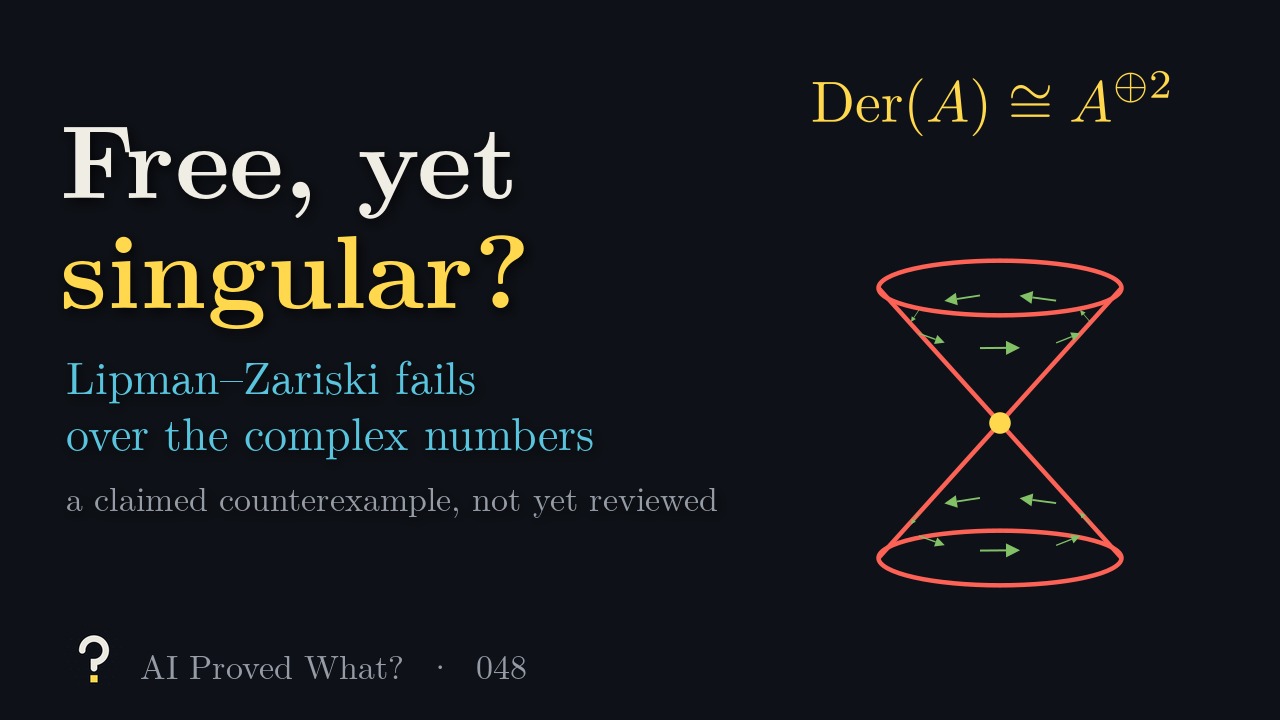
A characteristic-zero counterexample to Lipman–Zariski
Covers result 048 in OpenAI’s catalog: its one paper. See its connections to other results and the work it cites.
4:20. English captions available. The video loads from YouTube when you press play.
Chapters
The claim, in plain words
Near a smooth point of a surface, two vector fields generate all the others, with functions as coefficients: the tangent sheaf is locally free of rank two. The Lipman–Zariski conjecture says the converse over the complex numbers: a variety whose tangent sheaf is locally free is smooth. In positive characteristic it fails: on xy = zp, the fields x∂x − y∂y and ∂z generate all vector fields. Over ℂ, Lipman showed such a variety is normal, and the conjecture was proved for hypersurfaces, positively graded rings (Hochster), isolated singularities in dimension at least three (van Straten–Steenbrink), and log terminal and log canonical singularities. For surfaces, Graf proved it when the geometric genus is at most one, and Bergner and Graf when pg − g − b ≤ 2.
Result 048 is a single 37-page OpenAI preprint claiming a normal affine complex surface, singular at exactly one point, whose derivation module is free of rank two on the whole surface. Its singular point is Gorenstein; the resolution has one exceptional curve, of genus 21 and self-intersection −10; the discrepancy is −5 (not log canonical) and pg ≥ 33, so pg − g − b ≥ 12. By Jörder’s theorem, no frame near the point can consist of commuting fields.
What it doesn’t claim
The positive results above are untouched: the singularity is not log canonical and lies far outside the surface criteria. Compact surfaces with free tangent sheaf are still complex two-tori (Graf).
Where it stands
- Posted as a preprint
- OpenAI, dated September 23, 2026, released October 6
- Peer reviewed
- Not yet
- Checked in Lean
- No: OpenAI published no Lean proof for this result
Last checked October 19, 2026. The paper has not been withdrawn or revised and cites no other paper from the release. Consequences in the paper: the smooth locus has log Kodaira dimension two, and blowing up along the derivation module never resolves the point. We found no public assessment by specialists.
How the construction goes
- The target. A curve C of genus 21 on ℙ¹ × ℙ¹ with a line bundle L, L4 ≅ KC; near the zero section of L−1, the two-form t−5 dt ∧ dz; two vector fields whose pairing with it is one along C and nonzero nearby give a frame off C.
- Residue data. The leading terms come from two sections of L with six common zeros; the pointwise corrections and global residue conditions are supplied by an auxiliary elliptic curve, a two-torsion relation and six vectors in a quadratic plane with total square 90, carried to C by a trace pairing.
- Glue and contract. The gluing of the neighborhood is changed by holomorphic flows, keeping the normal bundle, and the fields are solved order by order; finitely many orders suffice. Grauert’s criterion contracts C to a point, and normality extends the frame.
- Singular and algebraic. Adjunction gives KY · C = 50 > 0, so the point is singular; approximation with finite determinacy (in the style of Artin) gives an affine algebraic surface with the same completed local ring, and freeness carries over.
The numbers in the video
- A short Python script checks the characteristic-p fields on xy = zp, the genus (8 − 1)(4 − 1) = 21 of a bidegree (8, 4) curve, deg K = 40 = 4 · 10, KY · C = 50 and the discrepancy −5, the bound pg ≥ 12 + 21 = 33, and the paper’s six-vector construction with total square 90.
Read the source
- A singular normal affine surface with free tangent sheaf (PDF), September 23, 2026 (37 pages).
- The collection’s catalog, where this is result 048.
The paper
OpenAI groups related papers into one result; this one has a single paper.
Transcript
Read the full script
0:00A frame of vector fields
On a smooth surface, near every point, there are two vector fields that generate all the others: every vector field there is a combination of them, with functions as coefficients. So, near each point, the tangent sheaf is free of rank two. At a singular point, like the tip of a cone, that usually fails. The Lipman–Zariski conjecture says it always fails: over the complex numbers, if the tangent sheaf of a variety is locally free, the variety is smooth. In positive characteristic this is false. On the surface xy = zᵖ, ∂/∂z is a vector field, because the derivative of zᵖ is zero. Together with x∂/∂x − y∂/∂y, it generates all the others.
0:45What was known
Over the complex numbers, Lipman showed that such a variety must be normal. The conjecture was then proved for hypersurfaces, for positively graded rings, like cones, by Hochster, for isolated singularities in dimension three and up by van Straten and Steenbrink, and for log terminal and log canonical singularities. For surfaces, Graf proved it when the geometric genus is at most one, and Bergner and Graf when p_g − g − b is at most two. The general surface case stayed open.
1:18The claim
Result 048 is a 37-page OpenAI preprint, dated September 23. It claims a normal affine complex surface, singular at exactly one point, whose module of vector fields is free of rank two on the whole surface. If it holds, the Lipman–Zariski conjecture is false over the complex numbers. The singular point is Gorenstein. Its resolution has a single exceptional curve, of genus 21 and self-intersection −10. The discrepancy is −5, so the point is not log canonical. The geometric genus is at least 33, so p_g − g − b is at least twelve, far past the bound of two. By a theorem of Jörder, no frame near the point can consist of commuting fields.
2:06Building the fields
Start from a curve C of genus 21 on a product of two projective lines, and a line bundle L whose fourth power is the canonical bundle. Near the zero section of the dual bundle, take the two-form t to the −5, d t wedge d z. The goal is two vector fields whose pairing with this form equals one along the curve and stays nonzero near it. Then they are independent everywhere off the curve. Their leading terms come from two sections of L with six common zeros. Each zero needs a correction, and the corrections must also satisfy global residue conditions. An auxiliary elliptic curve, a two-torsion relation, and six vectors in a quadratic plane, with total square ninety, supply the data, and a trace pairing carries them over to C, where they satisfy both. Then the paper changes the gluing of the neighborhood by holomorphic flows, keeping the normal bundle, and solves for the fields order by order. Finitely many orders suffice, because a cohomology vanishing then lifts these expansions to genuine fields. Grauert’s criterion contracts the curve to a point, and normality extends the two fields to a frame there. Adjunction shows that the point is singular: at a smooth point, the canonical class would meet the curve nonpositively, but here their intersection number is fifty. Finally, approximation in the style of Artin turns the analytic germ into an affine algebraic surface with the same completed local ring, and freeness carries over.
3:39Where it stands
This is a preprint, not yet peer reviewed, with no Lean proof, and it has not been revised. It cites no other paper from the release. As consequences, the smooth part of the surface has log Kodaira dimension two, and blowing up along the derivation module never resolves the point. We found no public assessment. If it holds, a free tangent sheaf alone cannot detect smoothness over the complex numbers. A surface can carry two vector fields that generate every other one, everywhere, and still be singular. At the singular point both fields vanish, and no such pair can commute.
Spot a mistake?
This episode simplifies on purpose, but it shouldn’t be wrong. If something is, open an issue on GitHub or leave a comment on YouTube. Corrections are noted here with a date.