One variable too few?
A stable-coordinate counterexample in four variables
Covers result 049 in OpenAI’s catalog: all 2 papers. See its connections to other results and the work it cites.
4:41. English captions available. The video loads from YouTube when you press play.
Chapters
The claim, in plain words
A polynomial f in ℂ[x1, …, xn] is a coordinate if a polynomial automorphism turns it into x1; then every level set of f is a hyperplane in disguise. The stable coordinate conjecture (Shpilrain and Yu) says adding variables cannot create coordinates; it holds in two and three variables, and episode 047 covered a claimed failure in five. The Abhyankar–Sathaye conjecture asks whether an irreducible f whose zero set is a copy of affine space must be a coordinate; in the plane, the Abhyankar–Moh–Suzuki theorem says yes, and above the plane only special cases were known.
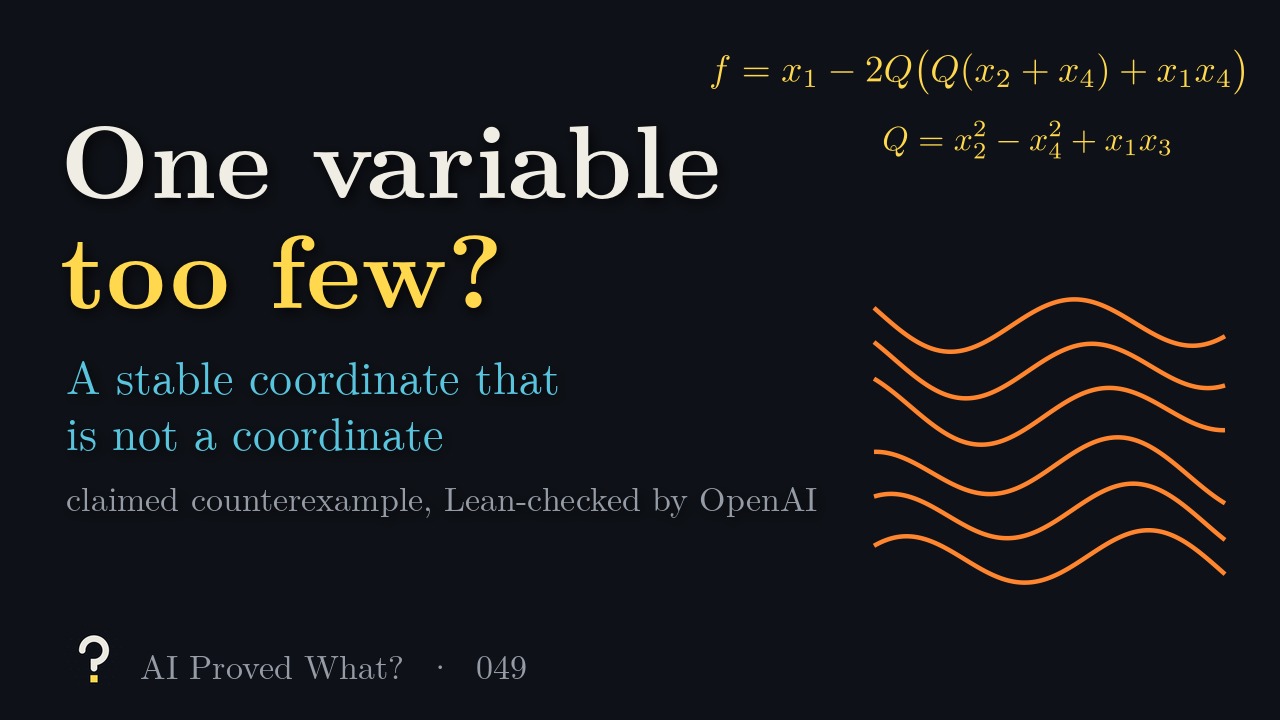
Result 049 is two OpenAI preprints. The main one (October 5, 2026; 14 pages) takes Q = x2² − x4² + x1x3 and f = x1 − 2Q(Q(x2 + x4) + x1x4), of degree five, and claims that f becomes a coordinate after adjoining one variable but is not a coordinate of ℂ[x1, …, x4]. Every level set of f is affine three-space, embedded so that no change of coordinates straightens it: the stable coordinate conjecture would fail in four variables, the first possible case, and Abhyankar–Sathaye would fail in dimension four. A companion (September 24, 2026; 6 pages) gives a degree-17 polynomial whose zero set is affine three-space but whose gradient vanishes at (2, 0, −1/2, 1/2), so it is not a coordinate; adding variables gives Abhyankar–Sathaye counterexamples in every dimension from four up.
What it doesn’t claim
Neither paper addresses three variables, where the Abhyankar–Sathaye question (can every plane in three-space be straightened?) remains open.
Where it stands
- Posted as preprints
- OpenAI, dated October 5 and September 24, 2026, released October 6
- Peer reviewed
- Not yet
- Checked in Lean
- The four-variable package and the companion, by OpenAI (scope note); we have not run the check
Last checked October 19, 2026. Neither paper has been withdrawn or revised. OpenAI’s Lean formalizations cover the four-variable package (degree five, one-stable, not a coordinate, every fiber affine three-space and not straightenable), the companion in every dimension from four up, and a related statement about commuting derivations: about 18,200 lines in 145 files, not counting Mathlib. The main paper adapts the method of result 047 but proves everything it needs. We found no public assessment by specialists.
How the proof goes
- A hypersurface model. Four-space is built as the hypersurface H = x²F − (1 + 2sx)J − pJ² − u = 0 in ℂ[p, s, u, F, J], x = s² − u² + pF; a determinant-one matrix change makes it linear in one variable and turns p into f.
- Stabilization. A derivation sends H to p; its flow turns H into H + pw, and after adjoining w, f is a coordinate. The same formulas make every level set affine three-space.
- A graded shadow. With weights −1, 0, 0, 1, 1 on p, s, u, F, J, the associated graded ring is built over the quadric xy = z(z + 1); a coordinate system containing f would give a nonzero additive action on the quadric killing a nonzero element of an explicit ideal.
- A factorization. Lifted to SL2 (with u), the ideal becomes principal, generated by v = a³b + a²u² − d²; a second grading isolates a²u² − d² = (au − d)(au + d), which forces a coefficient of negative weight in ℂ[a, d, u]: impossible.
The numbers in the video
- A short Python script checks that f has degree 5 and 16 terms, that the determinant-one matrix change turns p into f exactly, the derivation identities, the fiber p = 0, the factorization, and the companion’s identity x² + y³ = hs, its value −1 and zero gradient at (2, 0, −1/2, 1/2), and its degree 17.
Read the source
- A stable coordinate that is not a coordinate in four variables (PDF), October 5, 2026 (14 pages).
- An explicit noncoordinate polynomial with affine three-space zero fibre (PDF), September 24, 2026 (6 pages).
- OpenAI’s Lean scope note for result 049.
- The collection’s catalog, where this is result 049.
The 2 papers in this result
OpenAI groups related papers, such as alternative proofs, supporting results and consequences, into one result; we label the first paper it lists the main paper and the others companions.
Transcript
Read the full script
0:00Coordinates
In a polynomial ring in n variables, a polynomial f is a coordinate if some invertible polynomial change of variables turns it into x₁. Then every level set of f is a flat hyperplane in disguise. The stable coordinate conjecture says that adding variables cannot create coordinates: if f becomes a coordinate after one more variable is adjoined, it was already one. It holds in two and three variables, so four is the first case that could fail. Episode 047 claimed a failure in five. A related question, the Abhyankar–Sathaye conjecture, asks: if f is irreducible and its zero set is a copy of affine space, must f be a coordinate? In the plane, the Abhyankar–Moh–Suzuki theorem says yes: an embedded line can always be straightened. Above the plane, only special cases were known.
0:55One polynomial
The new example is short. Put Q = x₂² − x₄² + x₁x₃. Then f = x₁ − 2Q(Q(x₂ + x₄) + x₁x₄). It has degree five and 16 terms. The paper builds four-space as a hypersurface in five variables, p, s, u, F and J, where f is simply the variable p. A matrix of determinant one makes the equation linear in one variable, which identifies the hypersurface with four-space and turns p into f. Then, much as in episode 047, a derivation sends the equation to p, its flow adds p times a new variable w, and after adjoining w, f is a coordinate. The same formulas show that every level set of f is affine three-space.
1:47The claim
Result 049 has two OpenAI preprints. The main one, 14 pages dated October 5, claims that f is not a coordinate in four variables. So the stable coordinate conjecture would fail in four variables, the first possible case. And since every level set is affine three-space but cannot be straightened, the Abhyankar–Sathaye conjecture would fail in dimension four, even when all fibers are affine spaces. A 6-page companion, dated September 24, gives a different polynomial of degree 17 whose zero set is affine three-space, but whose gradient vanishes at the point (2, 0, −1/2, 1/2). A coordinate never has a critical point, so this polynomial is not one. Adding extra variables gives Abhyankar–Sathaye counterexamples in every dimension from four up.
2:39Why f is not a coordinate
Give p weight minus one, s and u weight zero, F and J weight one. The leading terms form a simpler graded ring, built over the quadric xy = z(z + 1). If f were a coordinate, some other coordinate would have positive degree, and differentiating along a third would give an additive action on the quadric that kills a nonzero element of an explicit ideal. Lifting the action to 2-by-2 matrices of determinant one, together with u, makes that ideal principal, generated by v = a³b + a²u² − d². The action must kill v. Here the paper’s quadratic choice pays off. A second grading isolates a²u² − d², which factors as (au − d)(au + d). That forces the leading part of the action, in this second grading, to fix a, d and u, and one coefficient would then have to be a polynomial in a, d and u with negative weight, which is impossible. So, the paper concludes, f is not a coordinate.
3:43Where it stands
These are preprints, not yet peer reviewed, and neither has been revised. OpenAI also published Lean formalizations: of the four-variable package, of the companion in every dimension from four up, and of a related statement about commuting derivations, about 18,000 lines in all, not counting Mathlib. We haven’t run the check. The main paper adapts the method of result 047 but proves everything it needs. Neither paper says anything about three variables, where the Abhyankar–Sathaye question, whether every plane sitting in three-space can be straightened, is still open. We found no public assessment. If it holds, a polynomial in four variables can become a coordinate the moment one variable is added, and a copy of affine three-space can sit in affine four-space in a way that no change of coordinates can straighten.
Spot a mistake?
This episode simplifies on purpose, but it shouldn’t be wrong. If something is, open an issue on GitHub or leave a comment on YouTube. Corrections are noted here with a date.