Hyperbolic, so ample?
Kobayashi’s canonical-ampleness conjecture
Covers result 051 in OpenAI’s catalog: its one paper. See its connections to other results and the work it cites.
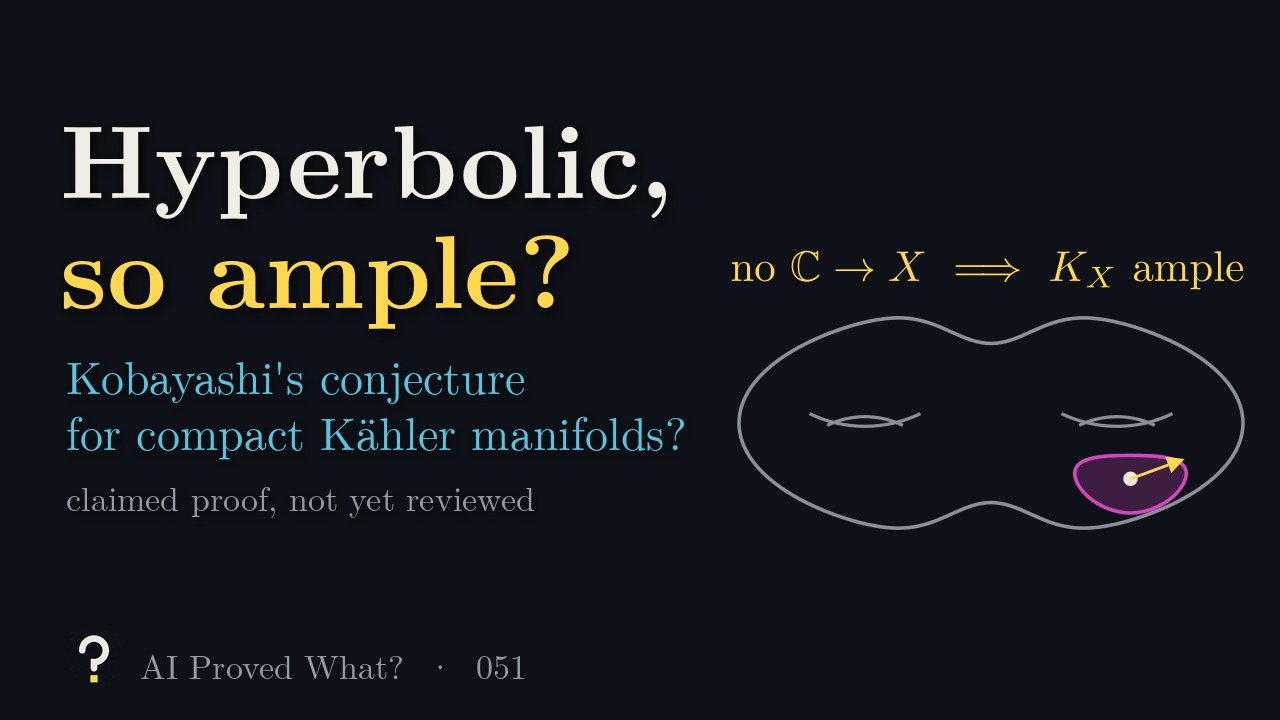
5:55. English captions available. The video loads from YouTube when you press play.
Chapters
The claim, in plain words
An entire curve in a complex manifold X is a nonconstant holomorphic map from the whole complex plane ℂ into X. On a compact Riemann surface of genus g, entire curves exist exactly when g ≤ 1, and the canonical bundle (the bundle of holomorphic one-forms) has degree 2g − 2, positive exactly when g ≥ 2. So on curves, “no entire curves” and “ample canonical bundle” coincide. A compact complex manifold with no entire curves is called hyperbolic (by Brody’s theorem this matches Kobayashi hyperbolicity), and its canonical bundle KX is the bundle of top-degree holomorphic forms. In the early 1970s Kobayashi conjectured that a compact Kähler hyperbolic manifold has ample canonical bundle (Diverio’s survey calls it “still widely open”). Earlier theorems reached that conclusion from curvature: Wu and Yau, then Tosatti and Yang, assumed a Kähler metric of negative holomorphic sectional curvature, but a hyperbolic manifold need not carry one.
Result 051 is an OpenAI preprint (dated September 23, 2026; 31 pages). It claims that every compact connected Kähler manifold of positive dimension with no nonconstant entire curve has ample canonical bundle, so a power of KX embeds X in projective space. If it holds, Kobayashi’s conjecture is settled for smooth compact Kähler manifolds.
What it doesn’t claim
The theorem is about smooth compact Kähler manifolds; it says nothing about singular spaces or non-Kähler manifolds. It also does not give a curvature statement: it does not produce a metric of negative holomorphic sectional curvature.
Where it stands
- Posted as a preprint
- OpenAI, dated September 23, 2026, released October 6
- Peer reviewed
- Not yet
- Checked in Lean
- No: OpenAI published no Lean proof for this result
Last checked October 19, 2026. The preprint has not been withdrawn or revised. It cites two other papers from the release, Fujita’s freeness conjecture (result 038) and semialgebraic universal covers (result 058), but only for two corollaries in its last section; the main theorem does not use them. The paper itself says its main analytic work is justifying the variations of the extremal disc all the way to its boundary; in our view that is where expert checking matters most. We found no public assessment by specialists.
How the proof goes
- Brody’s bound. On a compact hyperbolic manifold with a fixed Kähler metric k, every holomorphic disc f satisfies |f′(0)|²k ≤ D for one constant D; otherwise rescaling would produce an entire curve.
- Extremal discs. Fix a center x, a Kähler metric h, a closed (1, 1)-form q and δ > 0, and maximize |f′(0)|²k + Pq(f) − δAh(f) over finite-area discs with f(0) = x, where A is an area integral and P the same integral weighted by log(1/|z|). The area penalty gives a maximizer; comparing it with its dilations bounds its area near the edge, so it is continuous up to the boundary circle.
- Frames and identities. Along the disc there is a holomorphic frame that is h-orthonormal on the circle, and centered holomorphic variations in its directions. For such a disc, log det of the frame’s Gram matrix at the center equals PRh(f), with Rh the Ricci form, and the summed second variation of the area is n − ARh(f). At a maximum the second variation of the score is nonpositive, which ties these together.
- Nefness. With h = k and q = Rk, the Ricci integral is bounded on every disc; a Poletsky–Rosay disc envelope then gives bounded potentials and KX nef (already known by work of Ou and of Cao–Höring).
- A uniform volume bound. For any Kähler h with Ricci form at least −h, taking q = −h and δ = 1 gives hn ≥ e−D(n/(2n + D))n kn, with a constant independent of h.
- Positive volume. In the classes 2πc1(KX) + t[k], the Aubin–Yau theorem gives metrics with exactly that Ricci bound; their volumes are a polynomial in t bounded below, so t → 0 gives ∫c1(KX)n > 0.
- The standard finish. Nef with positive volume is big (Demailly’s holomorphic Morse inequalities); X is then Moishezon, hence projective since it is Kähler; with no rational curves, the cone theorem makes the big canonical bundle ample.
The numbers in the video
- A short Python script tabulates 2g − 2 for small genus, evaluates the volume constant e−D(n/(2n + D))n, checks the arithmetic–geometric mean step on random positive Hermitian matrices and the Green identity on the unit disc, and computes the toy volume curves in the video: 2(2 + t)(4 + t) for a product of curves of genus 2 and 3, and 2t² for a product of two elliptic curves (illustrations, not taken from the paper).
Read the source
- Canonical ampleness of compact hyperbolic Kähler manifolds (PDF), dated September 23, 2026 (31 pages).
- Simone Diverio, Kobayashi hyperbolicity, negativity of the curvature and positivity of the canonical bundle (arXiv survey, 2020).
- The collection’s catalog, where this is result 051.
The paper
OpenAI groups related papers into one result; this one has a single paper.
Transcript
Read the full script
0:00No entire curves
Take a compact Riemann surface of genus g. A nonconstant holomorphic map from the whole complex plane into it is called an entire curve. The sphere contains a copy of the plane, and the plane wraps around the torus. From genus two on there are none: the universal cover is the disc, any entire curve lifts to it, and a bounded holomorphic function on the plane is constant. Now look at the canonical bundle, the bundle of holomorphic one-forms. Its degree is 2g − 2: negative, then zero, then positive exactly from genus two on. On curves, no entire curves and a positive canonical bundle go together. In higher dimension, a compact complex manifold with no nonconstant entire curve is called hyperbolic, and its canonical bundle is the bundle of top-degree holomorphic forms. In the early 1970s, Kobayashi conjectured that on a compact Kähler manifold, being hyperbolic forces the canonical bundle to be ample. Earlier results reached that conclusion from curvature: Wu and Yau, and then Tosatti and Yang, assumed a Kähler metric of negative holomorphic sectional curvature. But a hyperbolic manifold need not carry such a metric.
1:16The claim
Result 051 is a 31-page OpenAI preprint, dated September 23. It claims the conjecture in this setting: every compact connected Kähler manifold of positive dimension with no nonconstant entire curve has ample canonical bundle. So a power of the canonical bundle embeds the manifold in projective space. If it holds, Kobayashi’s conjecture is settled for smooth compact Kähler manifolds. The proof climbs a ladder. With no entire curves there are no rational curves either, and recent work of Ou, and of Cao and Höring, already makes the canonical bundle nef, meaning it is never negative on any curve. The paper reproves nefness its own way. The missing rung was volume: the canonical class must have positive top self-intersection. That is the new part. The rest uses standard theorems.
2:10Extremal discs
Everything new happens on holomorphic discs. The first input is Brody’s lemma. On a compact hyperbolic manifold, measured in a fixed metric, the squared derivative at the center of any holomorphic disc is bounded by one constant, D. If not, rescaling discs with larger and larger derivatives would produce a limit map from the whole plane: an entire curve, which is excluded. Fix a center point and a Kähler metric h, and look for the disc that maximizes a score: the squared derivative at the center, plus a weighted integral of a chosen form q over the disc, minus a penalty for area. The area penalty is what guarantees a best disc exists. Comparing it with its own shrunken copies bounds its area near the edge, which makes the disc continuous up to the boundary circle. At the maximizer, the paper builds a holomorphic frame along the disc that is orthonormal on the boundary circle, and moves the disc in those directions with the center fixed. Two identities hold for any such disc: the log determinant of the frame’s metric at the center equals a weighted Ricci integral over the disc, and the summed second variation of the area is n minus the disc’s Ricci area. At a maximum, no such move can raise the score, and that ties these quantities together in one inequality.
3:31A volume that can’t shrink
Now the key estimate. Take any Kähler metric h whose Ricci form is at least minus h. Choose q equal to minus h, and compare the best disc with the constant disc, whose score is zero. The bound D then caps the frame’s size at the center, measured in the fixed metric, by 2n + D, while its volume measured in h stays above e^(−D). The arithmetic-geometric mean inequality compares the two, and gives a lower bound for the volume form of h, with a constant that does not depend on h. Nefness lets the paper approach the canonical class by Kähler classes: the canonical class plus t times a fixed Kähler class. In each one, the Aubin–Yau theorem gives a metric with exactly the Ricci bound needed, so all their volumes stay above one fixed positive number. The volume is a polynomial in t, so letting t go to zero gives the canonical class positive top self-intersection. Without hyperbolicity this can fail: on a product of two elliptic curves, which is full of entire curves and has trivial canonical class, these volumes really do shrink to zero. Then the ladder finishes. Nef with positive volume makes the canonical bundle big, by Demailly’s holomorphic Morse inequalities. That makes the manifold Moishezon, and a Moishezon manifold that is Kähler is projective. Finally, the cone theorem shows that a big canonical bundle with no rational curves is ample.
5:04Where it stands
This is a preprint, not yet peer reviewed, and it has not been revised. There is no Lean formalization. It cites two other results from the release, Fujita’s freeness from episode 038 and a classification of semialgebraic universal covers, but only for corollaries; the main theorem doesn’t use them. The paper itself says its main analytic work is justifying these variations of the extremal disc all the way to its boundary. In our view, that is where expert checking matters most. We found no public assessment. If it holds, the absence of entire curves alone, with no curvature assumption, forces the canonical bundle of a compact Kähler manifold to be ample, just as on curves of genus two and up.
Spot a mistake?
This episode simplifies on purpose, but it shouldn’t be wrong. If something is, open an issue on GitHub or leave a comment on YouTube. Corrections are noted here with a date.