K3 inside, still irrational?
Irrational cubic fourfolds with Hodge-theoretic and categorical K3 associations
Covers result 054 in OpenAI’s catalog: its one paper. See its connections to other results and the work it cites.
5:28. English captions available. The video loads from YouTube when you press play.
Chapters
The claim, in plain words
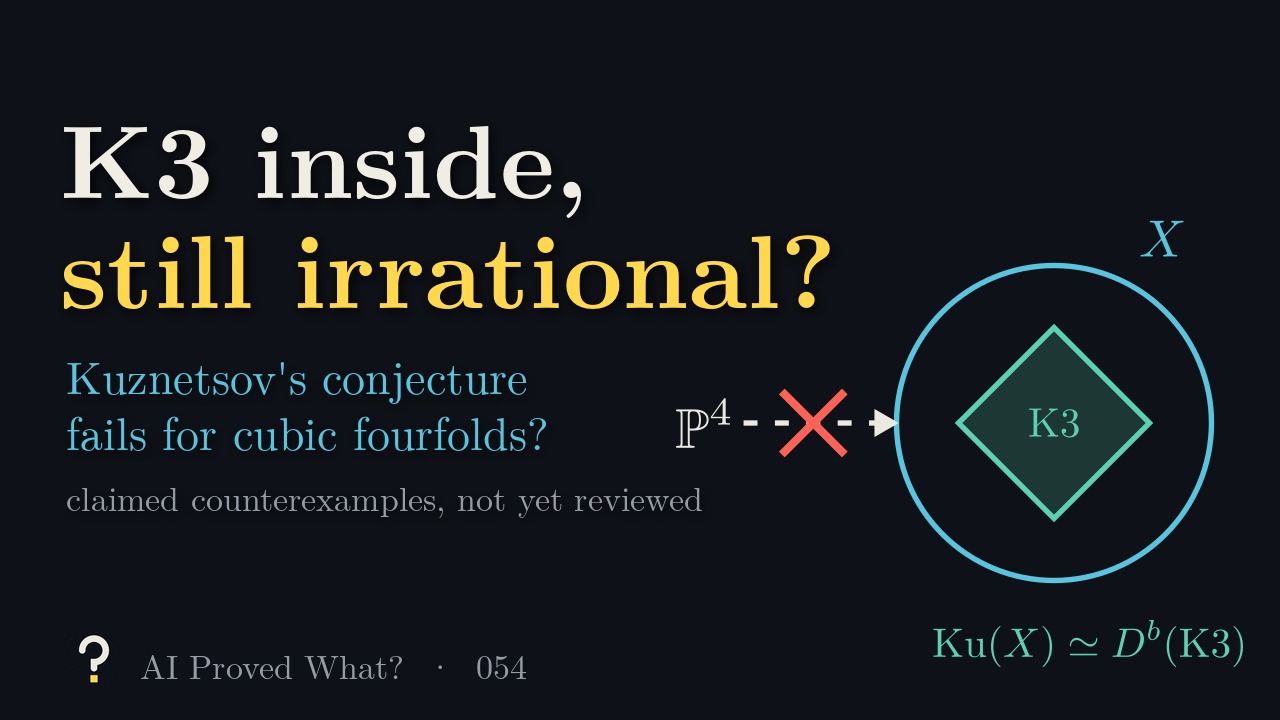
A cubic fourfold is a smooth degree-three hypersurface in ℙ5; it is rational if it is birational to ℙ4. Whether the very general one is rational was a famous open question, and a 2025 preprint by Katzarkov, Kontsevich, Pantev and Yu claims it is not. Special cubics lie on countably many Hassett divisors 𝒞d, labelled by a discriminant d, and some are rational: Pfaffian cubics, and, by Russo and Staglianò, every cubic in 𝒞26, 𝒞38 and 𝒞42. For admissible discriminants (14, 26, 38, 42, 62, 74, 78, 86, …) Hassett showed that part of the cubic’s middle cohomology is a copy of a polarized K3 surface’s, shifted in degree with the pairing reversed. Kuznetsov found a piece Ku(X) of the derived category; he showed it is the derived category of a K3 surface for Pfaffian cubics, and later work (Addington–Thomas; Bayer, Lahoz, Macrì, Nuer, Perry, Stellari) showed the same for every cubic on the admissible divisors. Kuznetsov conjectured that X is rational exactly when Ku(X) ≃ Db(S) for a K3 surface S; a Hodge-theoretic version predicts the same with associated K3 surfaces.
Result 054 is an OpenAI preprint (dated September 24, 2026; 62 pages). It claims that there is a threshold d0 such that for every admissible d > d0, a very general cubic in 𝒞d is irrational, although its Kuznetsov component is the derived category of a K3 surface and it has an associated K3 surface. If it holds, Kuznetsov’s conjecture is false, and an associated K3 surface is not sufficient for rationality. The threshold is ineffective: the proof gives no way to compute it; since every cubic in 𝒞42 is rational, it must lie at or above 42. Corollaries: for infinitely many d = 2n2 + 2n + 2 the irrational cubics have a Fano variety of lines birational to the Hilbert square of a K3 surface, and all of them have universally trivial zero-cycles, so the decomposition of the diagonal cannot detect their irrationality.
What it doesn’t claim
It does not identify any particular irrational discriminant, and it says nothing about stable rationality. It only refutes one direction of Kuznetsov’s conjecture: whether every rational cubic must have a K3 category is untouched.
Where it stands
- Posted as a preprint
- OpenAI, dated September 24, 2026, released October 6
- Peer reviewed
- Not yet
- Checked in Lean
- No: OpenAI published no Lean proof for this result
Last checked October 19, 2026. The preprint has not been withdrawn or revised, and it cites no other paper from the release. It would settle a central conjecture in the negative, so the real test is expert scrutiny of both evaluations: the Gromov–Witten argument that tracks whole transcendental lattices through a weak factorization, and the uniform bounds in the Sarkisov half. We found no expert assessment; press coverage so far repeats the claim.
How the proof goes
- A count of K3 surfaces. Suppose f: ℙ4 ⇢ X were birational. Fix the Picard-number-one K3 surfaces whose transcendental lattice, shifted and with the pairing reversed, is isometric to that of X. For any birational map, count the prime divisors created on the target minus those removed from the source, each counted only when its maximal rationally connected quotient is a K3 surface in this collection. The count is additive under composition.
- Weak factorization gives 1. Factor f into blowups and blowdowns along smooth centers. A surface blowup adds its whole transcendental lattice; an operator algebra built from genus-zero Gromov–Witten pairings keeps each surface block separate, so blowdowns remove whole blocks. The cubic keeps one block (h3,1 = 1), so one more K3 surface from the collection is blown up than blown down.
- The Sarkisov program gives 0. Factor f into links between Mori fiber spaces. Integer corrections on the nodes make each link’s count a difference of endpoint values; ℙ4 and X sit over a point, where the corrections vanish, so the total telescopes to 0.
- Large degree. Making the corrections well defined, especially at conic bundles, uses bounded families of link diagrams, which bound the genus of certain curves; a Picard-number-one K3 surface of large degree d has no pencils of such low genus. This is the source of the ineffective threshold. Since 1 ≠ 0, X is irrational.
The numbers in the video
- A short Python script lists the admissible discriminants, checks that 26, 38 and 42 are admissible (so the threshold is at least 42), that the Hilbert-square discriminants 2n2 + 2n + 2 are admissible, and that Fay’s quaternion obstruction vanishes on admissible discriminants.
Read the source
- Irrational cubic fourfolds with geometric K3 categories (PDF), September 24, 2026 (62 pages).
- Katzarkov, Kontsevich, Pantev, Yu, Birational invariants from Hodge structures and quantum multiplication (arXiv).
- Russo and Staglianò, Congruences of 5-secant conics and the rationality of some admissible cubic fourfolds (arXiv).
- The collection’s catalog, where this is result 054.
The paper
OpenAI groups related papers into one result; this one has a single paper.
Transcript
Read the full script
0:00Cubic fourfolds and K3 surfaces
A cubic fourfold is a smooth hypersurface of degree three in five-dimensional projective space. It is rational if it is birational to projective four-space. Whether a very general cubic fourfold is rational was a famous open question; a 2025 preprint by Katzarkov, Kontsevich, Pantev and Yu claims it is not. But special cubics can be rational. They lie on countably many divisors found by Hassett, labelled by a discriminant d. Pfaffian cubics are rational, and Russo and Staglianò showed that every cubic in the divisors of discriminant 26, 38 and 42 is rational. On these special divisors, K3 surfaces appear. For discriminants that pass a divisibility test, called admissible, Hassett showed that part of the cubic’s middle cohomology is a copy of a polarized K3 surface’s cohomology, shifted in degree and with the sign of the pairing reversed. And Kuznetsov found a piece of the cubic’s derived category, now called the Kuznetsov component. For Pfaffian cubics he showed it is the derived category of a K3 surface, and later work showed the same for every cubic on the admissible divisors. Kuznetsov conjectured that a cubic fourfold is rational exactly when its component is the derived category of a K3 surface. The Hodge-theoretic version predicts the same with associated K3 surfaces.
1:28The claim
Result 054 is a 62-page OpenAI preprint, dated September 24. It claims that for every sufficiently large admissible discriminant, a very general cubic in that divisor is irrational, even though its Kuznetsov component is the derived category of a K3 surface and it has an associated K3 surface in the Hodge-theoretic sense. If it holds, Kuznetsov’s conjecture is false, and an associated K3 surface is not enough for rationality. The threshold is ineffective: the proof gives no way to compute where it starts. Since every cubic of discriminant 42 is rational, it must start above that. The categorical half comes from earlier work of Addington and Thomas, and of Bayer and coauthors. The irrationality is the new part. The paper also derives corollaries: for infinitely many discriminants, these irrational cubics have a Fano variety of lines birational to the Hilbert square of a K3 surface, and all of them have universally trivial zero-cycles, so the decomposition of the diagonal cannot detect their irrationality.
2:38Counting K3 surfaces
The proof counts K3 surfaces along a birational map. Suppose the cubic X were rational, with a birational map f from projective four-space. Fix a collection of K3 surfaces of Picard number one whose transcendental lattice, shifted and with the pairing reversed, matches the cubic’s. For any birational map, count the prime divisors it creates on the target, minus those it removes from the source, each counted only when its maximal rationally connected quotient is a K3 surface from the collection. This count adds up under composition. First, evaluate it with weak factorization: f becomes a chain of blowups and blowdowns along smooth centers. Blowing up a surface adds its whole transcendental lattice to the middle cohomology. Using genus-zero Gromov–Witten pairings, the paper builds an operator algebra that keeps each surface block separate, so a later blowdown must remove a whole block. The cubic has one transcendental block left over, so overall, one more K3 surface from the collection is blown up than blown down. The count is one.
3:47A count that telescopes
Now evaluate the same count with the Sarkisov program: f also factors into links between Mori fiber spaces. The paper constructs integer corrections on these spaces, so that each link’s count is the difference of their values at its two ends. At both ends of the whole chain, projective four-space and the cubic sit over a point, where the corrections vanish. So the total telescopes to zero. The hard part is the conic bundles, where the correction must not depend on how the base is presented. Throughout this half, the link diagrams come in bounded families, which bounds the genus of certain curves. A K3 surface of Picard number one and degree d, the same d as the discriminant, has no pencils of such low genus once d is large. That is where the large discriminant, and the ineffective threshold, come from. One cannot equal zero, so the cubic is irrational.
4:42Where it stands
This is a preprint, not yet peer reviewed, and it has not been revised. There is no Lean formalization, and it cites no other paper from the release. It claims to settle a central conjecture in the field in the negative, so the real test is expert scrutiny of both evaluations: the new Gromov–Witten argument that tracks whole lattices, and the uniform bounds in the Sarkisov half. We found no expert assessment; press coverage so far just repeats the claim. If it holds, a K3 surface in the Hodge structure, or in the derived category, does not guarantee rationality: beyond some unknown discriminant, very general cubics with geometric K3 categories are irrational.
Spot a mistake?
This episode simplifies on purpose, but it shouldn’t be wrong. If something is, open an issue on GitHub or leave a comment on YouTube. Corrections are noted here with a date.