A fifth of a turn?
Gepner symmetry and large-volume stability on threefolds
Covers result 055 in OpenAI’s catalog: all 2 papers. See its connections to other results and the work it cites.
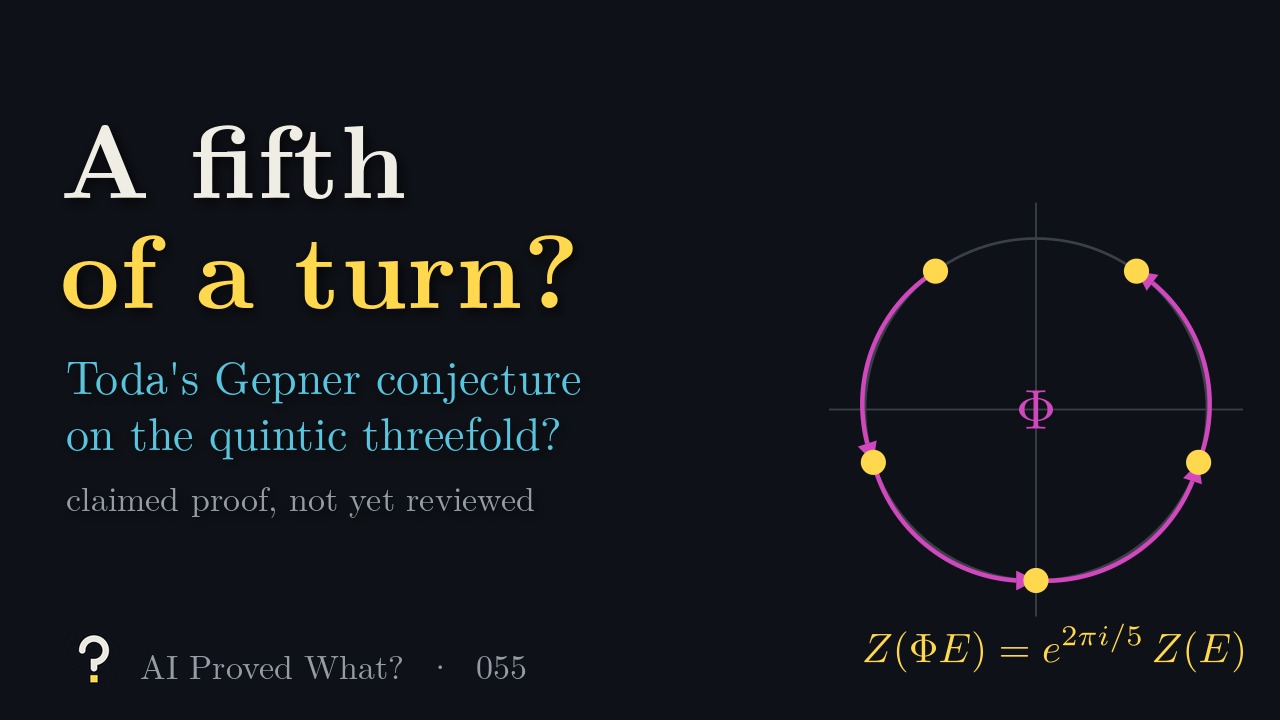
5:00. English captions available. The video loads from YouTube when you press play.
Chapters
The claims, in plain words
A Bridgeland stability condition on a derived category gives every object a complex number, its central charge; semistable objects get a phase (the angle of the charge in half-turns), and every object is built step by step from semistable pieces of decreasing phase. The idea comes from Douglas’s stability of branes in string theory; on threefolds, building even one was hard for years, and for the quintic threefold Chunyi Li showed they exist. On the quintic X ⊂ ℙ4, the autoequivalence Φ = T𝒪 ∘ (− ⊗ 𝒪(1)) satisfies Φ5 ≅ [2]. Toda conjectured a stability condition whose central charge Φ multiplies by e2πi/5 and whose phases Φ shifts by 2/5, the Gepner point predicted by physics. He proposed a sharper inequality on Chern characters, showed it would give a candidate heart, and conjectured that the candidate works; a 2025 preprint by Chunkai Xu proved an even stronger inequality implying Toda’s, but a genuine stability condition remained open, with Harder–Narasimhan filtrations for this irrational charge flagged by Toda as a difficulty.
Result 055 is two OpenAI preprints dated September 24, 2026. The first (22 pages) claims a proof of Toda’s conjecture: every smooth quintic threefold has a numerical Bridgeland stability condition with the support property, with Z(ΦE) = e2πi/5Z(E), Φ𝒫(φ) = 𝒫(φ + 2/5), and point sheaves of charge −1. The second (49 pages) works on every smooth projective threefold with trivial canonical bundle: at every sufficiently large volume, with one threshold near any chosen twist and direction, it constructs stability conditions with exactly the ordinary charge −∫e−B−itHch and the square-root-Todd charge −∫e−B−itHch √td (√td = 1 + c2/24), closer to the physicists’ large-volume formula. It also proves a corrected strong tilt inequality on every smooth projective threefold, answering questions of Bernardara–Macrì–Schmidt–Zhao and Martinez–Schmidt. Existence of some stability condition was already known; the new part is prescribing these charges.
What they don’t claim
The Gepner paper shows that a stability condition with the Gepner charge and symmetry exists; it does not say how it connects to the large-volume stability conditions or describe the whole space of stability conditions. The large-volume theorem holds above a volume threshold, not at every volume, and the uncorrected tilt inequality is false at small volume (Schmidt; Martinez–Schmidt).
Where it stands
- Posted as preprints
- OpenAI, both dated September 24, 2026, released October 6
- Peer reviewed
- Not yet
- Checked in Lean
- No: OpenAI published no Lean proof of either theorem; one uncatalogued Lean file checks numerical inequalities from the large-volume paper (we have not run it)
Last checked October 19, 2026. Neither preprint has been withdrawn or revised, and neither cites another paper from the release. The Gepner paper takes its geometric input from Xu’s inequality, itself a recent preprint. We found no public assessment by specialists. OpenAI published no Lean proof of either theorem. Its files do contain one uncatalogued (not linked from the collection’s catalog) Lean file of 603 lines, excluding Mathlib, with no unproved steps by our search; we have not run it. It checks real-number inequalities about Chern characters used in the large-volume paper’s wall arguments (twists, the discriminant, and how bounds move along walls), and an example showing that those numerical conditions alone do not give the paper’s inequality. Nothing about stability conditions themselves is formalized. Correction (October 15, 2026): the video says there is no Lean formalization; that is still true of both theorems, but we missed this file.
How the Gepner proof goes
- The charge. Numerical classes on the quintic form a rank-four lattice, and Φ acts by a 4 × 4 matrix with characteristic polynomial z4 + z3 + z2 + z + 1. The charge that Φ multiplies by e2πi/5, normalized so a point has charge −1, is unique: the Gepner charge.
- Two perturbed tilts. Tilt coherent sheaves first at slope −1/2 (as Toda proposed), then along the imaginary part of the charge, keeping two independent perturbations of the second cut (one in rank, one in first Chern character). Xu’s inequality gives small positive margins (about 0.0036, 0.00073 and 0.00016), so Φ maps one aisle inside another.
- A grid and support. Periodicity and positivity across the perturbed hearts give a nested grid of aisles with phase spacing 1/5; the blocks between them have charges in a sector of angle π/5, and testing all perturbed hearts gives the support estimate ‖[E]‖ ≤ C|Z(E)|.
- Refinement stops. The charge is irrational, so its values are not discrete; but support bounds the classes of subobjects, and the numerical lattice is discrete, so refining each block into semistable pieces terminates. The phases form a slicing, and Φ shifts each phase by 2/5.
The numbers in the video
- A short Python script recomputes the matrix of Φ, its characteristic polynomial and Φ*5 = I, checks the Euler form and the Gepner charge (Z ∘ Φ = e2πi/5Z, Z(𝒪x) = −1), evaluates the three margins, computes the five charges Z(Φk𝒪) on a regular pentagon, and checks √td = 1 + c2/24.
Read the source
- A Gepner stability condition on every smooth quintic threefold (PDF), September 24, 2026 (22 pages).
- Prescribed large-volume charges on threefolds with trivial canonical bundle (PDF), September 24, 2026 (49 pages).
- Yukinobu Toda, Gepner point and strong Bogomolov–Gieseker inequality for quintic 3-folds (arXiv).
- Chunkai Xu, Stronger Bogomolov–Gieseker type inequality on quintic threefold (arXiv, 2025).
- The collection’s catalog, where this is result 055.
The 2 papers in this result
OpenAI groups related papers, such as alternative proofs, supporting results and consequences, into one result; we label the first paper it lists the main paper and the others companions.
Transcript
Read the full script
0:00Stability and the Gepner point
A stability condition on a derived category gives every object a complex number, its central charge. Semistable objects get a phase, the angle of that number measured in half-turns, and every object must be built, step by step, from semistable pieces of decreasing phase. Bridgeland made this precise, following Douglas’s idea of stable branes in string theory. On threefolds, building even one stability condition was a hard problem for years. For the quintic threefold, Chunyi Li showed that they exist. The quintic threefold is a hypersurface of degree five in projective four-space. Physics predicts a special point, the Gepner point, with a symmetry: tensor with O(1), then apply the spherical twist at the structure sheaf. Call this Φ. Five applications give a shift by two. Toda conjectured a stability condition whose central charge Φ rotates by a fifth of a turn, and whose phases Φ shifts by exactly two fifths. He proposed a sharper inequality on Chern characters, showed it would give a candidate heart, and conjectured that the candidate works. A 2025 preprint by Xu proved an even stronger inequality, which implies Toda’s. But turning that candidate into a genuine stability condition stayed open, and Toda himself flagged Harder–Narasimhan filtrations for this irrational charge as a difficulty.
1:24The claim
Result 055 is two OpenAI preprints, dated September 24. The first, 22 pages, claims a proof of Toda’s conjecture: every smooth quintic threefold has a numerical Bridgeland stability condition, with the support property, whose central charge Φ multiplies by e^(2πi/5), whose phases Φ shifts by two fifths, and where a point has charge −1. The second, 49 pages, works on every threefold with trivial canonical bundle. At every sufficiently large volume it builds stability conditions with exactly the ordinary charge, and the square-root-Todd charge that is closer to the physicists’ large-volume formula, with one volume threshold near any chosen twist and direction. It also proves a corrected strong inequality on every smooth projective threefold, answering questions of Bernardara, Macrì, Schmidt and Zhao, and of Martinez and Schmidt. Some stability condition was already known to exist; the new part is prescribing these charges.
2:31Building the Gepner charge
In the first paper, the charge is pinned down by linear algebra. On the quintic, numerical classes form a rank-four lattice, and Φ acts by a 4 × 4 matrix whose characteristic polynomial is z⁴ + z³ + z² + z + 1. Its eigenvalues are the four nontrivial fifth roots of unity. The charge that Φ simply multiplies by e^(2πi/5), normalized so that a point has charge −1, is the Gepner charge, and it is unique. The paper tilts the category of coherent sheaves twice: first at slope −1/2, as Toda proposed, then along the imaginary part of the charge. The key move is to keep two independent perturbations of the second cut, one in rank and one in first Chern character. Xu’s inequality gives strict margins, small but positive, so applying Φ to one of these aisles lands inside another.
3:29From aisles to phases
Periodicity, together with positivity across the perturbed hearts, then gives a nested grid of aisles with phase spacing one fifth. Between consecutive aisles sits a block whose charges lie in a sector of angle π/5. Each block object belongs to a whole family of perturbed hearts, and testing all of them gives the support estimate: the size of a class is at most a fixed multiple of the size of its charge. The charge is irrational, so its values need not form a discrete set, which is why Harder–Narasimhan filtrations were the obstacle. Here, the support estimate bounds the classes of subobjects, and because the numerical lattice is discrete, only finitely many can occur, so refining each block into semistable pieces must stop. The phases are assembled into a slicing, and Φ moves each phase by two fifths.
4:21Where it stands
Both are preprints, not yet peer reviewed, and neither has been revised. There is no Lean formalization, and neither cites another paper from the release. The Gepner paper takes its geometric input from Xu’s inequality, itself a recent preprint. We found no public assessment. If they hold, the quintic has a genuine Bridgeland stability condition with exactly the charge and five-fold symmetry that physics assigns to the Gepner point, and every threefold with trivial canonical bundle carries the expected large-volume stability conditions.
Spot a mistake?
This episode simplifies on purpose, but it shouldn’t be wrong. If something is, open an issue on GitHub or leave a comment on YouTube. Corrections are noted here with a date.