Special means abelian?
Fundamental groups of special complex varieties and root orbifolds
Covers result 057 in OpenAI’s catalog: all 3 papers. See its connections to other results and the work it cites.
7:03. English captions available. The video loads from YouTube when you press play.
Chapters
The claims, in plain words
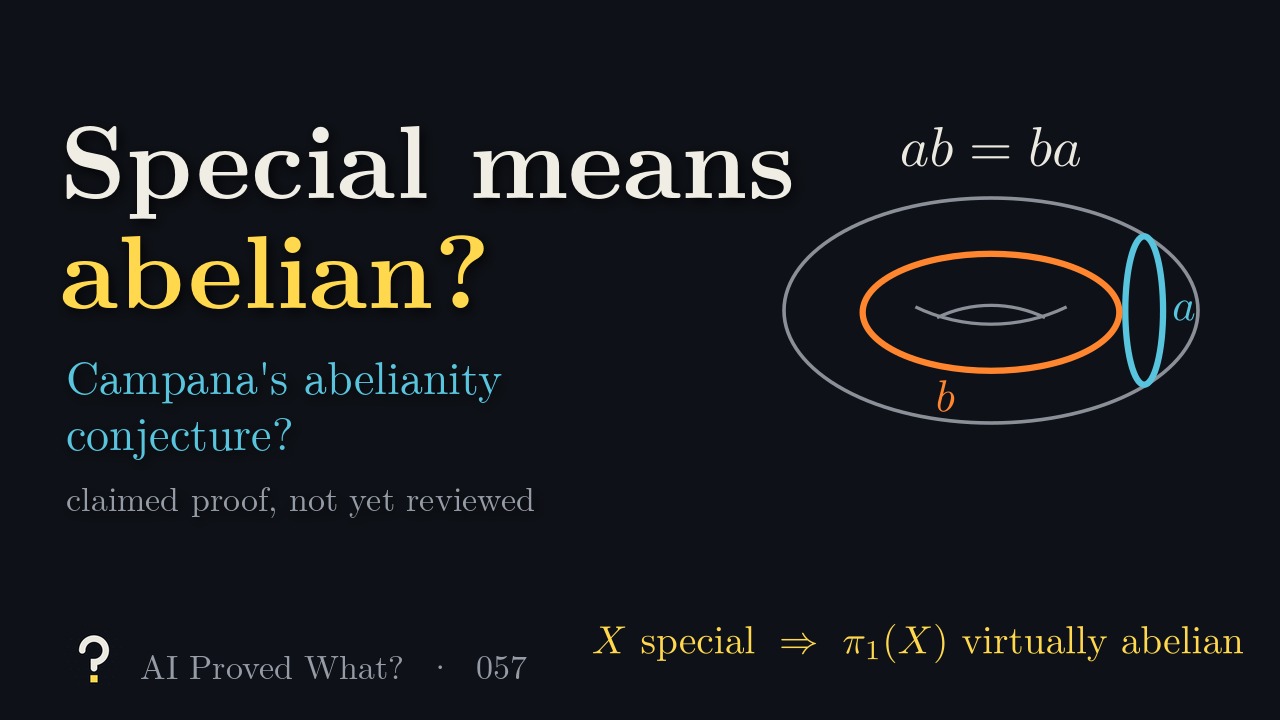
Loops in a space, up to sliding, form its fundamental group. On a torus the two basic loops commute, so the group is ℤ2; on a surface of genus two they do not, and the group is far from abelian. Campana’s classification splits compact Kähler manifolds into special ones and those that map onto a positive-dimensional base of general type, counted with orbifold multiplicities. Precisely, X is special if for no p ≥ 1 does a line bundle of Iitaka dimension p sit inside the holomorphic p-forms ΩpX. A curve of genus two is not special (its canonical bundle is such a line); projective space and every manifold of Kodaira dimension zero, such as a torus, are special. Campana conjectured that special manifolds have virtually abelian fundamental groups: an abelian subgroup of finite index, equivalently an abelian group after a finite unramified cover. Beauville’s decomposition gives the case c1 = 0, and Campana and Claudon proved the conjecture for threefolds. Quotients acting by matrices had a structure theory (Campana; Campana–Claudon–Eyssidieux), but an infinite group can have only finite matrix images.
Result 057 is three OpenAI preprints. The main one (September 23, 2026; 50 pages) claims the conjecture in every dimension: the fundamental group of every special compact Kähler manifold has an abelian subgroup of finite index, with no projectivity, linearity or residual-finiteness assumption. Corollaries: Kodaira dimension zero gives a virtually abelian fundamental group; Campana’s Conjecture S; if the universal cover is ℂn, a finite unramified cover is bimeromorphic to a complex torus (a form of Iitaka’s conjecture); universal covers of special manifolds are holomorphically convex. A 19-page companion (September 24) treats open varieties, where the group can be nilpotent without being abelian (in an example of Cadorel, Deng and Yamanoi, a degree-one line bundle over an elliptic curve minus its zero section has a Heisenberg group). It gives an independent proof that every matrix image of the fundamental group of a smooth special quasi-projective variety is virtually nilpotent of class at most two, announced earlier by Cao, Deng, Hacon and Păun, and builds special open surfaces whose general quasi-Albanese fibre (ℙ1 minus n ≥ 3 points) is not special, which it says contradicts a separate theorem on fibres in their preprint. A 14-page paper (October 5) assumes the main theorem and extends it to special order-two root orbifolds of smooth projective fourfolds along one smooth connected divisor.
What they don’t claim
The main theorem gives no uniform bound on the index of the abelian subgroup, and torsion is allowed. For open varieties the claim is about matrix images, up to finite index; the full fundamental group of a special open variety is not claimed to be nilpotent. The fourfold result covers one smooth divisor of multiplicity two and depends on the main theorem.
Where it stands
- Posted as preprints
- OpenAI, three papers dated September 23, September 24 and October 5, 2026, released October 6
- Peer reviewed
- Not yet
- Checked in Lean
- Main theorem: no; one unlinked Lean file checks the elementary group-theory step
Last checked October 19, 2026. None of the three papers has been revised. The fourfold paper explicitly assumes the main theorem; the open-variety paper does not use it. The main paper mentions two other release papers, including the surface of episode 046, only in remarks. We found no public response to the open-variety paper’s claim about the Cao–Deng–Hacon–Păun preprint, and no public assessment of these papers by specialists.
How the main proof goes
- The Albanese sequence. On a finite cover with the largest first Betti number, the Albanese map to a complex torus A is onto with connected fibres, and 1 → N → G → π1(A) → 1, where N is the image of the fundamental group of a general fibre. If N is finite, G is virtually abelian. N is finitely generated, and a theorem of Botong Wang shows every finite-index subgroup of N has finite abelianization.
- A minimal base. If N is infinite, among fibrations of the Albanese fibres that still leave an infinite quotient the paper takes one with the smallest base. This gives an orbifold (Y, ΔY), with multiplicities read off from the orders of loops in the group, whose orbifold fundamental group maps onto an infinite group Q.
- Two cases. If Q has an infinite matrix image, a general-type criterion of Campana–Claudon–Eyssidieux makes KY big. If every matrix image of Q is finite, the paper proves that zero lies in the spectrum of the Dolbeault Laplacian on the infinite cover, builds holomorphic tensors with Hilbert-space coefficients (Shalom’s theorem in the amenable case), and minimizes the rank of the resulting maps to Hilbert projective space to get a big line of forms, so KY + ΔY is big.
- The contradiction. Descending this positivity over the Albanese torus, keeping the actual orders of loops around boundary divisors, gives an orbifold base of general type whose forms pull back to a Bogomolov sheaf on a finite cover of X. Special manifolds and their finite covers have none, so N is finite.
- Class two for open varieties. With Cadorel–Deng–Yamanoi’s results as input, the nilpotent quotients carry mixed Hodge structures; first homology has weights −1 and −2, the fibre image is the commutator subalgebra with abelianization of weight −2, and brackets into it come from weights at most −3, so they vanish. The Heisenberg example shows two is sharp.
The numbers in the video
- A short Python script checks that torus loops commute while a genus-two surface group maps onto a free group, lists the special punctured curves (2g − 2 + #B ≤ 0), checks the Heisenberg group (z = [x, y] central, [xn, ym] = znm), and records the weights −1, −2, −3 behind the class-two bound.
Read the source
- The abelianity conjecture for special compact Kähler manifolds (PDF), September 23, 2026 (50 pages).
- Two-step monodromy of special quasi-projective varieties (PDF), September 24, 2026 (19 pages).
- A conditional abelianity theorem for special fourfold pairs with a half-weight divisor (PDF), October 5, 2026 (14 pages).
- Frédéric Campana and Benoît Claudon, Abelianity conjecture for special compact Kähler 3-folds (arXiv).
- Junyan Cao, Ya Deng, Christopher Hacon and Mihai Păun, Two-step nilpotent monodromy of local systems on special varieties (arXiv, 2026).
- The collection’s catalog, where this is result 057.
The 3 papers in this result
OpenAI groups related papers, such as alternative proofs, supporting results and consequences, into one result; we label the first paper it lists the main paper and the others companions.
Transcript
Read the full script
0:00Special manifolds and their loops
Loops in a space can be slid around, and loops up to sliding form its fundamental group. On a torus, going around one way and then the other gives the same loop as the reverse order, so the group is abelian: two copies of the integers. On a surface of genus two, the loops no longer commute, and the group is far from abelian. Campana’s classification splits compact Kähler manifolds into special ones, and those that map onto a positive-dimensional base of general type, counted with orbifold multiplicities. Precisely, a manifold is special if, for every p from one up, no line bundle of Iitaka dimension p sits inside its holomorphic p-forms. A curve of genus two is not special: its canonical bundle is such a line. Projective space, and every manifold of Kodaira dimension zero, such as a torus, are special. Campana conjectured that special manifolds have virtually abelian fundamental groups: abelian after passing to a finite unramified cover, or equivalently, containing an abelian subgroup of finite index. Beauville’s decomposition settles the case of vanishing first Chern class, and Campana and Claudon proved the conjecture for threefolds. For quotients that act by matrices, there was a structure theory, from Campana, and from Campana, Claudon and Eyssidieux. But an infinite group can have only finite matrix images, and controlling such quotients was the obstacle.
1:32The claims
Result 057 is three OpenAI preprints. The main one, 50 pages, dated September 23, claims Campana’s conjecture in every dimension: the fundamental group of every special compact Kähler manifold has an abelian subgroup of finite index. It needs no projectivity, and no assumption that the group is linear or residually finite. In particular, every compact Kähler manifold of Kodaira dimension zero would have a virtually abelian fundamental group. The paper also derives Campana’s Conjecture S, and a form of Iitaka’s conjecture: a compact Kähler manifold whose universal cover is complex n-space has a finite unramified cover bimeromorphic to a complex torus. And it shows that universal covers of special manifolds are holomorphically convex. A 19-page companion treats open varieties, where the group can be nilpotent without being abelian. In an example of Cadorel, Deng and Yamanoi, removing the zero section from a degree-one line bundle over an elliptic curve gives a surface whose group is a Heisenberg group. The paper gives an independent proof that every matrix image of the fundamental group of a smooth special quasi-projective variety is virtually nilpotent of class at most two, a result announced earlier by Cao, Deng, Hacon and Păun. It also builds special open surfaces whose general quasi-Albanese fibres are not special, and says this contradicts a separate theorem in their preprint, about those fibres. A 14-page paper, dated October 5, assumes the main theorem and extends it to special order-two root orbifolds of smooth projective fourfolds along one smooth connected divisor.
3:21Where an infinite group could hide
Here is how the main proof goes. Pass to a finite cover where the first Betti number is as large as possible, and look at the Albanese map to a complex torus, which for special manifolds is onto, with connected fibres. The fundamental group G then sits in an exact sequence: N, the image of the group of a general fibre, then G, then the lattice of the torus. If N is finite, G is virtually abelian by group theory. N is finitely generated, and a theorem of Botong Wang shows that every finite-index subgroup of it has finite abelianization. So suppose N is infinite. Among ways of fibering the Albanese fibres that still leave an infinite quotient, the paper takes one with the smallest possible base. This produces an orbifold Y, with multiplicities read off from the group, whose fundamental group maps onto an infinite group Q. There are two cases. If Q has an infinite image in some group of matrices, a general-type criterion of Campana, Claudon and Eyssidieux shows that the canonical bundle of Y is big. The new case is when every matrix image of Q is finite. Then the paper works on the infinite cover with analysis. It proves that zero lies in the spectrum of the Dolbeault Laplacian there, and builds holomorphic tensors with coefficients in a Hilbert space, using a theorem of Shalom in the amenable case. Their exterior powers give maps into an infinite-dimensional projective space. Minimizing the rank of these maps, and using minimality of the base, gives a big line of forms, so K + Δ, the orbifold canonical bundle of Y, is big.
5:00One contradiction, and a Hodge bound
Either way, Y is of general type in the orbifold sense. The paper then descends this positivity over the Albanese torus, keeping the actual orders of the loops around boundary divisors, and obtains an orbifold base of general type whose forms pull back to a Bogomolov sheaf on a finite cover of X. A special manifold has no such sheaf, and neither do its finite covers. So N must be finite, and the fundamental group is virtually abelian. With Cadorel, Deng and Yamanoi’s results as input, the open-variety bound comes from Hodge theory. The paper builds the nilpotent quotients of the group from Lie algebras carrying mixed Hodge structures, where first homology has weights −1 and −2. The image of the fibre group is the commutator subalgebra, and its abelianization has weight −2, while the brackets that would land in it come from weights at most −3. So those brackets vanish, and every unipotent quotient has class at most two. The Heisenberg example shows that two cannot be improved.
6:06Where it stands
All three are preprints, not yet peer reviewed, and none has been revised. The release links no Lean proof; one unlinked Lean file checks the elementary group-theory step. The fourfold paper explicitly assumes the main theorem; the open-variety paper does not use it. The main paper mentions two other release papers, including the surface from episode 046, only in remarks. We found no public response to the open-variety paper’s claim about Cao, Deng, Hacon and Păun, and no public assessment of these papers. If they hold, Campana’s prediction is right in every dimension: a compact Kähler manifold with no hidden base of general type has, up to finite index, an abelian fundamental group, and in the open setting, matrix images are, up to finite index, at most two-step nilpotent.
Spot a mistake?
This episode simplifies on purpose, but it shouldn’t be wrong. If something is, open an issue on GitHub or leave a comment on YouTube. Corrections are noted here with a date.