Same knot, other degree?
Counterexamples to Zariski’s multiplicity conjecture
Covers result 059 in OpenAI’s catalog: all 2 papers. See its connections to other results and the work it cites.
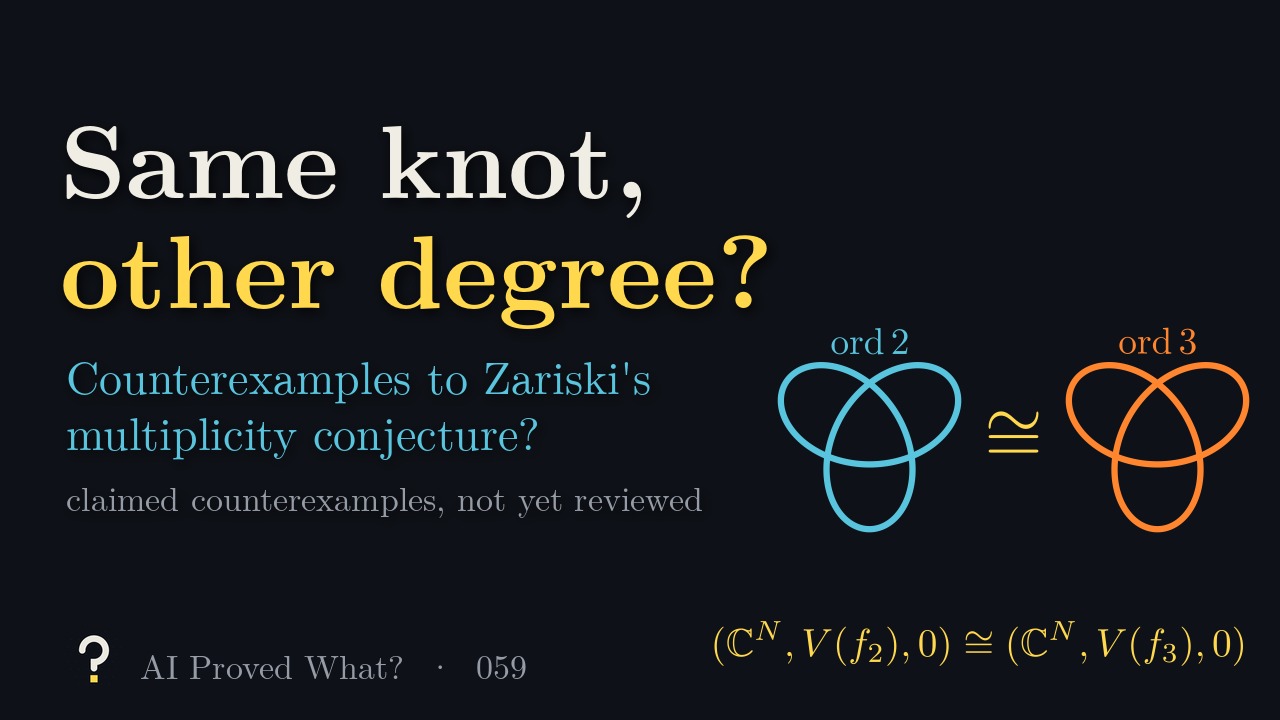
6:06. English captions available. The video loads from YouTube when you press play.
Chapters
The claims, in plain words
The multiplicity of a hypersurface singularity is the lowest degree in its equation: x2 − y2 (two lines) has multiplicity two, x3 − 3xy2 (three lines) has multiplicity three. Two germs are ambiently homeomorphic if a homeomorphism of the surrounding space, fixing the singular point, carries one zero set onto the other. In 1971 Zariski asked whether this embedded topology determines the multiplicity. It does for plane curves, and by A’Campo and Lê a germ that sits in space like a smooth one is smooth. Multiplicity is constant in families with constant Milnor number (Greuel and O’Shea for quasi-homogeneous singularities, Fernández de Bobadilla and Pełka in general), and for pairs with extra structure: Xu and Yau (quasi-homogeneous surfaces in ℂ3), Fernandes, Jelonek and Sampaio (multiplicity two under ambient bi-Lipschitz maps), and McLean (a contact map of the sphere carrying one link to the other). For an arbitrary pair, related by a merely topological homeomorphism, the question stayed open; Arnold asked the related question whether the corank of the Hessian is topological.
Result 059 is two OpenAI preprints. The first (September 24, 2026; 31 pages) constructs two weighted homogeneous polynomials with real coefficients, each with an isolated singular point, of multiplicities two and three, whose zero sets are ambiently homeomorphic, in one large complex dimension divisible by eight (fixed by exact arithmetic, not minimized). The functions are also topologically right equivalent, so Arnold’s corank question has a negative answer, and after adding one more square a conjecture of Budur, Fernández de Bobadilla, Lê and Nguyen on Milnor fibres of initial forms fails. The second (September 27, 2026; 32 pages) works in four complex variables: two convergent germs with isolated critical points, of multiplicities four and five, whose zero sets are ambiently homeomorphic. The two constructions are independent.
What they don’t claim
Neither paper treats three variables (surfaces in ℂ3), which remains open. The homeomorphisms are topological: by the theorems above they cannot be bi-Lipschitz (in the first paper) or contact maps of the sphere, and the germs cannot be joined by a family with constant Milnor number.
Where it stands
- Posted as preprints
- OpenAI, dated September 24 and September 27, 2026, released October 6
- Peer reviewed
- Not yet
- Checked in Lean
- No: OpenAI published no Lean proof of either counterexample; uncatalogued Lean files check parts of both constructions (we have not run them)
Last checked October 19, 2026. Neither preprint has been revised. The first paper mentions a release companion on μ-constant families of surface singularities only for context, and the second cites the first only for context. Both rely on classification theorems for knots and open books and on the arithmetic of quadratic and Hermitian forms from the existing literature. We found no public assessment by specialists. OpenAI published no Lean proof of either counterexample. Its files do contain 21 uncatalogued (not linked from the collection’s catalog) Lean files, 7,727 lines excluding Mathlib, with no unproved steps by our search; we have not run them. For the ℂ4 paper, 16 files build germs of multiplicities four and five that are reduced and have isolated critical points, but no theorem says their zero sets are ambiently homeomorphic, which is the heart of the counterexample. For the first paper, four files check that certain quadratic forms agree at every place (the input to the Hasse–Minkowski theorem, which is not itself formalized), and one file checks chain polynomials with isolated critical points and squarefreeness after adding a pure power. Correction (October 15, 2026): the video says there is no Lean formalization; that is still true of both counterexamples, but we missed these files.
How the constructions go
- Knots and Seifert forms. The link of an isolated singularity is its intersection with a small sphere; its complement fibres over a circle, and the Milnor page carries an integral Seifert form recording how cycles on one page link cycles on a nearby page. In the right dimensions, a classification theorem (Levine’s in the first paper, Kato’s in the second) turns an integral congruence of Seifert forms into an equivalence of links, and the cone over it gives an ambient homeomorphism. Multiplicity is read off from the lowest-degree terms, so the goal is different lowest degrees with the same integral Seifert form.
- The first paper. Chain polynomials are combined by Thom–Sebastiani sums, which multiply Milnor numbers and combine Seifert forms like tensor products. Arithmetic identities make the spectra agree up to shifts by two, while one side has squares (multiplicity two) and the other starts at cubes. A real isometry and an integer match of the monodromy need not fit together; symmetrizing, taking tensor squares, building isometries over ℚ and at every prime, and strong approximation (Eichler, Kneser, Platonov) give one integral Seifert isometry.
- The second paper. From the plane curve T(X − T2)(X − 2T2), two degree-four maps give six-branch plane curves with the same topology and Milnor number 51. Rescaling each map’s graph equation smooths the cone yz = w4, and functions on these have orders five and four. The Milnor pages are computed by cutting into inner and outer regions and tracking boundary classes modulo four; strong approximation matches the integral Seifert forms, and Kato’s classification of open books on S7 finishes.
The numbers in the video
- A short Python script checks the orders of the toy curves, the Milnor number 6 of T(X − T2)(X − 2T2) by a Gröbner basis and by its weights, Thom–Sebastiani multiplication of Milnor numbers, and δ = 28, μ = 51 for the six-branch curves.
Read the source
- Ambiently homeomorphic isolated hypersurfaces of multiplicities two and three (PDF), September 24, 2026 (31 pages).
- Ambiently homeomorphic isolated hypersurface germs in ℂ4 with multiplicities four and five (PDF), September 27, 2026 (32 pages).
- Mark McLean, Reeb orbits and the minimal discrepancy of an isolated singularity (arXiv).
- Fernandes, Jelonek and Sampaio on multiplicity and bi-Lipschitz maps (arXiv).
- The collection’s catalog, where this is result 059.
The 2 papers in this result
OpenAI groups related papers, such as alternative proofs, supporting results and consequences, into one result; we label the first paper it lists the main paper and the others companions.
Transcript
Read the full script
0:00Can topology see multiplicity?
The multiplicity of a hypersurface singularity is the lowest degree appearing in its equation. x² − y² has multiplicity two: two lines crossing. x³ − 3xy² has multiplicity three: three lines. Two germs are ambiently homeomorphic if a homeomorphism of the surrounding space, fixing the singular point, carries one zero set onto the other. In 1971, Zariski asked whether this embedded topology determines the multiplicity. For plane curves it does, through the branches and how they meet. And by A’Campo and Lê, a germ that sits in space like a smooth one is smooth, so multiplicity one is topological. Since then there have been many partial answers. In families with constant Milnor number, Greuel and O’Shea proved constant multiplicity for quasi-homogeneous singularities, and Fernández de Bobadilla and Pełka proved it in general. For pairs, Xu and Yau handled quasi-homogeneous surfaces in three-space; Fernandes, Jelonek and Sampaio showed that multiplicity two is preserved by bi-Lipschitz maps of the surrounding space; and McLean proved equal multiplicity when a contact map of the sphere carries one link to the other. But for an arbitrary pair, related by a merely topological homeomorphism, the question stayed open. A related question of Arnold asks whether the corank of the Hessian is a topological invariant.
1:31The claims
Result 059 is two OpenAI preprints. The first, 31 pages, dated September 24, constructs two weighted homogeneous polynomials with real coefficients, each with an isolated singular point, of multiplicities two and three, whose zero sets are ambiently homeomorphic. They live in one large complex dimension, divisible by eight, fixed by exact arithmetic but not minimized. The functions themselves are also topologically right equivalent. So Zariski’s conjecture fails, and so does Arnold’s corank question, and, after adding one more square, a conjecture of Budur, Fernández de Bobadilla, Lê and Nguyen about Milnor fibres of initial forms. The second, 32 pages, dated September 27, works in four complex variables: two convergent germs with isolated critical points, of multiplicities four and five, whose zero sets are ambiently homeomorphic. The two constructions are independent. Surfaces in three-space, the case of three variables, are left open by both.
2:39Same knot, different degree
Both proofs rest on Milnor’s fibration. Intersect the hypersurface with a small sphere around the singular point to get its link. The complement of the link fibres over a circle, and each fibre, a Milnor page, carries an integral Seifert form, which records how cycles on one page link cycles pushed to a nearby page. In the right dimensions, a classification theorem, Levine’s in the first paper and Kato’s in the second, says that if two Seifert forms are integrally congruent, the links are equivalent in the sphere, and the cone over that equivalence is an ambient homeomorphism. Multiplicity, by contrast, is read off from the lowest-degree terms. So the goal is two equations with different lowest degrees but the same integral Seifert form. In the first paper, the building blocks are chain polynomials, combined by Thom–Sebastiani sums in separate variables, which multiply Milnor numbers and combine Seifert forms like tensor products. Arithmetic identities make the spectra of the two sides agree, up to shifts by two, while squares on one side give multiplicity two, and the other side starts at cubes. Equal spectra give a real isometry, and integral monodromy results give an integer match of the monodromy, but the two need not fit together. The paper symmetrizes, takes tensor squares, builds isometries over the rationals and at every prime, and then uses strong approximation, after Eichler, Kneser and Platonov, to find one integral isometry of the Seifert forms.
4:13Four variables, and what survives
The four-variable paper starts from the plane curve T(X − T²)(X − 2T²). Two different degree-four maps pull it back to six-branch plane curves with the same topology and Milnor number 51. Rescaling each map’s graph equation smooths the cone yz = w⁴; on these it builds functions of orders five and four. Cutting each Milnor page into an inner region and an outer one, and tracking boundary classes modulo four, the paper computes the integral Seifert forms, matches them by strong approximation, and applies Kato’s classification of open books on the seven-sphere. These pairs are consistent with the positive results. No family with constant Milnor number can join germs of different multiplicity, so no such family connects these pairs; only a homeomorphism does. By the theorem of Fernandes, Jelonek and Sampaio, the homeomorphism in the first paper cannot be bi-Lipschitz, and by McLean’s theorem, no contact map of the sphere can carry one link to the other. Here, topology sees the knot but not the degree.
5:20Where it stands
Both are preprints, not yet peer reviewed, and neither has been revised. There is no Lean formalization. The first paper mentions a companion from the release, on surface singularities in three variables, only for context. Both rely on classification theorems for knots and open books, and on the arithmetic of quadratic and Hermitian forms, from the existing literature. We found no public assessment. If they hold, Zariski’s question has a negative answer: two hypersurface singularities can be topologically identical in their surrounding space, yet have different multiplicities, already in four variables. Whether this can happen for surfaces in three-space is still open.
Spot a mistake?
This episode simplifies on purpose, but it shouldn’t be wrong. If something is, open an issue on GitHub or leave a comment on YouTube. Corrections are noted here with a date.