A hidden shell?
The global spherical shell conjecture for class VII surfaces
Covers result 060 in OpenAI’s catalog: its one paper. See its connections to other results and the work it cites.
5:12. English captions available. The video loads from YouTube when you press play.
Chapters
The claim, in plain words
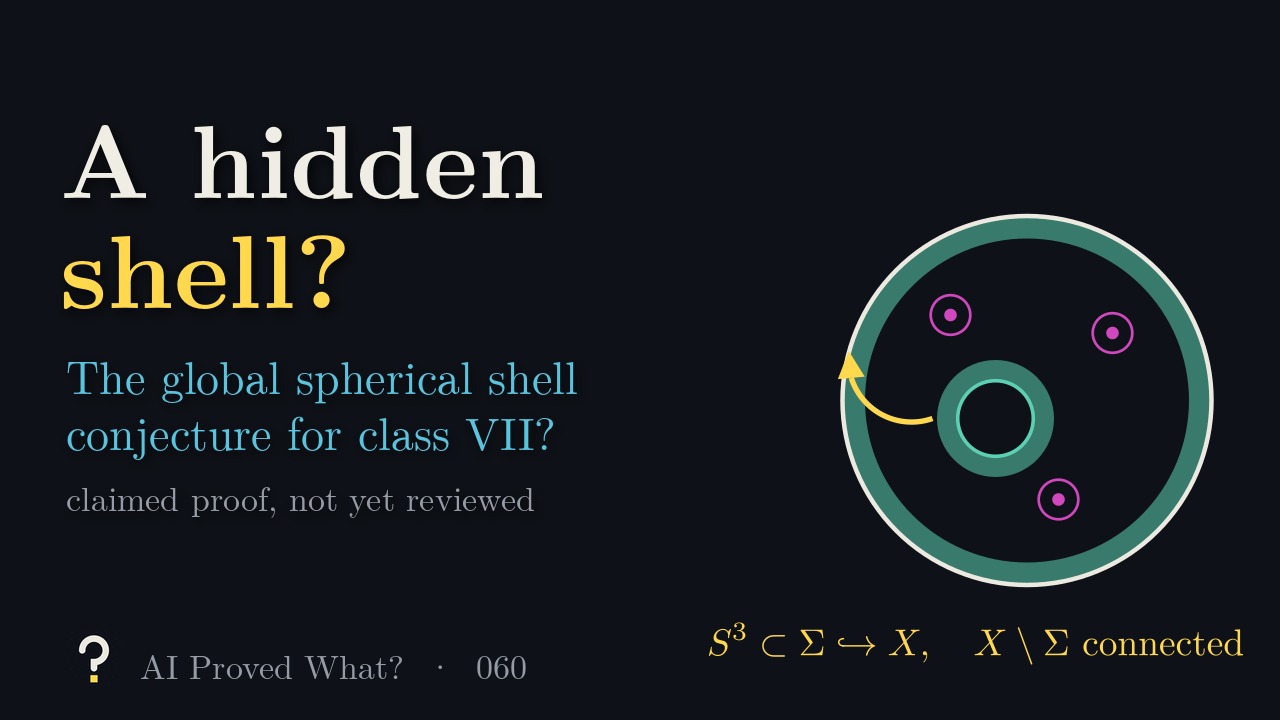
Compact complex surfaces that are not Kähler can be strange. The simplest is the Hopf surface: take ℂ2 minus the origin and identify each point z with z/2. A fundamental domain is the thick shell 1/2 < |z| ≤ 1 around the three-sphere, with its inner face glued to its outer face, so the surface is S1 × S3. Surfaces of class VII are those with first Betti number one and Kodaira dimension −∞. With second Betti number zero, work of Bogomolov, of Li, Yau and Zheng, and of Teleman shows that every such surface is a Hopf or an Inoue surface.
Kato found a way to build examples with positive second Betti number: blow up points inside a ball, cut out a small ball, and glue a neighbourhood of its boundary sphere to a neighbourhood of the outer sphere. The result contains a global spherical shell, a holomorphic copy of a neighbourhood of S3 ⊂ ℂ2 ∖ {0} whose complement is connected. Nakamura’s working hypothesis, the global spherical shell conjecture, says that every minimal class VII surface with positive second Betti number contains one. Teleman proved this when b2 = 1 and found a cycle of curves when b2 = 2; Kurnosov and Spicer handled b2 = 3, given two foliations.
Result 060 is one OpenAI preprint (September 24, 2026; 39 pages). It claims the conjecture: every connected minimal compact complex surface of class VII with positive second Betti number b contains a global spherical shell. By Kato’s deformation theorem, each such surface then deforms to a Hopf surface blown up b times, its fundamental group is ℤ, and it is diffeomorphic to (S1 × S3) # b copies of the projective plane with reversed orientation. The paper also completes a result of Albanese, Di Cerbo and Lombardi: aspherical compact complex surfaces satisfy χ ≥ (9/5)|σ|, with the possible class VII exception now gone. And it is the class VII step of the Oka classification in episode 042.
What it doesn’t claim
The theorem is about minimal surfaces with positive second Betti number; the case b2 = 0 was already settled (Hopf and Inoue surfaces). It does not give a new construction of surfaces: the conclusion is that every such surface is one of Kato’s.
Where it stands
- Posted as a preprint
- OpenAI, dated September 24, 2026, released October 6
- Peer reviewed
- Not yet
- Checked in Lean
- No: OpenAI published no Lean proof for this result
Last checked October 19, 2026. The preprint has not been revised. It cites no other paper from the release, though the Oka classification of result 042 relies on it. Its inputs are established theorems, including Donaldson’s diagonalization, Enoki’s theorem, and the criterion of Dloussky, Oeljeklaus and Toma. We found no public assessment by specialists.
How the proof goes
- Reduce to curves. A class VII surface has a negative definite intersection form, so by Donaldson’s theorem and a parity count the canonical class is a sum of b perpendicular classes of square −1. Enoki’s theorem gives a shell if there is an effective divisor of square zero, and Dloussky, Oeljeklaus and Toma build a shell from b rational curves. So the task is to produce b rational curves on a surface where none are known.
- Sections on the cyclic cover. The paper works on the infinite cyclic cover, with a height function that goes up by one under the deck transformation. From finite cyclic quotients it builds many compactly supported line-bundle classes, nearly n·b of them for the n-fold quotient. Fourier–Laplace analysis on the periodic ends, in the style of Taubes, gives each class a holomorphic section tending to one at the top end and to zero at the bottom, so its zero divisor stays below some height.
- Compact rational curves. Holomorphic differentials on a component of the divisor define currents on the cover, and a residue argument rules out square-integrable ones, so every component has genus zero. A uniform estimate on long cylinders excludes domains missing two or more points, and a periodic gauge argument excludes the plane, so every component is a compact rational curve.
- The count. The curves’ translates are organized over Laurent polynomials; with fewer than b rational curves there would be too few orbits to support all the independent classes as n grows. So there are at least b, independence caps it at b, and the Dloussky–Oeljeklaus–Toma criterion gives the shell.
The numbers in the video
- A short Python script checks the Hopf shell, the class VII numerics e = b, σ = −b, K2 = −b and χ(𝒪) = 0 for (S1 × S3) # b reversed projective planes, why the canonical class has coordinates ±1 in a diagonal basis, and how these surfaces and ball quotients compare with χ ≥ (9/5)|σ|.
Read the source
- Global Spherical Shells on Minimal Surfaces of Class VII (PDF), September 24, 2026 (39 pages).
- Episode 042, the Oka classification that uses this result for class VII.
- The collection’s catalog, where this is result 060.
The paper
OpenAI groups related papers into one result; this one has a single paper.
Transcript
Read the full script
0:00Shells in non-Kähler surfaces
Compact complex surfaces that are not Kähler can be strange. The simplest is the Hopf surface: take complex two-space minus the origin, and identify each point z with half of z. A fundamental domain is a thick shell around the three-sphere, with its inner face glued to its outer face, so the surface is a circle times a three-sphere. Surfaces of class VII are those with first Betti number one and Kodaira dimension minus infinity. With second Betti number zero, work of Bogomolov, of Li, Yau and Zheng, and of Teleman shows that every such surface is a Hopf or an Inoue surface. Kato found a way to build examples with positive second Betti number: blow up points inside a ball, cut out a small ball, and glue a neighbourhood of its boundary sphere to a neighbourhood of the outer sphere. The result contains a global spherical shell: a holomorphic copy of a neighbourhood of the three-sphere whose complement is connected. Nakamura’s working hypothesis, the global spherical shell conjecture, says that every minimal class VII surface with positive second Betti number contains one. Teleman proved this when the second Betti number is one, and found a cycle of curves when it is two; Kurnosov and Spicer handled three, given two foliations.
1:19The claim
Result 060 is one OpenAI preprint, 39 pages, dated September 24. It claims the conjecture: every connected minimal compact complex surface of class VII with positive second Betti number b contains a global spherical shell. By Kato’s deformation theorem, each such surface then deforms to a Hopf surface blown up b times, its fundamental group is the integers, and it is diffeomorphic to a circle times a three-sphere, connected-summed with b copies of the projective plane with reversed orientation. The paper also completes a result of Albanese, Di Cerbo and Lombardi on aspherical complex surfaces, those with contractible universal cover: their Euler characteristic is at least 9/5 of the absolute value of their signature, and the possible class VII exception is now gone. And it is the step that the Oka classification in episode 042 used for class VII.
2:20Producing curves
Here is the plan of the proof. A class VII surface has a negative definite intersection form, so by Donaldson’s theorem and a parity count, the canonical class is a sum of b perpendicular classes of square minus one. Two known theorems reduce the problem to curves. Enoki’s theorem gives a shell if there is an effective divisor of square zero. And Dloussky, Oeljeklaus and Toma build a shell from b rational curves. So the task is to produce b rational curves on a surface where none are known. The paper works on the infinite cyclic cover, with a height function that goes up by one under the deck transformation. From finite cyclic quotients it builds many compactly supported line-bundle classes, nearly n times b of them for the n-fold quotient. Using Fourier–Laplace analysis on the periodic ends, in the style of Taubes, each class gets a holomorphic section that tends to one at the top end and to zero at the bottom, so its zero divisor stays below some height.
3:25Compact curves, then counting
The danger is that this divisor has open components that run off to infinity. The paper rules them out. Holomorphic differentials on a component define currents on the cover, and a residue argument rules out any square-integrable ones, so every component has genus zero: a sphere, or a domain in the sphere. A uniform estimate on long cylinders excludes domains missing two or more points, and a periodic gauge argument excludes the plane. So every component is a compact rational curve. Finally, the curves are counted. Their translates are organized over Laurent polynomials, and if the surface had fewer than b rational curves, there would be too few orbits to support all those independent classes as n grows. So there are at least b, and independence of their classes caps it at b: exactly b rational curves, and the theorem of Dloussky, Oeljeklaus and Toma gives the global spherical shell.
4:24Where it stands
The preprint is not yet peer reviewed, and it has not been revised. There is no Lean formalization, and it cites no other paper from the release, though the Oka classification of episode 042 relies on it. Its inputs are established theorems, including Donaldson’s diagonalization, Enoki’s theorem, and the Dloussky, Oeljeklaus and Toma criterion. We found no public assessment. If it holds, every minimal class VII surface with positive second Betti number is a Kato surface, built by blowing up a ball, cutting out a small ball, and gluing the two boundary spheres together, and its smooth topology is a circle times a three-sphere with b reversed projective planes attached.
Spot a mistake?
This episode simplifies on purpose, but it shouldn’t be wrong. If something is, open an issue on GitHub or leave a comment on YouTube. Corrections are noted here with a date.