Only Wolf spaces?
Contact Fano manifolds and the LeBrun–Salamon conjecture
Covers result 062 in OpenAI’s catalog: its one paper. See its connections to other results and the work it cites.
6:04. English captions available. The video loads from YouTube when you press play.
Chapters
The claim, in plain words
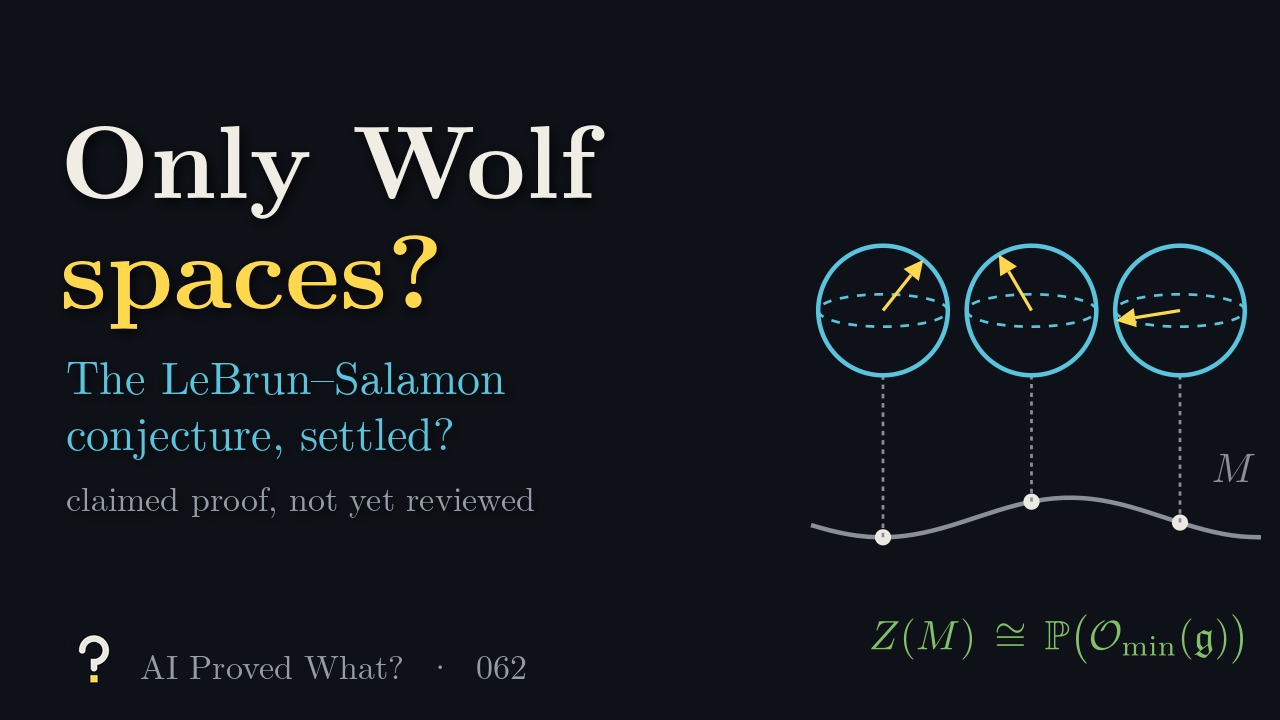
A Riemannian manifold of dimension 4m, with m ≥ 2, is quaternionic-Kähler if its holonomy lies in Sp(m)·Sp(1). Each tangent space then carries a whole sphere of complex structures, I, J, K and their combinations, and as you move around the sphere rotates, so no single one is preserved. With positive scalar curvature, the known examples are Wolf’s symmetric spaces, one for each simple complex Lie algebra: quaternionic projective space, the Grassmannian of complex 2-planes, the Grassmannian of oriented real 4-planes, and five exceptional spaces built from G2, F4, E6, E7 and E8. In 1994 LeBrun and Salamon conjectured that there are no others, up to scaling, and proved that each dimension has only finitely many. The conjecture was known in real dimension 8 (Poon and Salamon), in dimensions 12 and 16 (Buczyński and Wiśniewski), and under nonnegative sectional curvature (Brendle and Semmelmann).
Salamon’s twistor space collects the sphere of complex structures over each point. It is a complex manifold of dimension 2m + 1 with a contact structure (a field of hyperplanes as far from integrable as possible) and an ample anticanonical bundle: a contact Fano manifold. So the conjecture would follow from an algebraic one: every contact Fano manifold is an adjoint variety, the projectivized smallest nonzero nilpotent orbit of a simple Lie algebra.
Result 062 is one OpenAI preprint (September 23, 2026; 40 pages). It claims exactly that: every contact Fano manifold of dimension at least three, with its contact structure, is an adjoint variety. Consequences: every compact positive quaternionic-Kähler manifold of real dimension at least 8 is a Wolf space, up to scaling; every contact Fano manifold has a Kähler–Einstein metric; and a projective contact manifold of dimension at least three with second Betti number one is an adjoint variety (with second Betti number at least two it is biholomorphic to a projectivized cotangent bundle, which was already known from work of Kebekus, Peternell, Sommese and Wiśniewski, and of Demailly).
What it doesn’t claim
The Riemannian statement starts in real dimension 8; in dimension 4 the holonomy condition is empty and quaternionic-Kähler is defined differently. For projective contact manifolds with second Betti number at least two, the paper identifies only the underlying complex manifold, not the contact structure.
Where it stands
- Posted as a preprint
- OpenAI, dated September 23, 2026, released October 6
- Peer reviewed
- Not yet
- Checked in Lean
- No: OpenAI published no Lean proof for this result
Last checked October 19, 2026. The preprint has not been revised, and it cites no other paper from the release. Its inputs are established results, including Kebekus on contact lines, Buczyński on their varieties of directions, and LeBrun’s and Salamon’s twistor theorems. The conjecture has drawn claimed proofs before (preprints by Kobayashi and by Yasukura, who later found errors and narrowed his claims), so specialists will want to check this one closely. We found no public assessment by specialists.
How the proof goes
- Reduction. Two cases are explicit: odd-dimensional projective space with L = 𝒪(2), and the variety of points and hyperplanes, the adjoint varieties of the symplectic and special linear algebras. Otherwise the Picard group is generated by the contact line bundle L = TX/F, and there are contact lines, rational curves of degree one against L, which cover the manifold (Kebekus).
- A very free conic. Through a general point the paper picks two free contact lines whose tangent vectors pair nontrivially under the derivative of the contact form, and smooths their union into a conic g of degree two with g*TX ≅ 𝒪(2) ⊕ 𝒪(1)2n.
- A two-point section. Each nearby conic h gives (z − w)2 θ(h′(z)) θ(h′(w)). On projective space this is the symplectic pairing ω(x, y), squared. The expression extends over conics that break into two lines, because the contact form applied to the curve’s velocity vanishes to the right order there, and it depends only on the two image points, so it descends to a symmetric section B of L ⊠ L on X × X.
- Jets and symmetry. Along the diagonal B vanishes to second order with leading term θ2, and symmetry fixes the next term. Together these make global sections of L generate first jets at every point. Sections of L are contact Hamiltonians, so contact vector fields span every tangent space and the contact symmetries act transitively. The contact moment map then identifies the manifold with an adjoint variety; applied to a twistor space, this gives a Wolf space, and the paper recovers the metric up to scaling.
The numbers in the video
- A short Python script builds the root system of every simple Lie algebra, computes the dual Coxeter number h two ways, and gets the dimensions 2h − 3 of the adjoint varieties (G2: 5, F4: 15, E6: 21, E7: 33, E8: 57) and 4(h − 2) of the Wolf spaces (8, 28, 40, 64, 112), and counts Wolf spaces in each real dimension. It checks −K = (n + 1)L for the two explicit models, α ∧ (dα)n = 2n n! on projective space, and that ω(x, y)2 equals (z − w)2 θ(h′(z)) θ(h′(w)) along lines, with second-order vanishing and leading term θ2.
Read the source
- Contact Fano manifolds and the LeBrun–Salamon conjecture (PDF), September 23, 2026 (40 pages).
- LeBrun and Salamon, Strong rigidity of positive quaternion-Kähler manifolds (Invent. Math., 1994).
- Buczyński and Wiśniewski, Algebraic torus actions on contact manifolds (arXiv).
- Brendle and Semmelmann, Quaternionic-Kähler manifolds with nonnegative sectional curvature (arXiv).
- The collection’s catalog, where this is result 062.
The paper
OpenAI groups related papers into one result; this one has a single paper.
Transcript
Read the full script
0:00Rigid quaternionic geometry
A Riemannian manifold of dimension 4m, with m at least two, is called quaternionic Kähler if its holonomy lies in the group Sp(m)·Sp(1). At each point the tangent space has a whole sphere of complex structures, I, J and K and their combinations, and as you move around, the sphere rotates, so no single one is preserved. When the scalar curvature is positive, the known examples are the symmetric Wolf spaces: quaternionic projective space, the Grassmannian of complex two-planes, the Grassmannian of oriented real four-planes, and five exceptional spaces built from G2, F4 and the E series. Wolf matched them with the simple complex Lie algebras. In 1994, LeBrun and Salamon conjectured that there are no others: every compact positive quaternionic Kähler manifold is a Wolf space, up to scaling. They proved that each dimension has only finitely many, up to scaling. The conjecture was known in real dimension eight, by Poon and Salamon, in dimensions twelve and sixteen, by Buczyński and Wiśniewski, and under nonnegative sectional curvature, by Brendle and Semmelmann. Claimed proofs have circulated as preprints before, and one author later found errors in his own and narrowed his claims.
1:21Twistors and the claim
The bridge is Salamon’s twistor space. Over each point, collect the sphere of complex structures. The result is a complex manifold of dimension 2m + 1, and it carries a contact structure: a field of hyperplanes, as far from integrable as possible, so that the contact form wedge a power of its derivative never vanishes. The twistor space is also Fano: its anticanonical bundle is ample. So the conjecture would follow from an algebraic one: every contact Fano manifold is an adjoint variety, the projectivized smallest nonzero nilpotent orbit of a simple Lie algebra. Result 062 is one OpenAI preprint, 40 pages, dated September 23. It claims exactly that: every contact Fano manifold of dimension at least three, with its contact structure, is an adjoint variety. Three consequences follow. Every compact positive quaternionic Kähler manifold of real dimension at least eight is a Wolf space, up to scaling. Every contact Fano manifold has a Kähler–Einstein metric. And with work of Kebekus, Peternell, Sommese and Wiśniewski, and of Demailly, every projective contact manifold of dimension at least three is, when its second Betti number is one, an adjoint variety, and otherwise, as was already known, biholomorphic to a projectivized cotangent bundle.
2:49Lines, conics and a two-point section
Here is how the proof goes. Two cases are explicit: odd-dimensional projective space, and the variety of points and hyperplanes, the adjoint varieties of the symplectic and special linear algebras. Otherwise the Picard group is generated by the contact line bundle L, and there are contact lines: rational curves of degree one against L. Kebekus showed that they cover the manifold. The paper picks two of them through a general point whose tangent vectors pair nontrivially under the derivative of the contact form, and smooths their union into a very free conic: a rational curve of degree two along which the tangent bundle is positive. Each nearby conic h gives a function of two parameters, z and w: the square of z minus w, times the contact form applied to the velocity at z, times the contact form applied to the velocity at w. On projective space, this is just the symplectic pairing of the two points, squared. The paper shows the expression extends over conics that break into two lines, because the contact form, applied to the curve’s velocity, vanishes to the right order as the conic breaks, and that it depends only on the two image points. So it descends to one symmetric section B of L times L on the product of the manifold with itself.
4:11From jets to symmetry
Along the diagonal, B vanishes to second order, and its leading term is the square of the contact form. Symmetry then fixes the next term. Together these imply that global sections of L generate first jets at every point: any value and any first derivative can be prescribed. Sections of L are contact Hamiltonians, generating vector fields that preserve the contact structure. So these fields span every tangent space, and the group of contact symmetries acts transitively. A homogeneous contact manifold is pinned down by its moment map: each point defines, up to scale, a linear function on the Lie algebra of contact symmetries, and the image is the closed orbit in the projective space of that algebra. So the manifold is an adjoint variety, with its standard contact structure. Applied to the twistor space of a positive quaternionic Kähler manifold, this says it is the twistor space of a Wolf space, and the paper recovers the metric from it, up to scaling.
5:15Where it stands
The preprint is not yet peer reviewed, and it has not been revised. There is no Lean formalization, and it cites no other paper from the release. Its inputs are established results, including Kebekus on contact lines, Buczyński on their varieties of directions, and LeBrun’s and Salamon’s twistor theorems. Because this conjecture has drawn claimed proofs before, specialists will want to check this one closely. We found no public assessment. If it holds, positive quaternionic Kähler geometry is completely rigid: from real dimension eight up, the only examples are the symmetric Wolf spaces, up to scaling, one for each simple Lie algebra of the right size, and every contact Fano manifold is an adjoint variety.
Spot a mistake?
This episode simplifies on purpose, but it shouldn’t be wrong. If something is, open an issue on GitHub or leave a comment on YouTube. Corrections are noted here with a date.