How many divisors?
The generalized Mukai conjecture
Covers result 063 in OpenAI’s catalog: its one paper. See its connections to other results and the work it cites.
5:36. English captions available. The video loads from YouTube when you press play.
Chapters
The claim, in plain words
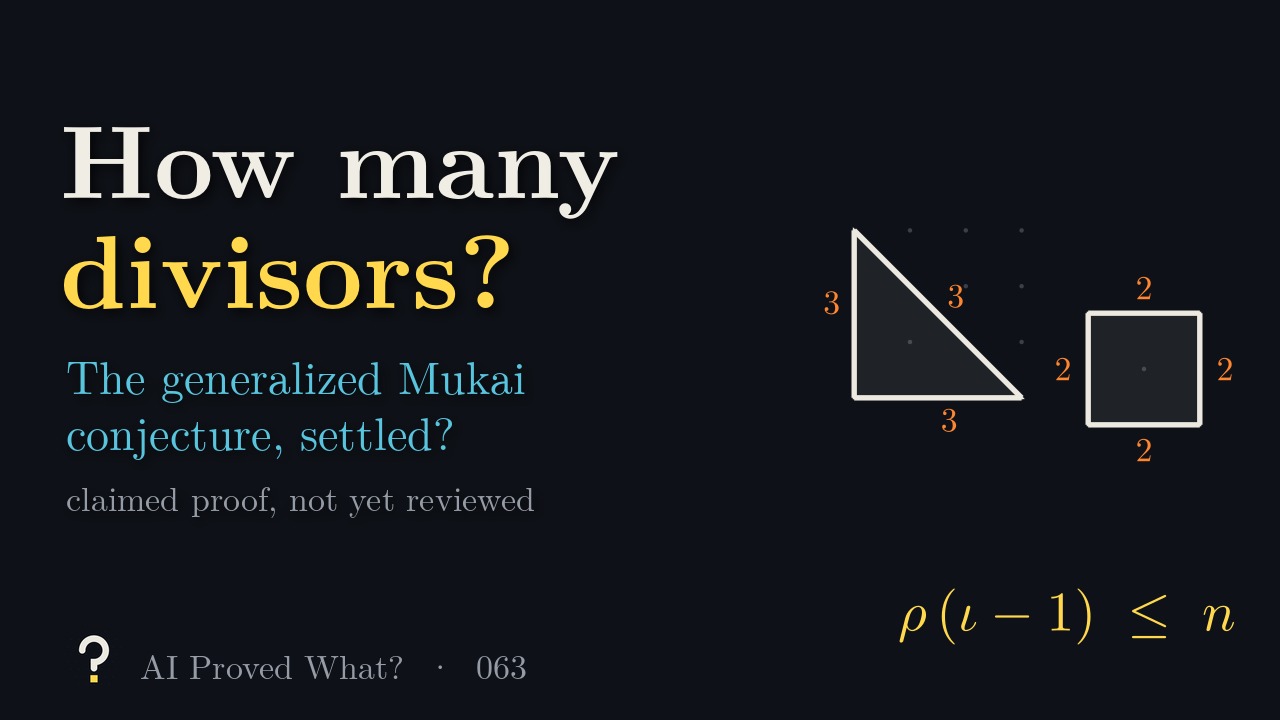
A Fano manifold is a smooth projective variety whose anticanonical bundle is ample, so in a sense it is positively curved, like projective space. Two numbers measure it. The Picard number ρ counts independent divisor classes. The pseudoindex ι is the smallest anticanonical degree of a rational curve on it. Projective space of dimension n has ρ = 1 and ι = n + 1; a product of two projective lines has ρ = 2 and ι = 2; blowing up the plane at a point creates a curve of anticanonical degree one, so ι = 1.
Mukai’s conjecture (1988) used the Fano index: the Picard number times the index minus one is at most the dimension. Bonavero, Casagrande, Debarre and Druel replaced the index by Wiśniewski’s pseudoindex, which is at least as large, making the statement stronger, and proved it up to dimension four; Andreatta, Chierici and Occhetta reached dimension five. It was also known for toric, horospherical and spherical varieties, and when the pseudoindex is more than a third of the dimension (Novelli, extending joint work with Occhetta).
Result 063 is one OpenAI preprint (September 24, 2026; 19 pages). It claims the generalized Mukai conjecture in every dimension: for every Fano manifold of positive dimension n, ρ(ι − 1) ≤ n, and equality holds exactly for a product of ρ copies of projective space of dimension ι − 1. For products of projective spaces the bound is easy to see: the pseudoindex comes from a line in the smallest factor, so equality needs all the factors to have the same size. As a special case it recovers Wiśniewski’s theorem that 2ι > n + 2 forces ρ = 1.
What it doesn’t claim
The statement is about smooth Fano manifolds. When ι = 1 the inequality is automatic, so the content is for manifolds all of whose rational curves have anticanonical degree at least two. The proof does not assume semisimple quantum cohomology, and it uses no extra symmetry.
Where it stands
- Posted as a preprint
- OpenAI, dated September 24, 2026, released October 6
- Peer reviewed
- Not yet
- Checked in Lean
- No: OpenAI published no Lean proof for this result
Last checked October 19, 2026. The preprint has not been revised, and it cites no other paper from the release. Among its inputs are established tools: genus-zero Gromov–Witten theory with virtual classes, the divisor, string and topological recursion identities, the ordered-chain bound of Bonavero, Casagrande, Debarre and Druel with its erratum, and Occhetta’s characterization of products of projective spaces. We found no public assessment by specialists.
How the proof goes
- Quantum matrices. For a basis D1, …, Dρ of divisor classes, quantum multiplication by Dj is a matrix Aj(q) on cohomology: cup product plus two-point corrections Sβ counting rational curves of degree β meeting two cycles. The matrices commute. A correspondence of anticanonical degree d lowers codimension by d − 1, so a nonzero product of ρ correspondences in independent curve degrees gives ρ(ι − 1) ≤ n. On ℙ1 × ℙ1, one ruling takes a point to a line and the other takes the line to the whole surface: a drop of 2 = n.
- Point descendants. Virtual counts of rational curves through a point, cut down by a power of a cotangent class, are bounded below by (ad)−(d−1) for curve degrees carried by free rational curves (a is fixed so that −aK is very ample). They satisfy a recurrence driven by the quantum matrices.
- Independent eigenvalues. If every joint eigenvalue tuple of the Aj satisfied a polynomial relation, the recurrence would force, after factorial normalization, decay faster than any exponential along a suitable free degree, while the lower bound allows only exponential decay. So one joint eigenvalue tuple is algebraically independent. On ℙ1 × ℙ1 the tuples are (±√q1, ±√q2).
- From eigenvalues to curves. An alternating trace of matrix-valued differentials, unchanged by any change of basis, detects the independent eigenvalues in a triangular basis and a nonzero product of independent curve correspondences in the fixed basis. That proves the inequality.
- Equality. At equality every chosen degree is minimal; the curves form proper families, the ordered-chain bound applies, and Occhetta’s characterization gives a product of projective spaces.
The numbers in the video
- A short Python script computes ρ, ι and ρ(ι − 1) for all 66 products of projective spaces up to dimension 8 (equality exactly for equal factors), reads ρ and ι for the toric del Pezzo surfaces from their fans, checks that the quantum matrices of ℙ1 × ℙ1 commute with joint eigenvalues ±√q1, ±√q2, and solves the paper’s descendant recurrence on ℙn, getting 1/(k!)n+1, above the lower bound.
Read the source
- The generalized Mukai conjecture (PDF), September 24, 2026 (19 pages).
- Bonavero, Casagrande, Debarre and Druel, Sur une conjecture de Mukai (arXiv).
- Novelli, on Fano manifolds with large pseudoindex (arXiv).
- Gagliardi, Hofscheier and Pearson, the generalised Mukai conjecture for spherical varieties (arXiv).
- The collection’s catalog, where this is result 063.
The paper
OpenAI groups related papers into one result; this one has a single paper.
Transcript
Read the full script
0:00Two numbers of a Fano manifold
A Fano manifold is a smooth projective variety whose anticanonical bundle is ample, so in a sense it is positively curved, like projective space. Two numbers measure it. The Picard number, ρ, counts independent divisor classes. The pseudoindex, ι, is the smallest anticanonical degree of a rational curve on it. Projective space of dimension n has Picard number one and pseudoindex n plus one. A product of two projective lines has Picard number two and pseudoindex two. Blowing up the plane at a point creates a curve of anticanonical degree one, so the pseudoindex drops to one. Mukai’s conjecture, from 1988, used the Fano index: the Picard number times the index minus one is at most the dimension. Bonavero, Casagrande, Debarre and Druel replaced the index by Wiśniewski’s pseudoindex, which is at least as large, making the statement stronger, and proved it up to dimension four. Andreatta, Chierici and Occhetta reached dimension five. It was also known for toric, horospherical and spherical varieties, and when the pseudoindex is more than a third of the dimension, by work of Novelli, extending joint work with Occhetta.
1:16The claim
Result 063 is one OpenAI preprint, 19 pages, dated September 24. It claims the generalized Mukai conjecture in every dimension: for every Fano manifold of positive dimension n, ρ(ι − 1) is at most n, and equality holds exactly for a product of ρ copies of projective space of dimension ι − 1. For products of projective spaces the bound is easy to see: the pseudoindex comes from a line in the smallest factor, so equality needs all the factors to have the same size. No restriction on dimension, symmetry or geometry is assumed. As a special case, the bound recovers Wiśniewski’s theorem that a pseudoindex larger than half the dimension plus one forces Picard number one. Earlier general approaches built chains of rational curves directly. This one starts from quantum cohomology, which counts rational curves meeting prescribed cycles, and brings in proper families of curves only at the very end, in the equality case.
2:22Quantum cohomology
Here is the idea. Choose a basis of divisor classes. Quantum multiplication by each one is a matrix acting on the cohomology of the manifold: the ordinary cup product, plus corrections that count rational curves of each degree meeting two given cycles, weighted by formal variables q. These matrices commute. A curve correspondence of anticanonical degree d lowers the codimension of a class by d minus one. So if a product of ρ correspondences in independent curve degrees is nonzero, the total drop, at least ρ(ι − 1), cannot exceed n. That is the inequality. On the product of two projective lines, each ruling has degree two. One correspondence takes a point to a line, the other takes the line to the whole surface: a total drop of two, equal to the dimension. The hard part is producing such a product in general, without assuming that quantum cohomology is semisimple. The paper turns to point descendants: virtual counts of rational curves through a point, cut down by a power of a cotangent class. It proves that for curve degrees carried by free rational curves, these numbers are bounded below by one over a d, to the power d minus one, for a fixed a.
3:42Eigenvalues and curves
The descendants obey a recurrence driven by the quantum matrices. Suppose every joint eigenvalue tuple of those matrices satisfied a polynomial relation. Then, after normalizing by factorials, the recurrence would force the descendants to decay faster than any exponential along a suitable free curve degree, while the lower bound allows only exponential decay. So one tuple of eigenvalues is algebraically independent. On the product of two lines, the eigenvalues are plus or minus the square root of q one, and plus or minus the square root of q two. An alternating trace of matrix-valued differentials, unchanged by any change of basis, turns that independence into a nonzero product of correspondences in independent curve degrees, which proves the inequality. At equality, every chosen degree is minimal. The curves then form proper families, the ordered-chain bound of Bonavero, Casagrande, Debarre and Druel applies, and Occhetta’s characterization shows that the manifold is a product of projective spaces.
4:52Where it stands
The preprint is not yet peer reviewed, and it has not been revised. There is no Lean formalization, and it cites no other paper from the release. Among its inputs are established tools: genus-zero Gromov–Witten theory with virtual classes, the divisor, string and recursion identities, the ordered-chain bound with its erratum, and Occhetta’s product theorem. We found no public assessment. If it holds, a Fano manifold whose rational curves all have high degree must have a small Picard number: when ι is at least two, ρ is at most n divided by the quantity ι − 1, and only products of equal projective spaces reach that bound.
Spot a mistake?
This episode simplifies on purpose, but it shouldn’t be wrong. If something is, open an issue on GitHub or leave a comment on YouTube. Corrections are noted here with a date.