Same number, same shape?
Topological triviality of μ-constant families of surface singularities
Covers result 064 in OpenAI’s catalog: its one paper. See its connections to other results and the work it cites.
5:55. English captions available. The video loads from YouTube when you press play.
Chapters
The claim, in plain words
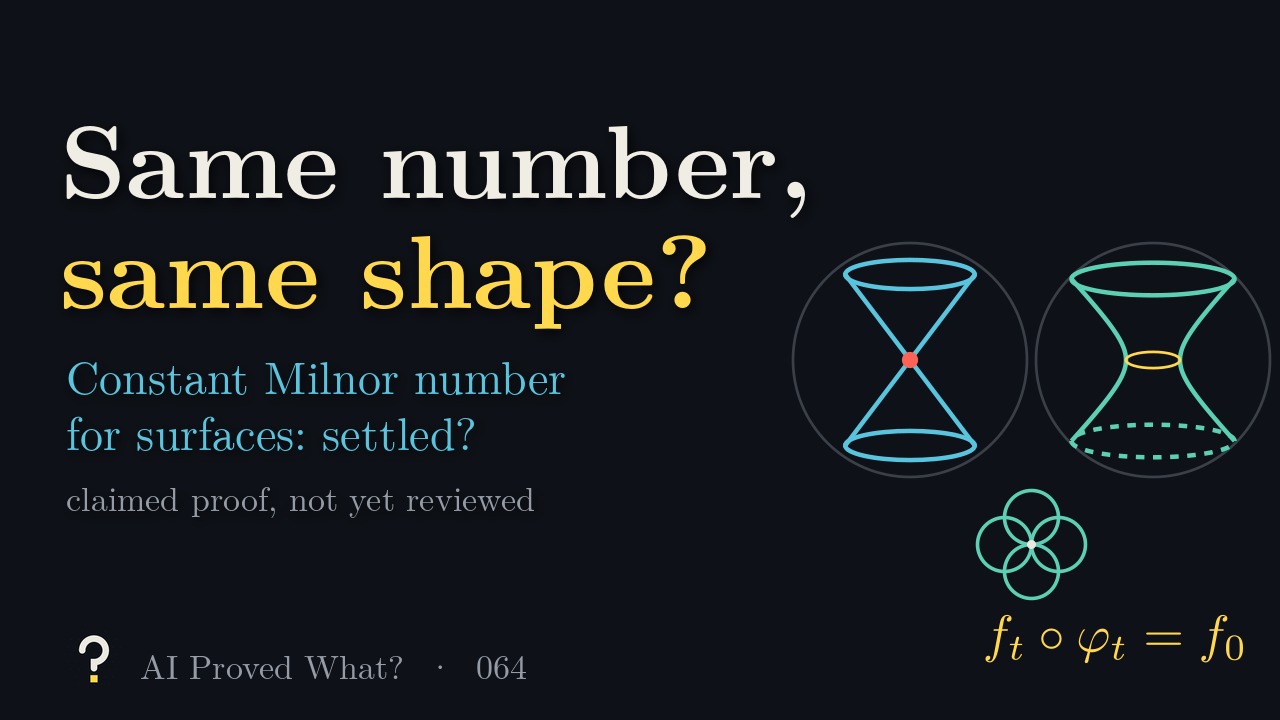
Take a polynomial in three complex variables with an isolated critical point at the origin, like x2 + y2 + z2. Its zero set is a surface with one singular point. Nearby level sets are smooth, and inside a small ball each one, the Milnor fiber, looks like a bouquet of two-spheres. The number of spheres is the Milnor number μ, the dimension of the local ring modulo the three partial derivatives: 1 for x2 + y2 + z2, and 6 for x2 + y3 + z4.
Now let the polynomial move in a family ft. If μ stays constant, is the family topologically trivial: is there, for each t, a homeomorphism of space, varying continuously with t, that turns ft into f0? Lê and Ramanujam proved in 1976 that constant μ gives constant topological type whenever the hypersurface dimension is not two, and Timourian and King upgraded this to triviality of the family. For surfaces in three-space, where the cobordism argument does not give a product, the question stayed open: the μ-constant problem.
Result 064 is one OpenAI preprint (September 24, 2026; 37 pages). It claims a positive answer for surfaces: every holomorphic one-parameter family of isolated surface singularities in ℂ3 with constant Milnor number is topologically right-trivial. After shrinking, there are homeomorphisms φt, fixing the origin and continuous in t together with their inverses, with ft ∘ φt = f0. So the zero sets and all nearby level sets move together.
What it doesn’t claim
Topological triviality is weaker than Whitney regularity. In the Briançon–Speder family z5 + t y6 z + x y7 + x15, μ stays 364 but the Milnor number of a generic plane section drops from 28 to 26 once t ≠ 0, so the family is not Whitney regular; the theorem says nothing about such finer invariants staying constant. The result is about one-parameter families of isolated singularities in three variables; constant multiplicity for μ-constant families was already known (Fernández de Bobadilla and Pełka).
Where it stands
- Posted as a preprint
- OpenAI, dated September 24, 2026, released October 6
- Peer reviewed
- Not yet
- Checked in Lean
- No: OpenAI published no Lean proof for this result
Last checked October 19, 2026. The preprint has not been revised, and it cites no other paper from the release; one of the Zariski counterexample papers of episode 059 mentions it for context. Its inputs are substantial established theorems: Okuma’s simultaneous resolution, the threefold minimal model program, Langer’s orbifold Bogomolov–Miyaoka–Yau inequality, Greuel and Steenbrink, nearby cycles, and Fernández de Bobadilla and Pełka. We found no public assessment by specialists.
How the proof goes
- Easy cases. If the central surface is a double point, the problem reduces to plane curves. If it is log canonical, its multiplicity is at most three, constant multiplicity keeps every generic plane section the same, and Teissier’s criterion finishes.
- Wahl’s invariant. Otherwise the paper uses Wahl’s logarithmic invariant β = −Ploc2, built from the positive part of the canonical divisor plus all exceptional curves on a resolution. If β is constant, Okuma’s theorem gives a simultaneous resolution after a finite base change.
- Constant μ forces constant β. After compactifying, semistable reduction and the threefold log minimal model program, the special fiber is a main component plus extra surfaces Sa. Constant μ gives 0 = Σ χc(Sa°) + δ with δ ≥ 0 (Greuel–Steenbrink); nefness and Langer’s inequality give 0 ≤ (K + B)2 ≤ 3χc(Sa°). So every extra square vanishes and β is constant.
- Homeomorphisms. With the simultaneous resolution (after t = ue), an Euler count shows the exceptional curves keep normal crossings. The parameter direction lifts to complete vector fields on the resolved tubes; the flows descend to the punctured zero sets and extend to nearby levels, preserving f. Properness and reverse transport give continuity of the maps and their inverses, and a correction along the angular seam returns to the original disk.
The numbers in the video
- A short Python script computes Milnor numbers by Gröbner bases (1, 4, 6, 8 for A1, A4, E6, E8; 364 for the Briançon–Speder family at several t, matching the weighted formula 14 × 13/2 × 4), checks the constant multiplicity 5, and computes the generic plane-section Milnor numbers 28 and 26 from Newton polygons with Kouchnirenko’s formula after checking nondegeneracy.
Read the source
- Topological triviality of mu-constant families of surface singularities (PDF), September 24, 2026 (37 pages).
- Fernández de Bobadilla and Pełka, Symplectic monodromy at radius zero and equimultiplicity of μ-constant families (Annals of Mathematics, 2024).
- Episode 059, on counterexamples to Zariski’s multiplicity conjecture.
- The collection’s catalog, where this is result 064.
The paper
OpenAI groups related papers into one result; this one has a single paper.
Transcript
Read the full script
0:00The μ-constant problem
Take a polynomial in three complex variables with an isolated critical point at the origin, like x² + y² + z². Its zero set is a surface with one singular point. Nearby level sets are smooth, and inside a small ball each one, the Milnor fiber, looks like a bouquet of two-spheres. The number of spheres is the Milnor number, μ. Algebraically, it is the dimension of the local ring modulo the three partial derivatives: one for x² + y² + z², and six for x² + y³ + z⁴. Now let the polynomial move in a family with a parameter t. If the Milnor number stays constant, is the family topologically trivial: is there, for each t, a homeomorphism of space, varying continuously with t, that turns each function into the first one? Lê and Ramanujam proved in 1976 that constant Milnor number gives constant topological type whenever the hypersurface dimension is not two, and Timourian and King upgraded this to triviality of the family. For surfaces in three-space, where their cobordism argument does not give a product, the question stayed open: the μ-constant problem.
1:17The claim
Result 064 is one OpenAI preprint, 37 pages, dated September 24. It claims a positive answer for surfaces: every holomorphic one-parameter family of isolated surface singularities in complex three-space with constant Milnor number is topologically right-trivial. After shrinking, there are homeomorphisms φ_t of the ambient space, fixing the origin and varying continuously with t, together with their inverses, such that f_t ∘ φ_t = f_0. So the zero sets and all nearby level sets move together. Constant Milnor number is weaker than Whitney regularity, a stronger form of equisingularity. By Teissier and by Briançon and Speder, Whitney regularity means that the whole sequence of sectional Milnor numbers is constant. In the Briançon–Speder family, z⁵ + t·y⁶z + x·y⁷ + x¹⁵, μ stays 364, but the Milnor number of a generic plane section drops from 28 to 26 once t is nonzero. A proof must handle such families. Fernández de Bobadilla and Pełka had already shown that the multiplicity stays constant.
2:36A logarithmic invariant
Here is the plan. If the central surface is a double point, or log canonical, the paper reduces to known tools: plane curves in the first case, and multiplicity at most three, constant multiplicity and Teissier’s criterion in the second. The main case is a surface that is not log canonical. There the paper uses Wahl’s logarithmic invariant beta: minus the self-intersection of the positive part of the sum of the canonical divisor and all exceptional curves on a resolution. If beta is constant, Okuma’s theorem gives a simultaneous resolution after a finite base change. So the numerical task is to show that constant μ forces constant beta. To compare beta across the family, the paper compactifies to projective surfaces and runs semistable reduction and the threefold log minimal model program. The special fiber becomes one main component plus extra surfaces over the singular point. Constant Milnor number makes the Euler characteristics cancel: zero equals the sum of the Euler characteristics of the extra open surfaces, plus a correction that is never negative, by Greuel and Steenbrink. With nefness from the model, Langer’s orbifold Bogomolov–Miyaoka–Yau inequality bounds each extra log canonical square between zero and three times that Euler characteristic. Together these force every extra square to vanish, so beta is constant.
4:05From resolution to homeomorphism
With beta constant, Okuma’s theorem gives, after a base change t = uᵉ, a simultaneous resolution whose exceptional curves stay reduced. An Euler characteristic count shows that they keep normal crossings, since smoothing a node would lower it. On these resolved tubes, the paper lifts the parameter direction to complete vector fields. The flows descend to the punctured zero sets and extend to the nearby nonzero levels, preserving the function. Properness of the tubes and reverse transport give continuity at the origin, for the maps and for their inverses. An explicit correction along the angular seam of the base change brings the trivialization back to the original disk. Parusiński had built trivializing vector fields for linear families, f + t·g, by a gradient method. An appendix explains why a continuous gradient lift alone is not enough: the trajectories need control too.
5:01Where it stands
The preprint is not yet peer reviewed, and it has not been revised. There is no Lean formalization, and it cites no other paper from the release, though one of the Zariski counterexample papers of episode 059 mentions it for context. Its inputs are substantial established theorems: Okuma’s simultaneous resolution, the threefold minimal model program, Langer’s inequality, Greuel and Steenbrink, nearby cycles, and Fernández de Bobadilla and Pełka. We found no public assessment. If it holds, the μ-constant problem is settled for surfaces: in three variables, a constant Milnor number means the function itself does not change topologically along the family, even when finer invariants, like the Milnor number of a plane section, jump.
Spot a mistake?
This episode simplifies on purpose, but it shouldn’t be wrong. If something is, open an issue on GitHub or leave a comment on YouTube. Corrections are noted here with a date.