Langlands, quantized?
Global quantum geometric Langlands at irrational level
Covers result 069 in OpenAI’s catalog: its one paper. See its connections to other results and the work it cites.
5:59. English captions available. The video loads from YouTube when you press play.
Chapters
The claim, in plain words
Take a smooth projective complex curve X and a simple complex group G, like SL2. The G-bundles on X form a moduli stack, BunG. Geometric Langlands relates D-modules on BunG, sheaves that encode linear differential equations there, to sheaves on the space of local systems for the Langlands dual group G∨. A proof was announced in 2024 by Gaitsgory, Raskin and seven coauthors.
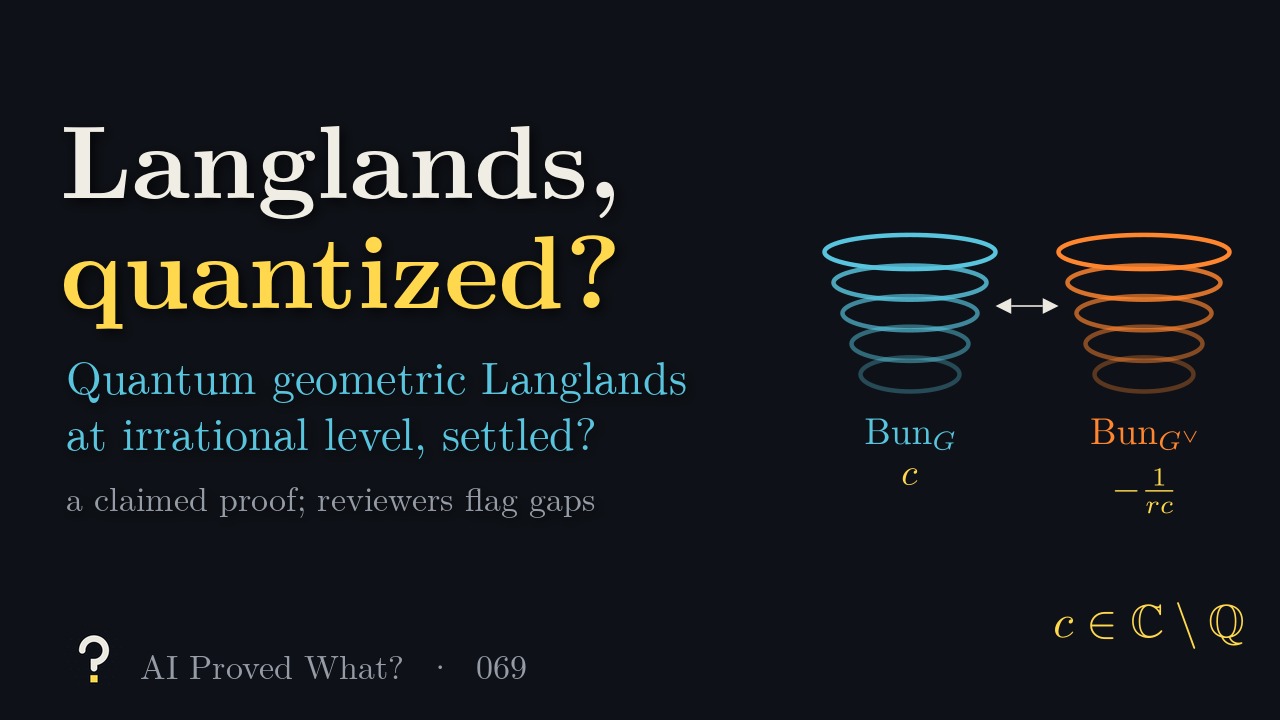
The quantum version deforms the picture by a complex number c, the shifted level. D-modules on BunG are twisted by the power (c − h∨)/(2h∨) of the determinant line, where h∨ is the dual Coxeter number, and the conjecture says that these categories for G at level c match those for G∨ at level −1/(rc), where r, the lacing number, is 1, 2 or 3. The idea goes back to Drinfeld and Stoyanovsky, matches the electric–magnetic duality of Kapustin and Witten, and was developed by Gaitsgory into the quantum Langlands program. Ordinary geometric Langlands appears in a limit, with the level zero on one side and infinite on the other.
Result 069 is one OpenAI preprint (119 pages, dated October 4, 2026). It claims the unramified de Rham equivalence Dc(BunG(X)) ≃ D−1/(rc)(BunG∨(X)) for every connected simple group, every smooth projective curve, and every level c that is not rational, including non-real levels. It keeps the actual groups, like SL2 against PGL2, and all connected components; the equivalence is pinned down by how it treats localized representations and Whittaker coefficients, and it matches central symmetries with transgressed local systems. Earlier, Campbell, Dhillon and Raskin proved the fundamental local equivalences at every irrational level and many rational ones, and Bogdanova constructed a quantum Langlands functor in the Betti setting.
What it doesn’t claim
Rational levels, where the monodromy q is a root of unity, reductive groups that are not simple, such as GLn, and ramified versions are not covered.
Where it stands
- Posted as a preprint
- OpenAI, dated October 4, 2026, released October 6
- Peer reviewed
- Not yet; a public review by OSVerify lists two major issues and one minor one, each with a proposed repair
- Checked in Lean
- No: OpenAI published no Lean proof for this result
Last checked October 19, 2026. The preprint has not been revised and cites no other paper from the release. On October 10, OSVerify, a Stanford verification project whose flagged issues are confirmed by human experts, posted a review. It lists two major issues: Proposition 4.3, where an absolute pairing stated for non-quasi-compact parameters fails to preserve direct sums (its counterexample is at level zero, not at an irrational level), and Proposition 6.1, the finite Whittaker test behind the identity JsRs ≃ Id, where constant fibres do not give the claimed global scalar identification. A minor issue concerns three wrong cross-references. Each comes with a proposed repair, and the review says the findings “do not necessarily establish that the paper’s main theorem is false.” Inputs include the proof of ordinary geometric Langlands, Feigin–Frenkel duality, Arakawa–Frenkel, Raskin’s categorical Drinfeld–Sokolov reduction, the local equivalences of Campbell, Dhillon and Raskin, and work of Drinfeld, Gaitsgory, Lin and Bogdanova.
How the proof goes
- Unstable strata vanish. On a very unstable stratum, the split bundles carry a copy of the multiplicative group acting on the determinant line with a nonzero integer weight m (8·deg L for SL2 and E = L ⊕ L−1). The twisted de Rham differential sends tn to (n − sm)tn, which is never zero for irrational s, so no twisted D-module lives there and each category reduces to a quasi-compact open.
- Constant ranks. Key steps become finite geometric calculations with a rank-one local system of monodromy q = e2πis. Ranks stay constant as long as q is not a root of unity, so a complex that vanishes at q = 1, the untwisted case where ordinary geometric Langlands applies, vanishes at every irrational level; a uniform weight bound from ordinary geometric Langlands handles the colimit.
- Local pairings. Localization turns Kac–Moody modules into twisted D-modules, as a quotient. Convolution and Drinfeld–Sokolov reduction pair Kac–Moody modules with Whittaker objects, landing in W-algebra modules; Feigin–Frenkel duality identifies the W-algebras of G and G∨ at inverse shifted levels. The pairings are extended over families of points, including collisions.
- Global assembly. Integration over the Ran space turns the local comparison into a global period identity and yields a functor between the bundle categories; two Whittaker identities JsRs ≃ Id supply its left and right inverses.
The numbers in the video
- A short Python script computes lacing numbers and dual Coxeter numbers of the simple types from their Cartan matrices, checks that c ↦ −1/(rc) is an involution keeping irrational levels irrational (√2 ↦ −√2/2 and i ↦ i for SL2), derives the weight 8n on the SL2 stratum in every genus, and shows that the twisted de Rham complex on the k-fold cover of the multiplicative group has a kernel exactly when qk = 1.
Read the source
- Global quantum geometric Langlands at irrational level (PDF), October 4, 2026 (119 pages).
- OSVerify’s review of the preprint.
- Campbell, Dhillon and Raskin, fundamental local equivalences (arXiv).
- Bogdanova, quantum Betti geometric Langlands functor (arXiv).
- The collection’s catalog, where this is result 069.
The paper
OpenAI groups related papers into one result; this one has a single paper.
Transcript
Read the full script
0:00Langlands, classical and quantum
Take a smooth projective complex curve X and a simple complex group G, like SL₂. The G bundles on X form a moduli stack, Bun_G. Geometric Langlands relates D-modules on Bun_G, sheaves that encode linear differential equations there, to sheaves on the space of local systems, flat connections, for the Langlands dual group, G∨. A proof of that conjecture was announced in 2024 by Gaitsgory, Raskin and seven coauthors. The quantum version deforms the picture by a complex number c, the shifted level. D-modules on Bun_G are twisted by a power of the determinant line, with exponent (c − h∨)/(2h∨), where h∨ is the dual Coxeter number. The conjecture says that these twisted categories, for G at level c, match those for G∨ at level −1/(rc), where r, the lacing number, is one, two or three. The idea goes back to Drinfeld and Stoyanovsky, matches the electric–magnetic duality of Kapustin and Witten, and was developed by Gaitsgory into the quantum Langlands program. Both sides are now twisted D-modules, and the exchange of levels is symmetric. Ordinary geometric Langlands appears in a limit, with the level zero on one side and infinite on the other.
1:21The claim
Result 069 is one OpenAI preprint, 119 pages, dated October 4. It claims the unramified de Rham equivalence for every connected simple group, every smooth projective curve, and every level c that is not rational, including non-real levels. Twisted D-modules on Bun_G at level c are equivalent to twisted D-modules on Bun_G∨ at level −1/(rc), keeping the actual groups, like SL₂ against PGL₂, and all connected components. The equivalence is pinned down by how it treats localized representations and Whittaker coefficients, and it matches central symmetries on one side with transgressed local systems on the other. Earlier, Campbell, Dhillon and Raskin proved the fundamental local equivalences, at every irrational level and many rational ones, and Bogdanova constructed a quantum Langlands functor in the Betti setting.
2:22Why irrational levels help
Irrationality is used throughout the proof; two uses stand out. First, on a very unstable stratum, the split bundles have an extra symmetry, a copy of the multiplicative group, acting on the determinant line with a nonzero integer weight m, and they cover the stratum. For SL₂, with the bundle L plus its inverse, the weight is eight times the degree of L. On that copy of the multiplicative group, the twisted de Rham differential multiplies t to the n by n minus s m, where s is the exponent. If s is irrational, that is never zero, so no twisted D-module lives there, and each category reduces to a finite-type open piece of Bun_G. Second, the paper turns key steps into finite geometric calculations with a rank-one local system of monodromy q, equal to e^(2πis). Ranks in such calculations can jump only where q is a root of unity, that is, where s is rational. So a complex that vanishes at q equal to one, the untwisted case, where results of ordinary geometric Langlands apply, vanishes at every irrational level. Passing from finite stages to the full colimit needs one more argument, a uniform weight bound that rests on ordinary geometric Langlands.
3:43Building the equivalence
The construction starts from localization, which turns modules over loop Lie algebras, Kac–Moody modules, into twisted D-modules on Bun_G, as a quotient. Locally, convolution and Drinfeld–Sokolov reduction pair a Kac–Moody module with a Whittaker object, producing modules over a W-algebra. Feigin–Frenkel duality identifies the W-algebras of G and G∨ at inverse shifted levels, so both sides reach a common target. The paper extends these pairings over families of points, including collisions. Integrating over the Ran space of finite sets of points turns the local comparison into a global period identity, which yields a functor between the two bundle categories. Two Whittaker identities, saying that Whittaker coefficients followed by the matching Poincaré construction give back the identity at irrational level, supply its left and right inverses.
4:42Where it stands
The preprint is not yet peer reviewed, and it has not been revised. There is no Lean formalization, and it cites no other paper from the release. Its inputs include the proof of ordinary geometric Langlands, Feigin–Frenkel duality, results of Arakawa and Frenkel, Raskin’s categorical Drinfeld–Sokolov reduction, the local equivalences of Campbell, Dhillon and Raskin, and work of Drinfeld, Gaitsgory, Lin and Bogdanova. On October 10, OSVerify, a Stanford checking project whose findings are confirmed by human experts, posted a review listing two major issues and one minor one, each with a proposed repair, and said they do not necessarily make the main theorem false. One major issue sits in the finite Whittaker test behind the key identity; the other is a counterexample, at level zero, to a pairing stated too generally. If it holds, with those gaps repaired, quantum geometric Langlands is a theorem for unramified twisted D-modules at every irrational level, for every simple group and every curve. Rational levels, where q is a root of unity, reductive groups that are not simple, such as GLₙ, and ramified versions are not covered.
Spot a mistake?
This episode simplifies on purpose, but it shouldn’t be wrong. If something is, open an issue on GitHub or leave a comment on YouTube. Corrections are noted here with a date.