Four thirds to four?
Brennan’s conjecture and the integral-means spectrum
Covers result 072 in OpenAI’s catalog: all 2 papers. See its connections to other results and the work it cites.
5:31. English captions available. The video loads from YouTube when you press play.
Chapters
The claims, in plain words
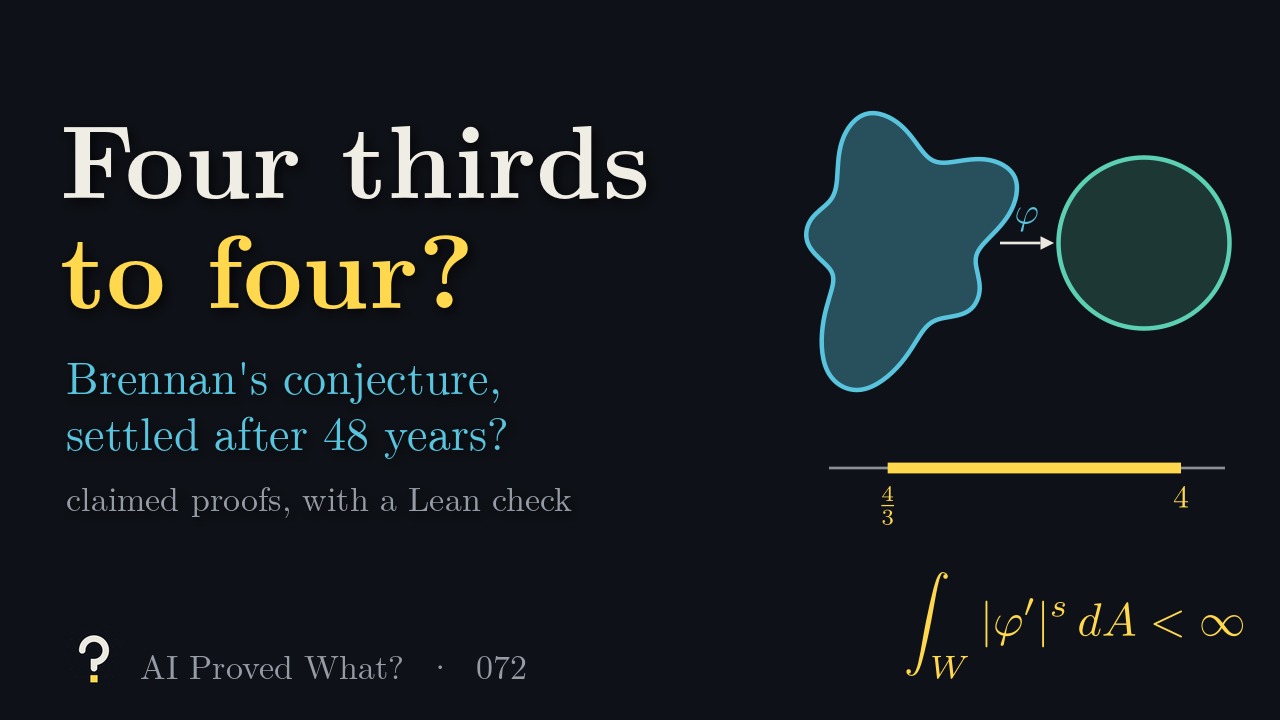
Map a simply connected domain W in the plane conformally onto the unit disk with a map φ. The size of |φ′| measures how much the map stretches near each point. In 1978 Brennan conjectured that the area integral of |φ′|s over W is finite for every s between 4/3 and 4, for every such domain, with no condition on the boundary. For the inverse map f from the disk, the range becomes powers t of |f′| strictly between −2 and 2/3. The Koebe function z/(1 − z)2, which maps the disk onto the plane minus a slit, shows that both endpoints fail.
The hard part is negative powers, where the derivative is very small. They are measured by integral means of |f′|t around circles of radius r, which grow like a power of 1/(1 − r); the worst exponent over all normalized univalent maps is the integral-means spectrum BS(t), and Brennan’s conjecture is equivalent to BS(−2) = 1. Distortion alone gives 2. Carleson and Makarov proved BS(t) = |t| − 1 for sufficiently negative t, without reaching −2. Bertilsson extended the area range to about 3.42, and Hedenmalm and Shimorin to about 3.75, bounding BS(−2) by about 1.22; Sola lowered that to about 1.21.
Result 072 is two OpenAI preprints, both dated September 24, 2026. The first (31 pages) claims a bound on the inverse-square integral means with exponent 1 + ε, uniform over all normalized univalent maps; so BS(−2) = 1, Brennan’s conjecture holds with its full range, and BS(t) = |t| − 1 for every t ≤ −2. The second (15 pages) concerns the spectrum for maps onto bounded domains. Kraetzer’s experiments suggested t2/4 for |t| ≤ 2, which is 1/4 at t = −1; the paper proves a bound with exponent strictly below 1/4 there, uniform over all normalized univalent maps, disproving that prediction.
What they don’t claim
The exact value of the bounded spectrum at t = −1 (the gap below 1/4 is not computed), its value at t = 1, and much of the rest of the integral-means spectrum (a survey describes what is known).
Where it stands
- Posted as preprints
- OpenAI, both dated September 24, 2026, released October 6
- Peer reviewed
- Not yet
- Checked in Lean
- Main statements of both papers, by OpenAI (scope note); we have not run the checks
Last checked October 19, 2026. Neither preprint has been revised. OpenAI’s scope note describes Lean proofs of the main statements (Brennan and strict bound): 47 files and about 14,000 lines for the first paper and a separate 94 files and about 16,000 lines for the second, with no unfinished proofs; we have not built them. The two papers cite each other as independent companions, and neither cites papers from other results in the release. Inputs include classical distortion and compactness for univalent maps, Hopf’s tangent-turning argument and Sard’s theorem; the method is related to the conformal snowflakes of Beliaev and Smirnov. We found no public assessment by specialists.
How the proofs go
- A dyadic operator. On the upper half-plane, with univalent maps normalized at i, changing the base point gives another map in the same compact class. A positive operator averages two such changes, at −1/2 + i/2 and 1/2 + i/2, weighted by |1/F′|2; its iterates sample points at heights 1/2, 1/4, 1/8, … above an interval. If its growth rate is at most 2, the uniform bound follows.
- A law on maps. Otherwise the rate is 2β with β > 1, and the paper builds a probability law on maps whose weighted changes of base point scale exactly like y−β. Differentiating this identity fixes moments of the logarithmic derivative, which make an expected Jacobian strictly positive.
- Saddles and maxima. For a target ξ, the potential yk/|F − ξ| has compact superlevel sets and only maxima and saddles as critical points. An index count built on Hopf’s argument finds at least as many maxima as saddles above every level, so each saddle is paired with a maximum at least as high; integrating against the law makes the same expected Jacobian at most zero, a contradiction.
- Strictness at t = −1. The companion runs a related argument; distinct critical values make each pairing strictly increasing, forcing a vanishing Jacobian in the borderline case, which a harmonic lower barrier rules out.
The numbers in the video
- A short Python script computes, for the Koebe function, (1 − r) times the inverse-square integral mean (22.5, 30.9, 31.89 and 31.99 at r = 0.9 to 0.9999, tending to 32), so its exponent is exactly 1 and the area integral diverges; checks the change of variables t = 2 − s and the dyadic points sampled by the operator; and evaluates Kraetzer’s predicted values.
Read the source
- Brennan’s conjecture and sharp inverse-square integral means (PDF), September 24, 2026 (31 pages).
- A strict inverse-first-power bound for univalent functions (PDF), September 24, 2026 (15 pages).
- OpenAI’s note on the scope of the Lean proofs.
- Hedenmalm and Shimorin, weighted Bergman spaces and the integral-means spectrum (arXiv).
- The collection’s catalog, where this is result 072.
The 2 papers in this result
OpenAI groups related papers, such as alternative proofs, supporting results and consequences, into one result; we label the first paper it lists the main paper and the others companions.
Transcript
Read the full script
0:00How small can a derivative get?
Map a simply connected domain W in the plane conformally onto the unit disk, with a map phi. The size of its derivative measures how much the map stretches near each point. In 1978, Brennan conjectured that the integral over W of phi prime to the power s is finite for every s between 4/3 and four, for every such domain, with no condition on the boundary. Passing to the inverse map f from the disk, the range becomes powers t of f prime between minus two and 2/3. The Koebe function, which maps the disk onto the plane minus a slit, shows that the range cannot be larger: both endpoint integrals diverge. The hard part is negative powers, where the derivative is very small. These are measured by integral means around circles of radius r, which grow like a power of one over one minus r. The worst exponent over all normalized univalent maps is the integral-means spectrum, and Brennan’s conjecture amounts to the value one at t equal to minus two. The distortion theorem alone gives exponent two. Carleson and Makarov showed that the spectrum equals the absolute value of t, minus one, for all sufficiently negative t, without reaching minus two. Bertilsson extended the area range to about 3.42, and Hedenmalm and Shimorin pushed it to about 3.75, bounding the exponent at minus two by about 1.22; Sola then lowered that bound to about 1.21.
1:35The claims
Result 072 is two OpenAI preprints, both dated September 24. The first, 31 pages, claims Brennan’s conjecture: a bound on the inverse-square integral means, with exponent one plus any epsilon, uniform over all normalized univalent maps. So the spectrum at minus two is exactly one, and the whole area range from 4/3 to four holds. It also gives the spectrum as the absolute value of t, minus one, for every t at most minus two. The second, 15 pages, targets the spectrum for maps onto bounded domains. Kraetzer’s experiments suggested a spectrum of t²/4 for t between minus two and two, which is 1/4 at t equal to minus one. The paper proves a bound with exponent strictly below 1/4 there, uniform over all normalized univalent maps, bounded or not, disproving that prediction. OpenAI also published Lean proofs of the main statements of both papers: 47 files and about 14,000 lines for the first, and a separate 94 files and about 16,000 lines for the second. We have not run them.
2:48A law on maps
Distortion squared gives exponent two; the missing information is how often very small derivatives occur around a circle. The proof moves to the upper half-plane, with univalent maps normalized at the point i. Changing the base point gives another map in the same compact class. A positive operator averages two such changes, at −1/2 + i/2 and 1/2 + i/2, weighted by the inverse derivative squared. Its iterates sample points above an interval at heights one half, one quarter, one eighth, and so on. If its growth rate is at most two, the uniform bound follows. Otherwise the growth rate is two to some power beta greater than one. The paper then builds a probability law on maps whose weighted changes of base point scale exactly like y to the minus beta. Differentiating this identity fixes moments of the logarithmic derivative, and they make an expected Jacobian strictly positive. Now pick a target point xi, and look at the potential y to the k, divided by the distance from F to xi. For almost every target and map, its superlevel sets are compact, and its critical points are maxima and saddles. An index count, built on Hopf’s argument for the turning tangent, finds at least as many maxima as saddles above every level, so each saddle can be paired with a maximum at least as high. Integrating this pairing against the law shows that the same expected Jacobian is at most zero: a contradiction. The companion runs a related argument at the inverse first power. There, distinct critical values make each pairing strictly increasing, which forces a vanishing Jacobian in the borderline case, and a harmonic lower barrier then rules that case out.
4:39Where it stands
Neither preprint is peer reviewed, and neither has been revised. OpenAI published Lean proofs for both papers; we have not run the checks. The two papers cite each other as independent companions, and neither cites papers from other results in the release. Inputs include classical distortion and compactness for univalent maps, Hopf’s tangent argument and Sard’s theorem, and the method is related to the conformal snowflakes of Beliaev and Smirnov. We found no public assessment. If it holds, Brennan’s conjecture from 1978 is settled with its sharp range, from 4/3 to four, and Kraetzer’s predicted spectrum fails at minus one. The exact bounded spectrum there, and much of the rest of the integral-means spectrum, remain open.
Spot a mistake?
This episode simplifies on purpose, but it shouldn’t be wrong. If something is, open an issue on GitHub or leave a comment on YouTube. Corrections are noted here with a date.