Enough distances?
The Falconer distance conjecture
Covers result 073 in OpenAI’s catalog: its one paper. See its connections to other results and the work it cites.
5:43. English captions available. The video loads from YouTube when you press play.
Chapters
The claim, in plain words
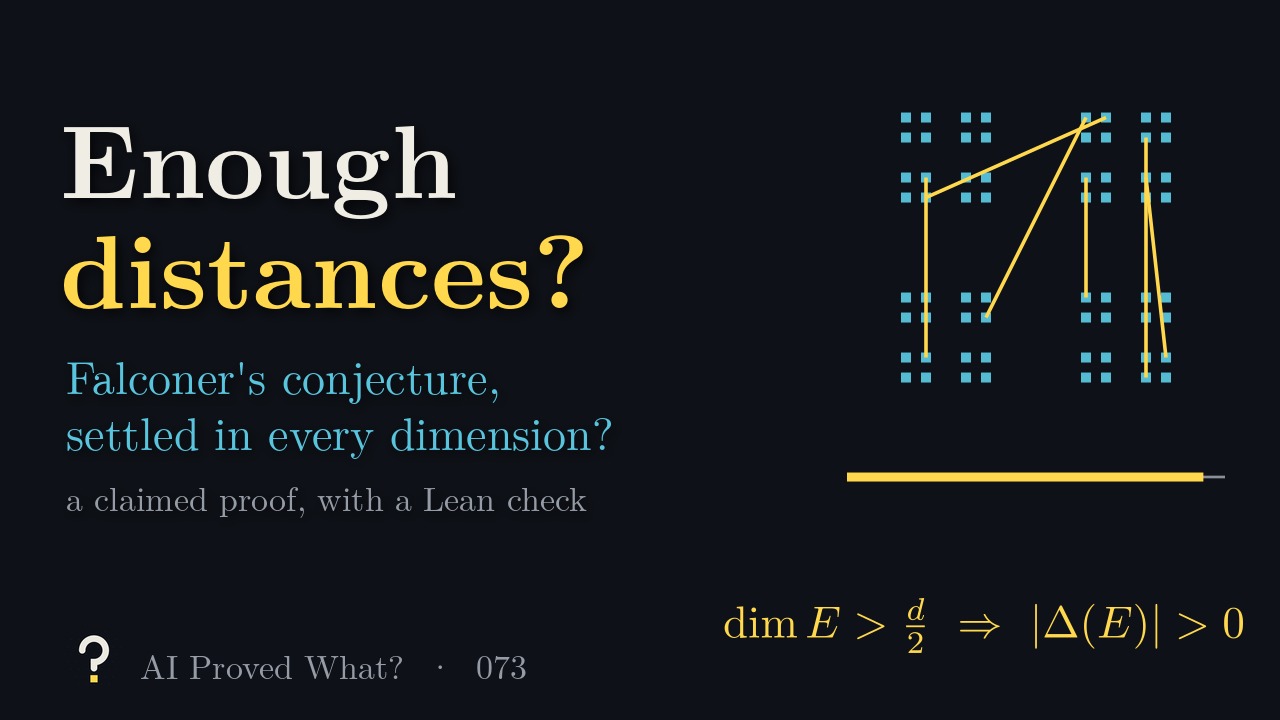
Take a compact set E in d-dimensional space and collect all distances between its points: that is the distance set Δ(E). A set with interior has every small distance, but fractal sets can be thin. In 1985 Falconer asked how large the Hausdorff dimension of E must be to force a distance set of positive length. He showed that dimension above (d + 1)/2 is enough and conjectured that above d/2 suffices.
The threshold d/2 cannot be lowered. On a grid of spacing 1/N every squared distance is a whole number over N2, so distances crowd onto about 2N2 values, and only about N2/√(log N) of them occur. Replacing each point by a tiny disc and repeating with finer grids gives a set of dimension d/2 whose distances fill a set of length zero.
Progress came through Fourier analysis: Mattila’s spherical averages; Wolff’s 4/3 and Guth, Iosevich, Ou and Wang’s 5/4 in the plane; Erdoğan’s 11/6 and, with decoupling, 9/5 (Du, Guth and coauthors) and 12/7 (Du, Ou, Ren and Zhang) in space. At the critical dimension, Shmerkin and Wang showed that sets with equal Hausdorff and packing dimension d/2 have distance sets of dimension one.
Result 073 is one OpenAI preprint (64 pages, dated September 23, 2026). It claims the conjecture for every d ≥ 2: every compact set of Hausdorff dimension greater than d/2 determines distances of positive Lebesgue measure. No regularity is assumed, the inequality is strict, and the statement concerns the full distance set rather than distances from a single pin. The paper says it uses no decoupling theorem and no earlier distance theorem at an improved threshold.
What it doesn’t claim
Nothing at exactly d/2, and nothing about the distances from a single pin at the threshold.
Where it stands
- Posted as a preprint
- OpenAI, dated September 23, 2026, released October 6
- Peer reviewed
- Not yet
- Checked in Lean
- The theorem in every dimension, by OpenAI (scope note); we have not run the check
Last checked October 19, 2026. The preprint has not been revised. OpenAI’s scope note describes a Lean proof of the theorem in every dimension, with the planar case as a separate statement: about 2,500 files and 190,000 lines with no unfinished proofs, which we have not built. A public GitHub repository reports that it passes the comparator check; we have not verified that. The paper cites one other release paper, result 166 on distinct distances, only as background. Its one deep outside input is the incidence theorem of Orponen and Shmerkin; the rest is standard tools (Frostman’s lemma, stationary phase, the Loomis–Whitney inequality) and methods of Orponen, Shmerkin and Ren re-proved in the form needed. We found no expert review.
How the proof goes
- A distance measure. Take two separated Frostman measures on E of dimension s > d/2 and push their pairs forward by the distance map; the goal is to show that this distance measure has a density.
- Directions. The directions from one point to the other piece need cap bounds of exponent d/2, even when radial projections cannot have densities. The paper builds them scale by scale, deleting small exceptional sets of pairs: integer exponents come from projecting to smaller spaces, and in odd dimensions a thin-tube improvement adds the missing half dimension, using the Orponen–Shmerkin incidence theorem.
- Belts. A Fourier calculation turns cap bounds into belt estimates on the sphere; in a frequency annulus of radius B the bound carries a factor Bd−2S, exactly one at S = d/2.
- Profiles. At each frequency the measures split into almost uniform classes with mass profiles. A recursion trades counts of pairs with nearly equal distances against spherical Fourier energies, through stationary phase and a graph estimate, and a potential built from two separated depths pays for every step, giving a power-small Fourier bound in each dyadic shell for approximating measures.
- The shell lemma. The pair restrictions shrink without a quantitative rate. If positive measures decrease to a limit and the N-th one is close to a measure with small Fourier mass in the N-th shell, both errors decaying geometrically, the limit is absolutely continuous. It is nonzero and lives on Δ(E), so Δ(E) has positive length.
The numbers in the video
- A short Python script lists the earlier thresholds, counts the distinct distances of N × N grids (50, 381, 3,663 and 29,584 for N = 10, 30, 100 and 300, about 0.78 N2/√(log N)), and checks that the middle-thirds dust (dimension 1.26) has distance set [0, √2] because the Cantor set minus itself is [−1, 1].
Read the source
- The Falconer distance conjecture in all dimensions (PDF), September 23, 2026 (64 pages).
- OpenAI’s note on the scope of the Lean proof and the formal statement.
- Shmerkin and Wang, on distance sets at the critical dimension (arXiv).
- The collection’s catalog, where this is result 073.
The paper
OpenAI groups related papers into one result; this one has a single paper.
Transcript
Read the full script
0:00How many distances?
Take a compact set E in d-dimensional space and collect all distances between its points. That is the distance set. A set with interior has every small distance, but fractal sets can be thin. In 1985, Falconer asked how large the Hausdorff dimension of E must be to force a distance set of positive length. He showed that dimension above (d + 1)/2, is enough, and conjectured that above d/2 suffices. The threshold d/2 cannot be lowered: Falconer’s lattice-type examples have dimension exactly d/2 and distance sets of length zero. The reason is visible in a grid. In an N × N grid of spacing 1/N, every squared distance is a whole number over N², so the distances crowd onto at most about 2N² values, and only about N²/√(log N) of them actually occur. Replace each point by a disc slightly smaller than 1/N², and repeat with ever finer grids. The limit set has dimension one, which is d/2, yet its distances fill a set of length zero. Above the threshold, the conjecture says no compact set can crowd its distances like that. Progress came through Fourier analysis. Mattila turned the problem into estimates for spherical averages. In the plane, Wolff reached 4/3, and Guth, Iosevich, Ou and Wang reached 5/4. In space, Erdoğan reached 11/6; then, using decoupling, Du, Guth and coauthors reached 9/5, and Du, Ou, Ren and Zhang 12/7. At the critical dimension itself, Shmerkin and Wang showed that sets with equal Hausdorff and packing dimension d/2 have distance sets of dimension one.
1:46The claim
Result 073 is one OpenAI preprint, 64 pages, dated September 23. It claims the conjecture in every dimension d of at least two: every compact set of Hausdorff dimension greater than d/2 determines distances of positive Lebesgue measure. No regularity is assumed, the inequality is strict, and the statement is about the full distance set, not distances from a single pin. The paper says it uses no decoupling theorem and no earlier distance theorem at an improved threshold. OpenAI also published a Lean proof of the theorem in every dimension, with the planar case as a separate statement: about 2,500 files and 190,000 lines. We have not run it.
2:33Angles and shells
The proof starts from two separated Frostman measures on E, of dimension s greater than d/2, and pushes their pairs forward by the distance map. The goal is to show that this distance measure has a density. Two issues stand in the way. First, directions: the directions from one point to the other piece of the set need cap bounds of exponent d/2, even when radial projections cannot have densities. The paper builds those bounds scale by scale, deleting small exceptional sets of pairs. Integer exponents come from projecting to smaller spaces, where radial estimates are available. In odd dimensions, a thin-tube improvement adds the missing half dimension, using the incidence theorem of Orponen and Shmerkin. A Fourier calculation then turns cap bounds into estimates for belts on the sphere. In each frequency annulus of radius B, the bound carries a factor B to the power d minus twice the cap exponent, which is exactly one at the critical value d/2. Second, these angular bounds must become a distance estimate, for a fractal that can be irregular across scales. At each frequency, the measures split into almost uniform classes with mass profiles. A recursion trades a count of pairs with nearly equal distances against spherical Fourier energies, through stationary phase and a graph estimate, and a potential built from two separated depths pays for every step. The result is a power-small bound on the Fourier energy, in each dyadic shell, of measures that approximate the distance measure. Finally, the pair restrictions shrink with the scale, without a quantitative rate. A monotone shell lemma handles this: if positive measures decrease to a limit, and the N-th one is close to a measure with small Fourier mass in the N-th dyadic shell, with both errors decaying geometrically, then the limit is absolutely continuous. The limit is nonzero and lives on the distance set, so that set has positive length.
4:39Where it stands
The preprint is not yet peer reviewed, and it has not been revised. OpenAI published a Lean proof; we have not run the check. It cites one other paper from the release, result 166 on distinct distances, only as background. Its one deep outside input is the incidence theorem of Orponen and Shmerkin. The rest is standard tools, such as Frostman’s lemma, stationary phase and the Loomis–Whitney inequality, plus methods of Orponen, Shmerkin and Ren that the paper re-proves in the form it needs. We found no expert review. One public GitHub repository reports that OpenAI’s Lean proof passes the comparator check; we have not verified that. If it holds, the Falconer distance conjecture is settled in every dimension: above half the ambient dimension, every compact set has distances filling a set of positive length. The paper makes no claim at exactly d/2, and none about a single pin at the threshold.
Spot a mistake?
This episode simplifies on purpose, but it shouldn’t be wrong. If something is, open an issue on GitHub or leave a comment on YouTube. Corrections are noted here with a date.