Needles in every direction?
Kakeya in three and four dimensions
Covers result 074 in OpenAI’s catalog: all 2 papers. See its connections to other results and the work it cites.
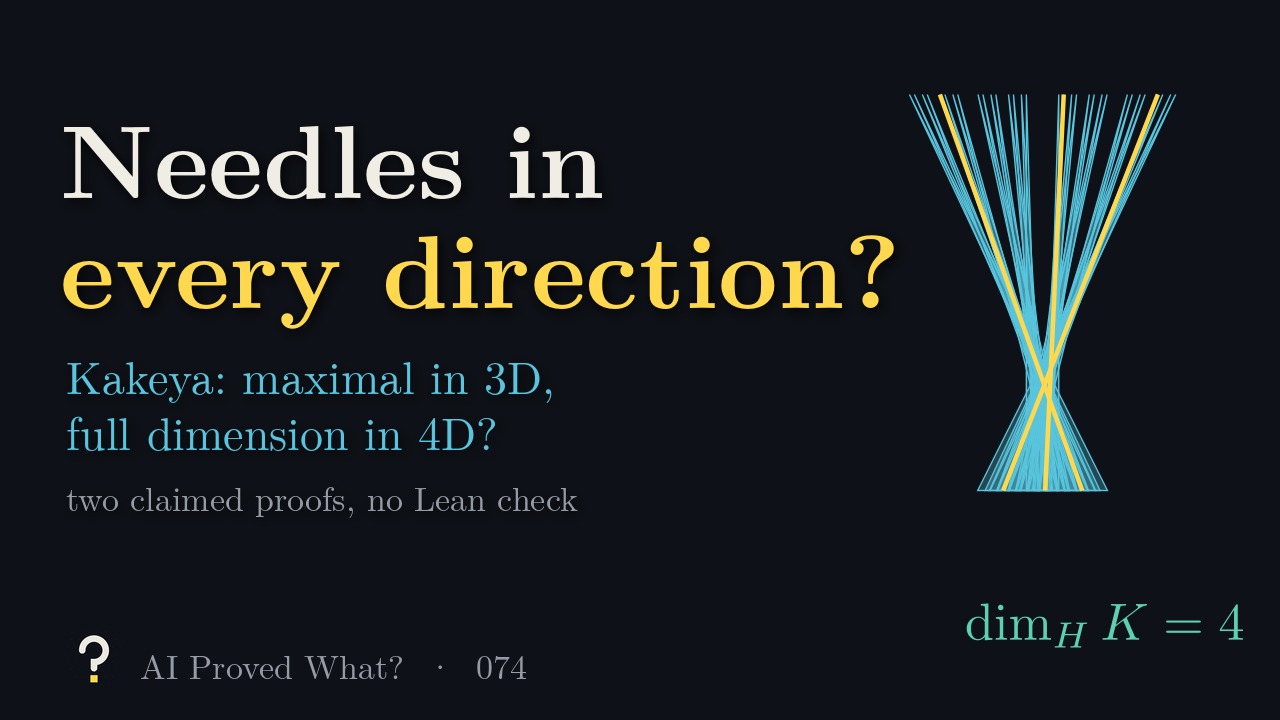
7:34. English captions available. The video loads from YouTube when you press play.
Chapters
The claim, in plain words
In 1917 Fujiwara and Kakeya asked for the smallest region in which a needle of length one can be turned all the way around. A disc of diameter one has area about 0.79, a three-cusped deltoid about 0.39, and the best convex region, an equilateral triangle of height one, about 0.58. Then Besicovitch showed that a set can contain a unit segment in every direction and still have area zero, and that the needle can be turned in as little area as you like.
A set with a unit segment in every direction is a Kakeya set. The Kakeya conjecture says that, even with volume zero, such a set in n-dimensional space has full Hausdorff dimension n; Davies proved the plane in 1971. A stronger form thickens each segment into a tube of radius δ: the maximal function records, for each direction, the largest average of a function over the tubes pointing that way, and the maximal conjecture says it is bounded from Ln of space to Ln of the sphere of directions, up to a loss of δ−ε. Wolff’s hairbrush gave dimension (n + 2)/2; Wang and Zahl proved the set conjecture in three dimensions in 2025, and Guth, Wang and Zahl streamlined the proof. The maximal version in three dimensions stayed open; in four dimensions the best Hausdorff bound was 3.059, by Katz and Zahl.
Result 074 is two OpenAI preprints. The first (97 pages, dated September 23, 2026) claims the Kakeya maximal conjecture in three dimensions. The key is the density: for tubes in different directions, each shaded on a fraction λ of its volume, the shaded parts must fill about λ3 times the total tube volume. A bush of tubes through one point, shaded only near it, shows the cube cannot be improved; Wang and Zahl’s theorem gives the bound only with a large power of λ. The second (175 pages, dated September 24, 2026) claims that every subset of four-dimensional space with a unit segment in every direction has Hausdorff dimension 4, with no measurability or compactness assumed. Then bounded Kakeya sets in four dimensions have Minkowski dimension 4, and Kakeya sets in five dimensions have dimension at least 4.
What it doesn’t claim
Not the maximal conjecture in four or more dimensions, and not the set conjecture in five or more.
Where it stands
- Posted as preprints
- OpenAI, dated September 23 and 24, 2026, released October 6
- Peer reviewed
- Not yet
- Checked in Lean
- No: OpenAI published no Lean proof of either theorem
Last checked October 19, 2026. Neither preprint has been revised. OpenAI published no Lean proof of either theorem; one uncatalogued Lean file states the three-dimensional maximal conjecture and proves groundwork at a fixed scale. OSVerify reviewed the four-dimensional paper and reported no major issues and two minor ones: a citation to Lemma 2.3 of the three-dimensional paper that should be Lemma 3.3, and a sentence that gives the Jacobian of the inverse of a coordinate map, although the displayed estimate is correct. Both are fixable, and OSVerify says they do not show the theorem is false. We have seen no expert review of the three-dimensional paper, which supplies one lemma the four-dimensional proof uses. That paper notes that result 077 claims the same maximal estimate through Fourier restriction.
How the proofs go
- A critical exponent (3D). The proof sets up inequalities for weighted tubes with marked times and asks for the least extra power of 1/δ that makes them all hold. If it were positive, some configurations would nearly attain equality.
- Planes and plates (3D). Multilinear Kakeya makes directions on short pieces nearly coplanar; the planar Furstenberg theorem of Ren and Wang gives density inside plates; the Guth–Wang–Zahl estimate captures saturated plates. Comparing two ways of cutting the configuration forces a canonical profile F(s) = β(s − τ)+, flat and then with constant slope.
- Two frames (3D). Inside each packet a tube has four coordinates, two for position and two for velocity. Two marked events on the same tube give two frames related by shear matrices, and the product Δt Δϑ multiplies the last velocity coordinate. A pinning estimate for that product slope (after Shmerkin–Wang and Orponen–Shmerkin–Wang) and an entropy count show the packets cannot carry the information they need, so the exponent is zero.
- Quadratic charts (4D). Lines can crowd near low-degree algebraic surfaces; the saddle z = xy contains two families of lines. A chart is a set of line pieces in a moving box on which one quadratic test stays small, with enough mass; charts nest. A Kakeya set of dimension below four would give a weighted line problem in which every substantial terminal chart system needs intervals of a definite, shrinking length.
- Three regimes (4D). Along a critical path with time rate k and narrowness rate ℓ: for ℓ = 0 an approximate polynomial field with a potential, with leftover cubic and quartic terms near a conic folded into a quadratic correction; for 0 < ℓ < ∞ wide intervals, or a horizontal model with boxes H × H2; for ℓ = ∞ a projection giving charts whose time cost tends to zero. Each contradicts the extremal choice.
The numbers in the video
- A short Python script checks the needle areas π/4, π/8 (with unit chords of the deltoid) and 1/√3; builds the sliding-triangle construction, whose union area falls to 30% of the triangle with 32 pieces and 17% with 4,096; computes the bush, whose shading fills about λ3/12 of the total tube volume; lists the earlier bounds 5/2, 3, 3 + 1/40 and (159 + √145)/56 ≈ 3.0543; and checks the two-frame shear identity and the two families of lines on z = xy.
Read the source
- The Kakeya maximal conjecture in three dimensions (PDF), September 23, 2026 (97 pages).
- Every four-dimensional Kakeya set has full Hausdorff dimension (PDF), September 24, 2026 (175 pages).
- OSVerify’s review of the four-dimensional paper.
- Wang and Zahl, the Kakeya set conjecture in three dimensions and Guth, Wang and Zahl’s streamlined proof (arXiv).
- The collection’s catalog, where this is result 074.
The 2 papers in this result
OpenAI groups related papers, such as alternative proofs, supporting results and consequences, into one result; we label the first paper it lists the main paper and the others companions.
Transcript
Read the full script
0:00Needles and tubes
In 1917, Fujiwara and Kakeya asked for the smallest region in which a needle of length one can be turned all the way around. A disc of diameter one works, with area about 0.79. A three-cusped curve, the deltoid, does better, at about 0.39. Among convex regions, the best is an equilateral triangle of height one, with area about 0.58. Then Besicovitch found a surprise: a set can contain a unit segment in every direction and still have area zero, and the needle can be turned in as little area as you like. One way to see it: slice a triangle into thin pieces and slide them so they overlap. Each direction the triangle held is still covered by a unit segment, but the area shrinks. With 32 pieces it falls to 30% of the triangle, and with 4,096 pieces, to 17%. Slowly, but as far as you like. A set with a unit segment in every direction is called a Kakeya set. In higher dimensions such sets can also have volume zero, but the Kakeya conjecture says they cannot be thin: their Hausdorff dimension should be full. Davies proved this in the plane in 1971. A stronger, quantitative form thickens each segment into a tube of radius δ. The maximal function records, for each direction, the largest average of a function over tubes pointing that way. The maximal conjecture says this operator is bounded from Lⁿ of space to Lⁿ of the sphere of directions, up to a loss of δ^(−ε), and it implies the dimension statement. Wolff’s hairbrush argument gave dimension at least (n + 2)/2: 5/2 in space, three in four dimensions. In 2025, Wang and Zahl proved the set conjecture in three dimensions, and Guth, Wang and Zahl later streamlined the proof. The maximal version in three dimensions stayed open. In four dimensions, the best Hausdorff bound was about 3.06, from Katz and Zahl.
2:06The claims
Result 074 is two OpenAI preprints. The first, 97 pages, dated September 23, claims the Kakeya maximal conjecture in three dimensions. The key is how the bound depends on density. Take tubes pointing in different directions, and shade a fraction λ of each. The union of the shaded parts must have volume at least about λ³ times the total tube volume. A bush shows the cube cannot be improved: tubes through one point, shaded only near it, have density λ, but all their shading fits in a ball of volume about λ³. Wang and Zahl’s theorem gives this bound only with a large power of λ. The second preprint, 175 pages, dated September 24, claims the set conjecture in four dimensions: every subset of four-dimensional space with a unit segment in every direction has Hausdorff dimension four. No measurability or compactness is assumed. Then bounded Kakeya sets in four dimensions have Minkowski dimension four, and, by projection, Kakeya sets in five dimensions have dimension at least four. OpenAI published no Lean proof of either theorem; one uncatalogued Lean file states the three-dimensional maximal conjecture and proves groundwork at a fixed scale.
3:27Three dimensions
The three-dimensional proof argues by contradiction. It sets up a family of inequalities for weighted tubes with marked times, and asks for the least extra power of 1/δ needed to make them all hold: the critical exponent. If that exponent were positive, some configurations would nearly attain equality, and their geometry is then forced step by step. Multilinear Kakeya makes directions on short pieces nearly coplanar. The planar Furstenberg theorem of Ren and Wang gives density inside plates, and the Guth, Wang and Zahl estimate captures saturated plates. Comparing two ways of cutting the configuration forces a canonical profile: flat at first, then with constant slope. In that stationary regime, inside each packet, every tube is described by four coordinates: two for position and two for velocity. Two marked events on the same tube give two frames, related by a pair of shear matrices. Changing the time adds velocity to position; changing the normal direction mixes the two spatial coordinates. One coefficient, the product of the two changes, multiplies the last velocity coordinate. A pinning estimate for that product slope, adapted from work of Shmerkin and Wang, and of Orponen, Shmerkin and Wang, together with an entropy count, shows that the packets cannot carry the information they must. So the critical exponent is zero, and the maximal estimate follows.
4:58Four dimensions
In four dimensions, the danger is lines crowding near low-degree algebraic surfaces. A saddle, z = xy, contains two whole families of lines. The proof’s basic object is a chart: line pieces in a moving box, over a time interval, on which one quadratic polynomial test stays small, with enough incidence mass to count. Charts can be nested. A hypothetical Kakeya set of dimension below four gives a weighted line problem in which every substantial system of terminal charts must use intervals of a definite, shrinking length. The proof shows that some chart system always does better. It follows nested charts along a critical path, with a time rate k and a narrowness rate ℓ, and splits into three regimes. When ℓ is zero, separated velocities determine an approximate polynomial field with a potential, and if the directions lie near a conic, the leftover cubic and quartic terms are folded into a quadratic correction. When ℓ is positive and finite, either wide intervals already give an improvement, or the lines are forced into a horizontal model whose boxes have width H and thickness H². When ℓ is infinite, a final projection gives charts whose time cost tends to zero. Each case contradicts the extremal choice. Inputs include multilinear Kakeya, a dot-product theorem of Wang and Zahl, and a lemma from the three-dimensional paper.
6:26Where it stands
Neither preprint is peer reviewed, and neither has been revised. OpenAI published no Lean proof of either theorem. OSVerify reviewed the four-dimensional paper and reported no major issues and two minor ones: a citation that points to Lemma 2.3 of the three-dimensional paper instead of Lemma 3.3, and a sentence that gives a Jacobian for the wrong direction of a coordinate map, although the displayed estimate is correct. Both are easy to fix, and OSVerify notes that they do not show the theorem is false. We have seen no expert review of the three-dimensional paper, which supplies one lemma the four-dimensional proof uses. That paper also notes that result 077, another release paper, claims the same maximal estimate through Fourier restriction. If they hold, the Kakeya maximal conjecture is settled in three dimensions, and the Kakeya set conjecture in four. The maximal conjecture from four dimensions up, and the set conjecture in five dimensions and above, remain open.
Spot a mistake?
This episode simplifies on purpose, but it shouldn’t be wrong. If something is, open an issue on GitHub or leave a comment on YouTube. Corrections are noted here with a date.