Restriction, settled?
Fourier restriction for positively curved surfaces
Covers result 077 in OpenAI’s catalog: all 2 papers. See its connections to other results and the work it cites.
5:49. English captions available. The video loads from YouTube when you press play.
Chapters
The claim, in plain words
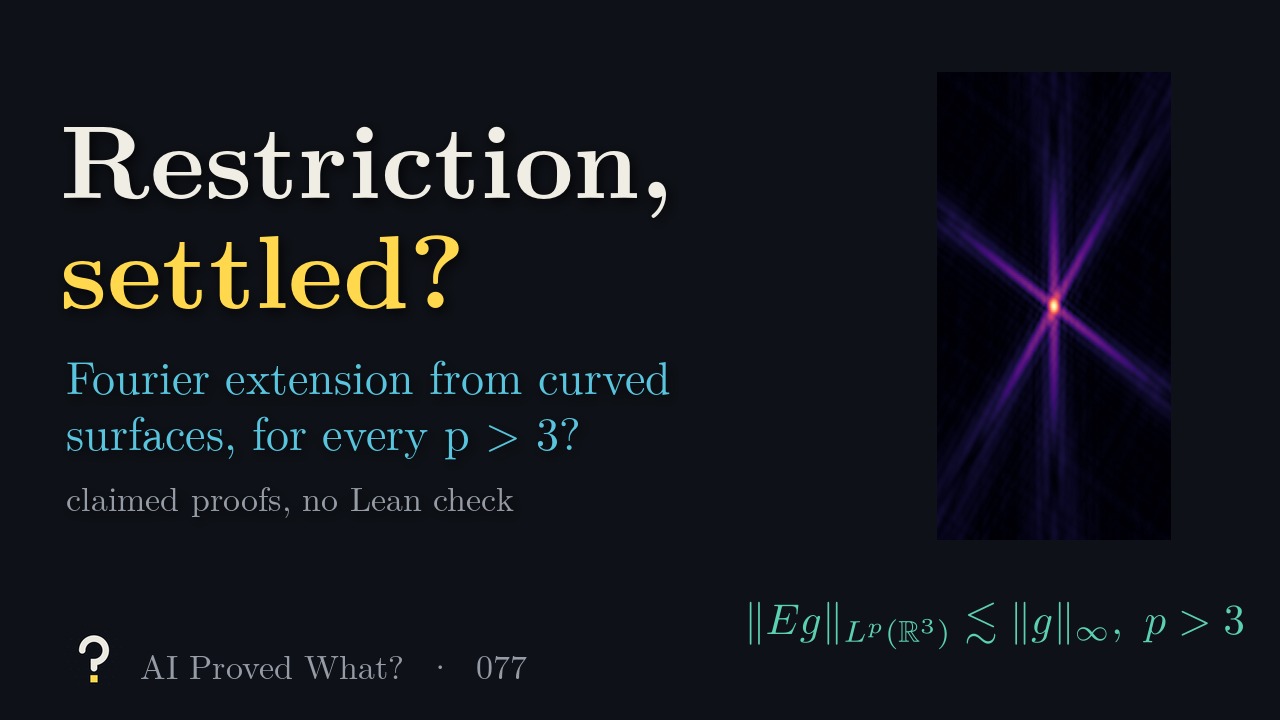
Put a function g on the unit sphere and add up plane waves in every direction, each weighted by g: the result is the Fourier extension Eg, a function on all of space. One form of Stein’s restriction problem asks for which p the pth power of Eg is integrable when g is bounded. For g = 1 the extension is 2 sin(2πr)/r, which decays only like one over the distance, so its pth power is integrable exactly when p > 3; the conjecture says every p > 3 works.
The difficulty shows in wave packets: a small cap of radius δ produces a tube with width on the order of 1/δ and length on the order of 1/δ2, along the cap’s normal, and many tubes crossing in a small region is where the Kakeya problem enters. Tomas and Stein proved the estimate for p ≥ 4, even for square-integrable data; after Tao’s 10/3 and Bourgain and Guth’s 3.3, Guth reached 13/4, Wang 42/13 for the paraboloid, and Wang and Wu 22/7 in the diagonal form.
Result 077 is two OpenAI preprints, both dated September 24, 2026. The first (103 pages) claims the bounded-data restriction conjecture for the sphere, every p > 3; with Bourgain’s factorization and interpolation it gives every mixed-norm estimate strictly inside Stein’s conjectured range, though not the critical line. The second (25 pages) claims the diagonal estimate, from Lp of the surface to Lp of space for every p > 3, on every compact smooth positively curved surface, with or without boundary; a consequence is local smoothing for the free Schrödinger equation in two dimensions, with a threshold that Rogers showed cannot be lowered.
What it doesn’t claim
Nothing at p = 3, where the constant function shows the estimate fails, nothing on the critical line of the mixed-norm range, and nothing in higher dimensions.
Where it stands
- Posted as preprints
- OpenAI, both dated September 24, 2026, released October 6
- Peer reviewed
- Not yet
- Checked in Lean
- No: OpenAI published no Lean proof of either theorem
Last checked October 19, 2026. Neither preprint has been revised. OpenAI published no Lean proof of either theorem; two uncatalogued Lean developments (one for the sphere, one for surfaces) state the theorems and prove only the classical range p ≥ 4. The surface paper relies on the sphere paper’s packet theorem and on result 074’s three-dimensional Kakeya maximal paper, which OSVerify did not review. The sphere paper also gives a second route to that Kakeya estimate, and notes that its main estimate follows from the Bochner–Riesz paper of result 078 through Tao’s implication. Outside inputs include Bourgain and Demeter’s decoupling theorem and Ren and Wang’s Furstenberg estimate. Neither paper is among those OSVerify reviewed, and we have seen no expert review.
How the proof goes
- Elliptic capacity. For an ellipse with semiaxes L ≥ w, the weight L1+κw1−κ is its area times a small power of the aspect ratio. Packets are tested jointly by velocity and position with two independently placed copies of the same ellipse, and a hairbrush count turns the extra power into a saving.
- Geometric propagation. If concentration grew too fast as the lines move, an extremal choice of scales would give a calibrated path of ellipse widths; entropies of velocity, position, time and axis must then grow, by projection theorems from Ren and Wang’s Furstenberg estimate, contradicting the assumed concentration whether the aspect ratio is steady, growing or shrinking.
- The packet theorem. Arbitrary finite arrays of wave packets are carried from scale to scale, even with coordinates deleted, with at most a tiny power loss: a refined form of Bourgain–Demeter decoupling controls a fourth moment, an exact frame identity the second, and together they cancel a shortfall in time support.
- Removing the loss. A sparse-ball argument in the style of Tao removes the remaining power loss, giving every p > 3. For general surfaces, the packet theorem is combined with the Kakeya maximal theorem, which controls positive weights on tubes.
The numbers in the video
- A short Python script checks E1 = 2 sin(2πr)/r by quadrature; integrates its pth power up to radius 10, 100 and 1000 (224, 322 and 421 at p = 3, growing by about 98 per factor of 10; 406, 430 and 438 at p = 3.5); computes the wave packet from a cap of angular radius 0.15 (half-maximum width 4.7, length 107) and three crossing packets; and lists the earlier exponents.
Read the source
- Elliptic capacity propagation and Fourier restriction to the sphere (PDF), September 24, 2026 (103 pages).
- Diagonal Fourier extension for positively curved surfaces in three dimensions (PDF), September 24, 2026 (25 pages).
- The collection’s catalog, where this is result 077.
The 2 papers in this result
OpenAI groups related papers, such as alternative proofs, supporting results and consequences, into one result; we label the first paper it lists the main paper and the others companions.
Transcript
Read the full script
0:00Waves from a sphere
Put a function g on the unit sphere, and add up plane waves in every direction, each weighted by g. The result is the Fourier extension of g, a function on all of space. One form of Stein’s restriction problem asks how fast it must decay: for bounded g, for which p is its pth power integrable? Take g equal to one. The extension is 2 sin(2πr)/r, which decays only like one over the distance. Its pth power is integrable exactly when p is greater than three: at p equal to three, the integral grows like the logarithm of the radius. The conjecture says every p greater than three works. The difficulty is visible in wave packets. A small cap of the sphere, of radius δ, produces a tube whose width is on the order of 1/δ, and whose length is on the order of 1/δ², pointing along the cap’s normal. In our computation with δ = 0.15, the bright core is about five units wide and over a hundred long. Caps with different normals give tubes in different directions, and the danger is many tubes crossing in a small region. This is where the Kakeya problem enters. Tomas and Stein proved the estimate for p of at least four, even for square-integrable data. After steady progress, including Tao’s 10/3 and Bourgain and Guth’s 3.3, Guth’s polynomial partitioning reached p above 13/4, Wang’s broom method p above 42/13 for the paraboloid, and Wang and Wu p above 22/7, in the stronger diagonal form, where the data are measured in the same Lᵖ norm.
1:42The claims
Result 077 is two OpenAI preprints, both dated September 24. The first, 103 pages, claims the bounded-data restriction conjecture for the sphere: every p greater than three. With Bourgain’s factorization, this gives the diagonal estimate for the sphere and, by interpolation, every mixed-norm estimate strictly inside Stein’s conjectured range. The critical line, where the two exponents exactly balance, is not claimed. It also gives a second route to the Kakeya maximal estimate of result 074, and notes that the bounded-data estimate also follows from the Bochner–Riesz paper of result 078, through Tao’s implication. The second, 25 pages, claims the diagonal conjecture for every compact smooth positively curved surface, with or without boundary: the extension maps Lᵖ of the surface into Lᵖ of space for every p greater than three. A consequence is local smoothing for the free Schrödinger equation in two dimensions, with a Sobolev threshold that Rogers showed cannot be lowered. OpenAI published no Lean proof of either theorem. Two uncatalogued Lean developments state both theorems, and prove only the classical range, p at least four.
3:03Capacity and packets
The first paper’s central idea is an elliptic capacity. For an ellipse with long semiaxis L and short semiaxis w, it uses the weight L^(1+κ) · w^(1−κ): the area, times a small power of the aspect ratio. Packets are tested jointly by velocity and position, with two independently placed copies of the same ellipse. Thin ellipses in different orientations overlap only in small regions, and a hairbrush count turns the extra power of the aspect ratio into a saving. A geometric propagation theorem then controls how concentration can change as the lines move. If it failed, an extremal choice of scales would give a calibrated path of ellipse widths. Entropies of velocity, position, time and axis must then grow, by planar projection theorems derived from the Furstenberg estimate of Ren and Wang. In each of three cases, whether the aspect ratio is steady, growing or shrinking, that growth contradicts the assumed concentration. Next, a packet theorem carries arbitrary finite arrays of wave packets from scale to scale, even when coordinates are deleted, with a loss of at most a tiny power. A refined form of Bourgain and Demeter’s decoupling controls a fourth moment, an exact frame identity controls the second, and together they cancel a possible shortfall in time support. A sparse-ball argument in the style of Tao then removes the remaining power loss, giving every p greater than three. The diagonal paper combines this packet theorem with the Kakeya maximal theorem, which controls positive weights on tubes.
4:46Where it stands
Neither preprint is peer reviewed, and neither has been revised. There is no Lean proof of either theorem. The surface paper relies on the sphere paper’s packet theorem and on the three-dimensional Kakeya maximal paper of result 074, which OSVerify did not review and for which we have seen no expert review. Their outside inputs include Bourgain and Demeter’s decoupling theorem and Ren and Wang’s Furstenberg estimate. Neither paper is among those OSVerify reviewed, and we have seen no expert review of either. If they hold, the bounded-data form of Stein’s restriction conjecture for the sphere is settled for every p greater than three, along with every estimate strictly inside the conjectured range, and the diagonal form holds for every compact, smooth, positively curved surface. The endpoint p equal to three fails, as the constant function shows, and the problem remains open in higher dimensions.
Spot a mistake?
This episode simplifies on purpose, but it shouldn’t be wrong. If something is, open an issue on GitHub or leave a comment on YouTube. Corrections are noted here with a date.