Any smoothing enough?
The Bochner–Riesz conjecture in three dimensions
Covers result 078 in OpenAI’s catalog: its one paper. See its connections to other results and the work it cites.
4:58. English captions available. The video loads from YouTube when you press play.
Chapters
The claim, in plain words
A natural way to rebuild a function from its frequencies is to keep the frequencies in a ball and throw the rest away. In 1971 Fefferman showed, with a Kakeya-type construction, that this sharp cutoff is unbounded on Lp for every p other than 2, in two or more dimensions. Bochner–Riesz means soften the edge: multiply the Fourier transform by (1 − |ξ|2)δ inside the ball and by zero outside. The question is how much smoothing δ each Lp needs.
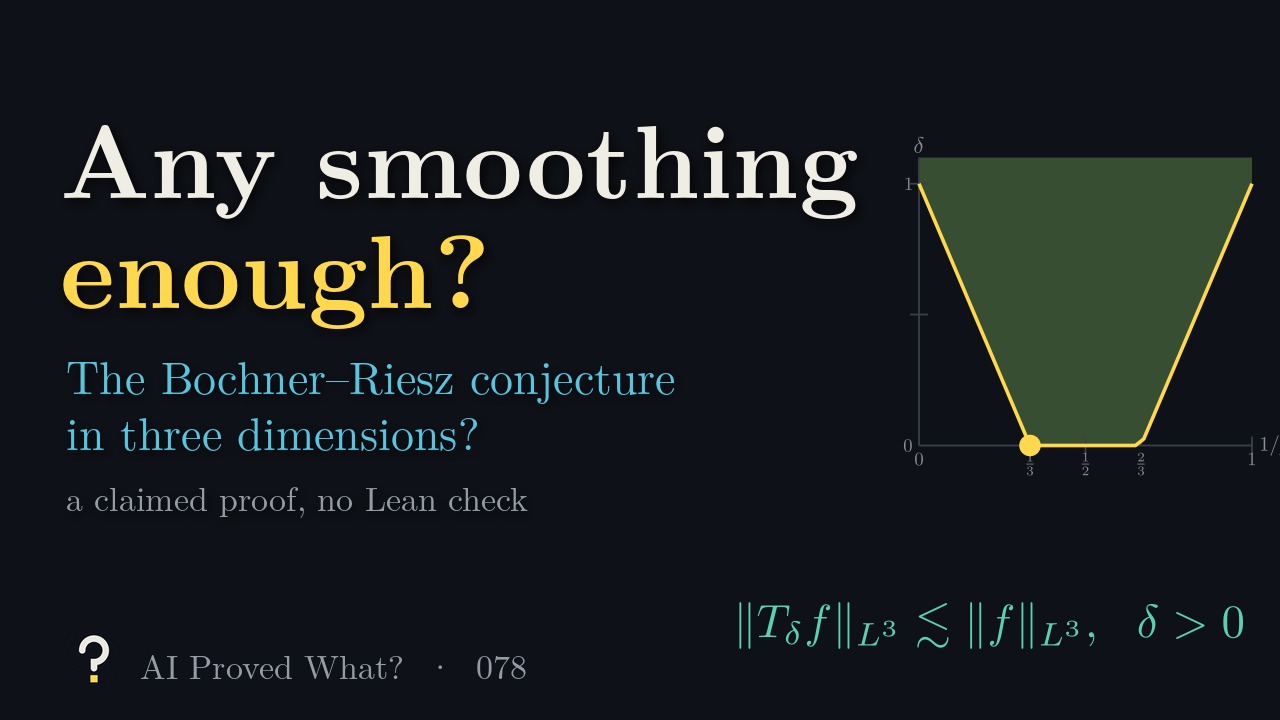
In three dimensions the kernel oscillates and decays like the distance to the power −2 − δ, so it lies in Lp only when δ > 3/p − 2. That condition bites below p = 3/2, duality mirrors it above p = 3, and together they give the conjectured critical order max{3|1/p − 1/2| − 1/2, 0}. At p = 3 the conjecture says every positive δ works. Carleson and Sjölin proved the whole conjecture in the plane in 1972. In three dimensions, Lee’s bilinear method gave the range where the larger of p and its dual exponent is at least 10/3; Wu reached 13/4, and Gao, Wu and Xi 22/7. Tao showed that the Bochner–Riesz conjecture implies the restriction conjecture for the sphere.
Result 078 is one OpenAI preprint, 114 pages, dated September 24, 2026. Its main theorem: for every δ > 0, the Bochner–Riesz multiplier of order δ is bounded on L3(ℝ3). Interpolation and duality then give the whole conjectured strict range, for every p from 1 to ∞. Through Tao’s implication it also gives the bounded-data sphere restriction estimate claimed in result 077’s sphere paper.
What it doesn’t claim
Nothing at the critical order itself, where the bound is known to fail except at p = 2, and nothing in higher dimensions. The paper notes that Zipeng Wang has proposed a proof in all dimensions; that is a separate claim, not covered here.
Where it stands
- Posted as a preprint
- OpenAI, dated September 24, 2026, released October 6
- Peer reviewed
- Not yet
- Checked in Lean
- No: OpenAI published no Lean proof of this theorem
Last checked October 19, 2026. The preprint has not been revised, and OpenAI published no Lean proof of this theorem. Its geometric input is Ren and Wang’s Furstenberg estimate; it uses a change of variables from Guo and coauthors, and one step is related to work of Shmerkin, Orponen and Wang. The paper notes an independent route to the same range through the critical local smoothing paper of result 079, also from the release; neither that paper nor result 077 is an input. The paper is not among those OSVerify reviewed, and we have seen no expert review.
How the proof goes
- Masses on lines. Positive masses move along lines, and the paper scores what is learned by observing them through rectangles at different scales, with a weight that rewards fine resolution and penalizes eccentricity. The score grows at rate at most the penalty parameter. Isotropic extremal paths are excluded with planar projections and the Loomis–Whitney inequality; the rest have four data coordinates whose resolutions sharpen at fixed relative speeds, handled mainly through planar projections and Ren and Wang’s Furstenberg estimate.
- Wave packets. The masses become oscillatory packets. An earlier packet cannot be located as precisely as a later observation requires, and the paper records this mismatch as fine velocity information. Growth beyond half the penalty parameter would add a fixed amount of that information at every backward step, but a layer holds only a bounded amount, so the growth rate is at most half the penalty parameter.
- Shells of the kernel. On a shell of radius λ the kernel has size about λ−2−δ. A pseudoconformal change of variables from the work of Guo and coauthors puts each shell into the class the packet estimate covers, giving an L3 bound of about λ−δ+ν for any small ν. With ν < δ the shells add up.
The numbers in the video
- A short Python script checks the kernel formula Kδ(r) = Γ(δ+1) π−δ r−3/2−δ J3/2+δ(2πr) against the radial integral; fits the decay of its peaks between radius 20 and 200 (exponents −2.25, −2.5 and −3 for δ = 1/4, 1/2 and 1); checks that the kernel lies in Lp exactly when δ > 3/p − 2; computes the critical order (1 at p = 1, 1/4 at p = 4, 0 for 3/2 ≤ p ≤ 3); and orders the earlier thresholds 10/3, 13/4 and 22/7.
Read the source
- Bochner–Riesz multipliers in three dimensions (PDF), September 24, 2026 (114 pages).
- The collection’s catalog, where this is result 078.
The paper
OpenAI groups related papers into one result; this one has a single paper.
Transcript
Read the full script
0:00Softening the ball
To rebuild a function from its frequencies, a natural first step is to keep only frequencies in a ball and throw the rest away. In 1971, Fefferman showed, using a Kakeya-type construction, that this sharp cutoff is unbounded on Lᵖ for every p except two, in two or more dimensions. Bochner–Riesz means soften the edge: multiply by one minus the squared length of the frequency, raised to a power δ, and zero outside the ball. The question is how much smoothing each Lᵖ needs. In three dimensions, the Bochner–Riesz kernel oscillates and decays like the distance to the power −2 − δ; for δ equal to 1/4, 1/2 and 1, our fits give exponents of −2.25, −2.5 and −3. For the operator to be bounded on Lᵖ, the kernel must lie in Lᵖ, and this forces δ to be greater than 3/p − 2. That bites below p equal to 3/2; duality gives the mirror condition above three, and together they give the conjectured critical order. At the critical exponent p equal to three, the conjecture says every positive order works. In the plane, Carleson and Sjölin proved the whole conjecture in 1972. In three dimensions, Lee used bilinear restriction to prove the conjecture when the larger of p and its dual exponent is at least 10/3. Wu reached 13/4. Guo, Oh, Wang, Wu and Zhang revisited the classical oscillatory-integral approach with a pseudoconformal change of variables, and Gao, Wu and Xi reached 22/7. Tao showed that the Bochner–Riesz conjecture implies the restriction conjecture for the sphere.
1:45The claim
Result 078 is one OpenAI preprint, 114 pages, dated September 24. Its main theorem: for every positive order δ, the Bochner–Riesz multiplier is bounded on L³ of three-dimensional space. Interpolation and duality then give the whole conjectured strict range. Through Tao’s implication, it also gives the bounded-data sphere restriction estimate of result 077. The paper notes an independent route to the same range, through the local smoothing paper of result 079, and that Zipeng Wang has also proposed a proof of the Bochner–Riesz conjecture in all dimensions. OpenAI published no Lean proof of this theorem.
2:30Masses, packets, shells
The proof has two stages. First, positive masses move along lines, and the paper scores how much is learned by observing them through rectangles at different scales, with a weight that rewards fine resolution and penalizes eccentricity. It proves that the score’s growth rate is at most the penalty parameter. Extremal paths are either isotropic, excluded with planar projections and the Loomis–Whitney inequality, or have four data coordinates whose resolutions sharpen at fixed relative speeds, handled mainly through planar projections and the Furstenberg estimate of Ren and Wang. Second, the masses become wave packets, whose squared amplitudes are positive but whose sum oscillates. The obstruction is at the uncertainty boundary: an earlier packet cannot be located as precisely as a later observation requires. The paper records this mismatch as fine velocity information. Growth beyond half the penalty parameter would add at least a fixed amount of that information at every backward step, but the layer can hold only a bounded amount, so after finitely many steps the assumption fails. Finally, the multiplier. On a shell of radius λ in physical space, the kernel has size about λ^(−2−δ). A change of variables from the work of Guo and coauthors puts each shell into the class the packet estimate covers, giving a bound of about λ^(−δ+ν), for any small ν. Choosing ν smaller than δ lets the shells add up, which proves the L³ bound.
4:07Where it stands
The preprint is not yet peer reviewed, and it has not been revised. There is no Lean proof. Its geometric input is Ren and Wang’s Furstenberg estimate. It uses a change of variables from Guo and coauthors, and one step is related to work of Shmerkin, Orponen and Wang. It is not among the papers OSVerify reviewed, and we have seen no expert review. The independent route through result 079 also comes from the release. If it holds, the Bochner–Riesz conjecture is settled in three dimensions in its strict range, and with Tao’s implication the bounded-data restriction estimate for the sphere follows again. At the critical order itself the bound is known to fail, except at p equal to two, and the paper makes no claim in higher dimensions.
Spot a mistake?
This episode simplifies on purpose, but it shouldn’t be wrong. If something is, open an issue on GitHub or leave a comment on YouTube. Corrections are noted here with a date.