One operator enough?
Riesz transforms and uniform rectifiability in higher codimension
Covers result 081 in OpenAI’s catalog: its one paper. See its connections to other results and the work it cites.
5:30. English captions available. The video loads from YouTube when you press play.
Chapters
The claim, in plain words
Some sets are rectifiable in a strong, quantitative way: in every ball centered on the set, a fixed fraction of its mass lies on a Lipschitz image of a disk, a flat disk stretched by a controlled amount. David and Semmes called this uniform rectifiability. They showed that this geometry makes a whole class of singular integrals bounded, and that boundedness of all of them forces it back, and they asked whether one natural operator is enough: the n-dimensional Riesz transform, whose kernel is z/|z|n+1.
The setting is an Ahlfors–David regular measure of dimension n, where every ball of radius r centered on the set carries mass comparable to rn. On a flat plane the Riesz kernel cancels by symmetry. Mattila, Melnikov and Verdera answered the question for one-dimensional sets in the plane in 1996, curvature methods handle dimension one in every ambient dimension, and Nazarov, Tolsa and Volberg answered it in codimension one in 2014. Mas and Tolsa characterized uniform rectifiability under a stronger hypothesis, a bound on the variation of the truncations. The range in between is listed as an open question in Tolsa’s plenary lecture for the 2026 International Congress.
Result 081 is one OpenAI preprint, 56 pages, dated September 24, 2026. Its theorem: in ℝd with d ≥ 4 and 2 ≤ n ≤ d − 2, every n-dimensional Ahlfors–David regular measure whose hard-truncated Riesz transforms are bounded on L2 with one common constant is uniformly rectifiable, with constants depending only on the dimensions and the two bounds. No principal values and no variation bounds are assumed; a final section combines the theorem with Mas and Tolsa’s work to get variation bounds and principal values.
What it doesn’t claim
The theorem is for Ahlfors–David regular measures of integer dimension. The Lean formalization covers the main theorem but not the variation and principal-value section.
Where it stands
- Posted as a preprint
- OpenAI, dated September 24, 2026, released October 6
- Peer reviewed
- Not yet
- Checked in Lean
- OpenAI published a Lean proof of the main theorem; we have not run the check
Last checked October 19, 2026. The preprint has not been revised. OpenAI published a Lean formalization of the main theorem, 824 files and 65,638 lines with no unproved steps that we could find, matched against a 62-line statement that has hard truncations, Ahlfors–David regularity with one constant, and Lipschitz images of balls with constants fixed before the measure. We have not run the check ourselves. The paper proves its own limiting and rigidity statements, in the spirit of the reflectionless-measure methods of Jaye and Nazarov, and for its last step cites the David–Semmes criterion. It is not among the papers OSVerify reviewed, and we have seen no expert review.
How the proof goes
- Excess and normal heights. The difficulty is to carry flatness down to smaller scales. The paper measures the excess, the scale-normalized L2 distance of the measure from an affine n-plane, and the normal heights, the displacement perpendicular to that plane, and divides the heights by the size of the initial excess before passing to a limit, when the Riesz pairings against mean-zero Lipschitz tests are small compared with that scale.
- Energy, then rigidity. Testing the transform against a normal height times a cutoff produces a positive fractional energy, which gives compactness of the normalized heights even while the measures move. In the limit the heights satisfy an equation whose Fourier symbol has order one; with weighted integrability at infinity, this forces every limiting height to be affine, and approximating by an affine graph improves the excess at the smaller scale.
- Counting failures. Outside a family with a packing bound, every cell has a smaller cell a few generations down that is close to a plane from both sides. A later failure of flatness forces a cell in between where the transform oscillates detectably, and a finite counting argument controls these failures. The packing is the bilateral weak geometric lemma, and a theorem of David and Semmes turns it into the Lipschitz images.
The numbers in the video
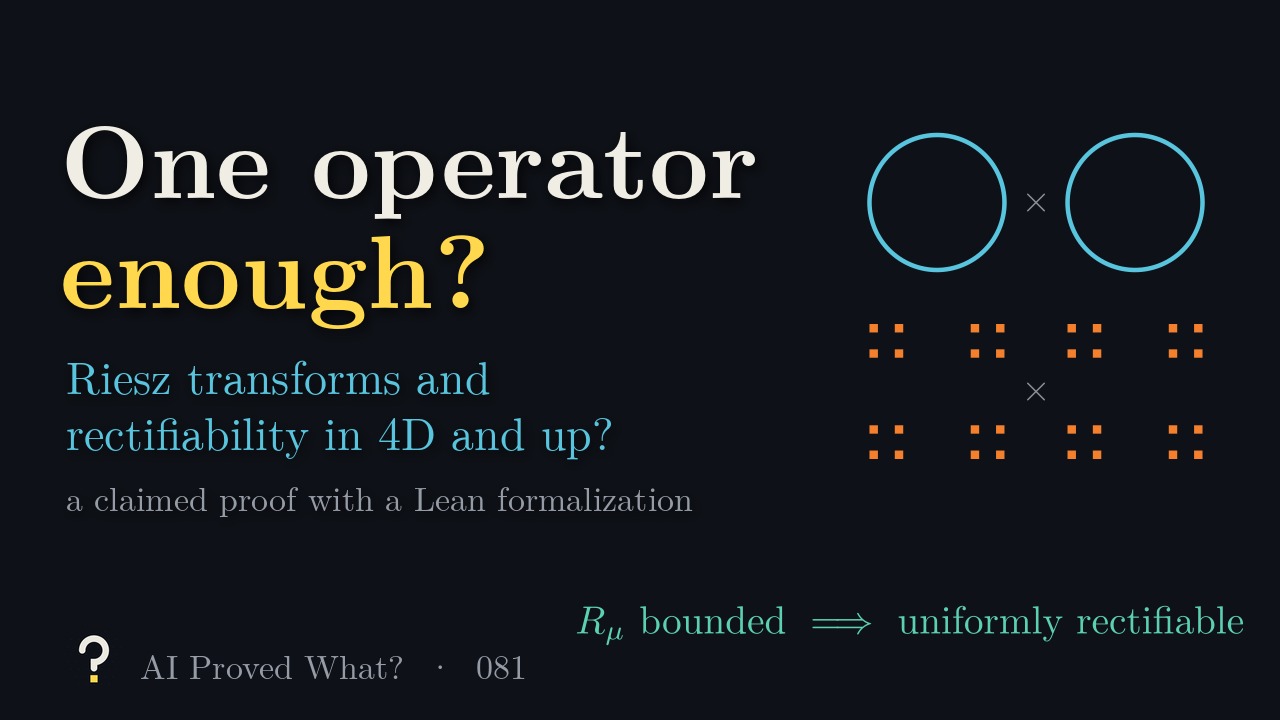
- A short Python script checks that the Riesz transform of 1 vanishes at the centre of a flat symmetric patch, and compares two 2-dimensional sets in four-dimensional space, each discretized by 16k equal point masses: the torus (circle × circle) and K × K, the four-corner Cantor set squared. The mean square of the truncated Riesz transform of 1 is 0.119, 0.182, 0.200, 0.205 and 0.206 on the torus (k = 1 to 5) and 0.377, 0.803, 1.243 and 1.687 on K × K (k = 1 to 4, growing by about 0.44 per generation). K × K is 2-dimensional Ahlfors–David regular: ball mass over r2 stays between 0.25 and 0.63.
Read the source
- Riesz transforms and uniform rectifiability in higher codimension (PDF), September 24, 2026 (56 pages).
- The Lean scope note and the statement it is checked against.
- The collection’s catalog, where this is result 081.
The paper
OpenAI groups related papers into one result; this one has a single paper.
Transcript
Read the full script
0:00One operator, many shapes
Some sets are rectifiable in a strong, quantitative way: in every ball centered on the set, a fixed fraction of its mass lies on a Lipschitz image of a disk, a flat disk stretched by a controlled amount. David and Semmes called this uniform rectifiability. They showed that this geometry makes a whole class of singular integrals bounded, and that boundedness of all of them forces it back. Their question was whether one natural operator is enough: the n-dimensional Riesz transform, whose kernel is the vector from one point to another divided by the distance to the power n + 1. The setting is an Ahlfors–David regular measure of dimension n: every ball of radius r centered on the set carries mass comparable to rⁿ. On a flat plane the Riesz kernel cancels by symmetry. Compare two two-dimensional sets in four-dimensional space: a torus, the product of two circles, and the product of two four-corner Cantor sets, which is far from flat at every scale. In our computation, the Riesz transform of the constant function settles on the torus as the scale shrinks, while on the Cantor product its mean square keeps growing by about 0.44 per generation. Mattila, Melnikov and Verdera answered the question for one-dimensional sets in the plane in 1996, using the curvature behind the Cauchy integral, and curvature methods handle dimension one in every ambient dimension. In 2014, Nazarov, Tolsa and Volberg answered it in codimension one, and they named a maximum principle with no known higher-codimension analogue as the obstacle. Mas and Tolsa characterized uniform rectifiability under a stronger hypothesis, a bound on the variation of the truncations. The range in between, dimension two up to d − 2, is listed as an open question in Tolsa’s plenary lecture for the 2026 International Congress.
2:01The claim and the Lean check
Result 081 is one OpenAI preprint, 56 pages, dated September 24. Its theorem: in dimension d at least four, with n between two and d − 2, every n-dimensional Ahlfors–David regular measure whose hard-truncated Riesz transforms are bounded on L² with one common constant is uniformly rectifiable, with constants depending only on the dimensions and the two bounds. No principal values and no variation bounds are assumed. A final section combines it with Mas and Tolsa’s theorem to get variation bounds and principal values. OpenAI also published a Lean formalization of the main theorem, over 65,000 lines in 824 files, matched against a short separate statement of the theorem. We read that statement: it has hard truncations, Ahlfors–David regularity with one constant, and Lipschitz images of balls with uniform constants. The formalization does not cover the variation and principal-value section. We have not run the check ourselves.
3:07Excess, heights, packing
The difficulty is to carry flatness down to smaller scales. The paper measures the excess, the scale-normalized L² distance of the measure from an affine n-plane, and the normal heights, the displacement perpendicular to that plane. It divides the heights by the size of the initial excess and passes to a limit, but only when the Riesz pairings against mean-zero Lipschitz tests are small compared with that scale. Testing the transform against a normal height times a cutoff produces a positive fractional energy. This gives compactness of the normalized heights, even while the measures themselves move. In the limit, the heights satisfy an equation whose Fourier symbol has order one, and together with weighted integrability at infinity this forces every limiting height to be affine. Approximating by an affine graph then improves the excess at the smaller scale. The rest is counting. The operator bound gives this: outside a family with a packing bound, every cell has a smaller cell a few generations down whose support is close to a plane from both sides. Starting from a flat cell, a later failure of flatness forces a cell in between where the transform oscillates detectably, and a finite counting argument controls these failures even when their scales are far apart. This packing is the bilateral weak geometric lemma, and a theorem of David and Semmes turns it into the Lipschitz images.
4:34Where it stands
The preprint is not yet peer reviewed, and it has not been revised. The Lean formalization of the main theorem is the strongest check here, though we have not run it ourselves. The paper proves its own limiting and rigidity statements, in the spirit of the reflectionless-measure methods of Jaye and Nazarov, and for its last step it cites the David–Semmes theorem that turns the bilateral weak geometric lemma into Lipschitz images. It is not among the papers OSVerify reviewed, and we have seen no expert review. If it holds, the David–Semmes question for the Riesz transform is answered in every integer dimension: dimension one and codimension one were known, and this fills every case in between, from two-dimensional sets in four-dimensional space upward. The constants are uniform, depending only on the dimensions and the two bounds.
Spot a mistake?
This episode simplifies on purpose, but it shouldn’t be wrong. If something is, open an issue on GitHub or leave a comment on YouTube. Corrections are noted here with a date.