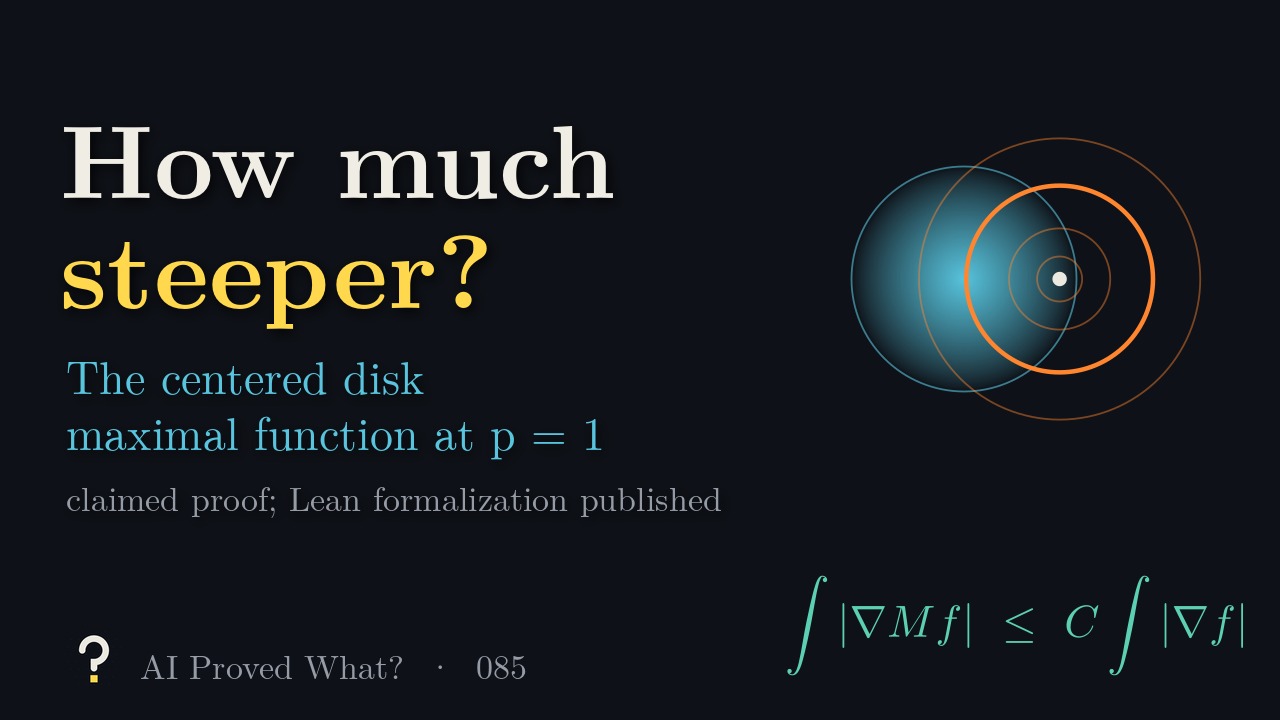
How much steeper?
The centered disk maximal function at p = 1
Covers result 085 in OpenAI’s catalog: its one paper. See its connections to other results and the work it cites.
6:40. English captions available. The video loads from YouTube when you press play.
Chapters
The claim, in plain words
At each point of the plane, average the size of a function f over every disk centered there and keep the largest average. That is the centered disk maximal function Mf. The Hardy–Littlewood maximal theorem bounds Mf in Lp for every p above one, but at p = 1 it fails: unless f is zero, Mf decays no faster than one over distance squared and is never integrable.
Smoothness is a separate question. In 1997 Kinnunen proved that for p above one, if f and its gradient lie in Lp, so do Mf and its gradient, using the pointwise bound |∇Mf| ≤ M(|∇f|). At p = 1 that majorant is not integrable either. In 2004 Hajłasz and Onninen asked whether the gradient bound survives anyway: is the integral of |∇Mf| at most a constant times the integral of |∇f|? In one dimension, Tanaka and then Aldaz and Pérez Lázaro proved such bounds for the uncentered operator, and Kurka for the centered one. In higher dimensions they were known for radial or block-decreasing inputs with uncentered balls, and as variation bounds for the dyadic and uncentered cube operators, but not for centered disks.
Result 085 is one OpenAI preprint, 45 pages, dated September 26, 2026. Its theorem: there is an absolute constant C such that, for every real f in the Sobolev space W1,1 of the plane, Mf is locally integrable, lies locally in W1,1, and ∫|∇Mf| ≤ C ∫|∇f|. No radial symmetry or compact support is assumed. The paper presents this as answering the planar centered-disk case of Hajłasz and Onninen’s question.
What it doesn’t claim
The constant is not computed, and the argument covers disks in the plane only. Balls in higher dimensions, the best constant, and continuity of the map from f to the gradient of Mf are not claimed.
Where it stands
- Posted as a preprint
- OpenAI, dated September 26, 2026, released October 6
- Peer reviewed
- Not yet
- Checked in Lean
- OpenAI published a Lean proof; we have not run the check
Last checked October 19, 2026. The preprint has not been revised. OpenAI published a Lean formalization, 30 files and 19,397 lines with no unproved steps that we could find, matched against a separate statement of the full theorem: Mf is finite almost everywhere, locally integrable and locally in W1,1, with an integrable weak gradient obeying the bound. A separate formalization proves the signed finite-band estimate. We have not run the check ourselves. The paper notes that a 2025 theorem of Lahti and Weigt would turn a variation bound into Sobolev regularity; it proves that bound and removes the singular part directly. It is not among the papers OSVerify reviewed, and we have seen no expert review.
How the proof goes
- A signed estimate. For a smooth, compactly supported g, the paper averages g itself rather than its size and takes the largest average over radii between a and b. The integral of the gradient of this envelope is bounded by a constant times that of g, however many scales lie between a and b.
- Cancellation at the best radius. Where the average is locally largest in the radius, its radial derivative vanishes, and a rotational moment vanishes on every disk; in complex notation, a smoothed disk gives zero total to the gradient weighted by the conjugate of y − x. Two such disks differ on a thin shell, and the factor 1 − conj(y − x)/conj(z − x), which vanishes at a shell point z, makes gradient mass near z nearly free. A sweep by nested disks tangent at z shows that, outside one exceptional set of centers and for every radius within one doubling, the relevant shell mass concentrates near one point, using only a bound on positive mass inside the inner disk. The resulting local estimate charges a localized error piece of size m at scale s, seen at a larger scale r, only m·(s/r)1/100.
- Prices, particles, assembly. Pairing positive and negative parts of the gradient from the finest grid upward gives every dyadic square a price, and the prices add up to a constant times the gradient integral of g, for every direction in a fixed finite palette. Vector mass followed along refinement paths chooses directions scale by scale, paying for changes of direction and for spatial variation. When the bands are assembled, each row of transition probabilities sums to one, so its spatial derivatives sum to zero, and the direction costs pay for the terms that remain. Finally, approximation extends the estimate to Sobolev inputs, and a signed cutoff that subtracts a local mean shows that the gradient of Mf has no singular part.
The numbers in the video
- A short Python script computes Mf for the cone f(y) = max(0, 1 − |y|), whose gradient has total size π. Mf equals f out to a distance of about 0.79 from the peak, where the best radius jumps from 0 to about 0.76. The integral of Mf over the disk of radius R is 3.10, 4.26, 5.55 and 6.90 at R = 5, 10, 20 and 40, and that of the majorant M(|∇f|) is 8.50, 11.85, 15.64 and 19.70: neither is integrable.
- The level sets of Mf are disks whose area grows like 1/t and whose perimeter grows like 1/√t, so the total gradient of Mf is finite: about 4.50, a ratio of 1.43. For two cones at distances 3, 6 and 12, computed on a grid, the ratio is 1.28, 1.35 and 1.39. No computation can test every input.
Read the source
- An Endpoint Gradient Bound for the Centered Disk Maximal Operator (PDF), September 26, 2026 (45 pages).
- The Lean scope note and the statement it is checked against.
- The collection’s catalog, where this is result 085.
The paper
OpenAI groups related papers into one result; this one has a single paper.
Transcript
Read the full script
0:00Taking the best average
At each point of the plane, draw every disk centered there, average the size of a function over each disk, and keep the largest average. That is the centered disk maximal function, Mf. For a cone of height one and radius one, near the peak the best disk is a tiny one, and Mf equals f. But from a distance of about 0.79, a large disk reaching back almost to the peak does better, and the best radius jumps. The maximal theorem of Hardy and Littlewood bounds Mf in Lᵖ for every p above one, but at p = 1 it fails: unless f is zero, Mf decays no faster than 1/distance², and is never integrable. Smoothness is a different question. In 1997, Kinnunen proved that for p above one, if f and its gradient lie in Lᵖ, so do Mf and its gradient, using a pointwise bound: the gradient of Mf is at most the maximal function of the gradient of f. At p = 1 that last step breaks, because a maximal function is never integrable. For the cone, the integral of that majorant over a disk of radius R keeps growing, by roughly four with each doubling of R. In 2004, Hajłasz and Onninen asked whether the gradient bound survives anyway: is the integral of the gradient of Mf at most a constant times the integral of the gradient of f? It can survive, because a gradient only sees boundaries. The level sets of Mf for the cone are disks. As the level t falls, their area grows like 1/t, so Mf has infinite integral; but their perimeter grows only like 1/√t, and the total of the perimeters, which is the integral of the gradient, is finite. In our computation it is about 4.5, against pi for the cone itself, a ratio of 1.43; for two cones at distances three, six and twelve, the ratio stays between 1.28 and 1.39. In one dimension, Tanaka, and then Aldaz and Pérez Lázaro, proved such bounds for the uncentered operator, and Kurka for the centered one. In higher dimensions they were known for radial or block-decreasing inputs with uncentered balls, and as variation bounds for uncentered cubes, but not for centered disks.
2:23The claim
Result 085 is a 45-page OpenAI preprint dated September 26. Its theorem: there is an absolute constant C such that, for every real function f in the Sobolev space W^(1,1) of the plane, Mf is locally integrable, lies locally in W^(1,1), and the integral of its gradient is at most C times the integral of the gradient of f. No radial symmetry or compact support is assumed. The constant is not computed, and the argument is for disks in the plane only. The paper presents this as answering the planar centered-disk case of Hajłasz and Onninen’s question. OpenAI also published a Lean formalization, about 19,400 lines in 30 files, matched against a separate statement of the full theorem, including that Mf is finite almost everywhere and has an integrable weak gradient obeying the bound. We have not run the check ourselves.
3:23Cancellation at the best radius
The heart of the proof is a signed estimate. For a smooth, compactly supported g, average g itself, not its size, and take the largest average over radii between a and b. The integral of the gradient of this envelope is bounded by a constant times that of g, however many scales lie between a and b. The first input is cancellation. At a radius where the average is locally largest, its radial derivative vanishes, and a rotational moment vanishes on every disk. In complex notation, a smoothed disk then gives zero total to the gradient weighted by the conjugate of y − x. Comparing two such disks leaves a thin shell, and the factor 1 − conj(y − x)/conj(z − x), which vanishes at a shell point z, makes gradient mass near z nearly free. So the question becomes geometric: when is almost all the relevant mass on a shell concentrated near one point? A sweep by nested disks, all tangent at that point, answers it for every center outside one exceptional set, uniformly over every radius within one doubling, and it needs a bound on positive mass only inside the inner disk. This gives a local directional estimate: split the gradient into positive pieces pointing into a fixed cone of directions, plus localized error pieces. An error of size m spread over scale s, seen at a larger scale r, costs only m·(s/r)^(1/100). Two multiscale constructions pay for the rest. The first pairs positive and negative parts of the gradient from the finest grid upward, giving every dyadic square a price; the prices add up to at most a constant times the gradient integral of g, and one set of prices serves every direction in a fixed finite palette. The second follows vector mass along refinement paths and chooses directions scale by scale, paying for each change of direction and for spatial variation of the choice. When the bands are assembled, each row of transition probabilities sums to one, so its spatial derivatives sum to zero, and this cancellation leaves only terms the direction costs already pay for. Finally, approximation extends the estimate to Sobolev inputs, and a signed cutoff that subtracts a local mean shows that the gradient of Mf has no singular part.
5:52Where it stands
The preprint is not peer reviewed and has not been revised. The Lean formalization of the full theorem has been published, and we have not run it. The paper notes that a 2025 theorem of Lahti and Weigt would turn a variation bound into Sobolev regularity; it proves that bound and removes the singular part directly. It is not among the papers OSVerify reviewed, and we have seen no expert review. If it holds, taking the best centered disk average in the plane can increase the total size of a gradient by at most a fixed factor, even at the endpoint p = 1. Balls in higher dimensions, the best constant, and continuity of the map from f to the gradient of Mf are not claimed.
Spot a mistake?
This episode simplifies on purpose, but it shouldn’t be wrong. If something is, open an issue on GitHub or leave a comment on YouTube. Corrections are noted here with a date.