Squeezed into less?
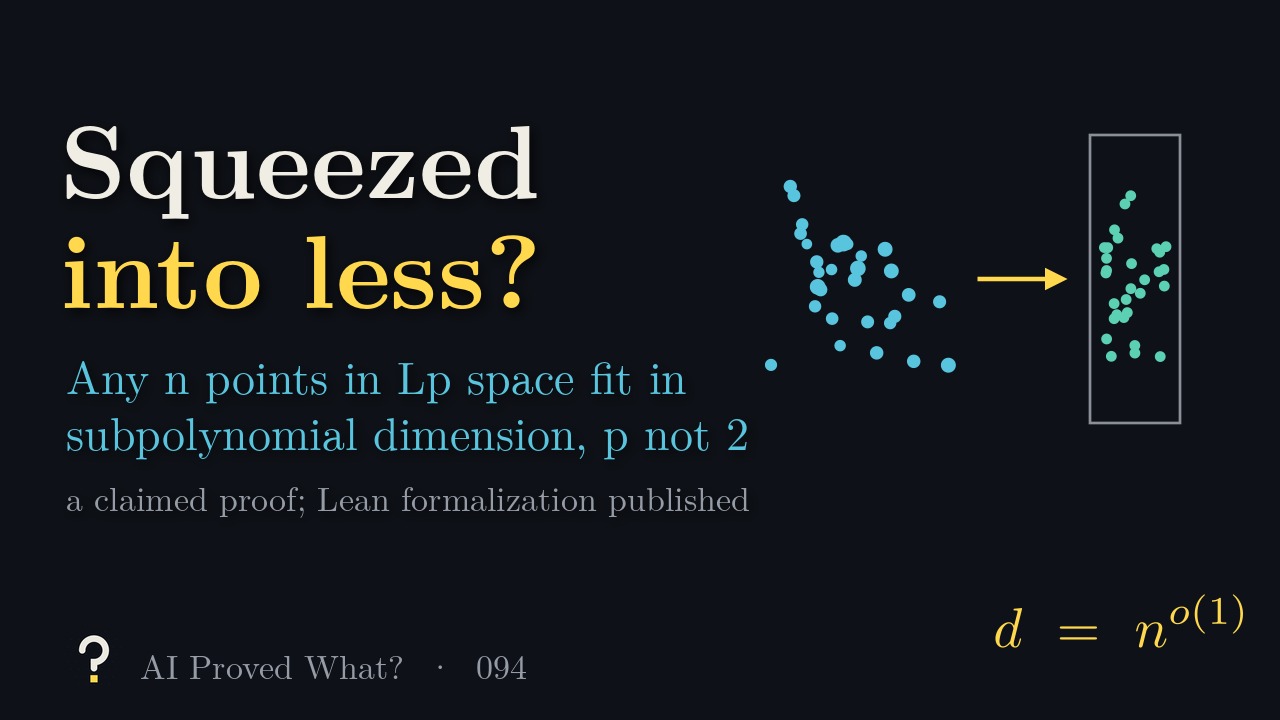
Any n points in an Lp space, p not 2, fit into no(1) dimensions with small distortion
Covers result 094 in OpenAI’s catalog: its one paper. See its connections to other results and the work it cites.
6:22. English captions available. The video loads from YouTube when you press play.
Chapters
The claim, in plain words
Take n points and the distances between them, and look for n new points in a space of much lower dimension whose distances are the same up to a factor D, the distortion. In Euclidean space the Johnson–Lindenstrauss lemma does this with a constant times log n dimensions for any fixed D above 1; a random Gaussian map works. In our test, 2,000 random points in 1,000 dimensions, mapped to 400, had largest stretch over smallest stretch about 1.46.
In an Lp space the distance is the p-th root of the sum, or integral, of p-th powers of coordinate differences, and the new points must lie in ℓpd, the same kind of space in d dimensions. For p other than 2 the known bounds were far larger. Ball showed that n(n−1)/2 coordinates always suffice for an exact copy, and that order n² are needed for p below 2. With distortion, Schechtman reached order n for p below 2. Linear maps can need order n dimensions for every p ≠ 2; at p = 1 Brinkman and Charikar showed that even nonlinear maps need a power of n; and for p above 2 Naor and Ren recently showed that order log n is not enough. OpenAI’s catalog presents the new result as answering Naor’s question whether a sublinear dimension is possible.
Result 094 is one OpenAI preprint dated September 23, 2026 (19 pages). It claims that for every fixed p between 1 and ∞ other than 2 and every D above 1, every n-point subset of an Lp space embeds into ℓpd with distortion at most D and d ≤ exp(C (log n)γ(p)), which is no(1): smaller than any fixed power of n. Here γ(p) = 2 − p for p below 2 and 1 − 2/p for p above 2. A packing argument shows that at least log n / log(1 + 2D) coordinates are needed. For exact embeddings the answer is instead of order n²: between ⌊(n − 1)/4⌋² and n(n−1)/2 for n ≥ 9.
What it doesn’t claim
The constant C depends on p and D, with no uniformity claimed near p = 1, near p = 2, or as D approaches 1. The result is existential: no efficient algorithm is claimed, and the maps need not be linear. Neither the exponent γ(p) nor the log n lower bound is claimed optimal, so the optimal dimension with distortion remains open, and p = 1 is not covered.
Where it stands
- Posted as a preprint
- OpenAI, dated September 23, 2026, released October 6
- Peer reviewed
- Not yet
- Checked in Lean
- OpenAI published a Lean proof of the dimension bounds; we have not run the check
Last checked October 19, 2026. The preprint has not been revised. OpenAI published a Lean formalization of the dimension bounds, 45 files and 7,918 lines including the electrical-flow localization from the paper’s appendix, matched against a separate statement, with no unproved steps that we could find. We have not run the check. The paper is not among those OSVerify reviewed, and we have seen no expert review.
How the proof goes
- Moments to coordinates. Give each point a random real label; across a pair, the difference of labels divided by the pair’s distance is a random increment. If one bounded distribution, with bound K, makes the p-th moments of all increments nearly equal, independent samples give the coordinates by Maurey’s empirical method, about K2p log n of them. A convexity and separation argument shows it is enough to handle each weighted average over pairs separately, with the same moment and bound K for every weighting.
- A projection with small rows. To keep increments consistent with labels on the points, the paper projects onto the space of such increments. A localization estimate for electrical flows, due to Gurel-Gurevich, Nachmias and Sachdeva, with a fixed-point reweighting of the pairs, keeps every row of the projection of total size at most 4 log(2n).
- Heavy tails, both sides of 2. Below 2 the paper builds increments with symmetric p-stable marginals, clips their heavy tails and projects back. Above 2 it uses overlapping truncations, signed Poisson sampling and a moment inequality of Rosenthal type. Either way log K is at most a constant times (log n)γ(p), which gives the dimension.
- Exact embeddings need n². For p ≠ 2 the parallelogram defect ‖u+v‖p + ‖u−v‖p − 2‖u‖p − 2‖v‖p is zero exactly when u and v have disjoint supports. In a k × k grid, rows must stay disjoint from rows and columns from columns, while each row meets each column (their defect is 2p − 4), so at least k² coordinates are needed.
The numbers in the video
- Johnson–Lindenstrauss: 2,000 Gaussian points in 1,000 dimensions, random Gaussian map to d dimensions; largest stretch over smallest about 2.03, 1.64 and 1.46 at d = 100, 200 and 400.
- Blind coordinate sampling at p = 3/2: for 40 spread-out points in 4,000 dimensions, 400 random coordinates give distortion about 1.25; for points with 5 nonzero coordinates each, it stays infinite up to 1,600 coordinates and above 10 at 3,200. That sparse set uses only 195 coordinates, so a map that adapts to it does fine.
- The parallelogram defect in a 3 × 3 grid: 0 for two rows, and 2p − 4 for a row and a column, exactly 4 at p = 3 and −1.17 at p = 3/2.
Read the source
- Subpolynomial dimension reduction in Lp (PDF), 19 pages.
- The Lean scope note.
- The collection’s catalog, where this is result 094.
The paper
OpenAI groups related papers into one result; this one has a single paper.
Transcript
Read the full script
0:00Fewer dimensions
Take n points and their distances, and look for new points in a space of much lower dimension with nearly the same distances. For Euclidean distances, the Johnson–Lindenstrauss lemma does this with only a constant times log n dimensions, for any fixed distortion above 1. In our test, 2,000 random points in 1,000 dimensions, sent through a random Gaussian map to 400 dimensions, stretched no distance more than about 1.46 times as much as any other. Johnson and Lindenstrauss asked what happens in other spaces. Here the space is Lₚ: distance is the p-th root of the sum, or integral, of p-th powers of the coordinate differences, and the new points must again lie in an Lₚ space, now of finite dimension d. For exact embeddings, Ball showed that C(n, 2) coordinates always suffice, and that order n² are needed for p < 2. Allowing distortion, Schechtman brought the dimension down to a constant times n for p < 2. For any p ≠ 2, linear maps can need order n dimensions, and at p = 1, Brinkman and Charikar showed that even nonlinear maps need a power of n. For p > 2, Naor and Ren recently showed that order log n is not enough. OpenAI’s catalog presents the result as answering Naor’s question: can the dimension be sublinear in n for p ≠ 2? Small examples show why blind sampling fails. The simplest idea is to keep a random sample of the coordinates and rescale. For 40 random points with p = 3/2, spread over 4,000 coordinates, 400 sampled coordinates already give distortion about 1.25. But if each point has only 5 nonzero coordinates, sampling misses some pair’s differences entirely: the distortion stays infinite up to 1,600 coordinates, and is still above 10 at 3,200 of the 4,000. The map has to adapt to each configuration, sparse or spread out.
2:07The claim
Result 094 is one OpenAI preprint, 19 pages, dated September 23. It claims that for every fixed p between 1 and ∞, other than 2, and every distortion D above 1, every n-point subset of an Lₚ space embeds into Lₚ of dimension n^o(1), smaller than any fixed power of n. Precisely, the dimension is at most exp(C (log n)^γ), where γ is 2 − p below 2, and 1 − 2/p above 2. A packing argument shows that at least log n / log(1 + 2D) coordinates are needed. For exact embeddings, the dimension instead grows like n²: between about n²/16 and C(n, 2). The constants depend on p and D, with no uniformity claimed near the endpoints or as D nears 1, and the result is existential: no efficient algorithm is claimed. The maps need not be linear. Neither the exponent nor the log n lower bound is claimed optimal, and p = 1 is not covered. OpenAI also published a Lean formalization of the dimension bounds, 45 files and about 8,000 lines, matched against a separate statement. We have not run the check.
3:28How the proof goes
The proof turns embedding into probability. Give each point a random real label. Across a pair, the difference of labels divided by the pair’s distance is a random increment. If one bounded distribution makes the p-th moments of all these increments nearly equal, then independent samples give the coordinates, by Maurey’s empirical method: the number needed grows like K^(2p), times log n. A convexity and separation argument shows it is enough to meet each weighted average over the pairs separately, as long as the common moment and the bound K stay the same for every weighting. To keep the increments consistent with labels on the points, the paper projects onto the space of such increments. A localization estimate for electrical flows, of Gurel-Gurevich, Nachmias and Sachdeva, with a fixed-point reweighting of the pairs, keeps every row of this projection small, of total size at most order log n. Below 2, the paper builds increments with symmetric p-stable marginals, clips their heavy tails, and projects back. Above 2, it uses overlapping truncations and signed Poisson sampling, with a moment inequality of Rosenthal type. Either way, the bound K is exp(C (log n)^γ), and that gives the dimension. The lower bound for exact embeddings is elementary. For p ≠ 2, the parallelogram defect, the p-th power of the norm of u plus v, plus that of u minus v, minus twice the p-th powers of the norms of u and v, is zero exactly when u and v have disjoint supports. Take a k × k grid, with the rows and columns as points, together with their negatives and zero. An exact embedding must keep rows disjoint from rows and columns from columns, while every row must meet every column, since their defect is 2ᵖ − 4, not zero. So it needs at least k² coordinates. In our computation that defect is exactly 4 for p = 3, and −1.17 for p = 3/2.
5:36Where it stands
The preprint is not peer reviewed and has not been revised. OpenAI’s Lean formalization covers the dimension bounds; we have not run it. The proof uses the electrical-flow localization of Gurel-Gurevich, Nachmias and Sachdeva, presented in an appendix, and Maurey’s empirical method. It is not among the papers OSVerify reviewed, and we have seen no expert review. If it holds, every n-point subset of Lₚ, for p between 1 and ∞ other than 2, fits into n^o(1) dimensions with any distortion above 1, while exact embeddings can need order n². The optimal dimension with distortion remains open.
Spot a mistake?
This episode simplifies on purpose, but it shouldn’t be wrong. If something is, open an issue on GitHub or leave a comment on YouTube. Corrections are noted here with a date.