k-median at 1 + 2/e?
A claimed deterministic (1 + 2/e + ε)-approximation for metric k-median, matching the hardness threshold
Covers result 125 in OpenAI’s catalog: all 2 papers. See its connections to other results and the work it cites.
7:23. English captions available. The video loads from YouTube when you press play.
Chapters
The claims, in plain words
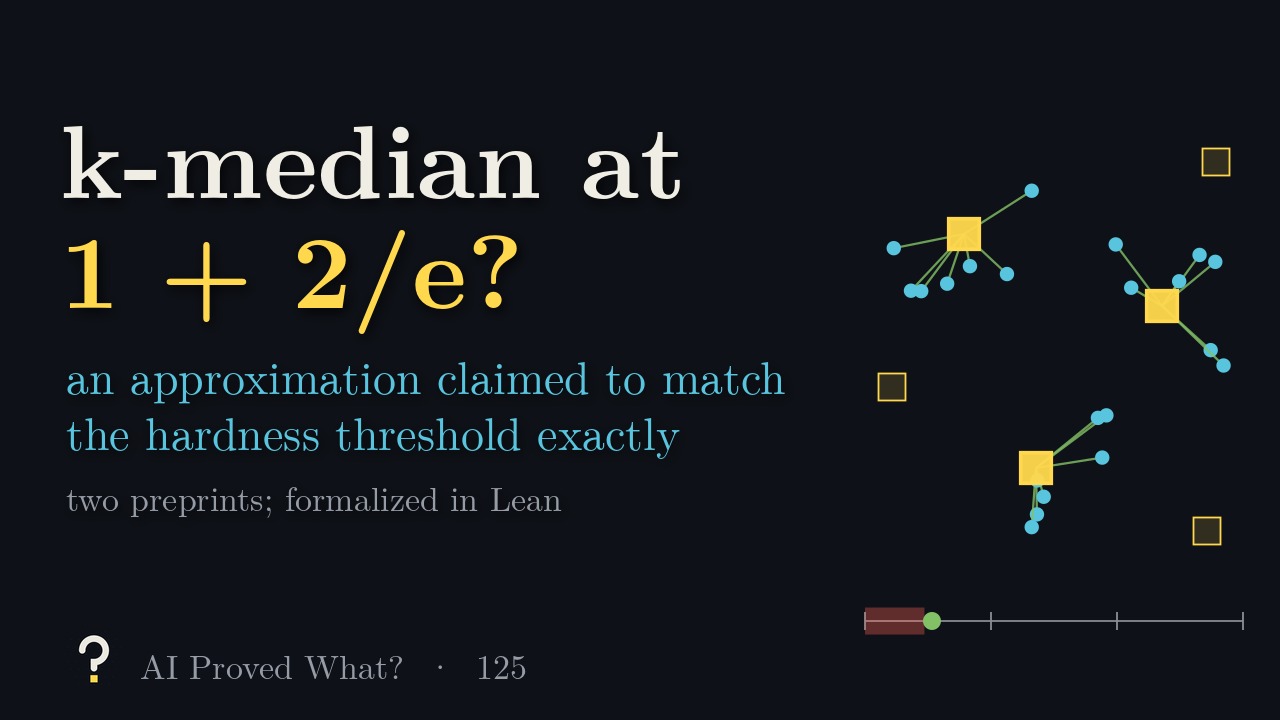
Pick at most k facilities from a list of candidates, so that the total distance from every client to its nearest open facility is as small as possible. That is metric k-median: distances obey the triangle inequality, and the budget k is strict. Finding the optimum is NP-hard. There is also a floor for approximation: turn a coverage problem into distances (distance 1 when an element is in a set, 3 when it is not, 2 within a side), and choosing k sets that cover c of m elements costs exactly 3m − 2c. Feige’s hardness for maximum coverage then implies that, unless P = NP, no deterministic polynomial-time algorithm beats 1 + 2/e ≈ 1.736.
Algorithms came down slowly: Charikar, Guha, Tardos and Shmoys gave the first constant factor; Jain and Vazirani used primal-dual methods; Arya and coauthors reached 3 + ε by local search; Li and Svensson showed that a few extra facilities can be removed at small cost, reaching 1 + √3; Byrka and coauthors’ bi-point rounding gave 2.675, and Gowda and coauthors 2.613. Cohen-Addad and coauthors reached 2 + ε, first announced in 2025, and Byrka and coauthors gave a graph-based iterative rounding with the same factor.
Result 125 is two OpenAI preprints, both dated September 24, 2026. The main one (46 pages) claims that for every fixed ε there is a deterministic polynomial-time algorithm that opens at most k facilities and pays at most (1 + 2/e + ε) times the optimum, on any finite rational metric with specified candidate facilities. With the coverage floor, the best possible factor for deterministic algorithms, unless P = NP, is then exactly 1 + 2/e, as an infimum. The companion (53 pages) gives a separate route below two, built on Cohen-Addad and coauthors’ algorithm: recovery from an anchor accurate on all but logarithmically many clusters, plus a payment argument, giving a randomized (2 − σ)-approximation for an absolute constant σ.
What it doesn’t claim
The endpoint 1 + 2/e itself is not claimed, only every factor above it, and the degree of the polynomial may depend on ε, so the algorithm is a theoretical one. The threshold is for this model, where candidate facilities may differ from the clients; when facilities must sit at clients, the lower-bound question is different.
Where it stands
- Posted as preprints
- OpenAI, two preprints, 46 and 53 pages, dated September 24, 2026
- Peer reviewed
- Not yet
- Checked in Lean
- OpenAI published Lean proofs of the four main statements, including the threshold under P ≠ NP; we have not run the check
Last checked October 19, 2026. The preprints have not been revised. OpenAI published Lean formalizations of the four main statements, matched against comparator statements such as the threshold, in 1,277 files and 142,414 lines with their imports (not counting Mathlib), with no unproved steps that we could find. For the threshold, the Lean proof also derives the hardness side from P ≠ NP, with its own modules for the Cook–Levin theorem, expanders and gap amplification. We have not run the check. Neither paper is among those OSVerify reviewed, and we have seen no expert review.
How the algorithm works
- From fractions to copies. Start from the standard linear program, which opens fractions of facilities with total opening at most k and cost at most the optimum. Round the openings to multiples of a small grid 1/Δ, so each opening is a stack of small copies; separated representative clients gather nearby mass into bundles, and each bundle’s missing part is rounded together with its suppliers. The total opening grows by at most three grid units.
- Opening and erasing. In each round, a random directed graph says which copies are erased when a copy’s facility opens: every target has exactly Δ incoming sources, chosen with probabilities that taper off with distance. Opening and erasing are balanced, and heavy sources are forced open, so apart from rare runs that are thrown away only a constant number of extra facilities is needed. This builds on the iterative rounding of Byrka and coauthors.
- Where 1 + 2/e comes from. For each client, a potential combines its surviving copies with a persistent bound on its final distance, with a coefficient that depends on elapsed time. The key function is A(x) = 1 + 2∫₀¹(1 − e−tx)dt; the process starts at x = 1, where A = 1 + 2/e, so each client’s potential starts at (1 + 2/e) times its fractional cost and on average barely grows. A finite comparison inequality, with no symmetry assumed and scalar estimates proved by exact polynomial certificates, bounds the drift.
- Derandomize, then trim. Only a few low-order moments of each random choice matter, so each random step is replaced by a small exact distribution with the same moments (Carathéodory elimination); all histories for a constant number of rounds are expanded and the cheapest outcome within the budget is kept. That gives a deterministic algorithm with at most k plus a constant number of facilities, and Li and Svensson’s reduction removes the surplus at an arbitrarily small extra loss.
The numbers in the video
- The coverage gadget was a metric on 300 random set systems, and the cost formula 3m − 2c held on all 6,984 choices we tried.
- A(1) = 1.7357588… = 1 + 2/e, and the paper’s identities for A and P hold numerically.
- The five scalar bounds of Lemma 4.2 held at every one of about 380,000 grid points we tried, some with no room to spare at the edges of their range.
- Exact elimination reduced a distribution on 40 states with 4 features to 5 states with the same expectations.
Read the source
- The approximation threshold for metric k-median (PDF), 46 pages.
- Single-exponential recovery and bounded-price strictness for metric k-median (PDF), 53 pages.
- The Lean scope note.
- The collection’s catalog, where this is result 125.
The 2 papers in this result
OpenAI groups related papers, such as alternative proofs, supporting results and consequences, into one result; we label the first paper it lists the main paper and the others companions.
Transcript
Read the full script
0:00Metric k-median
Pick at most k facilities from a list of candidates, so that the total distance from every client to its nearest open facility is as small as possible. That is metric k-median: distances obey the triangle inequality, and the budget k is strict. Finding the optimum is NP-hard, so the question is how close a fast algorithm can get, and there is a floor. Turn a coverage problem into distances: a facility for each set, a client for each element, at distance one when the element is in the set, three when it is not, and two between any two sets or any two elements. Then choosing k sets that cover c of m elements costs exactly 3m − 2c. In our check, the gadget was a metric, and that formula held on all 6,984 choices we tried, across 300 random set systems. Feige’s hardness for maximum coverage implies that, unless P equals NP, no fast algorithm can tell instances where k sets cover everything, at cost m, from those where every choice of k sets leaves nearly a fraction 1/e uncovered, and so costs at least nearly (1 + 2/e) m. So no deterministic polynomial-time algorithm beats 1 + 2/e, about 1.736. Algorithms came down slowly. Charikar, Guha, Tardos and Shmoys gave the first constant factor, Jain and Vazirani used primal-dual methods, and Arya and coauthors reached 3 + ε by local search. Li and Svensson showed that a few extra facilities can be removed at small cost, which took the factor below three, to 1 + √3, about 2.732. Byrka and coauthors’ bi-point rounding then gave 2.675, after a correction, and Gowda and coauthors 2.613. Cohen-Addad and coauthors reached 2 + ε, first announced in 2025, and Byrka and coauthors gave a graph-based iterative rounding with the same factor.
2:06The claims
Result 125 is two OpenAI preprints, both dated September 24. The main one, 46 pages, claims that for every fixed ε there is a deterministic polynomial-time algorithm that opens at most k facilities and pays at most (1 + 2/e + ε) times the optimum, on any finite rational metric with specified candidate facilities. Together with the coverage floor, the best possible factor for deterministic algorithms, unless P equals NP, is then exactly 1 + 2/e, as an infimum: the endpoint itself is not claimed. The degree of the polynomial may depend on ε. The companion, 53 pages, gives a separate route below two, built on Cohen-Addad and coauthors’ algorithm: a recovery algorithm that rebuilds a good solution from an anchor that is accurate on all but logarithmically many clusters, plus a payment argument, together giving a randomized 2 − σ approximation for an absolute constant σ. The threshold is for this model, where candidate facilities may differ from the clients; when facilities must sit at clients, the lower-bound question is different. OpenAI published Lean formalizations of the four main statements, about 1,280 files and 142,000 lines with their imports, not counting Mathlib. For the threshold, the Lean proof also derives the hardness side from P not equal to NP, with its own modules for the Cook–Levin theorem, expanders and gap amplification. We have not run the Lean check ourselves.
3:48How the algorithm works
The algorithm starts from the standard linear program, which opens fractions of facilities, with total opening at most k and cost at most the optimum. It rounds the openings to multiples of a small grid, 1/Δ, so that each opening is a stack of small copies. Separated representative clients gather nearby opening mass into bundles, and each bundle’s missing part is rounded together with its suppliers, which keeps both the budget and the cost of restoring a full unit under control. The total opening grows by at most 3 grid units. Then come rounds. In each round, a random directed graph says which copies are erased when a given copy’s facility opens: every target has exactly Δ incoming sources, chosen with probabilities that taper off with distance. Opening and erasing are balanced, and a source that would erase too much is simply forced open, so, apart from rare runs that are thrown away, only a constant number of extra facilities is needed. This source-opening and neighbor-erasure framework builds on the iterative rounding of Byrka and coauthors. The cost analysis is new. For each client, it tracks the surviving copies of its original unit and a persistent bound on its final distance, combined into a potential whose coefficient depends on elapsed time. The key function is A(x) = 1 + 2∫₀¹ (1 − e^(−tx)) dt. The process starts at x = 1, where A is exactly 1 + 2/e, so each client’s potential starts at (1 + 2/e) times its fractional cost, and on average it barely grows; that starting value is the factor. A finite comparison inequality, with no symmetry assumed, bounds the potential’s drift, and its scalar estimates are proved with exact polynomial certificates. In our check, the five scalar bounds of Lemma 4.2 held at every one of about 380,000 grid points we tried, some with no room to spare: a few become exact equalities at the edges of their range. Only a few low-order moments of each random choice enter the analysis. So each random step is replaced by a small exact distribution with the same moments, found by a Carathéodory elimination; all histories for a constant number of rounds are expanded, and the cheapest outcome within that budget is kept. That gives a deterministic algorithm opening at most k plus a constant number of facilities, and Li and Svensson’s reduction removes the surplus at an arbitrarily small extra loss. In our check, exact elimination reduced a distribution on 40 states with 4 features to 5 states with the same expectations.
6:40Where it stands
The preprints are not peer reviewed and have not been revised. The Lean formalizations cover the main theorem, the threshold under P not equal to NP, and both statements of the companion; we have not run them. Neither paper is among those OSVerify reviewed, and we have seen no expert review. If they hold, metric k-median with candidate facilities is settled up to ε: 1 + 2/e is the exact limit for deterministic polynomial-time approximation, unless P equals NP. The algorithm is a theoretical one, with a polynomial whose degree may depend on ε.
Spot a mistake?
This episode simplifies on purpose, but it shouldn’t be wrong. If something is, open an issue on GitHub or leave a comment on YouTube. Corrections are noted here with a date.