Five colours never suffice?
A preprint claims that every five-colouring of the plane has two points at distance one with the same colour, so the chromatic number of the plane is six or seven
Covers result 158 in OpenAI’s catalog: its one paper. See its connections to other results and the work it cites.
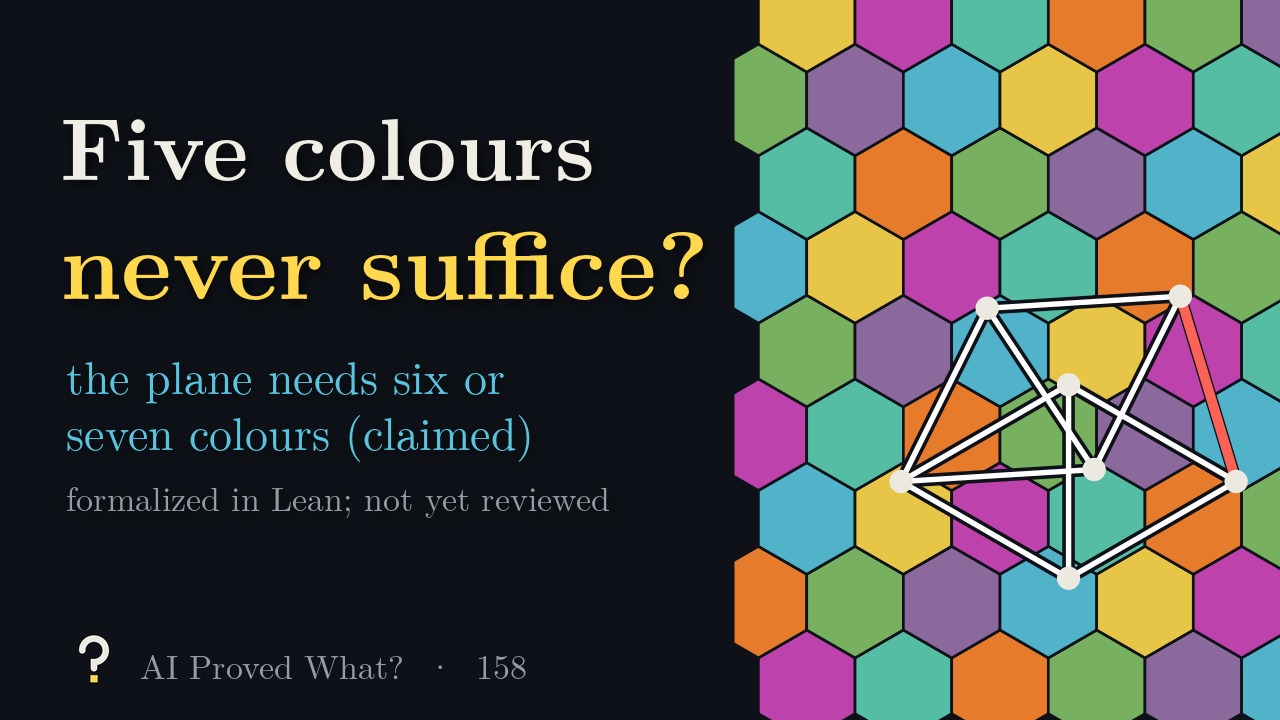
6:33. English captions available. The video loads from YouTube when you press play.
Chapters
The claim, in plain words
Colour every point of the plane so that any two points exactly one unit apart get different colours. The Hadwiger–Nelson problem asks for the fewest colours, χ(ℝ²), “with no regularity imposed on the color classes”. Seven always suffice: the paper uses hexagons of circumradius 2/5 (0.8 from corner to corner) coloured in a repeating pattern of seven, so that same-coloured points are at least (√21 − 2)·2/5 ≈ 1.03 apart. Four are needed, as the seven-point Moser spindle shows. As the paper recounts, Nelson posed the problem in 1950 and found the lower bound four, Isbell found the upper bound seven (both unpublished), and Hadwiger published it in 1961. In 2018 de Grey built a finite unit-distance graph that is not four-colourable (1,581 vertices in its corrected form); Heule found examples with 553 vertices using satisfiability proofs, Parts one with 509, and Exoo and Ismailescu gave an alternative proof. For restricted colourings the paper cites Falconer (1981: five colours for measurable classes), Townsend (repairing Woodall: six for map colourings) and Sokolov and Voronov (seven for polygonal colourings).
Result 158 is a single OpenAI preprint, The Euclidean plane is not five-colorable (62 pages, dated September 23, 2026). Theorem 1.1: “The Euclidean plane has no proper five-coloring, even when arbitrary color classes are allowed. Consequently, 6 ≤ χ(ℝ²) ≤ 7.” The paper works “throughout in ZFC” and says plainly: “The remaining alternatives six and seven are unresolved.” The problem is unrelated to Hadwiger’s conjecture on graph minors (result 157), though both are named after Hugo Hadwiger.
What it doesn’t claim
It does not decide between six and seven. It displays no finite graph: by the compactness theorem of de Bruijn and Erdős, some finite unit-distance graph that five colours cannot handle must exist, but “the graph and the positive constant here are existential”, and no size is given. It never states the measurable case outright, though its key step (Theorem 1.4) already rules out measurable five-colourings that allow a negligible set of bad unit pairs; by our own inference, Falconer’s measurable bound therefore rises from five to six. A footnote argues that a May 2026 manuscript announcing χ(ℝ²) = 7 relies on a density bound that fails.
Where it stands
- Posted as a preprint
- OpenAI, 62 pages, dated September 23, 2026
- Peer reviewed
- Not yet
- Checked in Lean
- Both bounds: no proper five-colouring for arbitrary colourings, and a proper seven-colouring. We have not rebuilt them
Last checked October 19, 2026. The preprint has not been revised since it was added to the repository in its initial commit on October 6, 2026. OpenAI published Lean formalizations of both bounds: no proper five-colouring of the plane for completely arbitrary functions (comparator), whose proof follows the paper’s route in 70 files and 30,336 lines; and a proper seven-colouring (comparator), in 9 files and 519 lines. Both counts exclude Mathlib, and we found no unproved steps. We have not rebuilt them. The converse half of the transfer, the robust corollary and the finite graph are not formalized. The paper is not among those OSVerify reviewed, and we have seen no expert review.
How the proof goes
- The transfer, for any number of colours. Keep only the points with real algebraic coordinates, a countable set, and average over all algebraic translations and rotations, giving a random proper colouring whose statistics never change under them. Fourier analysis on the compact dual group splits each colour into ordinary waves and a wild remainder; a rigidity theorem proved in the paper (Theorem 2.3) shows that the wild part has a uniform (Haar) spectrum, so it is uncorrelated with every shifted copy of itself and can be discarded. What survives is a weak measurable colouring: measurable, with unit pairs sharing a colour only for a negligible set of points and directions. Theorem 1.3: a proper k-colouring exists exactly when a weak measurable one does.
- Palettes, cycles and bands. Two points on a unit circle sixty degrees apart are one unit apart, so the colours seen one unit out in two such directions almost never overlap; with five colours, almost every direction sees at most two. Points where the colours meeting nearby form a cycle are isolated, and a covering lemma (a square cannot be covered by small open pieces overlapping at most two at a time) forces a cycle of three, four or five colours, with connected sets through one point, each banning its two colours from a band of points about one unit away.
- The endgame. Cycles of five and four are ruled out by reading colours in six directions sixty degrees apart, against the directions in which the connected sets leave the point. A triangle forces the two other colours into six alternating sectors and leaves an open, flower-shaped region where only its three colours occur. A rotated and shifted Moser spindle fits inside (Lemma 8.9, certified with exact rational arithmetic), and three colours cannot colour it.
The numbers in the video
- Our check: the Moser spindle with the paper’s coordinates has exactly 11 unit pairs, no proper colouring with 3 colours and 384 with 4.
- Our check of the paper’s hexagon colouring: 0 same-coloured pairs among 400,000 random unit pairs; unit circles see 4 to 6 colours.
- Our check of Lemma 8.9 with interval arithmetic: all seven placed points lie strictly inside the three-colour region; the closest (T) is about 0.0066 from the region’s edge.
- The Lean counts: 70 files and 30,336 lines (five colours), 9 files and 519 lines (seven colours), our count of the import closures.
Read the source
- The Euclidean plane is not five-colorable (PDF), 62 pages.
- The Lean scope note.
- The collection’s catalog, where this is result 158.
The paper
OpenAI groups related papers into one result; this one has a single paper.
Transcript
Read the full script
0:00The question
Colour every point of the plane, so that any two points exactly one unit apart get different colours. How few colours can you get away with? Seven always suffice: tile the plane with hexagons 0.8 of a unit from corner to corner, and colour them in a repeating pattern of seven, so that hexagons of the same colour sit more than one unit apart. Four are needed: in the Moser spindle, seven points joined by eleven unit-length edges; with only three colours, two pairs of triangles force both tips to share a colour with the starting point, but the tips are one unit apart. This is the Hadwiger–Nelson problem. As the paper recounts, Nelson posed it in 1950 and found the lower bound four, Isbell the upper bound seven, both unpublished, and Hadwiger published it in 1961. It is a different question from Hadwiger’s conjecture on graph minors. The lower bound stayed at four until 2018, when de Grey built a finite graph of unit distances, with 1,581 vertices in its corrected form, that four colours cannot handle. Heule, using satisfiability proofs, found examples with 553 vertices, and Parts one with 509; Exoo and Ismailescu gave an alternative proof. Restricted versions had gone further. If every colour class must be measurable, Falconer showed in 1981 that five colours are needed. For colourings by map-like regions, the paper credits Townsend, repairing an argument of Woodall, with a lower bound of six, and Sokolov and Voronov with seven for polygonal colourings. In the original problem, a colour class can be any set at all, which need not have an area, a tidy boundary or density points, and that leaves analysis little to hold on to. On the other hand, a lower bound does not need an explicit graph: by a compactness theorem of de Bruijn and Erdős, if the whole plane cannot be coloured with a given number of colours, some finite set of its points cannot be either. In our own checks, the Moser spindle has no proper colouring with three colours and 384 with four, and the seven-colour hexagon pattern gave no same-coloured pair among 400,000 random unit pairs.
2:18The claim
Result 158 is a 62-page OpenAI preprint, dated September 23. It claims that the plane has no proper colouring with five colours, even when the colour classes are completely arbitrary sets. With the seven-colouring, that leaves exactly two possibilities: the chromatic number of the plane is six or seven. The paper says plainly that these remaining alternatives are unresolved. It works throughout in standard set theory, with the axiom of choice: ZFC. It does not say whether the answer is six or seven. It displays no finite graph: a graph of unit distances that five colours cannot handle must exist, by compactness, but the paper calls it existential and gives no size. The paper never states the measurable case outright, though its key step rules out even measurable five-colourings that allow a negligible set of bad pairs; so, by our own inference, Falconer’s bound of five rises to six. And a footnote argues that a May 2026 manuscript announcing seven relies on a density bound that fails.
3:28How the proof goes
The proof has two halves, and the first works for any number of colours. Keep only the points with algebraic coordinates, a countable set, and average over all algebraic translations and rotations, giving a random colouring whose statistics never change under them. Fourier analysis on a huge compact group splits each colour into ordinary waves and a wild remainder. A rigidity theorem proved in the paper shows that the wild remainder has a perfectly uniform spectrum, so it is uncorrelated with every shifted copy of itself, and can be discarded without losing the rule that unit pairs differ. What survives is a measurable colouring in which unit pairs share a colour only for a negligible set of points and directions: a weak measurable colouring. The paper proves that such a colouring exists exactly when a proper one does. The second half rules out weak measurable colourings with five colours. Two points on a unit circle, 60 degrees apart, are exactly one unit apart, so, looking one unit out from any point, the colours seen in two directions 60 degrees apart almost never overlap. With five colours, the paper shows that almost every direction sees at most two. Points where the colours meeting nearby form a cycle turn out to be isolated, and the fact that a square cannot be covered by small pieces overlapping at most two at a time then forces a cycle of three, four or five colours, with connected sets through one point, each banning its two colours from a band of points about one unit away. Cycles of five and four are ruled out by reading colours in six directions, 60 degrees apart, against the directions in which the connected sets leave the point. A triangle forces the two other colours into six alternating sectors, which leaves an open, flower-shaped region where only its three colours occur. A rotated and shifted Moser spindle fits inside it, as the paper certifies with exact rational arithmetic; our own check confirms that all seven points lie strictly inside, the closest less than a hundredth of a unit from the edge. Three colours cannot colour the spindle. So no weak measurable five-colouring exists, and by the transfer, no proper one either.
5:46Where it stands
The paper is not peer reviewed and has not been revised. OpenAI’s Lean formalizations cover both bounds: no proper five-colouring, for completely arbitrary colourings, in 70 files and about 30,000 lines that broadly follow the paper’s route; and a proper seven-colouring, in 9 files and about 500 lines. We found no unproved steps, and we have not rebuilt them. The converse half of the transfer and the finite graph are not formalized. The paper is not among those OSVerify reviewed, and we have seen no expert review. If it holds, five colours never suffice for the plane. The answer to Nelson’s question is six or seven, and which one is still open.
Spot a mistake?
This episode simplifies on purpose, but it shouldn’t be wrong. If something is, open an issue on GitHub or leave a comment on YouTube. Corrections are noted here with a date.