Hindman proved?
A preprint claims that every finite colouring of the positive integers has sets of every size whose subset sums and subset products all share one colour
Covers result 164 in OpenAI’s catalog: its one paper. See its connections to other results and the work it cites.
5:42. English captions available. The video loads from YouTube when you press play.
Chapters
The claim, in plain words
Colour the positive integers with finitely many colours. Schur’s theorem gives x, y and x+y in one colour; the finite sums theorem of Folkman, Rado and Sanders gives all subset sums of arbitrarily large finite sets; and “applying an additive theorem to the coloring n ↦ χ(2n) gives its multiplicative counterpart”. Hindman asked for sums and products at once. He constructed a finite colouring with no infinite set whose terms, pairwise sums and pairwise products all share a colour, and conjectured that finite sets of every size exist. As the paper recounts, Graham and Hindman’s computer-assisted arguments gave {x, y, x+y, xy} in every two-colouring, Bowen proved a two-colour version with distinct, large x and y, Moreira proved {x, x+y, xy} for every finite colouring, and over the rationals Alweiss proved the full finite sums and products theorem. “The passage from rational to integer configurations requires more than clearing denominators”: a dilation scales a sum once and a product of j numbers j times.
Result 164 is a single OpenAI preprint, Monochromatic finite sums and products in the positive integers (70 pages, dated September 23, 2026). Theorem 1.1: for all r, m ≥ 1 and every colouring χ of ℕ with r colours, “there are distinct positive integers a1 < ⋯ < am and a color c ∈ [r] such that χ(∑j∈J aj) = χ(∏j∈J aj) = c for every ∅ ≠ J ⊆ [m]”, and the numbers can be chosen with a1 > R and each ad > R(∑k<d ak + ∏k<d ak)D for any fixed R ≥ 2 and D ≥ 1. “Theorem 1.1 resolves Hindman’s finite sums and products conjecture positively.” With this separation the 2m − 1 sums are distinct, the 2m − 1 products are distinct, and the two lists meet only at the ad (Corollary 1.2): for three numbers, eleven values in one colour.
What it doesn’t claim
No infinite set: “the separation does not assert the existence of an infinite simultaneous sequence”, and Hindman showed that one can fail. No explicit set and no bound: “no numerical bound for the smallest configuration is claimed”, and the finite-interval form (Corollary 2.6) gives an N with “no numerical estimate”. The colour is whatever the proof finds. Nothing is claimed for density versions or other number systems; the result over the rationals was already Alweiss’s, and the paper adapts his arguments. As our own illustration, large numbers can be forced: colour n ≥ 2 by the parity of j, where 22j ≤ n < 22j+1. Two different numbers in one band multiply into the next band, so any three numbers above one whose sums and products all share a colour include one of at least 65,536 (attained by 2, 16, 65,536), and any four, one of at least 264 ≈ 1.8 × 10¹⁹.
Where it stands
- Posted as a preprint
- OpenAI, 70 pages, dated September 23, 2026
- Peer reviewed
- Not yet
- Checked in Lean
- None listed; uncatalogued Lean covers one of the proof’s two principles, not the theorem
Last checked October 19, 2026. The preprint has not been revised since it was added to the repository in its initial commit on October 6, 2026. The release catalog lists no Lean formalization for this result, and none appears in the repository’s formalization list. The repository does contain Lean code, not linked from the catalog, whose top statement (RawMenu.lean) is, by our reading, the paper’s Alignment principle (Principle 2.4), with integer shifts, which makes it slightly stronger: by our count 283 files and 94,076 lines excluding Mathlib (the SumProduct development and supporting nilpotent charts). By our scan it has no unproved steps, and we have not rebuilt it. The Prediction principle, the product step (Lemma 2.5), the final deduction and Theorem 1.1 itself are not formalized; the Lean never mentions a colouring of the integers. The paper is not among those OSVerify reviewed, and we have seen no expert review.
How the proof goes
- Products first. Each ad is a product of a block of randomly chosen raw numbers at hugely separated scales. Whatever raw numbers come up, a Ramsey argument and the finite sums theorem pick blocks, depending on them, so that every product of the block products has one colour c (Lemma 2.5, following Alweiss’s argument over the rationals).
- Sums as nudges. Because the scales are so far apart, a sum of blocks is its largest block plus a comparatively small shift, and an arbitrary colouring can change at every step.
- Prediction. Inside the relevant counts, higher-order Fourier analysis replaces each colour by a bounded model built from nilsequences, values F(gkx) read off an orbit in a nilmanifold; where a colour occurs, its model is very likely large. Divisor weights and a transference argument handle the uneven spread of products; the external inputs include the Green–Tao–Ziegler inverse theorem with its correction.
- Alignment. Scale multipliers from a fixed finite menu make “model above 2τ at the centre” imply “model above τ after every required shift”, with probability at least δ, where δ does not depend on the models’ complexity. It uses nilpotent polynomial recurrence and adapts Alweiss’s compensating scale updates.
- The order of choices. δ is fixed first, then the tolerances, then the models; the weighted count of good configurations is then positive, so an actual set of integers exists.
The numbers in the video
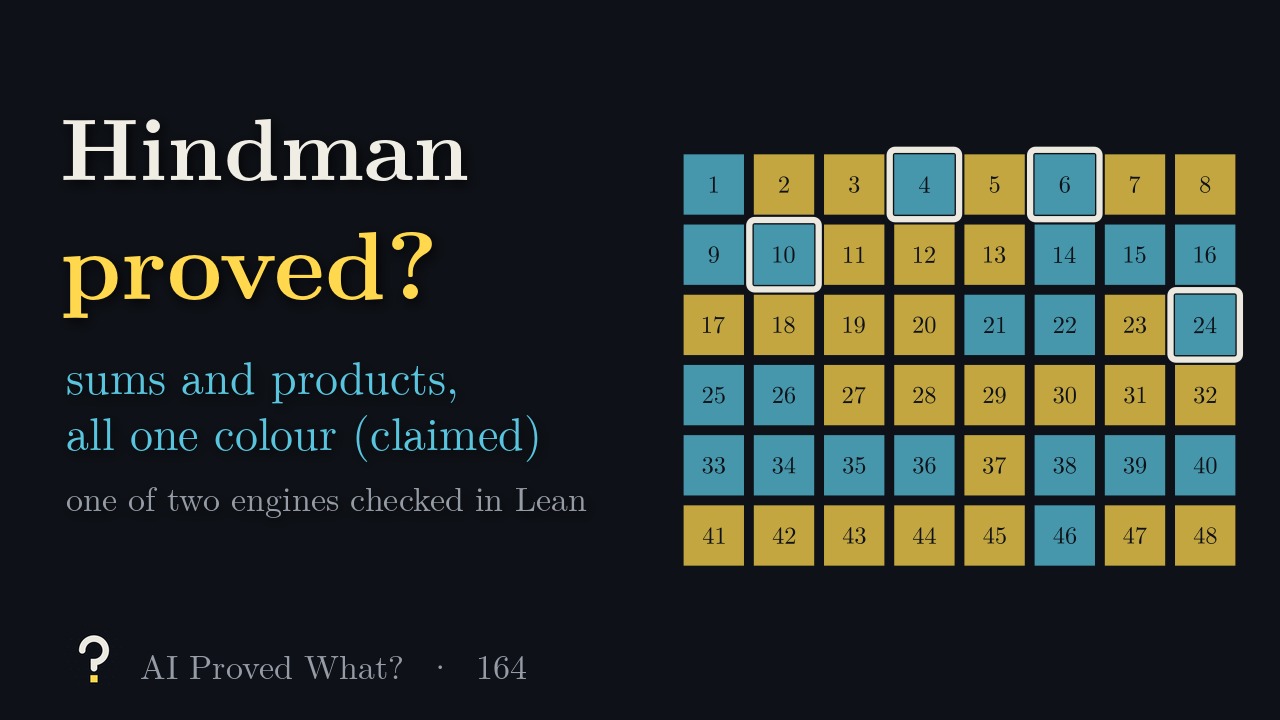
- Our smallest quartets x, y, x+y, xy in one colour (2 ≤ x < y): parity 2, 4, 6, 8; the parity of the number of prime factors 4, 6, 10, 24 (sums alone already at 2, 3, 5); a random two-colouring 5, 7, 12 for Schur’s triple.
- Our separated triple 3, 13, 111 (each above twice the sum plus product of the earlier ones): 7 sums and 7 products, 11 distinct values.
- Our band colouring: 65,536 for three numbers and 264 ≈ 1.8 × 10¹⁹ for four.
- The Lean count: 283 files and about 94,000 lines, our count of the import closure.
Read the source
- Monochromatic finite sums and products in the positive integers (PDF), 70 pages.
- The uncatalogued Lean statement of the Alignment principle.
- The collection’s catalog, where this is result 164.
The paper
OpenAI groups related papers into one result; this one has a single paper.
Transcript
Read the full script
0:00The question
Colour every positive whole number with one of finitely many colours. Schur’s theorem says some x, y and x plus y always share a colour, and the finite sums theorem extends this to all the subset sums of arbitrarily large finite sets. Products come for free: colour n by the colour of two to the n, and sums of exponents become products. Hindman’s question is about both at once. For two numbers, it asks for x, y, x plus y and x times y, all in one colour. For simple colourings that is easy: under parity, 2, 4, 6 and 8 are all even. Colouring by whether the number of prime factors, counted with repeats, is even or odd, the sums alone allow an odd count, but a product of two numbers whose counts are both odd or both even has an even count, so all four must have even counts: 4, 6, 10 and 24. As the paper recounts, Hindman showed that no infinite set works: there is a finite colouring with no infinite set whose terms, pairwise sums and pairwise products share a colour. His conjecture asks instead for finite sets of every size. Graham and Hindman, with computer help, showed that every two-colouring has some x, y, x plus y and x times y in one colour; Moreira proved that, for any finite colouring, some x, x plus y and x times y share a colour; and over the rational numbers, Alweiss proved the full finite sums and products theorem. Moving to whole numbers needs more than clearing denominators: rescaling multiplies a sum by the scale once, but a product of j numbers j times, and a colouring need not respect that.
1:40The claim
Result 164 is a 70-page OpenAI preprint, dated September 23. Its main theorem: for every number of colours, every set size m, and every colouring of the positive integers, there are m distinct numbers whose nonempty subset sums and subset products all share one colour. The paper says this resolves Hindman’s finite sums and products conjecture. The numbers can also be chosen so that each one exceeds any prescribed power of the sum and product of the ones before, so all the sums are different, all the products are different, and the only overlaps are the numbers themselves: for three numbers, eleven values in one colour. The paper does not produce an infinite set, which Hindman showed can fail, and it does not write a set down: the numbers are shown to exist, and it claims no numerical bound on how large they are. The colour is whatever the proof finds. And large numbers can be forced. In a colouring of ours by bands, where each band runs from a number to its square, two different numbers in one band multiply into the next band, which has the other colour. So any three numbers above one whose sums and products all share a colour must include one of at least 65,536, and with four numbers, one past 10^19.
3:02How the proof goes
Each of the m numbers is built as a product of several randomly chosen raw numbers, grouped into blocks at wildly different scales. Products are the tame half. Whatever raw numbers come up, Ramsey’s theorem and the finite sums theorem then pick blocks, depending on them, whose products, in every combination, share one colour, c. This step follows Alweiss’s argument over the rationals. The remaining task, as the paper puts it, is to make the sums have that same colour. Because the scales are so far apart, a sum of blocks is its largest block plus a comparatively tiny nudge, and an arbitrary colouring can change at every step. The first principle, Prediction, uses higher-order Fourier analysis. Inside the relevant counts, each colour is replaced by a structured model built from nilsequences: values read off as a point steps along an orbit in a nilmanifold, a twisted relative of the circle; in the simplest case, the point just steps around a circle by a fixed angle. Where a colour actually occurs, its model is very likely to be large. Divisor weights and a transference argument handle the fact that products are not spread evenly. The second principle, Alignment, chooses scale multipliers from a fixed finite menu, so that whenever a model is above twice a threshold at the centre, it stays above the threshold after every nudge. It adapts ideas from Alweiss’s proof over the rationals, uses recurrence in nilpotent groups, and succeeds with a probability of at least delta that does not depend on how complicated the models are. So delta is fixed first, the error tolerances are made tiny compared with it, and only then are the models built. The count of good sets is then positive, and an actual set of whole numbers exists.
4:48Where it stands
The paper is not peer reviewed and has not been revised. The release lists no Lean formalization for it, but the repository contains about 94,000 lines of Lean, not linked from the catalog, that prove, by our reading, the Alignment principle, one of the two engines. By our scan it has no unproved steps, and we have not rebuilt it. Prediction, which rests on deep external theorems, the product step and the final assembly are not formalized, and the Lean never states Hindman’s conjecture itself. The paper is not among those OSVerify reviewed, and we have seen no expert review. If the proof holds, every finite colouring of the whole numbers hides sets of any size whose sums and products all agree in colour, though the proof gives no estimate of how far out you must look.
Spot a mistake?
This episode simplifies on purpose, but it shouldn’t be wrong. If something is, open an issue on GitHub or leave a comment on YouTube. Corrections are noted here with a date.