Seymour’s conjecture: two steps keep up?
A preprint claims that every finite oriented graph has a vertex with at least as many vertices exactly two arrows away as one arrow away
Covers result 173 in OpenAI’s catalog: its one paper. See its connections to other results and the work it cites.
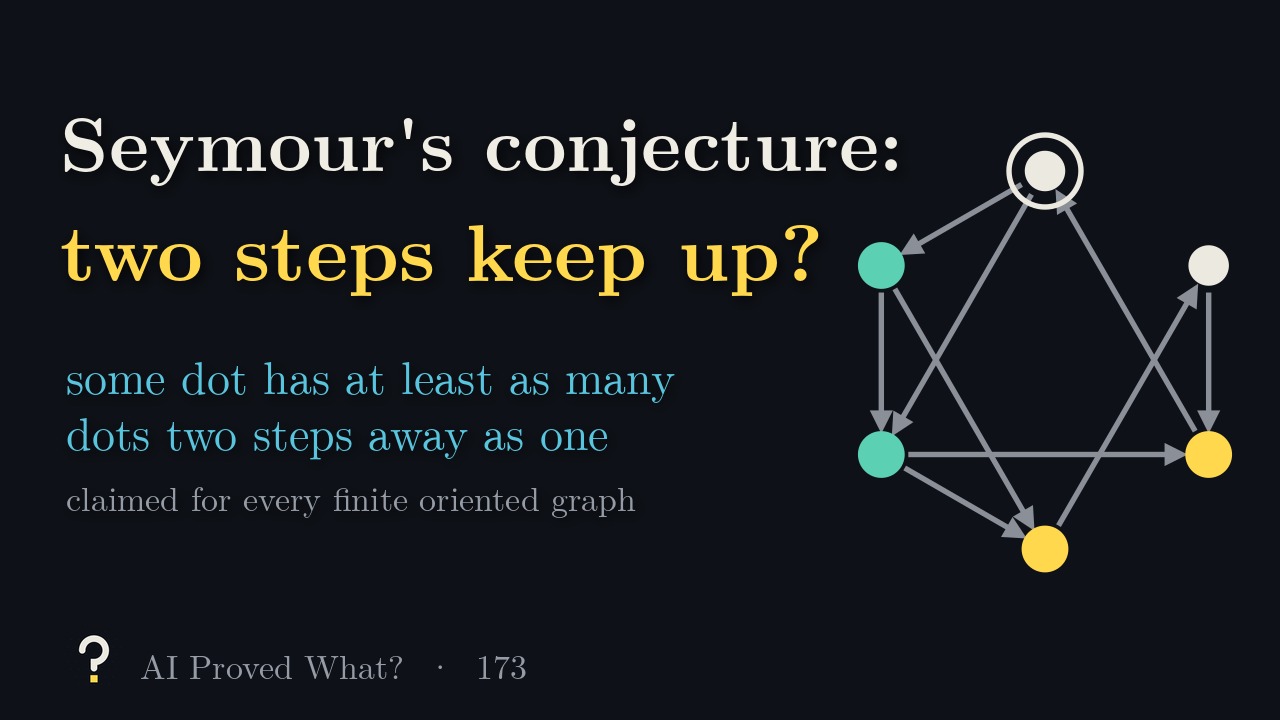
5:25. English captions available. The video loads from YouTube when you press play.
Chapters
The claim, in plain words
“An oriented graph is a finite directed graph with no loops, no multiple arcs, and no pair of opposite arcs.” For a vertex v, its out-neighbours are one arrow away, and its second neighbours are “the vertices at directed distance exactly two from v. Each vertex is counted once, regardless of the number of paths reaching it.” Seymour’s second-neighbourhood conjecture asks for a vertex with at least as many second neighbours as out-neighbours. In a directed triangle every vertex ties, one and one; in a ranked tournament only the sink works; and if two-way pairs were allowed, two vertices pointing at each other would each have one out-neighbour and no second neighbours. As the paper recounts, the conjecture was recorded by Dean and Latka (1995). For tournaments it was proved by Fisher (1996) and, with local median orders, by Havet and Thomassé; Kaneko and Locke handled minimum out-degree at most six; Chen, Shen and Yuster proved a ratio of approximately 0.657298, which Huang and Peng raised to approximately 0.715538 in a 2024 preprint.
Result 173 is a single OpenAI preprint, A proof of Seymour’s second-neighborhood conjecture (15 pages, dated September 23, 2026). Theorem 1.1: “Every nonempty finite oriented graph has a vertex v such that |N1+(v)| ≤ |N2+(v)|.” It “resolves the conjecture positively, without a connectivity or degree hypothesis.” The ratio is therefore 1, and the directed triangle shows it cannot be improved. The paper also derives the weighted forms through Seacrest’s equivalences (“the equivalences themselves are not new here”) and consequences for short cycles, including: “If δ+(D) ≥ n/3 and δ−(D) ≥ n/3, then D contains a directed 3-cycle.”
What it doesn’t claim
Only oriented graphs are covered: with two-way pairs the statement can fail, and infinite graphs are not discussed. The theorem promises some vertex, not every vertex, and says nothing about how many there are. The proof is by contradiction; once existence is known, checking every vertex finds one. In our own exhaustive search, no oriented graph with up to 7 vertices is a counterexample (2,142,288 isomorphism classes with 7 vertices), which of course proves nothing in general.
Where it stands
- Posted as a preprint
- OpenAI, 15 pages, dated September 23, 2026
- Peer reviewed
- Not yet
- Checked in Lean
- The main theorem, formalized by OpenAI; not run by us
Last checked October 19, 2026. The preprint has not been revised since it was added to the repository in its initial commit on October 6, 2026. OpenAI published a Lean formalization whose comparator statement matches Theorem 1.1 exactly: second neighbours are the vertices other than v, not already out-neighbours, reached by a two-step path, and sinks are allowed. By our count the proof takes 43 files and 4,861 lines excluding Mathlib (the development), with no unproved steps by our search; we have not rebuilt it. The weighted and short-cycle consequences are not formalized. The paper is not among those OSVerify reviewed, and we have seen no expert review.
How the proof goes
- Sets instead of single vertices. For a set S, F(S) is everything S points to. In a smallest counterexample (fewest vertices, then fewest arrows) there is no sink, every vertex has an arrow coming in, and, adapting an argument of Seacrest, every nonempty proper set S satisfies |F2(S) ∖ F(S)| < |F(S) ∖ S| (Lemma 2.2).
- Inflating. Following Brantner, Brockman, Kay and Snively, each vertex is replaced by a ranked block (a transitive tournament) with more vertices than the whole graph has. In the new graph every nonempty proper set U satisfies |U| + |F2(U)| < 2|F(U)|: the sizes are strictly concave (Lemma 2.3, Proposition 2.1).
- An extremal argument on pairs. On the grid of ordered pairs of vertices, one family moves its first coordinate along arrows and another its second; they are compatible when those images do not meet. Among compatible pairs of families containing the diagonal, take one maximizing their combined size M plus the number d of grid points left uncovered. The concavity makes the complements of the second images larger than M + 2d, but they may conflict (Proposition 4.1).
- The pruning lemma. For any finite relation, the conflicts can be removed by deleting at most |H| members plus the number of conflict points left uncovered afterwards, where |H| ≤ d (Lemma 3.1). Its proof bounds a matching in an augmented bipartite graph using generic ranks of matrices with free-variable entries, and Kőnig’s theorem.
- The contradiction. The pruned families score more than M + 2d − (d + d′) + d′ = M + d, contradicting the choice; so no counterexample exists.
The numbers in the video
- Our examples: the directed triangle (every vertex 1 and 1), the ranked tournament on 5 vertices (out-neighbours 4, 3, 2, 1, 0 and no second neighbours), and a two-way pair (1 and 0, failing).
- Our exhaustive search: every oriented graph up to 7 vertices (7, 42, 582, 21,480 and 2,142,288 isomorphism classes with 3 to 7 vertices), with no counterexample; also every labelled graph up to 5 vertices in Python.
- Our check of the concavity obstruction: all 16,292 labelled graphs with 3 to 5 vertices and every vertex entered have a set that breaks the inequality; for the triangle with doubled, unranked corners, single vertices satisfy it (1 + 2 < 2 · 2) but a pair does not (2 + 2 = 2 · 2).
- The Lean count: 43 files and 4,861 lines, our count of the import closure.
Read the source
- A proof of Seymour’s second-neighborhood conjecture (PDF), 15 pages.
- The Lean scope note.
- The collection’s catalog, where this is result 173.
The paper
OpenAI groups related papers into one result; this one has a single paper.
Transcript
Read the full script
0:00The question
Draw some dots and join pairs of them with arrows: never two arrows between the same pair, and never an arrow from a dot to itself. That is an oriented graph. For a dot, count its out-neighbours, the dots one arrow away, and its second neighbours, the dots exactly two arrows away: reachable in two steps, but not in one, and not the dot itself. Seymour’s second-neighbourhood conjecture says that some dot has at least as many second neighbours as out-neighbours. In a directed triangle every dot ties, one and one. A dot with no outgoing arrows, a sink, satisfies it trivially. In a ranked tournament, where each dot points to every later one, everything two steps away is already one step away, so only the last dot, the sink, works. And two-way pairs are excluded for a reason: two dots pointing at each other each have one out-neighbour and no second neighbours. The paper says the conjecture was recorded by Dean and Latka in 1995. For tournaments, where every pair of dots has an arrow, Fisher proved it in 1996, and Havet and Thomassé gave a combinatorial proof using local median orders. Kaneko and Locke handled graphs with minimum out-degree at most 6. Chen, Shen and Yuster showed that some dot always has at least about 0.657 times as many second neighbours as out-neighbours, and Huang and Peng raised that to about 0.716. Other work treated near-tournaments, random orientations and dense graphs. The general case stayed open.
1:34The claim
Result 173 is a single OpenAI preprint, 15 pages long, dated September 23, 2026. Its theorem: every nonempty finite oriented graph has a vertex with at least as many vertices at directed distance two as at distance one, with no connectivity or degree conditions. So the ratio goes all the way to one, and one cannot be improved, because the directed triangle ties. As consequences, the paper derives the weighted versions through Seacrest’s earlier equivalences, and a fact about short cycles: if every in-degree and every out-degree is at least a third of the number of dots, there is a directed triangle. Not claimed: graphs with two-way pairs, where the statement can fail, or infinite graphs. It promises some vertex, not every vertex, and says nothing about how many. The proof is by contradiction, though once you know such a vertex exists, checking every vertex finds one. In our exhaustive check, no oriented graph with up to 7 dots is a counterexample: that is over 2 million different shapes with 7 dots. Small cases prove nothing in general, of course.
2:45How the proof goes
The proof works with whole sets of dots. For a set S, write F(S) for everything that S points to. Take a smallest counterexample: fewest dots, then fewest arrows. It has no sink, and every dot has an arrow coming in. Adapting an argument of Seacrest, the paper shows that such a graph fails for every set at once: for every nonempty proper set, its new second step is smaller than its new first step. Next, following Brantner, Brockman, Kay and Snively, it inflates each dot into a ranked block with more dots than the whole graph has. In the inflated graph, for every nonempty proper set U, the sizes of U, its image and its second image are strictly concave: the image is bigger than the average of the other two. In our check of every graph with up to 5 dots in which every dot has an arrow coming in, some set breaks this, as the paper’s last step requires. For a triangle with doubled, unranked corners, single dots are not enough; a pair is needed. The last step shows that no graph can be concave like that. Work on the grid of ordered pairs of dots. One family of pairs moves its first coordinate along arrows, another moves its second, and the two families are compatible when those images do not meet. Among compatible families containing the diagonal, take a pair that maximizes their combined size plus the grid points they leave uncovered. The concavity makes the complements of the second images bigger, by more than twice the uncovered count, but they may conflict. The new tool is a pruning lemma, for any finite relation: the conflicts can be removed by deleting at most the number of special conflict points, plus the conflict points left uncovered afterwards. Its proof bounds a matching using ranks of matrices whose entries are free variables. The gain beats the cost, which contradicts the choice. So no counterexample exists.
4:42Where it stands
The paper is a preprint, not peer reviewed, and not revised. Its main theorem is stated in Lean exactly as in the paper, and OpenAI’s files contain a proof of about 4,900 lines, with no gaps we could find by search; we did not run the check. The weighted and short-cycle consequences are not formalized. It is not among the papers OSVerify reviewed, and we have seen no expert review. If it holds, every nonempty finite oriented graph has a dot with at least as many dots exactly two steps away as one step away, settling Seymour’s conjecture with the best possible ratio, one.
Spot a mistake?
This episode simplifies on purpose, but it shouldn’t be wrong. If something is, open an issue on GitHub or leave a comment on YouTube. Corrections are noted here with a date.