What’s left over?
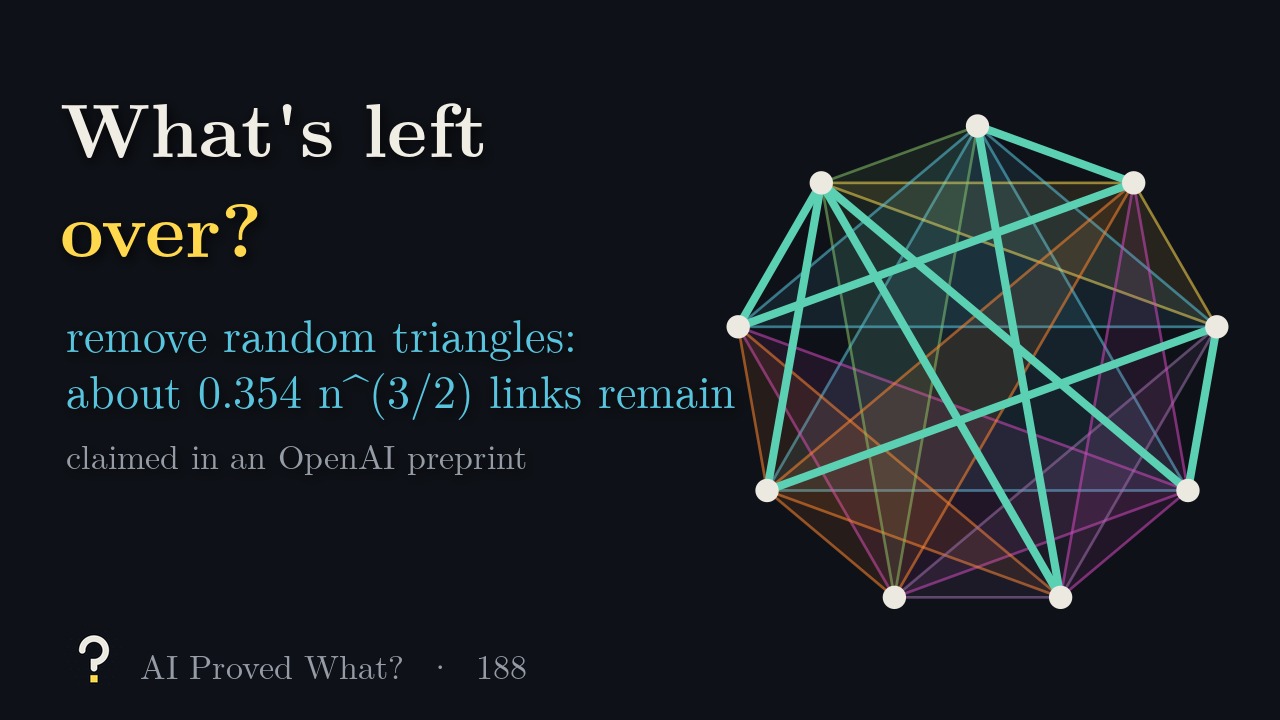
A preprint claims that random triangle removal from the complete graph typically leaves, for large n, about 0.354 n3/2 links, the constant Joos and Kühn conjectured
Covers result 188 in OpenAI’s catalog: its one paper. See its connections to other results and the work it cites.
6:30. English captions available. The video loads from YouTube when you press play.
Chapters
The claim, in plain words
Start with n dots and every link between them. Pick a triangle at random among those whose three links are still there, erase its links, and repeat until no triangle is left. The erased triangles form a packing, and the surviving links are its leave. In our exact computation, on 7 dots the leave is empty with probability 1125/4004, about 28%: the process finds a perfect packing, the Fano plane.
The paper tells the history this way. Bollobás and Erdős conjectured in 1990, as reported by Bohman, Frieze and Lubetzky, that the expected leave has order n3/2. Spencer, and Rödl and Thoma, showed it is a vanishing fraction of all links; Grable proved O(n11/6+ξ) and outlined n7/4+ξ; Bohman, Frieze and Lubetzky proved O(n7/4 log5/4 n) and then, in 2015, n3/2+o(1) with high probability. Joos and Kühn developed removal estimates for strictly balanced hypergraphs and conjectured an exact constant, for triangles 1/(2√2), in probability.
Result 188 is one OpenAI preprint, The Sharp Terminal Leave in Random Triangle Removal (25 pages, dated September 25, 2026). Its Theorem 1.1: for the uniform triangle-removal process starting from Kn, the number of edges left at the end, Fn, satisfies E[(Fn/n3/2 − 1/(2√2))²] → 0; in particular Fn/n3/2 → 1/(2√2) ≈ 0.354 in probability, and E Fn/n3/2 → 1/(2√2). This proves the triangle case of Joos and Kühn’s conjecture, in the stronger mean-square form.
What it doesn’t claim
Any rate of convergence; the overall error is only shown to vanish. A fluctuation law. A sharp constant for other starting graphs or for general hypergraph removal. The exponent 3/2 is Bohman, Frieze and Lubetzky’s. And the proof is not self-contained: for most of the process it relies on Joos and Kühn’s estimates, which the paper calls “the only external proof input”.
Where it stands
- Posted as a preprint
- OpenAI, 25 pages, dated September 25, 2026
- Peer reviewed
- Not yet
- Checked in Lean
- The main theorem, exactly as stated, formalized by OpenAI; not run by us
Last checked October 19, 2026. The preprint has not been revised since it was added to the repository in its initial commit on October 6, 2026. OpenAI published a Lean formalization: the comparator statement gives all three conclusions of Theorem 1.1. By our count the development takes 287 files and 33,800 lines, excluding Mathlib (source), and it proves its own versions of the early-process estimates that the paper takes from Joos and Kühn. We found no unproved steps by search; we have not rebuilt the proof. The collection’s formalization.yaml does not list this result. The paper is not among those OSVerify reviewed, and we have seen no expert review.
How the proof goes
- The hand-off. Joos and Kühn’s estimates show that, for most of the process, the graph looks random with a predictable density. The paper stops their clock at density n−1/2+1/2000, where each link lies in about D = n1/1000 triangles.
- Recursive questions. Give every triangle a random priority (a standard device) and scan in order (the same process). A link survives to a time exactly when no triangle through it with earlier priority finds its other two links untouched up to that priority: a recursive test, with the two links of a triangle tested together.
- Spencer’s law. In an idealized tree where every occurrence gets fresh randomness, a link survives with probability close to Spencer’s (1+2Dt)−1/2. With m links at the hand-off, m q(1) = n²p/(2√(1+2np²)) → n3/2/(2√2), whatever the hand-off density, once D = np² is large.
- The new estimates. Stability in the maximum norm, from cycle counts in the links of vertices and a semigroup bound; and collisions: a repeated triangle forces an extra link on at most two query paths, counted and priced to an error o(1/D), which matters because two links both survive with probability of order 1/D.
- Moments. The mean and second moment of Fn/(m q(1)) tend to 1, so its variance tends to 0.
The numbers in the video
- Exact laws (ours): on 5 dots 4 links always remain; on 6 dots 3 (probability 9/10) or 9; on 7 dots 0 (1125/4004) or 6; on 8 dots 4 or 7. One run on 9 dots: 84, 65, 50, 38, 26, 11, 6, 4, 1 triangles available before each step, 9 links left.
- Exact simulations (ours): the mean leave divided by n3/2 is 0.3258 at 50 dots, 0.3461 at 1,000 and 0.3502 at 5,000, that is 92%, 98% and 99% of 1/(2√2) = 0.3536, with the spread shrinking.
- Priority scan on 300 dots (ours): the fraction of untouched links follows Spencer’s law closely (0.7913 against 0.7916 at t = 10−3).
- Triangle count on 1,000 dots (ours), against Joos and Kühn’s heuristic n³p³/6 − n²p/12 from their paper (not this one): their curve reaches zero at about 11,180 links; our run ended at 10,827.
- The Lean count: our count of the import closure.
Read the source
- The Sharp Terminal Leave in Random Triangle Removal (PDF), 25 pages.
- The Lean scope note.
- The collection’s catalog, where this is result 188.
The paper
OpenAI groups related papers into one result; this one has a single paper.
Transcript
Read the full script
0:00The question
Start with n dots and every possible link between them. Now pick a triangle at random, among the triangles whose three links are all still there, and erase its three links. Repeat, until no triangle is left. The erased triangles never share a link, so they form a packing, and the links that survive are called its leave. How many survive? For tiny networks we can compute the answer exactly. On 7 dots, about 28% of the time nothing is left at all: the process stumbles onto a perfect packing, the Fano plane. Here is one run on 9 dots: there are 84 triangles to choose from at first, then 65, 50, and so on down to one, and 9 links remain. For large n, the question is how the leave grows, and with what constant. The paper tells the history this way. Bollobás and Erdős conjectured in 1990, as reported by Bohman, Frieze and Lubetzky, that the expected leave has order n^(3/2). Spencer’s branching-process analysis, and the nibble argument of Rödl and Thoma, showed that the leave is a vanishing fraction of all the links. Grable proved a bound of n^(11/6), plus any small amount, and outlined the calculations for 7/4. Bohman, Frieze and Lubetzky gave a short proof of n^(7/4), up to a logarithmic factor, and then, in 2015, proved that the leave is n^(3/2+o(1)), with high probability: the exponent, though not yet the exact order. Felix Joos and Marcus Kühn developed removal estimates for general, strictly balanced hypergraphs, and conjectured an exact constant; for triangles, it is 1/(2√2).
1:39The claim
Result 188 is one OpenAI preprint, 25 pages, dated September 25, 2026. It claims: for triangle removal starting from the complete graph, the number of links left at the end, divided by n^(3/2), converges in mean square to 1/(2√2), about 0.354. So the same holds in probability, and for the average. This is the triangle case of Joos and Kühn’s conjecture, which they stated in probability; the paper proves it in mean square. Our simulations of the process approach the constant from below: about 92% of it at 50 dots, 98% at 1,000, and 99% at 5,000, with the spread shrinking as n grows. Not claimed: any rate of convergence; the overall error is only shown to vanish. No fluctuation law. Only removal from the complete graph: the paper does not assert a sharp constant for other starting graphs, or for general hypergraph removal. The exponent 3/2 is not new; it is Bohman, Frieze and Lubetzky’s, up to that little o. And the proof is not self-contained: for most of the process, it relies on Joos and Kühn’s estimates, which the paper calls its only external proof input.
3:00How the proof goes
The proof hands off the early game. Joos and Kühn’s estimates show that, for most of the process, the graph looks like a random graph whose density shrinks on a predictable track. The paper stops their clock when the density is n^(−1/2+1/2000), so that each remaining link lies in about D triangles, where D is n^(1/1000). Everything after that is proved in the paper itself, though not all of it is new. Give every triangle a random priority, a standard trick, and scan them in order, accepting a triangle when its links are still there; this gives exactly the same process. A link survives up to some time exactly when no earlier triangle through it finds its other two links still there at its own priority. So survival becomes a recursive question, asked of lower-priority triangles, which ask further questions, and the paper tests the two links of each triangle together, with one jointly ordered list. Now imagine the questions never overlap: every occurrence of a triangle gets fresh randomness. In that idealized tree, a link survives to time t with probability close to Spencer’s, 1/√(1+2Dt). In our simulation on 300 dots, the real process follows that curve closely, though applying it from the start is our heuristic. The constant falls out: m links at the hand-off, each surviving with probability 1/√(1+2D), gives n²p/(2√(1+2np²)), which tends to n^(3/2)/(2√2), whatever the density p at the hand-off, as long as D is large. Joos and Kühn’s own heuristic reaches the same point from the triangle count, shown here for 1,000 dots. The work is to show that the real process matches the idealized tree accurately enough for second moments. That precision matters because the chance that two given links both survive is itself of order 1/D. The paper names two new estimates. First, stability in the maximum norm: small differences between links do not grow, which it proves from cycle counts in the graphs around each vertex and a bound on the resulting evolution. Second, collisions: the real process differs from the tree only when the same triangle turns up twice, and a repeat forces an extra link joining points on at most two query paths, a rare picture that the paper counts and prices, for an error smaller than 1/D. Then the mean and the second moment of the normalized leave both tend to one, so its variance tends to zero.
5:41Where it stands
The preprint is unrefereed and has not been revised. OpenAI’s Lean files state the main theorem exactly, with all three forms of convergence, and prove it in 287 files and about 34,000 lines, with no gaps we could find by search; we did not run the check. Notably, the Lean proof proves its own version of the early-process estimates that the paper takes from Joos and Kühn. The paper is not among those OSVerify reviewed, and we have seen no expert review. If it holds, random greedy triangle removal from the complete graph typically leaves, for large n, about 0.354 times n^(3/2) links, the constant Joos and Kühn predicted.
Spot a mistake?
This episode simplifies on purpose, but it shouldn’t be wrong. If something is, open an issue on GitHub or leave a comment on YouTube. Corrections are noted here with a date.